
Discover Jura Canton | A Visitor's Introduction to Jura Canton
Recommended places to visit, places to stay and things to do in and around Jura Canton
Jura Canton is a quiet, French-speaking region in north-western Switzerland, bordering France and shaped by wooded ridges, limestone plateaux, deep river valleys and open pastureland. Known for horse breeding, watchmaking, medieval towns and unhurried rural scenery, this canton is a perfect destination for walkers, cyclists, history enthusiasts and travellers seeking a less commercial side of Switzerland. With places such as Delémont, Porrentruy, Saint-Ursanne and the Franches-Montagnes, Jura Canton offers a distinctive mixture of culture, nature and cross-border character.
Recommended Jura Canton hotels and other accommodation
Pre-book Jura Canton Attractions, Tours & Experiences
Why is Jura Canton Worth a Visit?
Jura Canton is worth visiting because it feels markedly different from Switzerland’s better-known Alpine regions. There are no vast glaciers or major international resorts. Instead, the landscape is defined by rolling uplands, forested valleys, isolated farmhouses and small historic settlements.
The canton is particularly rewarding for slow travel. Quiet roads suit cycling, regional trains pass through wooded countryside, and walking routes connect villages, rivers and high pastures. The Franches-Montagnes area is especially known for horses and open landscapes that can feel surprisingly remote.
Jura also has considerable historical depth. Porrentruy preserves reminders of its former role as a residence of the prince-bishops of Basel, while Saint-Ursanne occupies a beautiful position beside the River Doubs beneath wooded cliffs.
The region’s proximity to France adds another dimension. Architecture, food and language reflect strong cross-border influences, while day trips into the French Jura are straightforward by car and possible on selected public-transport routes.
Jura Highlights: Things to See and Do in Jura Canton
Explore Delémont
Delémont is the capital of Jura Canton and the most practical starting point for exploring the region.
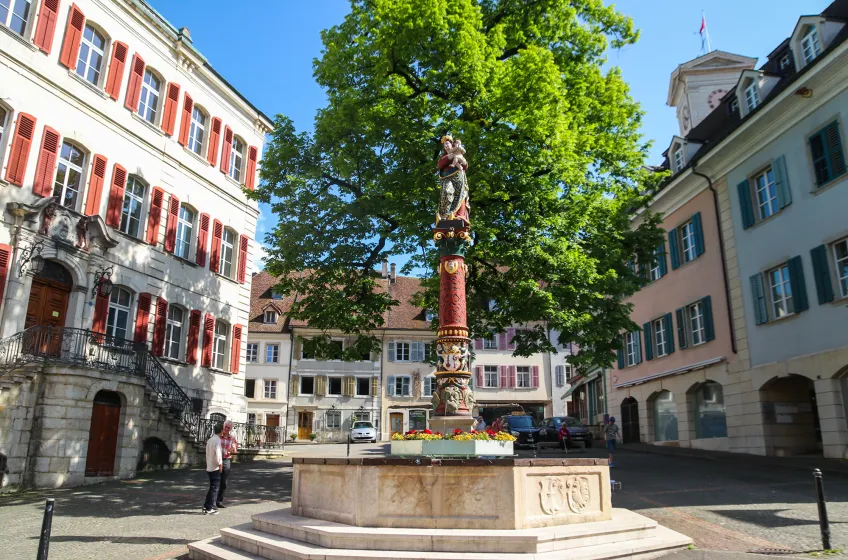
Its compact old town contains colourful historic houses, fountains, arcaded streets and surviving gates. The Porte de Porrentruy and Porte au Loup are among the most recognisable features.
The centre is small enough to explore in a few hours. Cafés, restaurants and shops provide a useful introduction to everyday life in the canton.
Delémont railway station has frequent connections towards Basel, Biel and Porrentruy, making the town a convenient car-free base.
Visit the Jura Museum of Art and History
The Musée jurassien d’art et d’histoire in Delémont explores the canton’s cultural, political and artistic development.
Displays cover regional identity, religious history, traditional crafts, archaeology and the creation of Jura as a separate canton. Temporary exhibitions may focus on local artists or wider social themes.
The museum is especially useful for understanding the region’s strong sense of independence and cultural distinctiveness.
Walk Through Delémont’s Old Gates and Fountains
Delémont’s old centre is known for its decorated public fountains.
Many are topped with carved figures or heraldic symbols and once played an essential role in the town’s water supply. Walking between them provides an easy route through the historic streets.
The surviving gates give a clear impression of the former fortified town. Early morning is the best time for quiet streets and photography.
Explore Porrentruy
Porrentruy is one of Jura Canton’s most attractive towns.
Its historic centre contains elegant houses, fountains, narrow lanes and substantial buildings connected with the former prince-bishops of Basel. The town feels grander than its modest size might suggest.
Porrentruy is close to the French border and makes a useful base for exploring the Ajoie region. It has good rail connections with Delémont and neighbouring towns.
Allow at least half a day for the centre and castle.
Visit Porrentruy Castle
Porrentruy Castle stands above the town and reflects its former political importance.
The complex developed over several centuries and served as a residence of the prince-bishops of Basel. Towers, courtyards and administrative buildings occupy the elevated site.
Interior access may depend on guided visits or current government use. The grounds and exterior are still worth exploring for their architecture and views over the town.
Discover the JURASSICA Museum
The JURASSICA Museum in Porrentruy focuses on natural history, fossils and the geology of the Jura region.
Displays explain prehistoric seas, dinosaurs and the formation of the surrounding limestone landscape. Fossils found in the region provide evidence of its distant geological past.
The museum is particularly suitable for families and visitors interested in palaeontology.
Associated outdoor sites and botanical collections may be available elsewhere around Porrentruy, so check current access before planning a full day.
Visit Saint-Ursanne
Saint-Ursanne is the canton’s most picturesque small town.
It stands beside the River Doubs, enclosed by wooded slopes and entered through historic gateways. Stone houses, narrow lanes and a medieval bridge create an exceptionally atmospheric setting.
The town is small, but it rewards an unhurried visit. Walk along the river, explore the old streets and climb towards the hermitage area for elevated views.
Saint-Ursanne becomes busier on summer weekends, so staying overnight or arriving early provides a quieter experience.
See the Collegiate Church of Saint-Ursanne
The Collegiate Church is the architectural centrepiece of Saint-Ursanne.
Its Romanesque portal is particularly notable, while the interior and adjoining cloister reflect the town’s long religious history. The church is associated with Saint Ursicinus, a hermit traditionally linked with the settlement’s foundation.
The site remains a place of worship, so visitors should remain quiet and avoid disrupting services.
Cross the Saint-Jean Bridge
The stone bridge over the River Doubs is one of Saint-Ursanne’s best-known landmarks.
Its arches and small statue create a classic view towards the town and surrounding hills. The bridge is especially attractive in the soft light of early morning or evening.
Riverside paths begin nearby, providing access to woodland walks and picnic areas.
Walk Along the River Doubs
The Doubs flows through some of Jura Canton’s most beautiful landscapes.
Walking routes follow sections of the river through forest, beneath limestone cliffs and past quiet stretches of water. Saint-Ursanne is one of the best starting points.
The river valley can feel remote, and mobile-phone coverage may be inconsistent. Carry water, food and weather protection when attempting longer stages.
Some paths become muddy or slippery after rain.
Explore the Franches-Montagnes
The Franches-Montagnes form a high plateau in the southern part of the canton.
The landscape is characterised by open pastures, forests, scattered farmhouses and distinctive Jura horses. It feels spacious and peaceful rather than dramatic.
Saignelégier is the main settlement and transport centre. From there, trains and buses connect smaller villages and walking routes.
The area is excellent for cycling, horse riding, cross-country skiing and long countryside walks.
Visit Saignelégier
Saignelégier is the informal capital of the Franches-Montagnes.
The town has a practical centre, local shops, restaurants and transport connections. Its principal appeal lies in the surrounding countryside rather than monumental architecture.
Saignelégier is strongly associated with horse breeding and regional agricultural traditions. It is a useful base for exploring Étang de la Gruère, Le Noirmont and the wider plateau.
Walk Around Étang de la Gruère
Étang de la Gruère is a protected peat bog and lake near Saignelégier.
A boardwalk and marked paths pass through woodland and wetland scenery. Dark water, mossy ground and dense vegetation create an atmosphere unlike the open pastureland nearby.
The area is ecologically sensitive. Remain on the designated route and avoid disturbing wildlife or entering restricted zones.
Morning and late afternoon are particularly peaceful, while autumn brings rich colours.
Discover the Franches-Montagnes Horse
The Franches-Montagnes is Switzerland’s best-known native horse breed.
The horses are valued for their calm temperament, strength and versatility. They remain closely connected with farming, riding and regional identity.
Visitors may see them in fields throughout the plateau. Riding centres and farms sometimes offer lessons, carriage rides or guided experiences, generally by advance arrangement.
Respect private land and do not feed animals without permission.
Visit Le Noirmont
Le Noirmont is a small town in the Franches-Montagnes surrounded by pastures and forests.
It has a strong local food culture and access to walking routes towards the Doubs Valley. The town also reflects the region’s connections with watchmaking and precision industry.
Le Noirmont works well as a quieter base for travellers seeking rural accommodation and railway access.
Explore the Doubs Nature Park
The Doubs Nature Park covers landscapes along the river and across the Jura uplands.
Forests, pastures, river gorges and traditional settlements support a wide range of wildlife and outdoor activities. Marked routes are available for walking, cycling and horse riding.
The park is not a single enclosed attraction. It is a broad inhabited landscape, so planning should focus on a particular village or route rather than trying to see everything in one day.
Visit Les Bois
Les Bois is a rural village in the Franches-Montagnes surrounded by farms and open countryside.
It is a useful starting point for walks and horse-related activities. Traditional buildings and broad views give the village a strong sense of the plateau’s character.
Facilities are limited compared with Saignelégier, so check restaurant and transport times in advance.
Explore Ajoie
Ajoie is the lower, gently rolling region around Porrentruy.
Its landscape includes orchards, farmland, forests and villages with strong French influence. The climate is relatively mild compared with the higher Franches-Montagnes.
The area is known for local food, especially the Damassine plum spirit, and works well for cycling or driving between small settlements.
Visit the Réclère Caves
The Réclère Caves lie near the French border in the western part of the canton.
Guided tours lead through underground chambers containing stalactites, stalagmites and other limestone formations. The caves remain cool throughout the year.
The surrounding area may also include outdoor family attractions and walking routes. Opening is seasonal, so check arrangements before travelling.
Wear closed shoes and bring an extra layer.
Explore the Préhisto-Parc
The prehistoric park near Réclère is designed as a family attraction.
A woodland route contains life-sized reconstructions of prehistoric animals and scenes intended to introduce geological and natural history.
It combines easily with the nearby caves and is most suitable for families with younger children.
Seasonal opening and weather conditions can affect the visit.
Visit the Mont-Repais and Jura Ridges
The canton’s limestone ridges provide extensive views over forests, farmland and neighbouring regions.
Walking routes vary from gentle forest tracks to longer ridge paths. Although the elevations are modest by Alpine standards, winter snow, fog and strong winds can still create difficult conditions.
The quieter ridges are ideal for visitors who prefer solitude to famous summit attractions.
Discover Jura’s Watchmaking Heritage
Watchmaking has played an important role in the canton’s economy, particularly in towns and villages near the Franches-Montagnes.
Small workshops, specialist manufacturers and precision-engineering businesses continue this tradition. Unlike La Chaux-de-Fonds or Le Locle, Jura does not have one dominant watchmaking attraction, but the industry remains visible in local museums and town life.
Factory visits are uncommon without advance arrangements.
Practical Advice for Visitors
Getting There
Jura Canton is well connected to Basel and Biel by rail.
Delémont lies on the main line between Basel and Biel. Journeys from Basel generally take around 35 to 45 minutes, while Biel is usually reached in a similar time.
Regional trains continue from Delémont towards Porrentruy, Saint-Ursanne, Saignelégier and La Chaux-de-Fonds.
Basel Airport is the most convenient international gateway for much of the canton. Geneva and Zurich are also possible but require longer rail journeys.
Choosing Where to Stay
Delémont is the best all-round base for first-time visitors, with strong transport links, restaurants and access to museums.
Porrentruy suits travellers interested in history, Ajoie and the French border.
Saint-Ursanne is ideal for atmosphere, river walks and a peaceful overnight stay.
Saignelégier is the best base for the Franches-Montagnes, horse culture and outdoor activities.
Le Noirmont or Les Bois provide quieter rural alternatives with more limited evening facilities.
Getting Around
Regional trains are especially useful in Jura Canton.
The railway links Delémont, Porrentruy, Saint-Ursanne, Saignelégier, Le Noirmont and several smaller communities. Buses serve villages not reached by rail.
Services are reliable but less frequent than around Zurich or Geneva. Check evening and Sunday timetables carefully.
A car is useful for caves, remote walking routes and scattered villages, but it is not essential for the principal towns.
Driving and Parking
Swiss motorways require a vignette.
Roads through the Jura are generally well maintained but can be narrow, winding and affected by snow or fog in winter.
Public parking is available in Delémont, Porrentruy, Saint-Ursanne and Saignelégier. Spaces in Saint-Ursanne may be outside the compact historic centre.
Cross-border routes into France can be quiet, but valid identification and appropriate vehicle documents should still be carried.
Cycling
Jura Canton is excellent for cycling, especially around Ajoie and the Franches-Montagnes.
The plateau has many quiet roads, although repeated climbs can make routes more demanding than they appear. E-bikes are useful for longer days.
Forest tracks and mountain-bike routes are also available, but access restrictions should be respected.
Carry repair equipment, water and a charged phone because services can be limited between villages.
Walking Safety
Most Jura walks are lower than Alpine routes, but weather and terrain still require preparation.
Forests can become confusing in fog, while limestone surfaces are slippery when wet. River paths may be affected by flooding after heavy rain.
Carry a map or reliable navigation system, waterproof clothing and sufficient food.
In winter, snowshoes or traction aids may be required on upland routes.
Language
French is the main language throughout the canton.
English is understood in many hotels, museums and larger restaurants, but it is less widely spoken in small rural businesses.
German may be understood around Delémont and transport hubs, though visitors should not rely on it everywhere.
Basic French greetings and polite phrases are appreciated.
Dining
Jura cuisine is hearty and strongly influenced by farming and neighbouring France.
Menus commonly include sausages, smoked meat, cheese, potatoes, game and seasonal mushrooms. Trout and other freshwater fish may appear near the Doubs.
Local restaurants often serve generous set meals at lunchtime. Rural kitchens may close early or operate on limited days.
Delémont and Porrentruy offer the widest choice, while village inns provide a more traditional experience.
Try Toétché
Toétché is one of Jura’s best-known regional specialities.
It is a savoury cream tart made with a yeasted base and a lightly salted filling. It may be served as a snack, starter or part of a local meal.
Bakeries, markets and regional festivals are good places to find it.
Damassine
Damassine is a clear fruit spirit made from a small plum grown particularly in Ajoie.
It has a strong aroma and is usually served in small quantities after a meal. Some producers also make preserves, pastries and other plum-based products.
The name and production are closely connected with the region. Use public transport or a designated driver when visiting distilleries.
Jura Cheese and Charcuterie
Local dairies produce several mountain and farmhouse cheeses.
Smoked sausages, cured meats and pâtés are widely available in markets and specialist shops. Products may have a stronger, more rustic flavour than those sold in larger Swiss cities.
Farm shops and village butchers are often the best places to buy regional food.
Shopping
Delémont and Porrentruy provide the canton’s broadest general shopping.
Typical purchases include Damassine, Toétché, local cheese, charcuterie, honey and watch-related products.
Farm shops may operate with limited hours or self-service arrangements. Carrying some Swiss francs is useful.
Most ordinary shops close on Sundays.
When to Visit
May and June are excellent for green landscapes, wildflowers and comfortable walking conditions.
July and August offer the warmest weather and fullest programme of rural events. Saint-Ursanne and popular natural sites can become busier at weekends.
September and October are ideal for autumn colour, local food and quieter cycling.
December to March suits cross-country skiing, winter walking and snowshoeing in the Franches-Montagnes when conditions allow.
November and early spring can be quiet, with reduced opening hours at caves, museums and rural restaurants.
Local Events
The Marché-Concours in Saignelégier is one of the canton’s most important annual events, celebrating horses, farming and regional traditions.
Saint-Ursanne hosts cultural gatherings, markets and medieval-themed events during the warmer months.
Delémont and Porrentruy organise festivals, concerts and seasonal markets throughout the year.
Village fairs, food celebrations and agricultural events take place across Ajoie and the Franches-Montagnes.
Dates vary annually, so check the local programme before planning travel around a particular event.
Exploring Beyond Jura Canton
Basel is the easiest major-city excursion, offering art museums, architecture and a historic centre beside the Rhine.
Biel provides bilingual culture, watchmaking heritage and access to Lake Biel.
Neuchâtel Canton offers La Chaux-de-Fonds, Le Locle, the Val-de-Travers and Lake Neuchâtel.
Solothurn Canton lies to the east, with its Baroque capital and Jura walking routes.
The French Jura is immediately across the border and offers forests, villages, regional food and further outdoor scenery.
Alsace is within driving distance for historic towns, vineyards and French-German cultural influences.
Shortlist
- Your Shortlist is empty