
Discover Zug Canton | A Visitor's Introduction to Zug Canton
Recommended places to visit, places to stay and things to do in and around Zug Canton
Zug Canton is a small but prosperous region in central Switzerland, centred on the attractive lakeside city of Zug and framed by gentle hills, forests and views towards the Alps. Known for its historic old town, low-tax business reputation, cherry-growing tradition and sunsets over Lake Zug, this compact canton is a perfect destination for walkers, food lovers and travellers seeking an easy excursion from Zurich or Lucerne. With efficient transport, quiet villages and accessible viewpoints, Zug offers a polished but relaxed introduction to central Switzerland.
Recommended Zug Canton hotels and other accommodation
Pre-book Zug Canton Attractions, Tours & Experiences
Why is Zug Canton Worth a Visit?
Zug Canton is worth visiting because it combines a beautiful lake setting with an unusually convenient location. Zurich and Lucerne are both within easy reach, yet the canton feels calmer and more intimate than either city.
Zug itself has a compact medieval old town, a lively waterfront and excellent mountain views on clear days. The lake is particularly well known for its sunsets, as the historic centre lies on the eastern shore and faces west across the water.
The canton also has a strong regional identity. Cherries have long been cultivated around Zug and appear in cakes, spirits and seasonal dishes. The best-known local speciality is Zuger Kirschtorte, a layered cake flavoured with cherry spirit.
Beyond the city, places such as Cham, Baar, Walchwil and Unterägeri provide lakeside paths, woodland walks and quieter village scenery. Zugerberg offers an easy mountain-style excursion without the effort or expense associated with Switzerland’s higher Alpine resorts.
Zug Canton Highlights: Things to See and Do in Zug Canton
Explore Zug Old Town
Zug’s old town occupies a compact area beside the lake and is the canton’s principal historic attraction.
Narrow lanes, painted façades, fountains and small squares create an attractive setting for a relaxed walk. Unter Altstadt and Ober Altstadt contain some of the most atmospheric streets, with traditional buildings standing close to the waterfront.
The centre is small enough to explore in an hour, but cafés, museums and lakeside stops can easily extend the visit.
Evening is especially appealing, when the streets become quieter and the setting sun illuminates the façades.
Walk Along Zug’s Lakeside Promenade
The lakeside promenade is one of the best reasons to visit Zug.
Paths extend through parks and harbour areas, providing views across Lake Zug towards Rigi, Pilatus and the peaks of central Switzerland. Benches, lawns and bathing areas make the waterfront popular with local residents.
The promenade is particularly attractive around sunset. On clear evenings, the sky and mountains reflect across the lake, creating some of the finest urban sunset views in Switzerland.
Summer weekends can be busy, but the atmosphere remains relaxed rather than crowded.
See the Zytturm
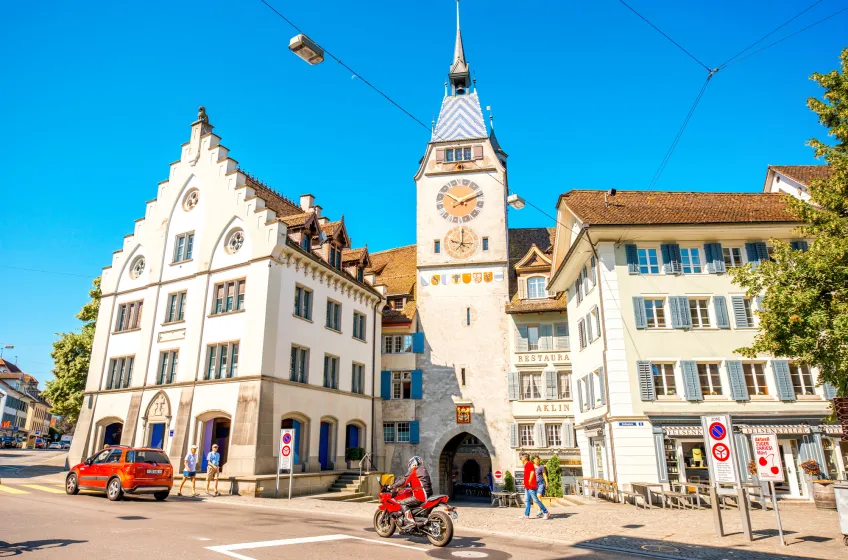
The Zytturm is Zug’s most recognisable historic landmark.
The medieval clock tower once formed part of the town’s fortifications and marks an entrance to the old centre. Its colourful clock face and decorative roof stand above the surrounding streets.
Visitors may be able to climb the tower during public opening periods. The upper level provides views over the rooftops, lake and surrounding hills.
Access involves stairs, and opening arrangements can be limited, so check locally before planning a visit specifically around the interior.
Visit Zug Castle
Zug Castle stands on the edge of the old town and now houses a museum devoted to local history.
The building developed from a medieval fortified residence and contains exhibitions on the canton’s political, domestic and cultural past. Displays include historic interiors, furniture, crafts and archaeological objects.
The castle is relatively small and works well as a one- to two-hour visit. Its scale makes it more approachable than many larger Swiss regional museums.
The surrounding old-town streets are worth exploring before or after the museum.
Visit the Kunsthaus Zug
Kunsthaus Zug is the canton’s principal art museum.
Its collection and temporary exhibitions focus on modern and contemporary art, with particular attention to artists connected with central Europe and Switzerland. The museum has also developed links with Viennese modernism.
The gallery occupies a relatively intimate setting, allowing visitors to explore without the scale or crowds of larger city museums.
Exhibition programmes change regularly, so check what is on before making a special journey.
Relax at Landsgemeindeplatz
Landsgemeindeplatz lies beside the lake at the edge of Zug’s old town.
The open square was historically associated with public political gatherings and now serves as a scenic civic space. Restaurants, cafés and waterfront views make it a popular meeting place.
The square is an ideal stopping point during a walk through the old town. In warmer weather, outdoor seating fills quickly in the evening.
Public events, markets and festivals may also take place here.
Cruise on Lake Zug
A boat trip provides a broader view of the canton’s lakeside landscape.
Passenger services connect Zug with communities such as Cham, Walchwil and Arth during the main navigation season. The route passes wooded slopes, villas, villages and open views towards the mountains.
A full cruise can be combined with lunch or a walk in another lakeside settlement. Shorter journeys are useful for experiencing the scenery without spending most of the day on the water.
Boat timetables are seasonal and may include relatively few departures, so check return connections carefully.
Visit Zugerberg
Zugerberg is the most accessible elevated viewpoint near Zug.
A funicular climbs from Schönegg to the plateau, where walking paths cross meadows, woodland and gently rolling terrain. Views extend over Lake Zug and towards the Alps.
The area is suitable for families, casual walkers and visitors who want fresh air without attempting a demanding mountain hike. Several routes connect farms, picnic areas and restaurants.
In winter, snow can create opportunities for sledging or cross-country skiing, although conditions are not guaranteed because of the modest altitude.
Explore Cham
Cham lies at the northern end of Lake Zug where the River Lorze leaves the lake.
The town has a pleasant lakeside park, walking paths and an attractive mix of residential and historic areas. Villette Park is one of its strongest features, with mature trees, lawns and views across the water.
Cham is less tourist-oriented than Zug and provides a good impression of everyday life in the canton.
Frequent trains make it an easy half-day excursion or starting point for a lakeside walk.
Walk Through Villette Park
Villette Park occupies a landscaped position beside Lake Zug in Cham.
Its lawns, old trees and waterside paths surround a 19th-century villa. The setting is especially pleasant in spring and summer, when flowers and greenery frame views across the lake.
The park is suitable for picnics and gentle walks. It can become lively during events but is generally peaceful on ordinary weekdays.
Combine the park with Cham’s old centre or a walk along the River Lorze.
Explore Baar
Baar is one of the canton’s largest communities and lies just north of Zug.
Although less picturesque than the lakeside capital, it has a historic centre, local shops and excellent access to surrounding countryside. Baar also provides a useful base for walking towards the Lorze Gorge and nearby woodland.
The town’s transport connections are particularly convenient, with frequent trains towards Zug, Zurich and Lucerne.
Walk Through the Lorze Gorge
The Lorze Gorge lies near Baar and offers one of the canton’s best woodland walks.
Paths follow the River Lorze through a narrow, wooded landscape with rock walls, bridges and evidence of former industrial activity. The gorge feels surprisingly secluded given its proximity to urban areas.
Conditions can be muddy after rain, and some sections include uneven steps or slippery surfaces. Wear shoes with reasonable grip.
The route can be combined with nearby caves or continued towards rural areas depending on trail conditions.
Visit the Höllgrotten Caves
The Höllgrotten caves near Baar are known for their unusually colourful limestone formations.
Unlike many caves formed over extremely long geological periods, these developed comparatively quickly through mineral-rich water associated with former industrial channels.
Illuminated paths lead through chambers filled with stalactites, pools and layered rock formations. The interior remains cool and damp throughout the year.
Opening is seasonal, and the approach includes woodland paths. Closed footwear and a light jacket are sensible even during summer.
Explore Walchwil
Walchwil lies on the eastern shore of Lake Zug beneath wooded slopes.
The village is known for its mild local climate, cherry orchards and attractive lake views. It has a quieter and more rural atmosphere than Zug or Cham.
Walking routes climb from the lakeside towards higher viewpoints and connect with the Zugerberg area. The slopes can be steep, so check the amount of ascent before setting out.
Walchwil is particularly appealing during spring blossom and autumn colour.
Visit the Ägeri Valley
The Ägeri Valley lies east of Zug and contains the towns of Unterägeri and Oberägeri beside Ägerisee.
The lake is surrounded by hills, forests and open countryside, making it popular for swimming, walking and cycling. The atmosphere is quieter and more rural than that of Lake Zug.
Unterägeri has the broader range of services, while Oberägeri provides access to further walking routes and upland scenery.
Buses connect the valley with Zug, although evening services may be less frequent.
Practical Advice for Visitors
Getting There
Zug Canton is exceptionally well connected by rail.
Zug city has frequent direct trains to Zurich, Lucerne, Basel and Ticino. Journeys from Zurich usually take around 25 to 40 minutes, while Lucerne can often be reached in a similar time.
Zurich Airport is the most convenient international gateway. Direct or one-change rail journeys to Zug generally take under an hour.
The main railway station is around 10 minutes on foot from the old town and lakefront.
Choosing Where to Stay
Zug city is the best base for first-time visitors, with the widest choice of hotels, restaurants and transport connections.
Cham offers a quieter lakeside setting with easy rail access to Zug and Zurich.
Walchwil suits visitors seeking village scenery and walking routes above the lake.
Unterägeri and Oberägeri are better for countryside, swimming and a slower pace.
Accommodation prices can be high because Zug is an important business centre. Weekends may offer better value than weekday stays.
Getting Around
Trains connect Zug with Cham, Baar and Walchwil, while buses serve the Ägeri Valley, Zugerberg funicular and smaller communities.
The city centre and waterfront are best explored on foot. Cycling is also practical, particularly around the flatter northern part of the lake.
Boat services provide a scenic alternative during the main season but are less frequent than trains and buses.
Check evening schedules when staying in smaller villages.
Parking
Central Zug has public garages near the railway station, shopping areas and old town.
Street parking is controlled by time limits, payment zones and resident restrictions. Read signs carefully, as enforcement is strict.
Parking can be expensive, making rail travel the easier option for day visitors.
At popular walking areas, use designated car parks and avoid blocking farm or residential access.
Dining
Zug has an excellent restaurant scene, reflecting both its Swiss traditions and international business community.
Traditional menus may include rösti, veal, lake fish, sausages and cheese dishes. Modern European and Asian restaurants are also widely available.
Lakefront restaurants provide attractive settings but tend to be more expensive. Baar and Cham often offer better-value neighbourhood dining.
Reservations are sensible for popular restaurants during weekday evenings, when business demand is high.
Try Zuger Kirschtorte
Zuger Kirschtorte is the canton’s best-known culinary speciality.
The cake combines layers of sponge, buttercream and nut meringue flavoured with cherry spirit. Its texture is light but rich, with a distinctive alcoholic flavour.
Several bakeries in Zug sell individual slices and whole cakes. Versions vary in sweetness and intensity, so sampling more than one can be worthwhile.
Because the cake contains alcohol, it may not be suitable for children or visitors avoiding spirits.
Cherry Products
Cherries have long been associated with the countryside around Zug.
Local products include kirsch, preserves, cakes, chocolates and seasonal desserts. Fresh cherries appear during early and midsummer, depending on the weather.
Kirsch is a clear cherry spirit rather than a sweet liqueur. It is usually consumed in small quantities or used in baking and fondue.
Check customs allowances before carrying spirits across an international border.
Shopping
Zug city has the canton’s broadest selection of shops, including Swiss chains, independent retailers and specialist food stores.
Typical regional purchases include Zuger Kirschtorte, kirsch, cherry preserves, chocolate and local honey.
Baar and Cham provide more everyday shopping, while farm shops around rural areas may sell fruit, eggs and cheese.
Most ordinary shops close on Sundays, although selected railway-station businesses remain open.
When to Visit
April to June is excellent for blossom, green landscapes and comfortable walking temperatures.
July and August are best for swimming, boating and long evenings beside the lake. Afternoon thunderstorms are possible.
September and October often bring clear air, autumn colours and quieter walking routes.
December offers seasonal markets and festive lighting, although Zug’s celebrations are smaller than those in Zurich or Lucerne.
Winter outside the Christmas period is calm and well suited to museums, restaurants and lakeside walks. Snow is possible but unreliable at lower elevations.
Local Events
The Zug cherry season is celebrated through food, market activity and traditions connected with the local harvest.
The Zuger Seefest and other lakeside events may include music, food stalls and public entertainment during summer, though programmes vary.
The Zug Fair brings rides, stalls and community activity to the city during autumn.
Fasnacht is celebrated before Lent with costumes, music and processions.
Christmas markets and Advent events take place in Zug and surrounding communities during the final weeks of the year.
Exploring Beyond Zug Canton
Lucerne is an easy excursion for its old town, Chapel Bridge, museums and Lake Lucerne cruises.
Zurich offers major museums, shopping, nightlife and a larger historic centre.
The Rigi can be reached through Arth-Goldau in neighbouring Schwyz, providing mountain railways and panoramic walking routes.
Einsiedeln Abbey is one of Switzerland’s principal pilgrimage sites and can be reached through the canton of Schwyz.
The Ägeri Valley can be combined with nearby Morgarten, a site associated with an important medieval Swiss battle.
Ticino is accessible by direct trains through the Gotthard route, making Lugano or Bellinzona possible as longer excursions.
Shortlist
- Your Shortlist is empty