
Discover Fribourg Canton | A Visitor's Introduction to Fribourg Canton
Recommended places to visit, places to stay and things to do in and around Fribourg Canton
Fribourg Canton is a bilingual region in western Switzerland, stretching from the vineyards and gentle shores of Lake Neuchâtel to the foothills and peaks of the Fribourg Pre-Alps. Known for its medieval capital, Gruyère cheese, chocolate-making and strong French- and German-speaking traditions, this varied canton is a perfect destination for history enthusiasts, food lovers, walkers and families. With fortified towns, lakeside wetlands, hilltop castles and mountain villages, Fribourg Canton offers a compact introduction to several sides of Swiss culture.
Recommended Fribourg Canton hotels and other accommodation
Pre-book Fribourg Canton Attractions, Tours & Experiences
Why is Fribourg Canton Worth a Visit?
Fribourg Canton is worth visiting because it combines historic towns, agricultural landscapes and Alpine scenery within a relatively small area. The city of Fribourg has one of Switzerland’s most impressive medieval centres, while Gruyères offers a hilltop castle, cobbled streets and the region’s best-known culinary traditions.
Food is a major part of the canton’s identity. Gruyère cheese comes from the surrounding countryside, while local dairies, mountain restaurants and village markets showcase the area’s farming heritage. Near Broc, visitors can also explore Switzerland’s chocolate-making tradition.
The canton’s bilingual character gives it a distinctive atmosphere. French predominates in the west and south, while German is widely spoken in the eastern district around Düdingen, Tafers and Plaffeien. Fribourg city itself sits close to the linguistic boundary and uses both languages in everyday life.
Fribourg Canton is easy to explore by train and bus. It works well as a day trip from Bern, Lausanne or Montreux, although three or four nights allow time for the capital, Gruyères, the lakes and the Pre-Alpine valleys.
Fribourg Highlights: Things to See and Do in Fribourg Canton
Explore Fribourg Old Town
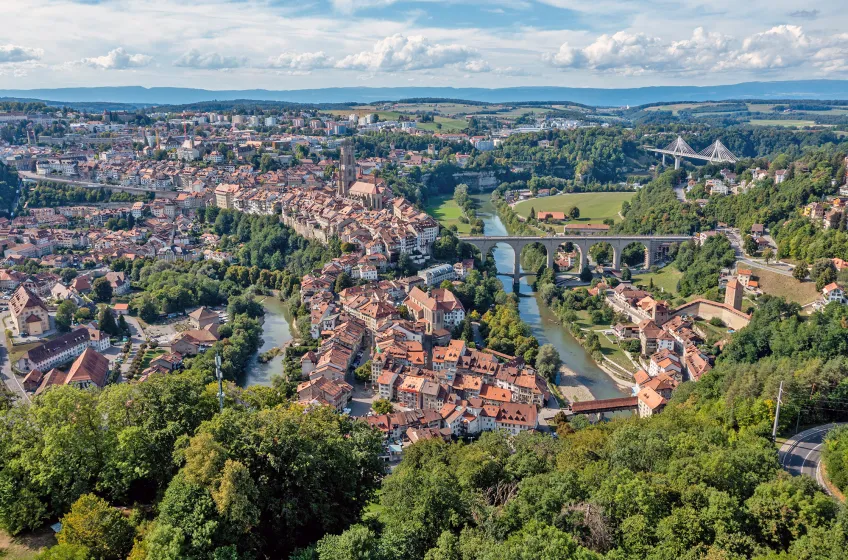
Fribourg’s old town occupies a dramatic position above the River Sarine, with steep streets, medieval houses and bridges connecting different levels of the city.
The upper town contains civic buildings, shops and the cathedral, while the lower districts of Auge and Neuveville feel more residential and atmospheric. Stone façades, fountains and narrow lanes create one of Switzerland’s best-preserved historic centres.
The terrain is steep, so allow more time than the compact map suggests. Walking downhill into the lower town and returning by funicular is easier than completing the route in reverse.
Early morning and evening are the best times for quiet streets and soft light on the old buildings.
Visit St Nicholas Cathedral
St Nicholas Cathedral is Fribourg’s principal landmark.
The Gothic church contains stained glass, sculpted portals and an imposing tower visible from across the city. Its interior reflects several periods of decoration, including important modern stained-glass work.
Climbing the tower provides broad views across the rooftops, River Sarine and surrounding countryside. The staircase is long and narrow, so it is unsuitable for visitors with limited mobility.
The cathedral remains an active place of worship, and sightseeing access may be restricted during services or ceremonies.
Ride the Fribourg Funicular
Fribourg’s historic funicular links the lower town with the city centre.
Opened in the late 19th century, it still uses wastewater as part of its counterweight system, making it one of the city’s most unusual pieces of transport heritage.
The short journey saves a steep climb and provides an enjoyable link between the River Sarine and the upper town.
The funicular is particularly useful after exploring the bridges and lower districts on foot.
Walk Across Fribourg’s Bridges
Fribourg is a city of bridges, ranging from medieval stone crossings to large modern structures above the river valley.
The Bern Bridge is one of the most atmospheric, with its covered wooden structure and views towards the old town. The nearby Middle Bridge and St John Bridge provide additional perspectives on the river and surrounding cliffs.
Higher crossings offer broader views across the city. A walking route linking several bridges is one of the best ways to appreciate Fribourg’s unusual geography.
Visit the Art and History Museum
The Museum of Art and History in Fribourg contains archaeological finds, religious art, sculpture and objects connected with the canton’s cultural development.
Its collections help explain Fribourg’s role as a Catholic centre and its position between French- and German-speaking Switzerland.
The museum is useful during poor weather and combines well with a visit to the cathedral and upper old town.
Temporary exhibitions may focus on regional artists, architecture or social history.
Explore Gruyères
Gruyères is a small fortified town standing on a hill above green farmland and the Saane Valley.
Its cobbled main street is lined with traditional buildings, restaurants and shops, while the surrounding mountains create a classic Swiss setting. Despite its popularity, the village retains considerable historic character.
Cars are kept outside the central area, making the old town pleasant to explore on foot. It becomes busiest between late morning and mid-afternoon, especially during summer.
Staying nearby or arriving early reveals a quieter and more attractive atmosphere.
Visit Gruyères Castle
Gruyères Castle dominates the upper end of the town.
The medieval fortress contains furnished rooms, painted decorations, exhibitions and terraces overlooking the surrounding countryside. Its architecture reflects centuries of changes under different owners.
The ramparts and gardens are among the highlights, offering views towards Moléson and the Fribourg Pre-Alps.
Allow around 90 minutes for a relaxed visit. The route includes stairs and uneven historic surfaces.
Discover the HR Giger Museum
The HR Giger Museum provides a surprising contrast to Gruyères’ medieval setting.
It is devoted to the Swiss artist and designer best known for the visual world of the film Alien. The collection includes paintings, sculpture, furniture and dark biomechanical imagery.
The museum is not suitable for all younger visitors, as some works are disturbing or sexual in nature. Adults interested in film design, science fiction and surrealism may find it one of the canton’s most distinctive attractions.
A themed bar nearby continues the artist’s skeletal, futuristic style.
Visit La Maison du Gruyère
La Maison du Gruyère is a working cheese dairy near Gruyères railway station.
Visitors can learn how Gruyère cheese is made, see production areas and explore displays about milk, Alpine farming and maturation. Production timing varies, so arriving during the morning may provide the best chance of seeing active cheesemaking.
The shop sells cheese at different ages, along with other regional products.
The dairy combines easily with Gruyères village and castle, although the uphill walk between the station and old town takes some effort.
Explore Maison Cailler in Broc
Maison Cailler in Broc presents the history and production of one of Switzerland’s best-known chocolate brands.
The visitor experience combines displays, sensory exhibits, production information and tasting. It is designed for families and casual visitors rather than specialist chocolate enthusiasts.
The attraction can become very busy during weekends, school holidays and wet weather. Advance booking is sensible.
Broc is connected by train and bus with Bulle and Gruyères, making it possible to combine cheese and chocolate in one day.
Visit Bulle
Bulle is the principal town of the Gruyère district and a practical transport hub.
Its centre contains a castle, market streets, cafés and shops used by local residents. Bulle feels less tourist-oriented than Gruyères and provides a useful base for the southern part of the canton.
The town is known for regional markets and livestock traditions. It also has better everyday dining and accommodation choices than the smaller hilltop village.
See Bulle Castle and Museum
Bulle Castle is a substantial medieval structure in the centre of town.
Part of the building remains in administrative use, while museum spaces explore Gruyère’s history, farming traditions, religious culture and regional art.
The castle courtyard and exterior are worth seeing even when museum access is limited.
The site combines well with Bulle’s market streets and nearby cafés.
Ride Up Moléson
Moléson is one of the most recognisable peaks in the Fribourg Pre-Alps.
A funicular and cable car provide access from Moléson-sur-Gruyères towards the summit area. On clear days, views extend across the Swiss Plateau, Lake Geneva region and surrounding mountain ranges.
Short walks are available near the upper stations, while longer routes cross steeper Alpine terrain.
Cloud and wind can affect the experience, so check summit conditions before travelling. Warm clothing is advisable even in summer.
Walk Around Schwarzsee
Schwarzsee is a mountain lake in the German-speaking part of the canton.
Forested slopes, walking paths and nearby peaks make it suitable for families, casual walkers and winter visitors. A circuit of the lake is relatively gentle, although surfaces may be muddy or icy depending on the season.
The area offers cable-car access, mountain restaurants and longer walking routes towards the surrounding Pre-Alps.
Schwarzsee is quieter than many internationally known Swiss resorts and has a strong local holiday atmosphere.
Explore the Gantrisch and Breccaschlund Landscapes
The eastern and southern parts of the canton contain excellent walking country.
Breccaschlund near Schwarzsee is a broad limestone basin surrounded by rugged ridges and traditional Alpine pastures. It is especially attractive during summer, when cattle graze on the high meadows.
The Gantrisch region extends towards neighbouring Bern Canton and offers forests, ridges and panoramic trails.
These routes vary considerably in difficulty. Check trail grading, weather and public-transport connections before setting out.
Visit Murten
Murten, or Morat in French, is a beautifully preserved small town beside Lake Murten.
Its medieval walls, arcaded main street and compact old centre make it one of the canton’s most attractive historic settlements. Visitors can walk along sections of the fortifications for views over rooftops and towards the lake.
The town also has strong historical associations with the Battle of Murten in 1476.
Murten works well as a day trip or an overnight base for exploring the lake and nearby vineyards.
Relax Beside Lake Murten
Lake Murten is one of Switzerland’s smaller major lakes and is known for relatively warm water during summer.
Beaches, boat services, cycling routes and lakeside paths make it popular with families and active visitors. The gentle surrounding landscape provides an easier contrast to the canton’s mountain areas.
Passenger boats may connect Murten with other settlements and, through canal routes, towards Lakes Neuchâtel and Biel.
Schedules vary seasonally, so check return options before planning a one-way cycle or walk.
Explore Estavayer-le-Lac
Estavayer-le-Lac stands above Lake Neuchâtel in the western part of Fribourg Canton.
The town has medieval streets, a castle, arcades and attractive views towards the lake. Its lakeside area includes a harbour, beaches and watersports facilities.
Estavayer feels different from the Alpine south of the canton, with a gentler landscape and stronger French-speaking character.
The historic centre and waterfront are separated by a slope, so allow time for the walk between them.
Visit the Grande Cariçaie
The Grande Cariçaie is an extensive wetland reserve along the southern shore of Lake Neuchâtel.
Reed beds, shallow water, woodland and marshes provide important habitats for birds and other wildlife. Marked paths and observation points allow visitors to explore selected sections.
The reserve is particularly rewarding for birdwatchers, though insect repellent can be useful during warmer months.
Remain on designated trails and respect seasonal restrictions designed to protect breeding areas.
Practical Advice for Visitors
Getting There
Fribourg Canton is well connected to the Swiss railway network.
Fribourg city lies on the main line between Bern and Lausanne. Trains from Bern generally take around 20 to 30 minutes, while Lausanne is roughly 45 to 60 minutes away depending on the service.
Bulle, Gruyères and Broc are reached through regional rail connections from Fribourg or Montreux. Murten has direct or connecting services from Bern, Fribourg and Neuchâtel.
Geneva and Zurich airports are both practical international gateways. Geneva is generally more convenient for the western and southern parts of the canton, while Zurich works well for travellers arriving from eastern Switzerland.
Choosing Where to Stay
Fribourg city is the best base for history, museums and easy rail access.
Bulle suits visitors focused on Gruyères, Broc, Moléson and the southern mountain areas. It offers a wider range of everyday services than Gruyères village.
Gruyères is ideal for atmosphere, but accommodation is limited and often more expensive.
Murten is an excellent choice for a lakeside stay with easy access to Bern and western Switzerland.
Schwarzsee suits walkers, families and winter visitors seeking a quieter mountain base.
Estavayer-le-Lac works well for Lake Neuchâtel, swimming and wetland excursions.
Getting Around
Trains connect the principal towns, while buses serve mountain villages, lakeside communities and rural districts.
Public transport is generally reliable, but evening and Sunday frequencies are lower outside the main towns.
Cable cars and funiculars operate seasonally and may close for maintenance between summer and winter periods.
A car is useful for remote trailheads and scattered villages but is unnecessary for Fribourg, Murten, Bulle and Gruyères.
Parking
Fribourg city has public garages near the centre, but the steep old town is better explored on foot.
Gruyères has designated visitor parking below the historic village. Cars are not normally permitted in the central street.
Broc, Moléson, Schwarzsee and other major attractions have parking near their entrances or lower stations, though spaces can fill on sunny weekends.
Always check time limits and payment rules, as enforcement is strict.
Language
Fribourg Canton is officially bilingual.
French is dominant in Fribourg city, Bulle, Gruyères, Murten and Estavayer-le-Lac, although German is also widely understood in many tourist settings.
German is more common around Tafers, Düdingen, Plaffeien and Schwarzsee. Local dialects may sound very different from standard German.
English is widely spoken in hotels, museums and major attractions, but learning a few basic French or German phrases is appreciated.
Dining
The canton is one of Switzerland’s strongest food destinations.
Gruyère cheese is the best-known product, but local menus also feature Vacherin Fribourgeois, a softer cheese used in fondue. The regional moitié-moitié fondue combines equal parts Gruyère and Vacherin Fribourgeois.
Other dishes include rösti, dried meat, sausages and cream-based desserts. Mountain restaurants serve substantial meals suited to walking and winter sports.
Fribourg city has the broadest restaurant range, while Bulle and Murten offer good regional and international choices.
Reservations are sensible on weekend evenings.
Cheese and Fondue
Cheese lovers should allow time for both tastings and traditional meals.
Gruyère develops a stronger flavour as it matures, so compare younger and older versions. Vacherin Fribourgeois is creamier and softer, with several seasonal varieties.
Fondue is traditionally shared, and restaurants may require a minimum of two people for some versions.
Mountain dairies and village shops often sell cheese directly, but opening hours can be irregular.
Shopping
Typical regional purchases include Gruyère cheese, Vacherin Fribourgeois, chocolate, meringues, double cream and local wines.
Fribourg city and Bulle provide the broadest general shopping. Gruyères and Broc focus more heavily on food and souvenirs.
Murten and Estavayer contain independent shops within their historic centres.
Switzerland uses the Swiss franc. Cards are widely accepted, but cash is helpful at farms, markets and small mountain businesses.
When to Visit
May and June are excellent for green landscapes, wildflowers and comfortable sightseeing temperatures.
July and August offer the fullest mountain transport, lake activities and festival programmes. Popular attractions around Gruyères and Broc can become crowded.
September is particularly good for walking, food tourism and vineyard scenery around Lake Murten.
December brings Christmas markets, winter food and seasonal atmosphere in Fribourg, Gruyères and Murten.
January to March suits skiing, snowshoeing and winter walking around Schwarzsee, Moléson and smaller mountain areas, although snow conditions vary.
April, May, October and November can be transition periods, with some lifts and mountain restaurants closed.
Local Events
The Bénichon is one of the canton’s most important traditional celebrations. This seasonal feast marks the end of agricultural work and includes elaborate meals, music and village gatherings.
Fribourg hosts cultural festivals, concerts and markets throughout the year, including events focused on music, film and regional traditions.
Murten’s light festival transforms the old town with illuminated installations during winter.
The Désalpe, or descent of cattle from Alpine pastures, takes place in several villages during autumn.
Religious festivals, cheese markets and local fairs are held across the canton. Dates vary annually, so check the programme before arranging travel around a specific event.
Exploring Beyond Fribourg Canton
Bern is the easiest city excursion, with a UNESCO-listed old town, museums and excellent rail connections.
Lausanne offers Lake Geneva views, museums and a lively hillside centre.
Montreux provides access to the eastern shore of Lake Geneva, Château de Chillon and mountain railways.
Neuchâtel has an attractive lakeside old town, castle and direct connections to the Jura region.
The Bernese Oberland begins south-east of the canton, with destinations such as Gstaad, Zweisimmen and Lake Thun within reach.
The Vaud Alps and Pays-d’Enhaut offer further walking, traditional villages and scenic rail journeys beyond Gruyères.
Shortlist
- Your Shortlist is empty