
Discover Aargau | A Visitor's Introduction to Aargau
Recommended places to visit, places to stay and things to do in and around Aargau
Aargau Canton is a varied region in northern Switzerland, stretching from the River Rhine and the Jura foothills to the lakes, forests and river valleys west of Zurich. Known for its concentration of medieval castles, thermal spa towns, Roman heritage and attractive riverside landscapes, this canton is a perfect destination for history enthusiasts, walkers, cyclists and travellers seeking quieter alternatives to Switzerland’s major cities. With towns such as Aarau, Baden, Brugg and Lenzburg, Aargau offers an unusually rich mixture of architecture, archaeology and countryside within easy reach of Zurich, Basel and Lucerne.
Recommended Aargau Canton hotels and other accommodation
Pre-book Aargau Canton Attractions, Tours & Experiences
Why is Aargau Canton Worth a Visit?
Aargau Canton is worth visiting because it contains one of Switzerland’s strongest collections of castles and historic sites. Hilltop fortresses, aristocratic residences, Roman remains and former Habsburg strongholds are scattered across the region, often close to railway stations and walking routes.
The canton is also shaped by water. The Aare, Reuss and Limmat rivers meet near Brugg before continuing towards the Rhine, creating wetlands, cycling corridors and attractive riverside settlements. Thermal springs in Baden, Bad Zurzach and Rheinfelden have supported spa traditions since Roman times.
Aargau feels less polished and less tourist-focused than destinations such as Lucerne or the Bernese Oberland. That is part of its appeal. Its old towns, museums and landscapes are largely used by local residents, giving visitors a more everyday view of Switzerland.
The canton works especially well for a rail-based touring holiday. Aarau, Baden, Brugg and Lenzburg are well connected, while buses provide access to castles, monasteries and rural villages.
Aargau Highlights: Things to See and Do in Aargau Canton
Explore Aarau Old Town
Aarau is the cantonal capital and one of the best places to begin exploring Aargau.
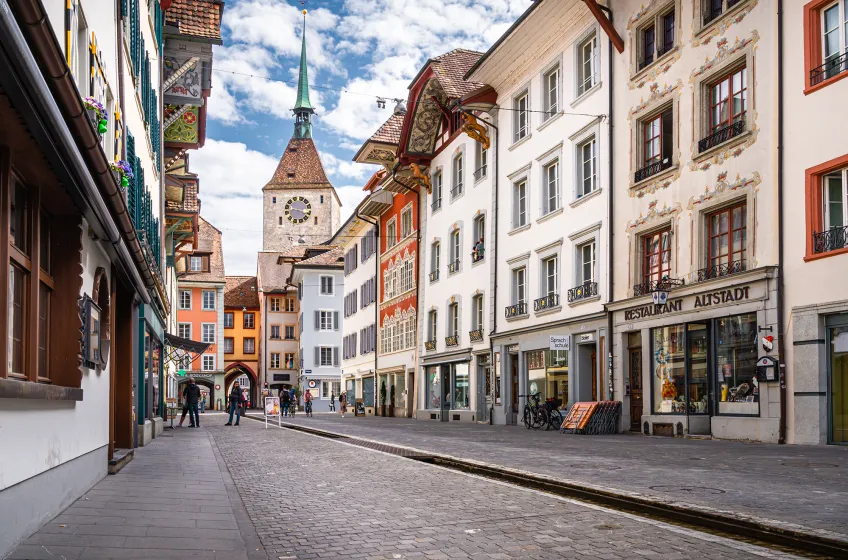
Its compact old town is known for colourful historic buildings, fountains and elaborately painted roof undersides known as Dachhimmel. These decorated eaves are one of Aarau’s most distinctive architectural features.
The streets around Rathausgasse, Pelzgasse and Schlossplatz contain cafés, small shops and civic buildings. The centre is easy to explore on foot and feels lively without being crowded.
Aarau also makes a practical base for rail journeys throughout the canton.
Visit the Aargau Museum of Nature
The Naturama in Aarau explores the geology, wildlife and landscapes of Aargau.
Displays cover rivers, forests, local animals, environmental change and the canton’s natural development. Interactive sections make it particularly suitable for families.
The museum is close to the railway station and works well during poor weather or as part of a day in Aarau.
See the Aargau Art Museum
The Aargauer Kunsthaus is one of Switzerland’s strongest regional art museums.
Its collection focuses mainly on Swiss art from the 18th century to the present day, including painting, sculpture, photography and contemporary installations. Temporary exhibitions often examine modern Swiss artists in greater depth.
The building combines older architecture with a modern extension and is centrally located near Aarau’s old town.
Visit Lenzburg Castle
Lenzburg Castle stands on a steep hill above the town of the same name.
The fortress developed over many centuries and contains furnished rooms, exhibitions and displays on castle life. Its towers and courtyards provide views across the surrounding countryside.
Family-focused activities make it one of the canton’s best castles for children. The climb from the town is noticeable, though buses may reduce part of the walk.
Allow at least two hours for the castle and grounds.
Explore Lenzburg Old Town
Lenzburg has a small but attractive centre below the castle.
Historic houses, fountains and pedestrian streets give the town a relaxed atmosphere. Cafés and shops make it easy to combine lunch with a castle visit.
The town is also a useful railway junction for journeys towards Aarau, Zurich and Lucerne.
Discover Hallwyl Castle
Hallwyl Castle is a picturesque moated fortress near Lake Hallwil.
The complex stands on small islands surrounded by water and woodland. Exhibitions explore the noble Hallwyl family, domestic life, military history and the development of the estate.
The castle is reached from nearby railway stations and bus stops, sometimes with a pleasant walk through the countryside.
Its waterside setting makes it particularly attractive from late spring to early autumn.
Relax Beside Lake Hallwil
Lake Hallwil lies in the southern part of the canton and is popular for swimming, boating, walking and cycling.
Villages and bathing areas line the shore, while seasonal passenger boats may connect several lakeside communities. The surrounding landscape is gentle and agricultural rather than Alpine.
A full circuit is possible by bicycle or as a long walk, though shorter sections are more practical for most visitors.
Summer weekends can become busy around popular bathing areas.
Visit Wildegg Castle
Wildegg Castle occupies a vineyard-covered hillside above the Aare Valley.
The Baroque residence contains furnished interiors, historic kitchens, collections and gardens. Unlike a heavily fortified medieval castle, Wildegg gives a stronger impression of aristocratic domestic life.
The grounds include heritage plants, roses and agricultural areas. Views extend across the valley towards nearby Jura slopes.
The uphill approach is part of the experience, so allow sufficient time.
Explore Habsburg Castle
Habsburg Castle gave its name to the dynasty that later ruled large parts of Europe.
The remaining complex stands on a wooded hill near Brugg. Although smaller than many visitors expect, its historical importance is considerable.
Exhibitions explain the early Habsburg family, their expansion and the castle’s role in the region. A restaurant and walking routes add to the visit.
The castle combines well with nearby Brugg, Windisch and Königsfelden.
Visit Brugg
Brugg lies near the meeting point of several major rivers and has a compact historic centre.
The town’s name refers to a bridge, reflecting its strategic position on the River Aare. Narrow streets, old houses and surviving defensive structures provide a pleasant setting for a short walk.
Brugg is also one of the best transport bases for exploring Roman Vindonissa, Königsfelden Abbey and Habsburg Castle.
Discover Roman Vindonissa
Vindonissa was an important Roman legionary camp near modern Windisch.
Archaeological sites, reconstructed features and museum displays reveal how soldiers and civilians lived around the settlement. Visitors can see remains associated with military buildings, water systems and everyday life.
The Vindonissa Museum in Brugg complements the outdoor sites with artefacts, models and historical interpretation.
The different remains are spread across a wider area, so allow several hours for a thorough visit.
Visit Königsfelden Abbey
Königsfelden Abbey stands near the Roman sites of Vindonissa.
The former monastery is best known for its exceptional medieval stained-glass windows. Their colour, detail and preservation make the church one of Aargau’s most important artistic landmarks.
The abbey was founded in connection with the Habsburg dynasty, adding another layer to the area’s history.
Access may be limited during ceremonies or special events.
Explore Baden Old Town
Baden is one of Aargau’s most attractive towns.
The old centre rises above the River Limmat, with narrow streets, historic houses and views towards the castle ruins. The town has a lively cultural and restaurant scene, helped by its proximity to Zurich.
Baden’s history is closely linked to thermal springs, political gatherings and industry. The mixture of spa architecture, medieval streets and modern cultural venues gives it a distinctive character.
Visit Baden’s Thermal Baths
Baden has been known for its hot mineral springs since Roman times.
The modern spa district lies beside the River Limmat and combines contemporary architecture with centuries-old bathing traditions. Visitors can book thermal pools, wellness facilities and spa treatments.
Prices are generally higher than ordinary public swimming pools, and popular periods may require advance booking.
The baths are particularly appealing during cool or wet weather.
Climb to Stein Castle Ruins
The ruins of Stein Castle stand above Baden.
A steep path and staircase lead to the remains, where visitors gain broad views over the old town, railway lines and surrounding hills.
The site played a role in regional conflicts and was rebuilt and destroyed more than once.
The climb is relatively short but demanding in hot weather. Wear shoes with reasonable grip.
Visit the Swiss Children’s Museum
The Swiss Children’s Museum in Baden explores childhood through toys, games, school materials and domestic objects.
Its displays compare how children lived, learned and played in different periods. Interactive elements make the museum particularly suitable for families.
The historic setting and nostalgic collections also appeal to adults.
Explore Bad Zurzach
Bad Zurzach is a spa town near the River Rhine and the German border.
Its thermal waters, historic centre and religious heritage make it a quieter alternative to Baden. The town has wellness facilities, parks and walking routes beside the Rhine.
Bad Zurzach is also associated with Saint Verena, whose shrine remains an important pilgrimage site.
Visit Rheinfelden
Rheinfelden lies on the Rhine opposite the German town of the same name.
Its Swiss old town contains colourful buildings, fountains, riverside walks and sections of historic fortification. A bridge connects the two countries, making it easy to cross the border on foot.
The town is known for brewing and thermal bathing. It works well as a day trip from Basel.
Explore Augusta Raurica Nearby
Although Augusta Raurica lies just outside Aargau in neighbouring Basel-Landschaft, it is an excellent extension from Rheinfelden.
The Roman site contains a large theatre, reconstructed buildings, mosaics and museum displays. It is one of Switzerland’s most significant archaeological attractions.
Visitors interested in Vindonissa may enjoy comparing the military character of that site with Augusta Raurica’s urban remains.
Walk Through the Aare–Reuss–Limmat River Region
The area around Brugg is known as Switzerland’s “water castle” because the Aare, Reuss and Limmat rivers converge nearby.
Wetlands, woodland paths and riverside routes create excellent walking and cycling opportunities. Observation areas may offer views of birdlife and river habitats.
The terrain is generally gentle, though paths can become muddy after rain.
Visit Muri Abbey
Muri Abbey is a former Benedictine monastery in southern Aargau.
Its impressive church contains Baroque decoration, historic tombs and connections with the Habsburg family. The monastery complex also hosts cultural events and exhibitions.
Muri itself is a pleasant regional town with good rail connections.
Explore Bremgarten
Bremgarten stands on a bend of the River Reuss and has one of Aargau’s most attractive small old towns.
Historic houses, bridges and sections of town wall create a picturesque setting. The river almost surrounds the centre, giving it a strong sense of place.
Bremgarten is especially atmospheric during seasonal markets and evening walks.
Visit the Jura Park Aargau
Jura Park Aargau covers rural landscapes in the north-western part of the canton.
The park includes vineyards, orchards, forests, limestone hills and traditional villages. Walking and cycling routes connect local producers, viewpoints and cultural sites.
Regional products include wine, fruit, honey and cheese. The area is best explored slowly, with public transport or by bicycle.
Practical Advice for Visitors
Getting There
Aargau is exceptionally well connected by rail.
Aarau, Baden, Brugg, Lenzburg and Rheinfelden all have frequent services to major Swiss cities. Zurich is generally the easiest gateway for eastern and central Aargau, while Basel is convenient for Rheinfelden and the north-west.
Aarau can usually be reached from Zurich in around 25 to 40 minutes and from Bern in roughly 40 minutes, depending on the service.
Zurich Airport is the nearest major international airport for most of the canton.
Choosing Where to Stay
Aarau is the best central base for museums, rail travel and access to several castles.
Baden suits visitors interested in thermal baths, restaurants and easy access to Zurich.
Brugg is ideal for Roman history, Habsburg Castle and the river landscapes.
Rheinfelden works well for spa stays, Basel excursions and cross-border trips.
Lake Hallwil is suitable for a quieter summer break focused on swimming and cycling.
Getting Around
Trains connect the main towns efficiently, while buses reach castles, villages and rural attractions.
Some historic sites require a final walk from the nearest stop. Check gradients when visiting hilltop castles.
A bicycle is useful along the Aare, Reuss and Rhine valleys, where many routes are relatively flat.
Evening bus services can be limited in smaller communities.
Driving and Parking
A car provides flexibility for visiting several castles in one day, but traffic around Zurich, Baden and the main motorways can be heavy.
Swiss motorways require a vignette.
Most castles and museums have designated parking nearby, though spaces can fill during festivals and sunny weekends.
Historic town centres are best explored after parking in public garages outside pedestrian areas.
Dining
Aargau’s cuisine reflects northern Swiss farming and river-valley traditions.
Menus commonly include rösti, sausages, veal, seasonal game and cheese dishes. Restaurants near the rivers may serve fish, though its origin varies.
The canton is known for carrots, reflected in the nickname Rüebliland, or carrot country. Carrot cake is one of its best-known sweet specialities.
Aarau, Baden and Rheinfelden provide the broadest restaurant choice.
Try Aargauer Rüeblitorte
Aargauer Rüeblitorte is a moist carrot cake made with ground nuts, eggs and citrus flavouring.
It is often covered with icing and decorated with small marzipan carrots. The texture is lighter and more almond-rich than many British-style carrot cakes.
Bakeries and cafés throughout the canton sell slices or whole cakes.
Wine and Local Produce
Vineyards are found in several parts of northern Aargau, particularly near the Jura foothills and Rhine Valley.
Small producers make white, red and sparkling wines, often in limited quantities. Tastings may require advance arrangements.
Other regional products include cherries, apples, honey, cheese and fruit spirits.
Farm shops and village markets are good places to find locally produced food.
Shopping
Aarau and Baden have the widest choice of independent shops, Swiss retailers and specialist food businesses.
Typical purchases include carrot cake, local wine, honey, cheese and regional spirits.
Bremgarten, Rheinfelden and Lenzburg also have attractive small shops within their old centres.
Most ordinary shops close on Sundays, apart from selected railway-station and tourist businesses.
When to Visit
April to June is excellent for castles, gardens, river walks and cycling.
July and August are best for lake swimming, outdoor dining and long evenings, though temperatures can become hot in the lower valleys.
September and October bring autumn colour, grape harvests and comfortable walking conditions.
December offers Christmas markets in several historic towns, particularly Bremgarten, Baden and Aarau.
Winter is well suited to thermal baths, museums and old-town visits, although castle opening hours may be reduced.
Local Events
Aarau hosts markets, cultural festivals and open-air events throughout the year.
Baden has a strong theatre, music and festival scene, while its spa district regularly stages cultural programmes.
Bremgarten is known for large seasonal markets that attract visitors from across the region.
Rheinfelden holds events connected with the Rhine, brewing traditions and its historic centre.
Wine festivals, village fairs and harvest celebrations take place in rural districts during late summer and autumn.
Exploring Beyond Aargau Canton
Zurich is the easiest major-city excursion, offering museums, shopping, nightlife and a large historic centre.
Basel provides internationally important art museums, modern architecture and Rhine-side neighbourhoods.
Lucerne offers a contrasting combination of lake scenery, mountains and medieval landmarks.
Solothurn has an elegant Baroque old town and easy rail connections from Aarau and Olten.
The canton of Zug lies to the south-east, with lakeside walks, cherry products and convenient mountain excursions.
The Black Forest in Germany can be reached through the Rhine corridor, while Alsace in France is practical from the western part of the canton.
Shortlist
- Your Shortlist is empty