
Discover Thurgau | A Visitor's Introduction to Thurgau
Recommended places to visit, places to stay and things to do in and around Thurgau
Thurgau Canton is a gentle, largely rural region in north-eastern Switzerland, stretching along the southern shore of Lake Constance and the River Rhine. Known for its orchards, vineyards, lakeside cycling routes and historic small towns, this peaceful canton is a perfect destination for walkers, cyclists, families and travellers seeking a quieter alternative to Switzerland’s Alpine resorts. With attractive places such as Frauenfeld, Arbon, Kreuzlingen and Steckborn, Thurgau offers an appealing mixture of waterfront scenery, castles, gardens and agricultural traditions.
Recommended Thurgau Canton hotels and other accommodation
Pre-book Thurgau Canton Attractions, Tours & Experiences
Why is Thurgau Canton Worth a Visit?
Thurgau Canton is worth visiting because it shows a softer and less mountainous side of Switzerland. Rolling farmland, apple orchards and vineyard slopes replace dramatic high peaks, while Lake Constance provides broad horizons and excellent opportunities for swimming, boating and cycling.
The canton is particularly attractive for slow travel. Railway lines connect the main towns, passenger boats serve the lake and Rhine, and an extensive network of cycle paths follows the shoreline and quiet country roads. Distances are manageable, making it easy to combine several towns in a single day.
Fruit-growing is central to Thurgau’s identity. The canton is often associated with apples, cider, juice, spirits and seasonal blossom. Vineyards around places such as Weinfelden, Berlingen and the Untersee produce regional wines, while farm shops sell cheese, honey, berries and fresh produce.
Thurgau also has considerable historical interest. Medieval castles, former monasteries, preserved town centres and archaeological sites are scattered throughout the countryside. Its position close to Germany makes cross-border excursions particularly easy.
Thurgau Highlights: Things to See and Do in Thurgau Canton
Explore Frauenfeld
Frauenfeld is the capital of Thurgau and the canton’s principal administrative centre.
Its compact old town contains colourful historic buildings, fountains, narrow streets and a prominent castle tower. Although smaller than many Swiss cantonal capitals, Frauenfeld has a pleasant local atmosphere and is easy to explore on foot.
The town is also a practical transport base, with frequent trains towards Zurich, Winterthur, Kreuzlingen and eastern Switzerland.
Allow several hours for the historic centre, castle museum and cafés.
Visit Frauenfeld Castle
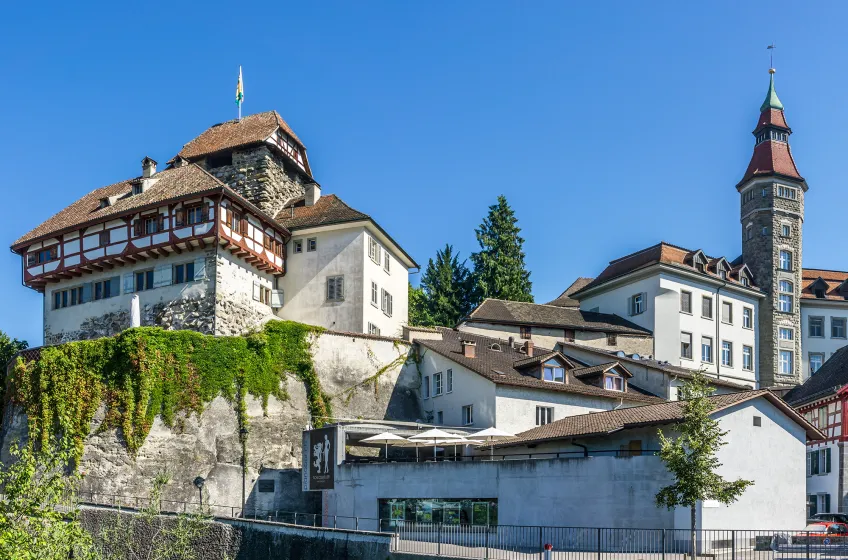
Frauenfeld Castle stands beside the old town and is one of the capital’s most recognisable landmarks.
The medieval tower forms the oldest part of the complex, while later additions reflect centuries of political and residential use. The castle now houses a museum devoted to Thurgau’s history.
Displays cover archaeology, domestic life, religion, regional government and rural culture. Historic rooms and the building itself are part of the attraction.
Opening days may be limited, so check local arrangements before making a special journey.
Discover Kartause Ittingen
Kartause Ittingen is a former Carthusian monastery near Frauenfeld and one of Thurgau’s most rewarding cultural sites.
The complex includes historic monastic rooms, churches, gardens, museums, workshops and agricultural buildings. Its architecture reflects both the strict life of the Carthusian monks and later Baroque development.
Visitors can explore cloisters, cells, religious art and exhibitions connected with monastic life. The estate also produces wine, cheese, herbs and other food.
Allow at least half a day, particularly when combining the museums with the gardens and restaurant.
Visit the Ittingen Museum and Art Museum Thurgau
Two important museums occupy parts of Kartause Ittingen.
The Ittingen Museum explains the daily life, spirituality and organisation of the former monastery. Preserved cells, chapels and communal areas provide an unusually detailed picture of the Carthusian order.
The Art Museum Thurgau focuses on modern and contemporary art, often presenting exhibitions that respond to the historic buildings and rural surroundings.
The contrast between monastic heritage and contemporary art makes the site especially distinctive.
Explore Kreuzlingen
Kreuzlingen is Thurgau’s largest town and stands directly beside the German city of Konstanz.
The urban areas meet at the international border, making it possible to walk or cycle between Switzerland and Germany with little sense of leaving a continuous city. Kreuzlingen itself has parks, residential districts, a harbour and an attractive Lake Constance waterfront.
The town is a useful base for exploring both sides of the lake. It also has excellent train connections towards Romanshorn, Weinfelden, Schaffhausen and Zurich.
Walk Through Seeburgpark
Seeburgpark is a large public park beside Lake Constance in Kreuzlingen.
Lawns, mature trees, playgrounds and waterfront paths make it ideal for picnics and gentle walks. Views extend across the lake towards Germany and the surrounding shoreline.
The park contains a small animal area and family attractions, while nearby bathing facilities provide summer access to the water.
It is particularly lively during warm weekends but spacious enough to remain enjoyable.
Visit Konstanz
Konstanz lies immediately across the border in Germany and is the easiest international excursion from Thurgau.
Its historic centre contains medieval streets, a cathedral, harbour and buildings associated with the Council of Constance. The city also has a wider selection of restaurants and shops than Kreuzlingen.
Carry valid travel identification, even though routine border controls may be minimal. Swiss mobile-phone roaming arrangements may also change when crossing into Germany.
Konstanz combines naturally with Kreuzlingen, Seeburgpark or a Lake Constance boat trip.
Explore Arbon
Arbon is one of Thurgau’s most attractive lakeside towns.
Its historic centre contains medieval streets, colourful houses, a castle and a broad promenade beside Lake Constance. The town’s location makes it particularly suitable for cycling, swimming and waterfront walks.
Arbon also has a strong industrial history associated with vehicle and machinery production. Museums explore this engineering heritage alongside the town’s much older Roman and medieval past.
The centre and waterfront can be explored comfortably in half a day.
Visit Arbon Castle
Arbon Castle rises above the historic centre close to the lake.
The complex includes a medieval tower and museum displays covering local history, archaeology and settlement around Lake Constance. Climbing the tower may provide broad views over rooftops and water.
The castle’s exterior and courtyard are worth seeing even when interior access is limited.
Discover Arbon’s Roman Heritage
Arbon developed on the site of the Roman settlement of Arbor Felix.
Archaeological remains and museum displays reveal its role as a fortified location near Lake Constance. Parts of the old town preserve traces of Roman walls and later medieval structures.
Visitors interested in archaeology should combine Arbon Castle Museum with a walk through the historic centre.
Cycle the Lake Constance Shore
Thurgau’s Lake Constance shoreline is one of Switzerland’s best areas for relaxed cycling.
Mostly gentle routes connect Kreuzlingen, Münsterlingen, Romanshorn and Arbon, passing parks, bathing areas, orchards and harbours. The terrain is far easier than cycling in the high Alps.
Long-distance riders can continue around Lake Constance through Germany and Austria. Border crossings are straightforward, but identification and appropriate insurance remain sensible.
Bicycles can often be carried on regional trains, although capacity may be limited during busy summer periods.
Visit Romanshorn
Romanshorn is an important railway and ferry town on Lake Constance.
Its harbour connects Switzerland with Friedrichshafen in Germany, while trains run towards St Gallen, Kreuzlingen and Zurich. The waterfront has promenades, restaurants and views across the lake.
Romanshorn is more functional than picturesque, but its transport links make it extremely useful for touring the region.
Take the Ferry to Friedrichshafen
The vehicle and passenger ferry between Romanshorn and Friedrichshafen provides an enjoyable international crossing.
The journey offers open views across Lake Constance and creates a practical route towards southern Germany. Friedrichshafen is known for its aviation history, waterfront and museums associated with airships.
Check departure times carefully, as sailings are less frequent than local trains. Bring valid identification and confirm bicycle or vehicle arrangements when relevant.
Visit the MoMö Museum
The MoMö Museum near Arbon explores Thurgau’s apple-growing and cider-making traditions.
Displays explain orchard cultivation, fruit processing and the development of juice and cider production. Tastings and a shop selling apple-based products may form part of the visit.
The attraction is particularly suitable for families and visitors interested in regional food.
Explore Weinfelden
Weinfelden is an important market town in central Thurgau.
Its centre contains traditional buildings, shops and restaurants, while vineyard slopes rise nearby. The town’s name reflects its long association with wine production.
Weinfelden is also a major railway junction, making it a convenient base for travelling around the canton.
Walking routes climb through the vineyards towards viewpoints over the surrounding countryside.
Walk Through the Weinfelden Vineyards
The slopes above Weinfelden are crossed by paths through vineyards, orchards and woodland.
These routes provide broad views over the town and towards the Alps on clear days. Information panels may explain local grape varieties and wine production.
Autumn is especially attractive, when the vines change colour and harvest activity brings life to the countryside.
Respect private plots and remain on marked paths.
Explore Stein am Rhein
Stein am Rhein lies just beyond Thurgau in the neighbouring canton of Schaffhausen, but it is one of the region’s easiest and most rewarding excursions.
The old town is known for richly painted façades, a riverside setting and the former St George’s Abbey. Its central square is among the most decorative in Switzerland.
Stein am Rhein can be reached by train, boat, bicycle or car from western Thurgau.
Arrive early during summer, as the compact centre becomes busy with day visitors.
Cruise the Untersee and River Rhine
The western section of Lake Constance, known as the Untersee, narrows into the River Rhine near Stein am Rhein.
Seasonal boats connect lakeside communities such as Kreuzlingen, Ermatingen, Mannenbach, Berlingen and Steckborn before continuing towards Stein am Rhein and Schaffhausen.
The journey passes vineyards, wetlands, historic villages and views towards Germany.
Schedules are seasonal and journey times can be long, so check the final connection carefully.
Visit Arenenberg
Arenenberg stands above the Untersee near Salenstein and is one of Thurgau’s most important historic residences.
The estate is closely associated with Hortense de Beauharnais and her son, the future French emperor Napoleon III. Furnished rooms, portraits and personal objects explore the family’s life in exile.
Terraced gardens provide excellent views across the lake towards Reichenau Island.
The combination of European history, interiors and landscape makes Arenenberg a particularly distinctive attraction.
Explore Steckborn
Steckborn is a small historic town on the Untersee.
Its waterfront, old houses and compact streets make it a pleasant stop during a boat or cycling journey. The town feels quieter than Stein am Rhein and offers attractive views across the water.
Steckborn railway station provides easy connections along the southern shore of the lake.
Visit Gottlieben
Gottlieben is a tiny village beside the Seerhein near Kreuzlingen.
Half-timbered houses, a small harbour and historic buildings create an intimate atmosphere. The village is particularly associated with delicate filled wafer biscuits known as Gottlieber Hüppen.
Gottlieben combines well with a walk, cycle ride or boat journey from Kreuzlingen.
Walk Through the Seebachtal Lakes
The Seebachtal in western Thurgau contains several small lakes surrounded by wetlands, woodland and farmland.
Walking and cycling routes connect the lakes and nearby villages. The area is particularly rewarding for birdwatchers and visitors seeking gentle countryside rather than major attractions.
Remain on designated paths and respect protected habitats.
Practical Advice for Visitors
Getting There
Thurgau is easily reached from Zurich and St Gallen.
Frequent trains connect Zurich with Frauenfeld, Weinfelden, Kreuzlingen and Romanshorn. Frauenfeld can generally be reached from Zurich in around 35 to 50 minutes, depending on the service.
St Gallen provides convenient access to Romanshorn, Arbon and eastern Thurgau.
Zurich Airport is the nearest major international gateway and has direct or straightforward rail connections to much of the canton.
Choosing Where to Stay
Frauenfeld is the best base for central transport connections, museums and Kartause Ittingen.
Kreuzlingen suits visitors interested in Konstanz, lake cruises and international excursions.
Arbon is ideal for a picturesque waterfront stay with a historic centre and cycling routes.
Romanshorn works well for ferry travel and rail connections, though it has a more functional atmosphere.
Steckborn or Ermatingen provide quieter bases beside the Untersee.
Weinfelden is practical for wine, countryside and train travel throughout the canton.
Getting Around
Regional trains provide excellent coverage along Lake Constance, the Untersee and the main inland corridors.
Buses connect smaller villages, castles and rural attractions. Evening and Sunday services may be less frequent.
Passenger boats provide scenic transport during the warmer months but cannot replace the regularity of trains.
A bicycle is especially useful because much of Thurgau is gently rolling rather than mountainous.
Cross-Border Travel
Thurgau borders Germany along much of Lake Constance and the Rhine.
Konstanz, Friedrichshafen and Reichenau Island are easy excursions. Carry valid identification and check any customs rules when transporting alcohol, food or large purchases.
Switzerland is outside the European Union customs area, so allowances still apply despite the open appearance of many crossings.
Mobile-phone charges may change when connecting to German networks.
Driving and Parking
Swiss motorways require a vignette.
Traffic can be heavy around Kreuzlingen and Konstanz, particularly during weekends, school holidays and shopping periods. Border routes may also become congested.
Public parking is available in the main towns and near major attractions. Historic centres are generally easier to explore after parking outside the narrowest streets.
Lake beaches and rural destinations can fill quickly during hot summer weekends.
Cycling
Thurgau is one of Switzerland’s most accessible cycling cantons.
Lake routes are generally gentle, while inland areas contain rolling hills and occasional steeper climbs. E-bikes are widely useful for vineyard and orchard landscapes.
Wear a helmet, use lights in poor visibility and remain alert on shared paths. Some waterfront routes become crowded with pedestrians.
Bicycle spaces on trains and boats may require reservations or additional tickets.
Dining
Thurgau’s cuisine is strongly influenced by farming, fruit-growing and Lake Constance.
Menus commonly include rösti, sausages, cheese dishes and seasonal vegetables. Fish from Lake Constance may appear in lakeside restaurants, though supply and origin vary.
Apple-based desserts, cider sauces and fruit products are common regional themes.
Kreuzlingen, Frauenfeld and Weinfelden have the broadest restaurant choice. Arbon and the Untersee villages offer attractive waterfront dining.
Apples and Cider
Thurgau is widely associated with apples and is sometimes nicknamed Switzerland’s cider region.
Local producers make apple juice, sparkling cider, vinegar, dried fruit, spirits and preserves. Farm shops are particularly good places to sample regional varieties.
During spring, orchard blossom adds colour to the countryside. Autumn brings harvesting and fresh juice production.
Alcoholic cider varies from dry to sweet, so check the label before buying.
Wine
Thurgau produces wine in several areas, particularly along the Untersee and around Weinfelden.
Pinot Noir and Müller-Thurgau are among the important grape varieties. The latter was developed by Swiss botanist Hermann Müller, who was born in the canton.
Small wineries may offer tastings by appointment, while village festivals and restaurants provide easier opportunities to sample regional bottles.
Use public transport or a designated driver when visiting several producers.
Shopping
Typical purchases include apple juice, cider, fruit spirits, wine, cheese, honey and Gottlieber Hüppen.
Frauenfeld, Kreuzlingen and Weinfelden provide the widest general shopping.
Farm shops and self-service stalls are common in rural districts. They may sell fruit, eggs, flowers, preserves and seasonal vegetables.
Carry some Swiss francs for unmanned kiosks, although many now accept digital payments.
When to Visit
April and May are especially attractive for orchard blossom, spring walks and quieter towns.
June to August is the main season for swimming, boating and cycling. Lake destinations become busy during hot weekends.
September and October bring grape and apple harvests, autumn colours and comfortable walking temperatures.
December offers local Christmas markets and seasonal food, though boat services are limited.
Winter is calm and often misty around the lake. Museums, spa visits and town walks remain possible, but many seasonal attractions reduce their hours.
Local Events
Fruit, wine and harvest festivals take place in towns and villages during late summer and autumn.
Frauenfeld hosts cultural events, markets and one of Switzerland’s major outdoor music festivals.
Arbon and Romanshorn hold waterfront celebrations, harbour events and summer programmes.
Traditional fairs, village festivals and Christmas markets take place throughout the canton.
Event dates vary each year, so check local programmes before arranging travel around a specific celebration.
Exploring Beyond Thurgau Canton
St Gallen is the easiest city excursion, with its UNESCO-listed Abbey District, historic library and textile heritage.
Appenzellerland offers painted villages, cheese traditions and access to the Alpstein mountains.
Schaffhausen provides a preserved old town, Munot fortress and access to the Rhine Falls.
Zurich is within easy reach for major museums, shopping and nightlife.
Konstanz and Reichenau Island in Germany offer medieval history, gardens and Lake Constance scenery.
Vorarlberg in Austria can be reached around the eastern end of Lake Constance, with Bregenz and its lakeside cultural attractions among the main destinations.
Shortlist
- Your Shortlist is empty