
Discover Montreux | A Visitor's Introduction to Montreux
Recommended places to visit, places to stay and things to do in and around Montreux
Montreux is an elegant resort town on the eastern shore of Lake Geneva in the Swiss canton of Vaud, backed by steep vineyard terraces and the foothills of the Alps. Known for its flower-lined promenade, Belle Époque hotels, jazz festival and easy access to Château de Chillon, this lakeside town is a perfect destination for music lovers, couples, railway enthusiasts and visitors exploring the Lake Geneva region. With its mild climate, mountain excursions and dramatic views across the water, Montreux offers one of Switzerland’s most distinctive combinations of lakeside glamour and Alpine scenery.
Recommended Montreux hotels and other accommodation
Pre-book Montreux Attractions, Tours & Experiences
Why is Montreux Worth a Visit?
Montreux is worth visiting because its setting is exceptional. The town curves around Lake Geneva beneath wooded slopes and vineyard-covered hills, with the mountains of France and the Swiss Alps visible across the water in clear weather.
The atmosphere is different from that of Lausanne or Geneva. Montreux feels more like a classic European resort, with grand hotels, palm trees, formal gardens and a long waterfront promenade. Its relatively mild local climate supports vegetation more commonly associated with southern Europe.
Music is central to the town’s identity. The Montreux Jazz Festival has brought international performers to the lakeshore for decades, while Queen recorded extensively in Montreux and remains closely associated with the town.
Montreux also makes an excellent transport base. Trains, boats, buses and mountain railways provide easy access to Château de Chillon, Rochers-de-Naye, Vevey, the Lavaux vineyards and the Pays-d’Enhaut.
Two full days are enough for the main lakeside sights and castle. Three or four nights allow time for a mountain railway, boat trip and vineyard excursion.
Montreux Highlights: Things to See and Do in Montreux
Walk Along the Montreux Promenade
Montreux’s lakeside promenade is the town’s defining attraction.
The path runs beside Lake Geneva through gardens planted with flowers, palms and ornamental trees. Sculptures, cafés, boat landings and small harbour areas appear along the route, while the mountains form a dramatic background.
The promenade is suitable for a gentle walk and is largely flat. Continue south towards Château de Chillon for one of the region’s most scenic lakeside routes.
Early morning is ideal for calm water and fewer people. Evening brings softer light and a livelier atmosphere around the restaurants and hotels.
See the Freddie Mercury Statue
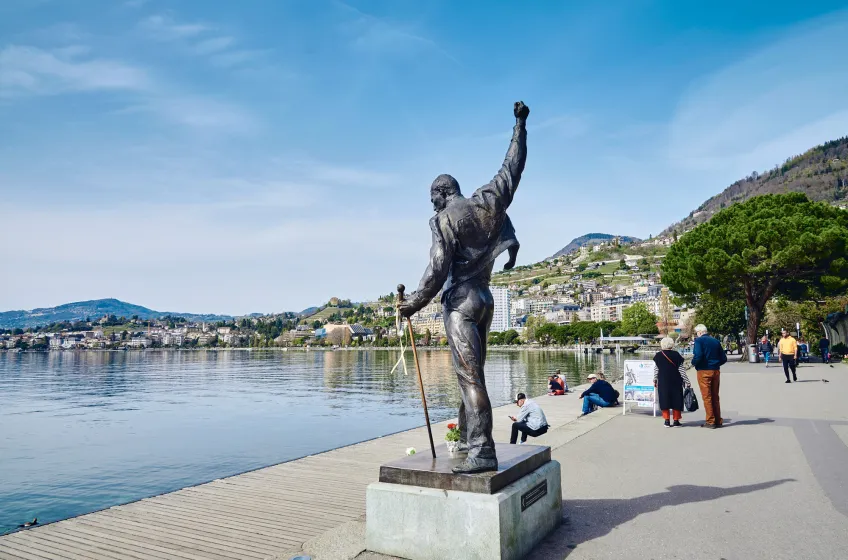
The Freddie Mercury statue stands beside the lake near the covered market.
The Queen singer is shown in one of his characteristic stage poses, facing the water with one arm raised. Fans regularly leave flowers, notes and small tributes at its base.
Montreux became important to Queen after the band began recording at Mountain Studios. Mercury also spent considerable time in the area.
The statue is one of the town’s most popular photo stops, so early morning is the quietest time to visit.
Visit Queen Studio Experience
The Queen Studio Experience explores the band’s connection with Montreux.
It occupies part of the former Mountain Studios complex, where Queen recorded several albums. Displays include photographs, costumes, handwritten material, studio equipment and information about the recording process.
The exhibition is relatively compact but rewarding for fans. Entry arrangements and opening periods may change, so check locally before visiting.
Explore Château de Chillon
Château de Chillon stands on a rocky island beside Lake Geneva just south of Montreux.
The castle developed over many centuries and controlled an important route between northern and southern Europe. Its towers, courtyards, halls, bedrooms and underground chambers create one of Switzerland’s most atmospheric historic sites.
The lakeside setting is especially memorable, with the castle reflected in the water on calm days. Inside, visitors can explore independently or use an audio guide.
Allow at least two hours. Arrive early during summer, as the castle is one of the most visited attractions in Switzerland.
Walk from Montreux to Chillon
The promenade between central Montreux and Château de Chillon is one of the best walks in the Lake Geneva region.
The route follows the shoreline past gardens, villas, hotels and small beaches. It is mostly level and takes roughly an hour without long stops.
Walking one way and returning by bus, boat or train is a convenient arrangement. The path can become busy during sunny weekends, particularly near the castle.
Ride the Train to Rochers-de-Naye
Rochers-de-Naye rises high above Montreux and provides exceptional views over Lake Geneva.
A cogwheel railway climbs directly from Montreux through forests and mountain settlements to the summit area. The journey itself is a major part of the experience.
On clear days, viewpoints reveal the lake, surrounding Alps and distant Jura. Short paths are available near the station, while longer routes enter exposed mountain terrain.
Weather at the summit can be cold, windy or cloudy even when conditions beside the lake are warm. Check visibility and take an extra layer.
Explore Glion
Glion is a hillside village above Montreux, reached by funicular, train or steep road.
Its elevated position provides broad views over the town and lake. Grand buildings and former hotels reflect its history as a fashionable resort.
Glion is a useful stop on the way to Rochers-de-Naye or the forests above Montreux. Short walks connect viewpoints, residential lanes and railway stations.
Visit Caux
Caux lies higher on the mountain above Montreux and has an impressive position overlooking Lake Geneva.
The village is best known for the large Caux Palace, a former luxury hotel later used as an international conference centre. Its architecture and setting are striking even when interior access is unavailable.
Caux is served by the railway towards Rochers-de-Naye and can be combined with mountain walks or a scenic return journey.
Take a Lake Geneva Cruise
Passenger boats provide one of the most enjoyable ways to appreciate Montreux’s setting.
Seasonal services connect Montreux with Vevey, Lausanne, Geneva and several smaller ports. Some boats continue towards the French shore.
Historic paddle steamers operate on selected routes, adding considerable atmosphere to the journey.
Check sailing times carefully, as services are less frequent than trains and vary by season. A boat in one direction and train return is often the most practical arrangement.
Explore the Old Town
Montreux’s historic upper district lies above the modern lakeside centre.
Steep lanes, traditional houses and small public spaces create a quieter atmosphere than the waterfront. The climb provides changing views over the lake and rooftops.
The Church of St Vincent stands in this area and offers an attractive viewpoint from its surrounding terrace.
Wear comfortable shoes, as gradients are steep and some surfaces are uneven.
Visit St Vincent Church
St Vincent Church stands above Montreux’s old town.
The church has medieval origins and a relatively restrained interior. Its elevated location is the principal attraction, providing views across the lake and towards the mountains.
The surrounding area is peaceful and far less visited than the waterfront.
See the Covered Market
Montreux’s covered market stands close to the lake and Freddie Mercury statue.
The open-sided structure reflects the town’s Belle Époque development and is used for markets, performances and public events.
Its lakeside position makes it a convenient landmark when exploring the central promenade. Seasonal food stalls or community activities may take place nearby.
Explore the Montreux Palace District
Montreux’s grand hotels are an important part of its visual identity.
The Fairmont Le Montreux Palace is the best-known example, with an elaborate Belle Époque façade facing the lake. Other former palace hotels and villas rise above the shoreline.
You do not need to stay in one of these properties to appreciate the architecture. A walk along the main waterfront road reveals how tourism transformed Montreux during the late 19th and early 20th centuries.
Visit the Lavaux Vineyards
The Lavaux vineyard terraces lie west of Montreux between Vevey and Lausanne.
Stone walls, narrow lanes and rows of vines descend towards Lake Geneva. Villages such as Saint-Saphorin, Rivaz, Epesses and Cully provide railway stations, wine cellars and viewpoints.
Chasselas is the principal local grape. Tastings are often available at small producers, though advance arrangements may be necessary.
Walking downhill through the vineyards is easier than climbing from the lakeshore. Summer heat can be intense, so carry water and sun protection.
Explore Vevey
Vevey lies a short train or boat journey west of Montreux.
Its old town, market square and promenade provide a more everyday atmosphere than Montreux. The town is closely associated with Charlie Chaplin, food culture and the multinational company Nestlé.
Highlights include Chaplin’s World in nearby Corsier-sur-Vevey, Alimentarium and the large fork sculpture standing in the lake.
Vevey and Montreux are easy to combine in a single day.
Practical Advice for Visitors
Getting There
Montreux lies on the main railway line along the northern shore of Lake Geneva.
Frequent trains connect it with Lausanne, Geneva, Vevey, Sion and Brig. Lausanne is generally around 20 to 30 minutes away, while Geneva normally takes roughly one hour to 90 minutes depending on the service.
Geneva Airport is the most convenient international gateway. Direct trains often continue along the lake towards Montreux.
The railway station stands above the waterfront. Reaching many hotels and the promenade involves sloping streets, stairs or lifts.
Getting Around
Central Montreux is compact, although the steep hillside makes some short distances tiring.
Local buses run frequently along the lake between Vevey, Montreux and Château de Chillon. Trains provide fast links to nearby towns, while funiculars and mountain railways serve the slopes above the lake.
Many hotels provide a local visitor card that includes or discounts public transport and selected attractions. Conditions depend on the accommodation and current scheme.
Boats are scenic but less frequent than buses and trains.
Parking
Parking in central Montreux can be expensive and limited.
Public garages are available near the station, shopping areas, casino and waterfront. Street spaces are controlled by payment zones and time restrictions.
Traffic becomes particularly heavy during festivals and summer weekends. Rail travel is usually the easiest option for day visitors.
Château de Chillon has nearby parking, but spaces can fill quickly. Walking, bus or boat travel from Montreux is often more relaxing.
Dining
Montreux has a broad range of restaurants, from hotel dining rooms to casual cafés and international kitchens.
Traditional Swiss choices include fondue, raclette, rösti and lake fish. French, Italian, Lebanese and Asian restaurants reflect the town’s international visitor population.
The waterfront offers scenic dining but generally at higher prices. Better value can often be found uphill, around the station or in nearby Vevey.
Reserve popular restaurants during weekends, the jazz festival and Christmas market period.
Wine
Montreux lies close to the Lavaux and Chablais wine regions.
Chasselas is the principal white grape and is usually dry, light and mineral. It pairs well with cheese, fish and regional dishes.
Pinot Noir, Gamay and regional blends are also available. Restaurants often serve local wine by the glass.
Public transport makes vineyard visits straightforward and avoids the need to drive after tasting.
Shopping
Central Montreux has fashion shops, food retailers and souvenir businesses concentrated near the station and main commercial streets.
Typical regional purchases include Vaud wine, cheese, chocolate and locally produced preserves.
Vevey and Lausanne offer a wider range of independent shops and larger retail areas.
Most ordinary shops close on Sundays, although selected tourist and railway-station businesses remain open.
When to Visit
April to June is excellent for flowers, lakeside walks and vineyard excursions. Temperatures are usually comfortable, though rain is possible.
July and August bring the fullest boat and mountain-railway schedules. They are also the busiest months, especially during major events.
September and October are particularly attractive for vineyards, clear views and cooler walking conditions.
Late November and December bring the Montreux Christmas market and festive lighting. Weekends become extremely busy.
January to March is quieter beside the lake and useful for museums, restaurants and snowy mountain excursions.
Local Events
The Montreux Jazz Festival is the town’s most famous event and brings major international performers, free stages and large crowds to the waterfront.
Montreux Noël transforms the lakeside into a large Christmas market with food stalls, crafts and seasonal entertainment.
The Septembre Musical festival presents classical music in venues around Montreux and Vevey.
Sporting, cultural and culinary events take place throughout the year. Accommodation prices rise sharply during major festivals, so early booking is essential.
Exploring Beyond Montreux
Vevey offers museums, a large market square and strong connections with Charlie Chaplin.
Lausanne combines a lively old town, Olympic heritage and the lakeside district of Ouchy.
The Lavaux vineyards provide walking, wine tasting and exceptional lake views.
Gruyères is known for its hilltop castle, cheese dairy and medieval centre.
The Rochers-de-Naye railway provides the most direct mountain excursion, while Les Pléiades and Les Paccots offer gentler alternatives nearby.
Across the lake, French destinations such as Évian-les-Bains and Thonon-les-Bains can be reached through seasonal boat connections and wider transport routes.
Shortlist
- Your Shortlist is empty