
Discover Lake Constance | A Visitor's Introduction to Lake Constance
Recommended places to visit, places to stay and things to do in and around Lake Constance
Lake Constance is a vast Alpine lake shared by Germany, Switzerland and Austria, with the Rhine flowing through it from east to west. Known locally as the Bodensee, it is surrounded by medieval towns, vineyards, gardens, wetlands and mountain scenery. The region is a perfect destination for cyclists, families, outdoor enthusiasts and travellers interested in combining several countries in one holiday. With its passenger boats, waterfront promenades and views towards the Alps, Lake Constance offers a varied escape that can be enjoyed as a relaxing lakeside break or an active touring holiday.
Recommended Lake Constance hotels and other accommodation
Pre-book Lake Constance Attractions, Tours & Experiences
Why is Lake Constance Worth a Visit?
Lake Constance is worth visiting because it combines historic towns, natural scenery and international travel within a relatively compact region. You can spend the morning exploring a German castle, cross the lake by ferry, have lunch in Switzerland and finish the day beneath the mountains of western Austria.
The shoreline is remarkably varied. Konstanz provides medieval streets and museums, Meersburg has a steep old town and hilltop castle, Lindau occupies an island with a handsome harbour, and Bregenz combines lakeside culture with quick access to the Alps. Smaller places offer vineyards, swimming areas, quiet promenades and traditional inns.
The lake is particularly well suited to travelling without a car. Trains follow much of the shoreline, boats connect major towns, and bicycles can be carried on many regional services. The largely level Lake Constance Cycle Route allows visitors to explore individual sections or complete a circuit of roughly 260 to 275 kilometres.
Lake Constance is also a strong family destination. Mainau Island, the Zeppelin Museum, lakeside beaches, cable cars, wildlife attractions and frequent boat trips provide plenty of alternatives to conventional sightseeing.
Lake Constance Highlights: Things to See and Do Around Lake Constance
Explore Konstanz
Konstanz is the largest city on the lake and one of the best bases for a first visit. Its historic centre survived the Second World War with relatively little damage, leaving medieval streets, painted façades and defensive towers intact.
The city’s principal landmark is Konstanz Münster, whose tower offers broad views over the rooftops and water when open. Nearby, the narrow lanes of Niederburg contain traditional inns, small shops and some of the city’s oldest houses.
At the harbour, the rotating Imperia statue provides a satirical reminder of the Council of Constance, which took place between 1414 and 1418. Passenger boats depart from this area for Mainau, Meersburg, Überlingen and other destinations.
Konstanz also sits directly beside the Swiss border. The neighbouring town of Kreuzlingen can be reached on foot or by bicycle without leaving the continuous urban area.
Visit Mainau Island
Mainau is the lake’s most famous garden attraction. Often called the Flower Island, it contains formal displays, mature parkland, an arboretum, a Baroque palace and broad views across the water.
Spring is marked by tulips and daffodils, while roses dominate parts of the garden in summer. Dahlias provide one of the main displays towards early autumn. The butterfly house is a warm indoor attraction containing tropical plants and free-flying butterflies.
Mainau is especially popular with families, thanks to its playgrounds, farm animals and child-friendly facilities. It can easily take half a day, while enthusiastic gardeners may prefer to stay longer.
The island is accessible by bus, bicycle, car and seasonal boat. Arriving by water is the most scenic option, though bus services from Konstanz are usually more frequent.
Wander Through Meersburg
Meersburg is one of the most attractive historic towns on the German shore. It rises steeply from the lake, with cobbled lanes, half-timbered buildings and vineyard views connecting the lower and upper towns.
The Old Castle, or Alte Burg, is one of Germany’s oldest inhabited castles. Its rooms include medieval halls, defensive passages, armour displays and areas associated with the writer Annette von Droste-Hülshoff.
The New Palace presents a more elegant Baroque contrast, with ceremonial rooms and a terrace overlooking the lake. Cafés and wine taverns occupy many of the surrounding streets.
Meersburg is connected with Konstanz by a vehicle ferry that operates throughout the year. The crossing is useful even for visitors without a car and provides excellent views of both shores.
Discover Lindau
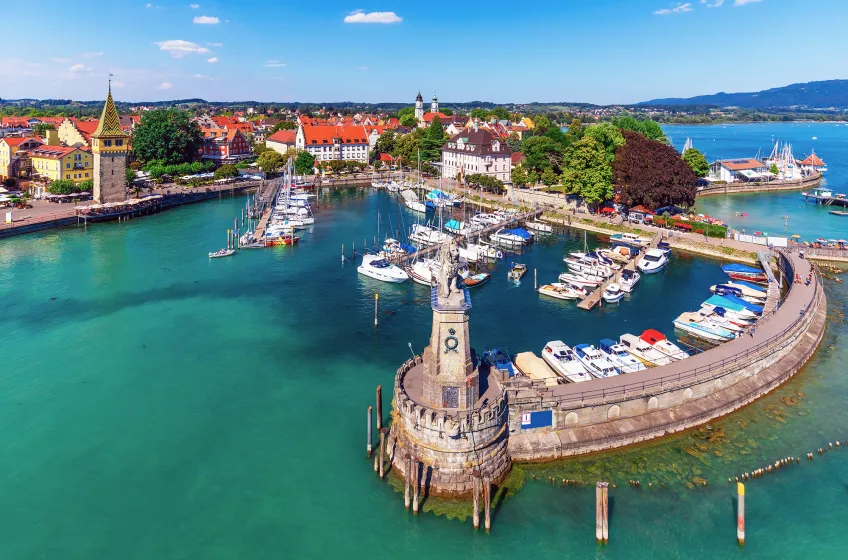
Lindau’s historic centre occupies an island near the eastern end of Lake Constance. Its harbour entrance, marked by a Bavarian lion and lighthouse, is among the most recognisable scenes on the lake.
The old town contains colourful façades, arcaded buildings, narrow lanes and the richly painted Old Town Hall. Maximilianstrasse forms the main pedestrian street, with cafés, shops and historic houses.
Visitors can climb the lighthouse for views over the harbour and towards the Alps. The waterfront is particularly pleasant in the evening, when the light catches the mountains across the lake.
Lindau is easily reached by train and passenger boat. Accommodation on the island can be expensive in summer, so staying on the mainland may offer better value.
Experience Bregenz and the Pfänder
Bregenz is the main Austrian city on Lake Constance. It is known for its waterfront cultural district and annual opera festival, staged on a huge floating platform.
Outside festival season, the lakeside promenade remains an attractive place for walking and cycling. The compact upper town contains older streets, a medieval tower and quieter residential corners.
The Pfänder cable car climbs from near the centre to a mountain viewpoint above the lake. On a clear day, the summit provides sweeping views across Lake Constance and towards numerous Alpine peaks.
Weather conditions can change quickly at altitude. Check visibility before paying for the cable car, as cloud may completely hide the panorama.
Visit Reichenau Island
Reichenau is a fertile island in the western part of Lake Constance and a UNESCO World Heritage Site. Its importance comes from the medieval monastery established there and the surviving churches associated with it.
The island’s three principal Romanesque churches contain historic architecture, wall paintings and religious art. St George’s Church at Oberzell is especially noted for its early medieval frescoes.
Reichenau is also known for vegetable farming, orchards and vineyards. Roadside stalls and small shops sell seasonal produce directly from local growers.
The landscape is flatter and less ornamental than Mainau, making it particularly suitable for cycling. A causeway connects the island to the mainland, while buses operate from Konstanz.
See the Zeppelin Museum in Friedrichshafen
Friedrichshafen is closely connected with the development of the Zeppelin airship. Its main museum occupies a former harbour railway station and presents the history, technology and cultural impact of rigid airships.
A reconstructed section of the passenger areas from the Hindenburg helps visitors understand the scale and sophistication of these aircraft. Displays also cover engineering, propaganda, disasters and the later development of the Zeppelin company.
The city’s long promenade provides clear views across the lake. Zeppelin sightseeing flights sometimes operate from the nearby airport, though these are expensive and highly dependent on weather.
Friedrichshafen is an important transport hub, with rail links and passenger boat services to other parts of the lake.
Explore the Pile Dwellings at Unteruhldingen
The open-air museum at Unteruhldingen recreates prehistoric pile dwellings above the water. Walkways connect reconstructed houses based on archaeological evidence from Stone Age and Bronze Age settlements.
Exhibitions explain how communities lived, farmed, traded and travelled around the lake thousands of years ago. The waterside setting makes the site especially memorable.
It is a strong family attraction, although some narrow walkways can become congested during busy periods. Arrive early on summer weekends or reserve enough time to avoid rushing.
The museum is near Meersburg and can be reached by bus, bicycle or seasonal boat.
Admire Birnau Basilica
Birnau Basilica stands above the northern shore between Überlingen and Meersburg. Its ornate Rococo interior is filled with decorative plasterwork, frescoes, gilding and playful sculptural details.
The church’s elevated position provides views over vineyards and across the lake. A visit can be combined with the nearby pile-dwelling museum or a walk through the surrounding countryside.
Birnau remains an active place of worship, so access may be restricted during services, weddings and religious events. Modest dress and quiet behaviour are expected.
Relax in Überlingen
Überlingen has one of the lake’s longest and most attractive promenades. Gardens, cafés and landing stages line the waterfront, while the old town rises gently behind it.
The Gothic Münster St Nikolaus dominates the centre and contains an impressive carved altar. Sections of the medieval town wall survive, along with towers and gateways.
Überlingen is also known for wellness facilities and lakeside swimming. Its position on the quieter north-western arm of Lake Constance makes it a good base for travellers seeking a more relaxed atmosphere than Konstanz or Friedrichshafen.
Cycle the Lake Constance Route
The Lake Constance Cycle Route follows the shore through Germany, Switzerland and Austria. The complete circuit is roughly 260 to 275 kilometres, depending on detours and the precise route chosen.
Most of the route is relatively flat, though there are some inland sections, road crossings and busier stretches. Leisure cyclists commonly take five to eight days to complete the circuit, allowing time for sightseeing.
Konstanz, Friedrichshafen, Lindau and Bregenz are practical starting points. Ferries and trains make it easy to shorten stages or skip less attractive sections.
During July and August, popular paths can become crowded with cyclists, pedestrians and families. Travel outside peak hours, use a bell considerately and avoid assuming every lakeside path is reserved for bicycles.
Take a Passenger Boat or Ferry
Passenger boats are an essential part of the Lake Constance experience. Seasonal services connect many of the major towns and attractions, including Konstanz, Mainau, Meersburg, Überlingen, Friedrichshafen, Lindau and Bregenz.
These boats are useful for sightseeing but should not always be treated like frequent urban transport. Some routes operate only a few times each day, and the last return service may be earlier than expected.
The vehicle ferry between Konstanz and Meersburg operates throughout the year and is one of the most dependable crossings. Another important route links Friedrichshafen with Romanshorn in Switzerland.
Bicycle spaces can be limited on popular sailings. Arrive early and check whether an additional ticket is required for the bike.
Visit the Rhine Falls
The Rhine leaves the western end of Lake Constance and eventually reaches the Rhine Falls near Schaffhausen in Switzerland. The falls are among Europe’s most powerful by water volume and make an impressive day trip from the western lake region.
Viewing platforms approach close to the rushing water, while seasonal boat trips travel beneath the falls and towards the central rock.
The site can be reached by train from Konstanz, usually with a change depending on the route. Carry Swiss francs or a payment card and remember that Swiss public transport uses a separate fare system from Germany.
Practical Advice for Visitors
Getting There
The most convenient airport depends on where you plan to stay. Zurich Airport has good rail connections to Konstanz, Romanshorn and other parts of the Swiss shore. Friedrichshafen Airport is much closer to the lake but offers a more limited flight network.
Stuttgart and Munich airports can be useful for the German side, although onward rail journeys are longer. Innsbruck and Memmingen may suit some routes to the eastern end of the lake.
Konstanz, Friedrichshafen, Lindau, Bregenz and Romanshorn all have railway stations. Direct trains are available from some major cities, but many journeys require a change at places such as Zurich, Stuttgart, Ulm or Munich.
Drivers should remember that Switzerland and Austria have motorway vignette systems. A vignette may not be needed when using only local roads, but check the precise route before travelling.
Choosing Where to Stay
Konstanz is the strongest all-round base for history, restaurants, public transport and excursions to Mainau or Reichenau. It is lively and convenient but often expensive.
Meersburg suits visitors seeking historic atmosphere, wine and lake views. Its steep streets may be difficult for anyone with limited mobility.
Friedrichshafen is practical for transport connections, museums and families. It feels more modern than Meersburg or Lindau but offers a broad range of accommodation.
Lindau is ideal for a romantic or scenic stay near the Alps, while Bregenz is best for mountain excursions and cultural events.
Überlingen offers a quieter base with gardens, swimming and access to the western German shore. Romanshorn and Kreuzlingen can provide useful Swiss alternatives, though general costs are usually higher.
Parking
Parking is difficult in the most popular lakeside centres during summer weekends. Konstanz, Meersburg, Lindau and Bregenz can all experience congestion.
Use park-and-ride facilities where available, particularly when visiting Konstanz. In Lindau, parking on the mainland and continuing by local transport or on foot is often easier than driving onto the island.
Hotel parking is not always included in the room price. Confirm charges and space availability before arrival.
Do not leave valuables visible inside the vehicle, especially at remote bathing areas, trailheads or railway station car parks.
Public Transport
Regional trains run around much of Lake Constance, but the railway does not form a perfectly continuous shoreline loop. Some journeys require inland connections, buses or ferries.
Local guest cards offered by hotels may include regional public transport. Benefits vary between districts and may not remain valid after crossing an international border.
The Bodensee Card PLUS covers admission to many regional attractions and includes selected boat travel. It can provide good value for an intensive sightseeing itinerary, but it is less useful for visitors planning mainly free walks, swimming or cycling.
Always compare the card price with your likely admissions rather than assuming it will save money.
Dining
Lake Constance cuisine combines German, Austrian and Swiss influences. Typical dishes include freshwater fish, cheese-based specialities, Swabian noodles, dumplings and seasonal fruit.
Restaurants may advertise Felchen, a whitefish traditionally associated with the lake. Local stocks have faced significant pressure, so fish served around the lake may come from other regions or fisheries. Ask about the origin when this is important to you.
The German shore is known for Müller-Thurgau, Pinot Gris and Pinot Noir wines. Vineyards are particularly prominent around Meersburg, Hagnau, Reichenau and the northern shore.
Apple juice, cider, fruit spirits and products made from local cherries or pears are widely available. Farm shops are often the best places to buy them.
Shopping
Popular local purchases include wine, fruit preserves, honey, cheese, spirits and products linked to Zeppelin history.
Konstanz has the widest conventional shopping selection, while small towns such as Meersburg and Lindau specialise more in souvenirs, food and independent boutiques.
Switzerland is outside the European Union, so customs allowances apply when carrying goods across the border. This is particularly relevant for larger quantities of alcohol, tobacco or high-value purchases.
Prices and currencies change as you move around the lake. Germany and Austria use the euro, while Switzerland uses the Swiss franc.
When to Visit
May, June and September are the best months for a balanced Lake Constance holiday. Boat services are operating, gardens are colourful and temperatures are usually comfortable for cycling or walking.
July and August bring the warmest swimming conditions and the most extensive transport schedules. They also bring crowded roads, busy cycle paths and high accommodation prices.
April is attractive for spring flowers, especially on Mainau, but weather can be changeable. October offers autumn colours and wine events, although some seasonal boat services begin to finish.
Winter is quiet and atmospheric, with Christmas markets in several towns. Mountain views can be exceptionally clear on cold days, but fog may also settle over the lake for extended periods.
Local Events
The Bregenz Festival is the region’s most famous cultural event. It takes place during July and August, with opera performed on a spectacular floating stage. Tickets and accommodation should be booked well in advance.
Konstanz’s Seenachtfest is a major waterfront celebration normally held in August, with music, food and a large evening display over the lake.
Friedrichshafen hosts major exhibitions and aviation-related events, while wine festivals take place in towns and villages from late summer into autumn.
Christmas markets are held in Konstanz, Lindau, Bregenz and other lakeside centres during Advent. Some extend into harbour areas or include decorated boats.
Event dates vary annually, so confirm the programme before reserving non-refundable accommodation.
Swimming and Water Safety
Lake Constance has numerous public beaches, grassy bathing areas and outdoor swimming pools. Water quality is generally good, but temperatures remain cool outside high summer.
Conditions can change quickly during thunderstorms. Leave the water immediately when storms approach and follow local warnings.
Not every section of shoreline is suitable for swimming. Avoid harbours, ferry routes, nature reserves and areas with strong currents, particularly near the Rhine.
Water shoes can be useful because many beaches consist of pebbles rather than sand.
Exploring Beyond Lake Constance
Appenzell in north-eastern Switzerland offers painted houses, traditional food and access to mountain walks. It can be reached from the Swiss shore by train.
St Gallen is known for its UNESCO-listed Abbey District and historic library. It makes an excellent cultural day trip from Romanshorn, Kreuzlingen or Bregenz.
The Rhine Falls near Schaffhausen are easiest to visit from Konstanz and the western lake region.
The Allgäu, north-east of Lindau, provides rolling countryside, dairy farms and access to the Bavarian Alps. Farther east, the mountain valleys of Austria’s Vorarlberg region offer cable cars, walking routes and attractive villages.
Liechtenstein is also within day-trip range from Bregenz or the Swiss eastern shore. Its small capital, Vaduz, combines museums, mountain scenery and views of the princely castle.
Shortlist
- Your Shortlist is empty