
Discover Konstanz | A Visitor's Introduction to Konstanz
Recommended places to visit, places to stay and things to do in and around Konstanz
Konstanz is a historic lakeside city in southern Baden-Württemberg, positioned where the River Rhine flows out of Lake Constance and directly beside the Swiss border. Known for its preserved medieval centre, busy harbour and easy access to Mainau Island, this university city is a perfect destination for history enthusiasts, families, cyclists and visitors who enjoy waterfront scenery. With its cobbled lanes, lake cruises and views towards the Alps, Konstanz offers an attractive base for exploring one of Central Europe’s most varied holiday regions.
Recommended Konstanz hotels and other accommodation
Pre-book Konstanz Attractions, Tours & Experiences
Why is Konstanz Worth a Visit?
Konstanz is worth visiting for its combination of medieval history, relaxed lakefront life and cross-border location. Unlike many German cities, its old centre escaped large-scale wartime destruction, leaving a particularly rich collection of historic houses, churches, towers and narrow streets.
The city played an important role in European religious and political history as the setting for the Council of Constance between 1414 and 1418. Its most famous episode was the trial and execution of the Czech reformer Jan Hus, whose legacy is commemorated at several locations around the old town.
Konstanz also feels very different from a conventional historic city break. Boats leave the harbour for destinations around Lake Constance, cyclists pass through on the long-distance lakeside route, and parks, bathing areas and waterside restaurants are integrated into everyday city life.
Switzerland begins immediately south of the centre. You can walk or cycle across the border into Kreuzlingen without leaving the urban area, making Konstanz an excellent destination for a simple two-country trip.
Konstanz Highlights: Things to See and Do in Konstanz
Konstanz Münster
Konstanz Münster, formally dedicated to Our Lady, dominates the old town skyline. The cathedral has origins in the early Middle Ages, although its present appearance reflects Romanesque, Gothic and later architectural periods.
The church was closely associated with the Council of Constance and contains historic chapels, carved choir stalls and an atmospheric crypt. Its interior is comparatively restrained in places, but careful exploration reveals details from several centuries.
When accessible, the cathedral tower provides one of the best views over the old town, harbour, Lake Constance and surrounding countryside. The climb involves many steps and narrow passages, so it may not suit visitors with limited mobility.
As the Münster remains an active place of worship, access can be restricted during services and religious ceremonies.
Niederburg
Niederburg is the oldest and most atmospheric quarter of Konstanz. It lies between the cathedral and the Rhine, with narrow lanes, medieval houses, small squares and traditional taverns.
The area rewards slow exploration rather than a fixed sightseeing route. Look for painted façades, decorative bay windows, old trade signs and architectural details above street level.
Niederburg is quietest during the morning. In the evening, its restaurants and wine bars create a livelier atmosphere without the intensity of the main shopping streets.
A regular street market and neighbourhood events are sometimes held here, adding to the district’s local character.
Konstanz Harbour and Imperia
Konstanz Harbour is the city’s principal waterfront landmark and the departure point for many Lake Constance boat services.
At the end of the harbour stands Imperia, a nine-metre-high rotating statue created by artist Peter Lenk. The figure holds miniature representations of a pope and an emperor, offering a satirical commentary on the political and religious power surrounding the Council of Constance.
The statue was controversial when installed but has become one of the city’s best-known symbols. The harbour is particularly attractive around sunset, when the light falls across the lake and distant mountains may become visible.
Arrive early for popular boat departures during summer, as queues can form around ticket offices and boarding areas.
Council Building
The large stone building beside the harbour is traditionally known as the Konzil, or Council Building. Originally constructed as a warehouse, it was used during the Council of Constance and is associated with the election of Pope Martin V in 1417.
Today, the building functions mainly as a restaurant and event venue rather than a conventional museum. Its historical importance is best appreciated from outside or as part of a guided city tour.
The surrounding harbour area contains information panels and several viewpoints across the water.
Rosgartenmuseum
The Rosgartenmuseum is Konstanz’s main museum of local history, art and culture. It occupies a former guildhall in the old town and covers the city’s development from prehistory to modern times.
Exhibits explore the Council of Constance, medieval trade, religious life and the relationship between the city and Lake Constance. Historic rooms and architectural details form part of the attraction.
The museum is an excellent choice for a rainy day and provides useful context before visiting the city’s churches and historic streets. Allow around 90 minutes for a general visit.
Hus Museum
The Hus Museum is dedicated to Jan Hus, the Czech religious reformer who was condemned during the Council of Constance and executed in 1415.
The museum occupies a historic house traditionally connected with his stay in the city. Exhibits explain his teachings, trial, death and later influence on European religious history.
The displays are relatively compact, making the museum easy to combine with a walking tour of the old town. Visitors with a particular interest in Hus can continue to the memorial stone marking the traditional site of his execution.
Rheintorturm and Pulverturm
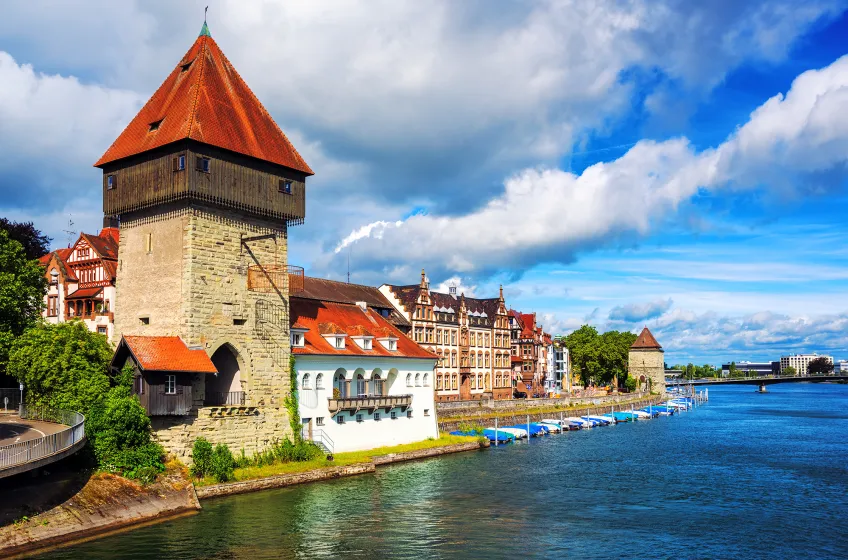
The Rheintorturm and Pulverturm are surviving towers from Konstanz’s medieval defences. They stand close to the point where the Rhine leaves Lake Constance.
The Rheintorturm once guarded an important bridge and trade route. The nearby Pulverturm formed part of the city wall and was later used to store gunpowder.
Together with the riverside promenade, the towers create one of the most attractive walking areas outside the busiest part of the centre. Continue across the Rhine bridge for views back towards the cathedral and old town.
Mainau Island
Mainau is one of the most popular attractions on Lake Constance and can easily occupy most of a day. Known as the Flower Island, it combines extensive gardens, mature trees, seasonal displays, a Baroque palace and family attractions.
Spring brings large displays of tulips and daffodils, followed by roses in summer and thousands of dahlias towards autumn. The butterfly house provides a warm indoor attraction filled with tropical plants and free-flying butterflies.
Mainau is open throughout the year, although its appearance and admission arrangements vary by season. Day visitors are generally admitted from the morning, with longer hours during the main gardening season.
The island can be reached by local bus, bicycle, car or seasonal boat. Travelling by boat provides the most scenic arrival, while the bus is usually the simplest option from central Konstanz.
SEA LIFE Konstanz
SEA LIFE Konstanz stands beside the harbour and is particularly popular with families. Its displays follow aquatic environments from the Rhine and Lake Constance to larger marine habitats.
The aquarium includes fish, rays and other sea creatures, with educational displays aimed at younger visitors. Admission also includes access to the adjacent Lake Constance Natural History Museum.
The attraction is relatively compact and usually takes around one and a half to two hours. It becomes busy during wet weather, weekends and school holidays, so booking a timed ticket can be worthwhile.
There is no dedicated aquarium car park. Public transport, park-and-ride services or arrival on foot from the railway station are more convenient.
Bodensee-Therme Konstanz
The Bodensee-Therme is a modern bathing and wellness complex on the lakeshore north of the centre. It includes indoor and outdoor pools, warm thermal water, a sauna area and direct views over Lake Constance.
In summer, visitors can combine the pools with access to the neighbouring lakeside bathing area. During colder weather, the outdoor thermal pool offers a memorable view across the water.
Sauna areas in Germany commonly operate without swimwear and may be mixed-gender. Check the current rules before entering, as the pool and sauna sections usually have different requirements.
Lake Constance Boat Trip
A boat trip is one of the best ways to appreciate Konstanz’s setting. Seasonal passenger services connect the city with Mainau, Meersburg, Überlingen, Friedrichshafen and other destinations around the lake.
Short trips work well for visitors with limited time, while longer excursions can form a full day out. The ferry route between Konstanz and Meersburg also carries cars and operates separately from many tourist cruises.
Schedules vary considerably by season. Summer offers the widest choice, while winter services are much more limited. Check the final return sailing carefully before leaving the city.
Archaeological Museum of Baden-Württemberg
The Archaeological Museum occupies buildings associated with the former Petershausen Abbey on the northern side of the Rhine.
Its displays cover human settlement in south-western Germany from prehistoric periods through the Roman era and Middle Ages. Objects from the Lake Constance region help explain the importance of the lake as a transport route and settlement area.
This is one of the city’s strongest indoor attractions and is particularly suitable for visitors interested in Roman history, early medieval culture or archaeology.
Walk or Cycle Across the Swiss Border
Konstanz and the Swiss town of Kreuzlingen form a continuous urban area. The border can be crossed on foot, by bicycle, car or local public transport.
Kreuzlingen’s Seeburgpark is an easy destination, with open lawns, lakeside paths, a small harbour and views towards Konstanz. The route is almost entirely flat and suitable for a relaxed walk or cycle ride.
Germany and Switzerland use different currencies, although cards are widely accepted. Carry valid travel identification, as occasional border checks are possible even though routine crossing often feels informal.
Practical Advice for Visitors
Getting There
Konstanz has direct or connecting rail services from major cities in southern Germany. Journeys from Stuttgart normally take around two and a half to three hours, while travel from Munich generally takes approximately three and a half to four hours.
Zurich Airport is often the most convenient international airport. Direct or simple rail connections usually reach Konstanz in around an hour to 90 minutes, depending on the service.
Konstanz Hauptbahnhof stands between the old town and harbour, making arrival by train especially convenient. Most central hotels and major sights are within walking distance.
Drivers usually approach through the German motorway and road network or via Switzerland. Check whether a Swiss motorway vignette is required for your chosen route. It is possible to avoid Swiss motorways, but this may increase journey time.
Parking
Parking in central Konstanz can be difficult, especially during summer weekends, festivals and sunny public holidays. Traffic frequently builds up on roads approaching the old town.
Several multi-storey car parks serve the centre, including facilities near the Lago shopping centre and historic district. These are convenient but can fill quickly.
Park-and-ride sites are often the best choice for day visitors. Leave the car outside the busiest area and continue by bus.
Do not assume that parking in neighbouring Switzerland will be cheaper or simpler. Different regulations, currencies and time restrictions apply.
Dining
Konstanz’s food reflects influences from Baden, Swabia and nearby Switzerland. Regional dishes include Käsespätzle, Maultaschen, sausage dishes and freshwater fish from Lake Constance.
Whitefish, often listed as Felchen, is a local speciality when available. Because catches can be limited, not every fish described as regional will necessarily come directly from the lake. Ask the restaurant when this matters to you.
The Niederburg district is a good place to find traditional inns and atmospheric evening dining. The harbour and lakeside offer scenic settings, although prices are often higher.
Konstanz also has a strong café culture and a varied international restaurant scene supported by its university population. Reserve tables for Friday and Saturday evenings during the summer season.
Shopping
Konstanz is a major shopping destination for residents of both Germany and Switzerland. The central pedestrian streets contain department stores, fashion retailers, bookshops and independent businesses.
The Lago shopping centre near the railway station is useful during wet weather and contains a broad range of shops and places to eat.
For more individual purchases, explore the lanes around Niederburg and the Münster. Local products include Lake Constance wine, fruit spirits, apple products and regional foods.
Saturdays can be particularly crowded because of cross-border shopping. Visit on a weekday morning for a calmer experience.
When to Visit
May, June and September are excellent months for Konstanz. The weather is generally suitable for walking, cycling and boat trips, while crowds are often lower than during the school summer holidays.
July and August bring the warmest lake temperatures and the fullest boat schedules. They also bring heavy visitor numbers, busy roads and higher accommodation prices.
April and early May are especially attractive for spring flowers on Mainau. Late summer and early autumn bring vineyard scenery, fruit harvests and dahlia displays.
Winter is quieter and can be atmospheric, particularly during the Christmas market. However, lake fog is possible, daylight is limited and many boat services operate reduced schedules.
Local Events
The Konstanz Lake Night Festival, or Seenachtfest, is one of the largest annual events on Lake Constance. It takes place along the waterfront and features music, food stalls, entertainment and a major evening display over the lake. In 2026, it is scheduled for 8 August.
The city’s Christmas market spreads through the old town and harbour area, with decorated stalls, food, drinks and seasonal gifts. Its waterside setting makes it one of the region’s most attractive winter events.
Other annual highlights include the Konstanz Carnival, concerts, theatre performances and neighbourhood festivals. Accommodation becomes expensive during major events, so book well ahead.
Exploring Beyond Konstanz
Meersburg lies directly across the lake and is one of the easiest excursions from Konstanz. Regular ferries connect the two shores, and the town is known for its steep historic streets, medieval castle and vineyard views.
Reichenau Island, west of Konstanz, is a UNESCO World Heritage Site associated with an influential medieval monastery. Its churches, vegetable farms and flat cycling routes make it very different from the more ornamental Mainau.
Stein am Rhein in Switzerland has a beautifully preserved centre filled with painted historic façades. It can be reached by train, boat, bicycle or a combination of transport.
The Rhine Falls near Schaffhausen form one of Europe’s most powerful waterfall systems. Allow most of a day when travelling from Konstanz by public transport.
Überlingen offers a long lakeside promenade, attractive old streets and gardens. Seasonal boats provide a scenic connection, while trains travel around the western end of the lake.
Friedrichshafen is closely associated with Zeppelin airships and contains a major museum dedicated to their history. It can be reached by boat or by using the Konstanz–Meersburg ferry followed by bus.
Shortlist
- Your Shortlist is empty