
Discover Tübingen | A Visitor's Introduction to Tübingen
Recommended places to visit, places to stay and things to do in and around Tübingen
Tübingen is a picture-book university town in south-west Germany, set on the River Neckar between the Black Forest and the Swabian Alb. Known for its half-timbered medieval old town, punt boats gliding past colourful riverfront houses and one of Europe’s oldest universities, this compact city is perfect for culture lovers, romantics, and anyone who enjoys lively student energy wrapped in historic charm. With its leafy river island, cobbled lanes and buzzing café scene, Tübingen offers an easygoing escape in the heart of Baden-Württemberg.
Recommended Tübingen Hotels & Other Accommodation
Pre-book Tübingen Attractions, Tours & Experiences
Why is Tübingen Worth a Visit?
Tübingen is worth visiting for its rare blend of intact medieval streetscape and youthful university vibe. Much of the old town survived the Second World War, so you can still wander lanes that twist between centuries-old façades, up to a hilltop castle and down to the water’s edge where stocherkähne—flat-bottomed punts—are poled along by students. The city’s intellectual pedigree dates back to 1477, and that spirit lives on in museums, bookshops and a full calendar of festivals and talks. Add in riverside beer gardens, the leafy Neckarinsel promenade and easy access to forests and castles, and you have a destination that’s both charming and genuinely livable. Whether you’re keen on museum-hopping, punting on the river, café-crawling or setting off on scenic walks, Tübingen leaves a lasting impression of warmth and whimsy.
Tübingen Highlights: Things to See and Do in Tübingen
Marktplatz and the Painted Town Hall
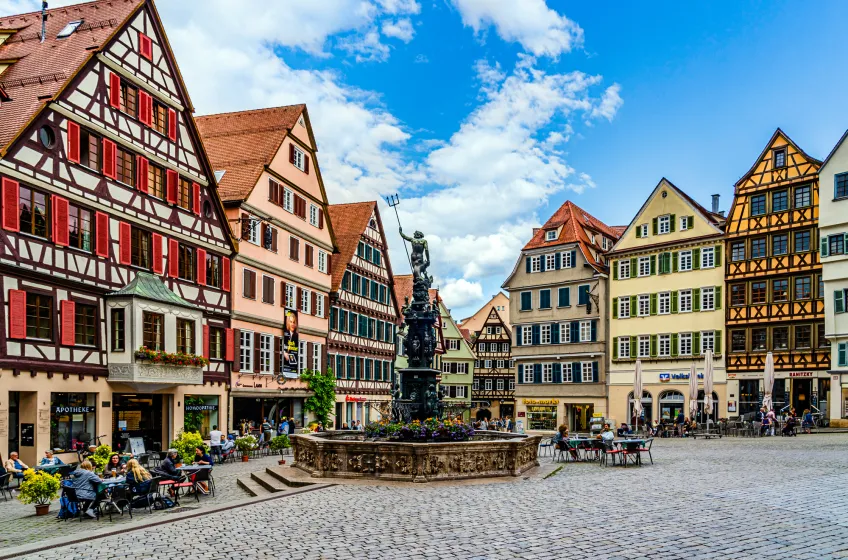
Start on the Marktplatz, framed by steep-gabled houses and the richly painted Renaissance-era Rathaus. The astronomical clock on the façade draws the eye, but linger for a coffee and watch deliveries rumble over the cobbles as market stalls set up with regional cheeses, flowers and fruit. Late afternoon light makes the square glow for photos, and in December the scene turns festive with stalls and mulled wine.
The Neckarfront and Stocherkahn Ride
The postcard view of Tübingen is the Neckarfront, a line of pastel houses stacked above the river with the Stiftskirche spire behind. See it from a stocherkahn, the local punt. Rides run from spring to autumn and are a delight on warm evenings. Bring a picnic, but remember there’s a knack to balancing—leave the poling to someone experienced if you’re new to it.
Hölderlinturm and the Riverbank
Poet Friedrich Hölderlin spent his later years in the slender tower by the bridge, now a small museum with tranquil views. Even if you don’t go inside, the spot is lovely for lingering. The nearby river steps are a favourite hangout for students with guitars, gelato and takeaway Flammkuchen.
Hohentübingen Castle and the Museum of Ancient Cultures
Climb the steep lanes to Schloss Hohentübingen, the city’s hilltop castle with sweeping views and an impressive courtyard. Inside, the University’s Museum Alte Kulturen exhibits treasures from archaeology and classical antiquity. The mix of medieval architecture and scholarly displays captures Tübingen’s character in a nutshell.
Stiftskirche St Georg
Tübingen’s landmark church dates to the late Middle Ages and was an early centre of the Reformation. Step inside for soaring Gothic vaulting, fine stained glass and a calm, contemplative space just moments from the bustle of the old town. If you’re there at noon, listen for the bells rolling across the rooftops.
Neckarinsel and the Plane-Tree Avenue
The Neckarinsel is a long, narrow river island shaded by a spectacular double row of plane trees. It’s the city’s green spine, perfect for a gentle stroll, an impromptu picnic or people-watching as punts glide by. In autumn, the leaf show is magnificent; in summer, it’s the coolest place in town on a hot day.
Kunsthalle Tübingen
For a change of tempo, the Kunsthalle presents strong temporary exhibitions of modern and contemporary art. It’s a short bus ride or walk from the centre and rewards you with thoughtfully curated shows and a smart museum shop.
Boxenstop Museum
This quirky private museum combines gleaming classic cars and motorbikes with vintage toys. It’s a surprisingly engaging hour or two, especially if you’re travelling with kids or anyone who loves engineering and design.
The French Quarter
On the south-eastern edge of the centre, the Französisches Viertel is a model of urban renewal, transformed from barracks into a creative district. Expect cafés with pavement tables, independent boutiques, murals and community gardens. It’s a great area for brunch and a contrast to the medieval lanes.
University Quarter and the Alte Aula
Wander past the Alte Aula (the old university hall) and around the university buildings scattered through the old town. Bookshops abound, and you’ll often stumble into a public lecture, a poster-plastered noticeboard of student society events, or an impromptu music performance in a courtyard.
Botanical Garden of the University
Up on the hill campus, the Botanischer Garten offers greenhouses and themed outdoor areas ranging from alpine plants to tropical species. It’s a restful place on a breezy afternoon, with views back towards the city.
Bebenhausen Abbey
A short hop north lies Bebenhausen, a beautifully preserved Cistercian monastery that later served as a royal hunting lodge. The church, cloister and timbered village surrounding it make for an atmospheric half-day trip and countless photo opportunities.
Practical Advice for Visitors
Getting There
Tübingen is well connected by regional trains and buses. From Stuttgart Hauptbahnhof, frequent regional services reach Tübingen Hauptbahnhof in roughly an hour, and Stuttgart Airport is a convenient gateway with direct buses or rail connections via the city. From Munich, expect around three hours with a change, and from Frankfurt roughly three to three and a half hours depending on connections. Driving is straightforward via the A8 and B27, but once you arrive you’ll do most of your exploring on foot.
Parking
The historic centre is largely pedestrianised and the streets are narrow, so it’s best to use the multi-storey car parks on or just outside the inner ring and walk in. Look for “Parkhaus” signs that show live space counts. At peak times and in December, consider park-and-ride options on the outskirts and hop on a bus into the centre.
Dining
This is Swabia, so come hungry. Try Maultaschen (stuffed pasta), Käsespätzle (cheesy noodles) and Zwiebelrostbraten (steak with onion gravy) in traditional Gaststätten. The riverside has convivial beer gardens; Neckar-side spots are popular on warm evenings for a Hefeweizen and hearty plates. In the old town, student cafés serve generous breakfasts, soups and cakes at friendly prices, and you’ll find excellent ice cream near the bridge. There’s a good spread of vegetarian and vegan options, plus international cuisines from Middle Eastern to Korean. For a special night, book a refined regional kitchen with a modern twist and ask for a local Trollinger or Lemberger wine.
Shopping
Tübingen shines for independent shopping. Marktgasse and the lanes around the Marktplatz brim with boutiques, design stores and chocolatiers. The city is a booklover’s haven, with excellent German and English-language selections and a proud local bookselling tradition. Keep an eye out for artisanal ceramics, fair-trade goods and regional delicacies like honey, schnapps and Swabian pasta. Regular markets bring farmers from the surrounding countryside into the centre; arrive early for the best produce and flowers.
When to Visit
Spring brings blossoms along the Neckar and mild temperatures perfect for wandering. Summer is peak punting season, with long evenings and al fresco dining everywhere, though expect occasional thunderstorms and crowds on sunny weekends. Autumn colours the plane trees on the Neckarinsel and the vineyards on nearby slopes, making it an atmospheric time for photos and walks. Winter is charming and decidedly cosy, with a chocolate festival in early December and a traditional Christmas market later in the month; wrap up warm and enjoy steaming mugs of Glühwein.
Local Events
The Stocherkahnrennen, a spirited punt-boat race, livens up the river in early summer and is a quintessential Tübingen spectacle. The Umbrian-Provençal Market fills the old town late summer with Italian and French specialities, a nod to Tübingen’s European ties. In early December, chocolART transforms the centre into a paradise for cocoa lovers, from single-origin bars to ornate pralines and live demonstrations. Year-round, the university fuels a rich schedule of lectures, theatre and music, while venues like the Kulturzentrum Sudhaus host gigs, comedy and cabaret.
Exploring Beyond Tübingen
Within minutes you can be among the beech and oak forests of the Schönbuch Nature Park, criss-crossed by waymarked trails and cycling routes. Bebenhausen Abbey, just to the north, is a must for history and architecture. To the south, the fair-tale silhouette of Hohenzollern Castle crowns a solitary hill and makes an easy day trip with panoramic views. The Swabian Alb offers caves, castles and dramatic escarpments; Blaubeuren’s mystical blue spring, the Blautopf, is a favourite if you don’t mind the journey. For shoppers, Outletcity Metzingen is a short train or bus ride away. Closer to home, neighbouring Rottenburg am Neckar blends Roman history with a handsome cathedral square, and Reutlingen’s old town is worth a wander, especially if you’re already passing through.
Tübingen’s magic lies in the way serious learning, student fun and medieval beauty all share the same few streets. Plan on plenty of aimless strolling, a ride on a punt, a seat in a café that spills onto a cobbled square, and a sunset pause on the river island. It’s the kind of small city that you’ll think about long after you’ve left—and probably plan to return to.
Shortlist
- Your Shortlist is empty