
Discover Ulm | A Visitor's Introduction to Ulm
Recommended places to visit, places to stay and things to do in and around Ulm
Ulm is a historic university city on the Danube in southern Germany, positioned where Baden-Württemberg meets Bavaria and directly facing its twin city, Neu-Ulm. Known for its immense Gothic minster, picturesque waterways and associations with Albert Einstein, this compact city is ideal for architecture enthusiasts, couples, families and travellers exploring southern Germany by rail. With medieval lanes, modern museums and relaxed riverside scenery, Ulm offers an appealing alternative to the region’s larger tourist centres.
Recommended Ulm Hotels & Other Accommodation
Pre-book Ulm Attractions, Tours & Experiences
Why is Ulm Worth a Visit?
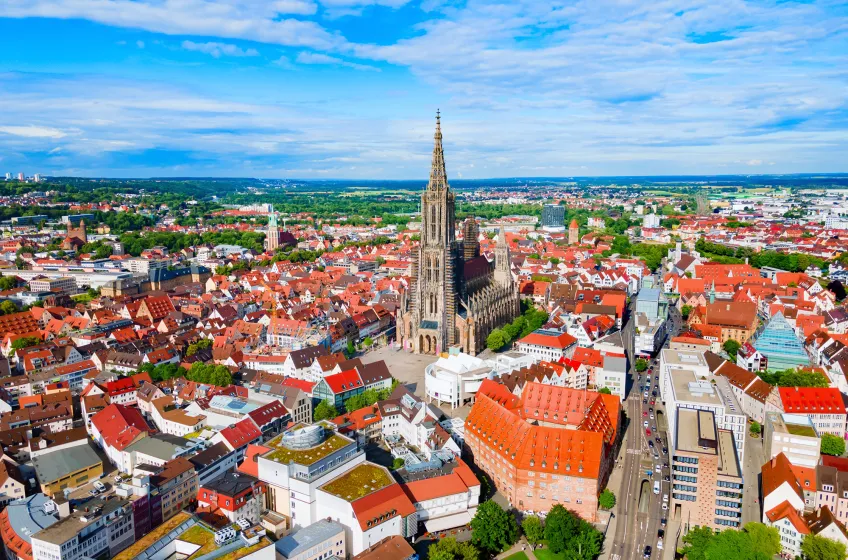
Ulm is worth visiting because it combines a genuinely impressive landmark with a historic centre that is small enough to explore comfortably on foot. Ulm Minster dominates almost every view, while the nearby Fishermen’s and Tanners’ Quarter provides a sharp contrast with its leaning timber-framed buildings, tiny bridges and channels of the River Blau.
The city also has an unusual geographical character. The Danube forms the state boundary here, separating Ulm in Baden-Württemberg from Neu-Ulm in Bavaria. Crossing the river therefore takes you not merely into another district, but into another German federal state.
Ulm’s history as a prosperous free imperial city is visible in its elaborate town hall, surviving fortifications and merchants’ houses. At the same time, striking modern buildings such as the Kunsthalle Weishaupt and the glass pyramid of the central library prevent the centre from feeling like an open-air museum.
The city is closely associated with Albert Einstein, who was born here in 1879. Although his birthplace was destroyed during the Second World War, Ulm acknowledges its most famous son through memorials, public art and an exhibition devoted to his family and early life.
Most visitors can see the essential sights in one full day, although an overnight stay allows time for museums, a leisurely dinner and a walk beside the Danube without rushing.
Main Highlights: Things to See and Do in Ulm
Ulm Minster
Ulm Minster, or Ulmer Münster, is the city’s defining landmark. Its intricately carved Gothic spire rises to 161.53 metres, making it the tallest church tower in Germany. Construction began in 1377, but the building was not completed until 1890, more than five centuries later.
Entry to the main church is generally free, although donations are welcomed. Inside, look for the enormous choir stalls, medieval sculpture, stained glass and the sense of scale created by the soaring nave.
The tower climb is the memorable challenge. It involves hundreds of steps, narrow spiral staircases and increasingly confined passages. The upper levels offer wide views over Ulm, Neu-Ulm, the Danube valley and, in especially clear conditions, towards the Alps. The final section is unsuitable for anyone uncomfortable with heights or tight spaces, and access can be restricted by weather or maintenance. Check current arrangements before making the climb.
Münsterplatz
The broad square surrounding the minster is the natural starting point for exploring Ulm. It provides the best opportunity to appreciate the tower’s height, although fitting the entire building into a photograph can be surprisingly difficult.
The square hosts regular markets, public events and Ulm’s atmospheric Christmas market. The Stadthaus, a modern white building designed by American architect Richard Meier, stands opposite the Gothic church. Its clean curves and pale exterior make it a deliberately bold architectural contrast rather than an attempt to imitate its medieval neighbour.
Fishermen’s and Tanners’ Quarter
The Fischer- und Gerberviertel is Ulm’s most picturesque neighbourhood. It developed beside the channels of the River Blau, where fishermen, millers, boatmen and leather workers once lived and worked.
Today its narrow lanes contain restaurants, small hotels and restored half-timbered houses. Water flows beneath tiny bridges and between buildings, creating scenes that feel more like a village than a city centre. The quarter is particularly attractive in the early morning, before day visitors arrive, and in the evening when restaurant terraces become lively.
Allow time to wander without following a rigid route. The finest details are often found in quiet corners, including old waterwheels, wooden balconies, crooked walls and small passages opening unexpectedly onto the river.
The Crooked House
The Schiefes Haus, or Crooked House, is one of the Fishermen’s Quarter’s most photographed buildings. Constructed in the 15th century, it leans dramatically over the Blau and now operates as a hotel.
Even visitors who are not staying overnight can admire its warped timber frame from the nearby footpaths and bridges. The reflection in the water makes a particularly good photograph when the river is calm. The building’s sloping floors and irregular rooms have been carefully preserved rather than straightened, giving hotel guests one of Ulm’s most unusual accommodation experiences.
Ulm Town Hall
Ulm’s Renaissance town hall is decorated with colourful murals, ornamental windows and an elaborate astronomical clock. The oldest parts of the building date from the 14th century, although its present appearance reflects several later alterations and restorations.
The astronomical clock is the feature most visitors pause to examine, but walk around the entire exterior to see the painted façades properly. Inside the entrance, a replica of an early flying machine recalls Albrecht Ludwig Berblinger, the “Tailor of Ulm”, whose attempt to fly across the Danube in 1811 ended in the river.
Danube Promenade and City Wall
A walk along the old city wall provides some of Ulm’s most attractive views. The route passes above the Danube beside lawns, trees and historic towers, with Neu-Ulm visible across the water.
The Metzgerturm, or Butchers’ Tower, is especially distinctive. The medieval gateway leans slightly, a feature traditionally blamed on imprisoned butchers crowding into one corner when confronted by angry townspeople. The story is entertaining, although changes in the marshy ground provide a more convincing explanation.
Continue towards the Friedrichsau park for a longer riverside outing, or cross one of the bridges into Neu-Ulm and return along the opposite bank.
Museum Ulm and the Lion Man
Museum Ulm is best known for the Löwenmensch, or Lion Man, an extraordinary Ice Age sculpture carved from mammoth ivory. Around 40,000 years old, it is among the earliest known figurative artworks representing an imaginary being.
The figure was discovered in the nearby Swabian Jura, where several caves have produced exceptionally important prehistoric objects. Museum displays and gallery access can change during renovation or exhibition work, so confirm what is on view before visiting.
The museum also holds medieval art, archaeological material and works connected with the Ulm School of Design.
Kunsthalle Weishaupt
Kunsthalle Weishaupt houses a private collection of modern and contemporary art in a purpose-built gallery close to the town hall. Exhibitions draw on works by major 20th- and 21st-century artists, with displays changing periodically.
A glazed walkway connects the building with Museum Ulm, symbolically linking the city’s ancient collections to its contemporary art. It is a good choice in poor weather and provides a very different experience from Ulm’s medieval streets.
Albert Einstein Memorials
Albert Einstein was born in Ulm on 14 March 1879, although his family moved to Munich when he was still an infant. His original birthplace on Bahnhofstrasse was destroyed in 1944.
A modest memorial marks the approximate site. More visually memorable is the Einstein Fountain near the historic Zeughaus, where a bronze head with wild hair and an extended tongue emerges from a rocket-like structure. The deliberately humorous sculpture has become one of the city’s favourite photo stops.
The Die Einsteins exhibition at the Museum zur Geschichte von Christen und Juden explores the wider Einstein family and its connections with Ulm.
Ulm Federal Fortifications
The Federal Fortress of Ulm was built during the 19th century and formed one of Europe’s largest fortress systems. Its walls, barracks and defensive works encircled both Ulm and Neu-Ulm.
Numerous sections survive, including the Wilhelmsburg citadel on Michelsberg hill. Some buildings are accessible only during tours or special events, but walking and cycling routes pass many of the structures. The elevated areas around Wilhelmsburg also provide good city views.
Friedrichsau Park
Friedrichsau is Ulm’s major riverside park, stretching eastwards along the Danube. Its lawns, mature trees, playgrounds and beer gardens make it popular with residents during warm weather.
The park is easily reached on foot, by bicycle or by tram. It is a useful destination for families and anyone wanting a break from sightseeing. Ulm Zoo, a small zoological attraction with an aquarium and tropical house, stands near the park’s edge.
Wiblingen Abbey
Wiblingen Abbey lies south of central Ulm and is worth the short journey for its magnificent Baroque library. The room is richly decorated with columns, statues, frescoes and painted galleries designed to celebrate learning and knowledge.
The adjoining basilica has an elaborate late-Baroque interior. Public transport connects Wiblingen with central Ulm, although drivers will find it straightforward to include as part of a wider excursion.
Practical Advice for Visitors
Getting There
Ulm lies on major rail routes linking Stuttgart, Munich and southern Germany. Direct or one-change trains make it an easy day trip from either Stuttgart or Munich, with the fastest journeys typically taking around an hour to an hour and a half depending on the service.
Ulm Hauptbahnhof is roughly a ten-minute walk from Münsterplatz. Follow Bahnhofstrasse eastwards towards the minster, whose tower provides a convenient visual guide.
The nearest major airports are Stuttgart and Munich. Memmingen Airport is geographically closer and handles a selection of European flights, although onward public transport may be less frequent.
Drivers reach Ulm via the A8 motorway between Stuttgart and Munich or the A7 running north–south through Germany.
Getting Around
Central Ulm is compact and best explored on foot. The minster, town hall, Fishermen’s Quarter and Danube are all within a relatively small area.
Trams and buses are useful for Wiblingen Abbey, Friedrichsau, the university district and outer fortifications. Ulm and Neu-Ulm share an integrated local transport network, so crossing into Bavaria does not complicate an ordinary city journey.
Cycling is another practical option. Dedicated routes follow the Danube, and the city forms part of the long-distance Danube Cycle Route.
Parking
Several underground and multi-storey car parks serve the centre, including facilities around the town hall, Fischerviertel and Salzstadel areas. Parking immediately beside the principal attractions is limited and usually charged.
For an easier arrival, follow electronic signs showing available spaces rather than attempting to find unrestricted street parking. On market days, festival weekends and during the Christmas period, central car parks can fill quickly.
Park-and-ride can be a less stressful alternative during major events. Do not leave valuables visible in the vehicle, and check the closing time if using a privately operated garage.
Dining
Swabian cooking is the local tradition. Look for Maultaschen, pasta parcels commonly filled with meat and herbs; Käsespätzle, soft egg noodles with cheese and onions; lentils with sausages; and Zwiebelrostbraten, beef served with fried onions.
The Fishermen’s Quarter has the most atmospheric concentration of restaurants, including traditional inns in timber-framed buildings. Münsterplatz and the surrounding streets offer cafés, bakeries and international choices, while riverside beer gardens are particularly enjoyable in summer.
Ulm also has its own brewing tradition. Ordering a local beer with a Swabian meal is an easy way to sample the regional character, although alcohol-free versions are widely available.
Restaurant kitchens may close earlier than visitors from Britain expect, particularly outside the busiest areas. Reserving a table is sensible on Friday and Saturday evenings.
Shopping
The main pedestrian shopping streets run between the railway station, Münsterplatz and the town hall. They contain familiar German and international brands, while smaller lanes around the Fishermen’s Quarter offer independent shops, crafts and gifts.
Markets on Münsterplatz are good places to browse seasonal produce, flowers, bread, cheese and regional foods. Opening days and stall numbers can vary, especially around public holidays.
For a local souvenir, consider Swabian food products, a model or print of Ulm Minster, or something connected with the Ulmer Spatz. This sparrow is the city’s emblem, inspired by a legend in which builders learnt how to carry a long beam through a gateway after watching a bird manoeuvre a twig into its nest.
When to Visit
Late spring and early autumn provide comfortable conditions for walking, with generally milder temperatures than midsummer and fewer peak-season crowds.
Summer brings beer gardens, river activity and major outdoor celebrations. July is particularly lively because of Schwörmontag and the Nabada river procession. Accommodation can become more expensive around these events.
December is atmospheric when the Christmas market fills Münsterplatz beneath the illuminated minster. Expect cold weather, early sunsets and busy weekends.
Winter outside the festive season is quieter and can be rewarding for museums and architecture, but tower access and attraction hours may be reduced. Check official opening information shortly before travelling.
Local Events
Schwörmontag, or Oath Monday, is Ulm’s most important civic celebration. It takes place on the penultimate Monday in July and centres on the mayor’s annual public address and renewal of the historic oath to serve the city fairly.
The day’s most exuberant event is the Nabada, a colourful procession of decorated boats and improvised craft floating down the Danube. Spectators should arrive early for a place along the city wall or riverbank.
The Ulm Christmas Market usually runs during Advent on Münsterplatz. Wooden stalls sell food, hot drinks, decorations and gifts beneath the minster’s illuminated tower.
The International Danube Festival, generally held every two years, celebrates the cultures of countries along the river through music, food, performances and discussions. Confirm the current programme before planning a journey around it.
Exploring Beyond Ulm
Blaubeuren lies about 20 kilometres west of Ulm and makes an excellent half-day or full-day excursion. Its principal attraction is the Blautopf, an intensely coloured karst spring surrounded by woodland and traditional buildings. The town also has a former Benedictine monastery and an attractive old centre.
The Swabian Jura contains limestone valleys, walking trails and caves associated with some of Europe’s earliest known art and musical instruments. Several archaeological sites form part of the UNESCO-listed Caves and Ice Age Art in the Swabian Jura.
Legoland Deutschland near Günzburg is around 30 kilometres east of Ulm and is a popular family day trip during its operating season.
For a quieter outing, follow the Danube by bicycle towards small riverside communities or explore the countryside around Blaustein and the valley of the River Blau.
Shortlist
- Your Shortlist is empty