
Discover Würzburg | A Visitor's Introduction to Würzburg
Recommended places to visit, places to stay and things to do in and around Würzburg
Würzburg is a historic university city on the River Main in Lower Franconia, northern Bavaria. Known for its UNESCO-listed Residenz, hilltop fortress and centuries-old wine culture, the city is a perfect destination for architecture enthusiasts, wine lovers and visitors exploring Germany by rail. With its Baroque landmarks, vineyard-covered slopes and lively riverside atmosphere, Würzburg offers a distinctive city break in the heart of Franconian wine country.
Recommended Würzburg hotels and other accommodation
Pre-book Würzburg Attractions, Tours & Experiences
Why is Würzburg Worth a Visit?
Würzburg is worth visiting for its unusual combination of monumental architecture, attractive river scenery and urban vineyards. Its greatest landmark, the Würzburg Residenz, is among Europe’s finest Baroque palaces, while Marienberg Fortress rises dramatically above the opposite bank of the Main.
The city is also one of Germany’s most appealing destinations for wine lovers. Vineyards begin almost at the edge of the centre, and several historic charitable foundations continue to produce respected Franconian wines. A glass of local Silvaner on the Old Main Bridge is as much a Würzburg experience as visiting a palace or museum.
Although much of Würzburg was destroyed during an air raid on 16 March 1945, major churches, palaces and historic streets were carefully rebuilt. The restored centre is compact and easy to explore on foot, with most important sights lying between the railway station, Residenz and river.
Würzburg works well for a weekend break, but it is also a useful base for visiting the small wine towns of the Main Valley. Direct and frequent rail connections make it convenient to combine with Frankfurt, Nuremberg, Bamberg or Rothenburg ob der Tauber.
Würzburg Highlights: Things to See and Do in Würzburg
Würzburg Residenz
The Würzburg Residenz is the city’s outstanding attraction. Built during the 18th century for Würzburg’s prince-bishops, the vast palace is a masterpiece of Baroque architecture and forms part of a UNESCO World Heritage Site.
Its most impressive feature is the monumental staircase, covered by an enormous ceiling fresco painted by the Venetian artist Giovanni Battista Tiepolo. The painting represents the continents as they were understood in 18th-century Europe and appears to open the ceiling towards the sky.
Beyond the staircase, visitors pass through richly decorated state rooms, including the White Hall and the magnificent Imperial Hall. The Mirror Cabinet, reconstructed after wartime destruction, is particularly elaborate.
Allow at least 90 minutes for the interior. Guided tours provide valuable context and may include rooms that are not otherwise accessible. Opening arrangements can change for state occasions, restoration work and special events, so check before travelling.
Court Garden
The Court Garden surrounds the eastern side of the Residenz and is free to enter. Formal terraces, ornamental gates, sculptures, fountains and carefully shaped trees create an elegant setting for the palace.
The garden is most colourful from late spring to early autumn, although its symmetrical layout remains attractive throughout the year. It is also a pleasant place to rest after touring the Residenz.
Visit early in the morning for quieter paths and clear views of the palace façade. Some sections may close temporarily during concerts, wine festivals or maintenance.
Marienberg Fortress
Marienberg Fortress occupies a commanding position above the western bank of the Main. It served as the residence of Würzburg’s prince-bishops for centuries before they moved into the Residenz.
The sprawling complex contains medieval fortifications, Renaissance courtyards, defensive walls and the round Marienkirche, one of the oldest surviving churches in the region. Its terraces offer excellent views over the old town, river and surrounding vineyards.
Parts of the fortress may be closed during long-term renovation work, but the courtyards, viewpoints and exterior paths still make the climb worthwhile.
The most scenic walking route begins near the Old Main Bridge and passes through the vineyards. It is steep in places, so wear comfortable shoes and carry water during warm weather. A local bus provides an easier alternative.
Old Main Bridge
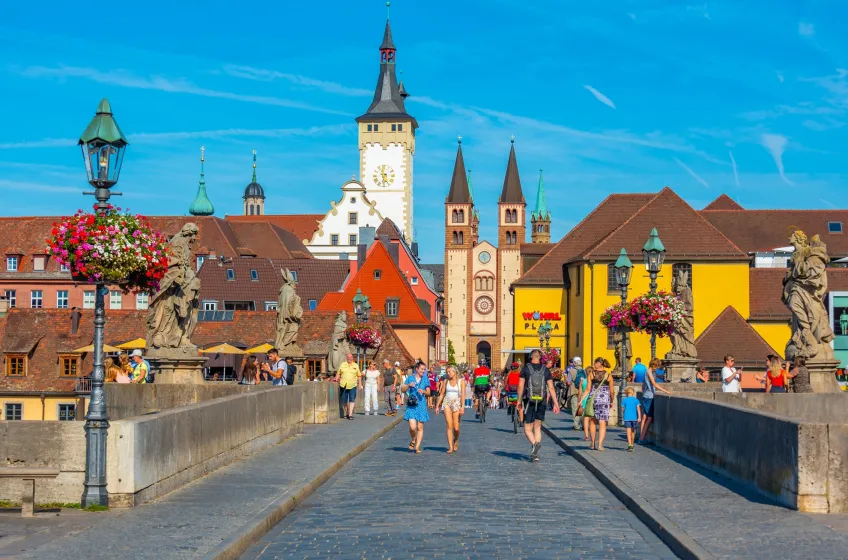
The Old Main Bridge, or Alte Mainbrücke, is Würzburg’s best-known meeting place. Built between the 15th and 16th centuries, it is lined with statues of saints, rulers and other historical figures.
The bridge provides a memorable view of Marienberg Fortress and the vineyard-covered hillside. On warm afternoons and evenings, visitors gather here with glasses of Franconian wine purchased from nearby wine bars.
The atmosphere can become extremely lively around sunset, particularly during university term time and summer weekends. Visit early in the morning for photographs without the crowds, then return later to experience the bridge at its most sociable.
Remember that it remains a public thoroughfare. Keep the central route clear and avoid placing glasses on the stone parapets where they may be knocked into the river.
Market Square and Marienkapelle
Würzburg’s Market Square is one of the busiest parts of the old town. Regular stalls sell fruit, vegetables, flowers and regional produce, while cafés and shops occupy the surrounding streets.
The square’s principal landmark is the red-and-white Marienkapelle. Despite being called a chapel, it is a substantial late-Gothic church with a tall tower and impressive doorways. Sculptures associated with the workshop of Tilman Riemenschneider form part of its artistic importance.
Beside the church stands the Falkenhaus, immediately recognisable by its ornate yellow-and-white Rococo façade. The building houses the city library and tourist information centre.
The square becomes especially atmospheric during seasonal markets and public festivals.
Würzburg Cathedral
Würzburg Cathedral, dedicated to Saint Kilian, is one of Germany’s largest Romanesque churches. Construction began during the 11th century, although the building contains additions and restorations from several later periods.
Inside, visitors can see bishops’ tombs, a broad Romanesque nave and works connected with the Franconian sculptor Tilman Riemenschneider. Modern elements introduced during post-war reconstruction sit alongside surviving historic features.
Attached to the cathedral is the elaborate Schönborn Chapel, designed as a burial place for members of the influential Schönborn family.
The cathedral remains an active place of worship. Sightseeing may be restricted during services, religious festivals and concerts.
Neumünster Church and Lusam Garden
Neumünster Church stands close to the cathedral and is traditionally associated with the early Christian missionaries Kilian, Kolonat and Totnan.
Its striking Baroque façade faces a small square, while the interior includes decorative plasterwork, paintings and a crypt. The contrast between the busy shopping streets outside and the quieter church interior is particularly noticeable.
Behind the church lies the small Lusam Garden. A memorial here is traditionally linked with the medieval poet Walther von der Vogelweide. Visitors sometimes leave flowers or handwritten notes on the monument.
Neumünster, the cathedral and Market Square can easily be combined during a short walk through the centre.
Bürgerspital Wine Estate
The Bürgerspital is a charitable foundation with a winemaking history extending back several centuries. It owns vineyards around Würzburg and produces a broad selection of Franconian wines.
Its traditional wine tavern is one of the best central places to sample Silvaner, Riesling and Müller-Thurgau alongside regional food. Many wines are sold in the distinctive flattened Bocksbeutel bottle associated with Franconia.
Ask staff for a tasting selection when available, rather than choosing an entire bottle without knowing the local styles. Dinner reservations are advisable during weekends, university events and the main festival season.
Juliusspital
Juliusspital is another historic charitable institution closely connected with Würzburg’s wine culture. Founded during the 16th century, it incorporates hospital buildings, courtyards, gardens, a church and extensive wine cellars.
The estate remains an important wine producer, with vineyards in and around Würzburg. Cellar tours and tastings may be available on scheduled dates or by advance arrangement.
Visitors who do not join a tour can still explore accessible parts of the courtyard and garden. The estate shop is a useful place to buy local wine or learn more about individual vineyard sites.
Würzburger Stein Vineyard
The Würzburger Stein rises north of the city and is one of Franconia’s best-known vineyard locations. Walking paths through the vines provide broad views over Würzburg, Marienberg Fortress and the Main Valley.
The vineyard is particularly attractive during late summer and early autumn, when the grapes are ripening and the slopes are at their greenest. Autumn brings changing leaf colours and harvest activity.
Several possible routes vary in length and steepness. Expect exposed paths with little shade, so take water, sun protection and suitable footwear. Avoid walking through working vineyard rows unless they are clearly marked as public paths.
Museum im Kulturspeicher
The Museum im Kulturspeicher occupies a converted grain warehouse beside the Main. The building combines preserved industrial architecture with contemporary exhibition spaces.
Its collections include regional works, German art from the 19th and 20th centuries and an important display of Concrete Art. Temporary exhibitions broaden the programme and can range from painting and photography to sculpture and design.
The museum is a good wet-weather option and provides a useful contrast to Würzburg’s churches and palaces. Its riverside location also makes it easy to include during a walk along the Main.
Käppele
The Käppele is an ornate pilgrimage church on the Nikolausberg, across the river from the old town. Designed by Balthasar Neumann, it is known for its richly decorated Rococo interior.
A long processional staircase climbs towards the church, passing small chapels depicting the Stations of the Cross. The elevated setting offers views across the city and surrounding landscape.
The climb can be demanding in hot weather. Local bus services can reduce the amount of walking, although reaching the main entrance may still involve steps or slopes.
As an active religious site, the church should be visited respectfully and quietly.
Main River Cruise
Seasonal boat trips along the Main provide a relaxing view of Würzburg’s fortress, vineyards and riverfront.
A popular route travels downstream towards Veitshöchheim, where visitors can explore a palace and Rococo garden. It is possible to travel one way by boat and return by local train or bus, creating an easy half-day excursion.
Sailings are generally more frequent during the warmer months and may be reduced or cancelled in poor weather. Check departure points and return times before leaving Würzburg.
Practical Advice for Visitors
Getting There
Würzburg is an important railway junction with frequent regional and long-distance services. Direct trains connect the city with Frankfurt, Nuremberg, Munich and several destinations in northern Germany.
The fastest journeys from Frankfurt or Nuremberg take a little over an hour. Frankfurt Airport is generally the most convenient major international airport, with rail journeys usually requiring around 90 minutes, depending on the connection.
Würzburg Hauptbahnhof is approximately 10 to 15 minutes on foot from Market Square. Trams leave from outside the station and provide convenient access to the centre and outer districts.
Drivers can reach Würzburg using the A3, A7 and A81 motorways. Traffic is often slow around motorway junctions, during Friday evenings and at the beginning or end of school holidays.
Parking
Würzburg has several multi-storey car parks close to the old town, Residenz and river. Using one of these is generally easier than searching for limited street parking.
Street spaces are frequently subject to charges, time restrictions or residents’ controls. Read signs carefully, as regulations vary between streets.
Central car parks can fill during wine festivals, Christmas markets and major concerts. Park-and-ride sites connected to the tram network may be more convenient at busy times.
Once parked, leave the car in one place. Most central attractions are within comfortable walking distance, and the historic streets are better explored on foot.
Dining
Traditional Franconian food is hearty and well suited to the region’s dry white wines. Typical dishes include Schäufele, a roasted pork shoulder with crisp crackling, Franconian sausages, potato dumplings and seasonal asparagus.
Bürgerspital Weinstuben is a classic choice for regional cooking and estate wines. Backöfele serves substantial Franconian dishes in a rustic old-town setting. Juliusspital and several independent wine taverns offer further opportunities to pair local food with Silvaner or Riesling.
For an inexpensive meal, try a Franconian sausage from a central food stall. Würzburg’s university population also supports Italian, Asian, Middle Eastern and vegetarian restaurants, especially around Sanderstrasse.
Many kitchens close earlier than visitors from the UK might expect. Book popular restaurants for Friday and Saturday evenings and check serving times before arriving late.
Shopping
The main shopping area extends along Schönbornstrasse, Domstrasse and Kaiserstrasse. It includes familiar German chains as well as independent shops, bookshops and delicatessens.
Franconian wine is the most characteristic purchase. The estate shops at Bürgerspital, Juliusspital and the Staatlicher Hofkeller offer selections from different vineyards and vintages.
Ask about transport packaging when buying several bottles. Travellers flying home should also check airline baggage and customs rules.
Market stalls around the Marienkapelle sell produce, flowers and regional foods. During Advent, the surrounding streets form the centre of Würzburg’s Christmas market.
When to Visit
May, June and September provide an excellent combination of mild weather, green vineyards and outdoor events. These months are particularly good for walking between the centre, fortress and surrounding wine slopes.
July and August bring long evenings, river cruises and a lively atmosphere on the Old Main Bridge. Temperatures can become hot, and exposed vineyard paths offer little shade.
Late September and October are attractive during the grape harvest. Vineyards begin to change colour, while seasonal wine and autumn dishes appear in local taverns.
December is popular for the Christmas market, festive concerts and decorated streets. Boat trips and garden attractions are less important in winter, and daylight hours are short.
Local Events
Mozartfest Würzburg is one of the city’s major cultural events. Usually held during late spring and early summer, it brings orchestral, chamber and solo performances to the Residenz and other historic venues.
The Würzburg Wine Village transforms Market Square into a collection of temporary wine taverns, allowing visitors to sample wines from producers across the region. It normally takes place around late spring or early summer.
The Hofgarten Wine Festival is held in the grounds of the Residenz and combines Franconian wine, food and live entertainment in a grand Baroque setting.
Further events include the Africa Festival, summer concerts, open-air cinema and the Christmas market. Dates vary each year, so confirm the current programme before arranging accommodation or travel.
Exploring Beyond Würzburg
Veitshöchheim lies approximately seven kilometres downstream and is the easiest excursion from Würzburg. Its palace garden contains lakes, fountains, sculptures and playful Rococo features. Travel is possible by train, bus, bicycle or seasonal boat.
Randersacker is a traditional wine village a few kilometres south-east of the city. Its vineyards, historic centre and wine taverns make it suitable for a relaxed afternoon trip.
Sommerhausen, around 15 kilometres from Würzburg, has narrow streets, preserved town walls, galleries and surrounding vineyards. It is especially enjoyable during wine festivals and seasonal markets.
Ochsenfurt, approximately 20 kilometres away, has a compact old town with medieval gates, towers and colourful historic buildings. Regional trains make it an easy half-day destination.
Rothenburg ob der Tauber is one of Germany’s best-preserved medieval towns. It is roughly an hour away by car, although public transport takes longer and normally requires at least one change. Allow a full day to walk the walls and explore the historic centre.
Shortlist
- Your Shortlist is empty