
Discover The Madrid Region | A Visitor's Introduction to The Madrid Region
Recommended places to stay, places to visit and things to do throughout the Madrid Region
The Madrid Region, officially the Community of Madrid, is a compact but remarkably varied area in central Spain, centred on the national capital and extending into the mountains, historic towns and open countryside of the Castilian plateau. Known for Madrid’s world-class museums, royal palaces, lively food culture and excellent transport connections, the region is a perfect destination for art lovers, history enthusiasts, walkers and city-break travellers. Beyond the capital, places such as Alcalá de Henares, Aranjuez, San Lorenzo de El Escorial and the Sierra de Guadarrama reveal a quieter side of central Spain.
Browse Madrid Region Hotels and Other Accommodation
Pre-book Madrid Region Activities, Tours and Experiences
Why is the Madrid Region Worth a Visit?
The Madrid Region is worth visiting because it offers far more than a single large city. Madrid itself contains some of Europe’s finest art collections, elegant boulevards, royal architecture, historic neighbourhoods and a nightlife culture that continues well into the early hours.
Outside the capital, the scenery changes quickly. Within an hour or so, visitors can reach royal gardens at Aranjuez, the vast monastery and palace at El Escorial, the university town of Alcalá de Henares or mountain trails in the Sierra de Guadarrama.
The region’s public transport is another major advantage. Trains, buses and metro services make many excursions possible without a car, while Madrid’s central position allows easy onward travel to Toledo, Segovia, Ávila and other historic Spanish cities.
Food adds further appeal. Traditional taverns serve cocido madrileño, roast meat, calamari sandwiches and hearty Castilian dishes, while Madrid city also has one of Spain’s broadest selections of modern and international restaurants.
Three or four days are enough for the principal attractions in Madrid. A week allows time for several regional excursions, while ten days provide a more relaxed combination of city culture, royal sites and mountain scenery.
Madrid Highlights: Things to See and Do in the Madrid Region
Explore Central Madrid
Central Madrid is best understood through its grand avenues, busy squares and contrasting neighbourhoods.
Puerta del Sol is the symbolic centre of the city and the starting point for several major streets. Nearby Plaza Mayor is enclosed by arcaded buildings and has long served as a setting for markets, ceremonies and public events.
From here, visitors can walk towards the Royal Palace, Gran Vía, the Literary Quarter or the traditional neighbourhood of La Latina.
Madrid is extensive, but many central landmarks are within comfortable walking distance. The main challenge is resisting the temptation to fit too much into one day.
Visit the Prado Museum
The Prado is one of the world’s greatest collections of European art.
Its galleries contain major works by Velázquez, Goya, El Greco, Rubens, Titian and Bosch. Las Meninas and The Garden of Earthly Delights are among its most famous paintings.
The museum is large enough to become overwhelming. Rather than trying to see every gallery, concentrate on a few artists or sections and allow at least two or three hours.
Advance booking is sensible during weekends, holidays and peak travel seasons.
Explore the Reina Sofía Museum
The Reina Sofía focuses on modern and contemporary art.
Its defining work is Picasso’s Guernica, surrounded by paintings, photographs and documents connected with the Spanish Civil War and 20th-century artistic movements.
The collection also includes important works by Salvador Dalí, Joan Miró and other Spanish and international artists.
The museum occupies a former hospital with a modern extension and outdoor terraces. Allow around two hours for a focused visit.
Visit the Thyssen-Bornemisza Museum
The Thyssen-Bornemisza completes Madrid’s principal group of major art museums.
Its collection fills many of the chronological and stylistic gaps between the Prado and Reina Sofía, ranging from medieval religious painting to Impressionism, American art and modern movements.
It is generally easier to navigate than the Prado and makes an excellent choice for visitors who want a broad overview of western art.
The three major museums stand close together along the Paseo del Prado, often called Madrid’s Golden Triangle of Art.
Walk Through Retiro Park
El Retiro is Madrid’s best-known city park.
Its paths pass formal gardens, tree-lined avenues, fountains, monuments and a large boating lake. The Crystal Palace is one of the park’s most attractive structures and is often used for exhibitions.
Retiro is particularly lively during weekends, when families, performers, runners and rowers gather throughout the park.
Morning and early evening are the most comfortable times during summer.
See the Royal Palace of Madrid
The Royal Palace stands on the western side of the historic centre.
Although it is still used for state ceremonies, much of the building operates as a visitor attraction. The interior includes grand staircases, throne rooms, decorated apartments, armour and royal collections.
The palace’s scale and level of decoration make it one of Spain’s most impressive royal buildings.
Timed tickets help reduce queues. Official events may occasionally affect access.
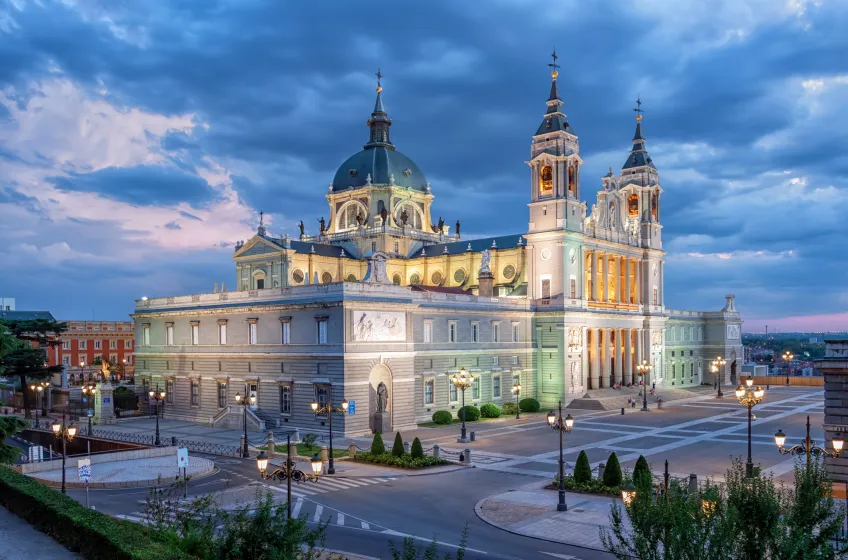
Visit Almudena Cathedral
Almudena Cathedral stands directly opposite the Royal Palace.
Its relatively modern interior has colourful ceilings and a very different atmosphere from Spain’s medieval cathedrals. A museum and dome visit may provide elevated views over the palace and western Madrid.
The cathedral remains an active place of worship, so services and ceremonies can affect visitor access.
Walk Along Gran Vía
Gran Vía is Madrid’s great entertainment and shopping avenue.
Its early 20th-century buildings form a dramatic urban canyon of domes, towers and ornate façades. The street contains theatres, hotels, shops and rooftop venues.
It is busy throughout the day and especially lively in the evening. Side streets lead towards Chueca, Malasaña, Sol and Plaza de España.
Several rooftop terraces offer views over the city, although drinks and entry charges can be expensive.
Discover the Literary Quarter
The Barrio de las Letras is associated with writers from Spain’s Golden Age.
Cervantes, Lope de Vega and other major literary figures lived or worked in the area. Quotations are set into some pavements, while narrow streets contain taverns, bookshops and small squares.
The House-Museum of Lope de Vega offers insight into domestic life and literary culture of the period.
The neighbourhood is centrally located between Puerta del Sol, the Prado and Plaza de Santa Ana.
Explore La Latina
La Latina is one of Madrid’s most atmospheric central neighbourhoods.
Its sloping streets, traditional taverns and small squares are especially lively around Calle Cava Baja and Plaza de la Paja. The district is popular for tapas, weekend socialising and informal evening meals.
On Sundays, the nearby El Rastro flea market fills surrounding streets with stalls, shoppers and crowds.
Keep valuables secure in busy market areas.
Visit Malasaña and Chueca
Malasaña is associated with alternative culture, independent shops, cafés and nightlife. Its streets reflect Madrid’s countercultural movements as well as current creative businesses.
Neighbouring Chueca is one of the city’s principal LGBTQ+ districts, known for bars, restaurants, fashion shops and an open, lively atmosphere.
Both areas are best experienced by wandering rather than following a strict sightseeing route.
Explore Madrid de los Austrias
Madrid de los Austrias is the historic district developed under the Habsburg monarchs.
It includes Plaza Mayor, Plaza de la Villa, old churches, traditional streets and parts of the royal quarter. The architecture is generally more restrained than the later Bourbon avenues.
Walking between Sol, Plaza Mayor and the Royal Palace provides a useful introduction to this historic core.
Visit the Temple of Debod
The Temple of Debod is an ancient Egyptian monument reconstructed in a park near Plaza de España.
It was given to Spain following international efforts to preserve monuments threatened by the construction of the Aswan High Dam.
The surrounding viewpoint is especially popular around sunset, with views towards the Royal Palace and western horizon.
Access to the interior may be limited, but the exterior setting remains worthwhile.
Explore Santiago Bernabéu Stadium
The Santiago Bernabéu is the home stadium of Real Madrid.
Stadium visits may include elevated views, museum displays, historic trophies and areas connected with the club’s history. Routes can change during matches, construction or special events.
Match tickets are often expensive and demand can be high. Use official sales channels and avoid unverified street sellers.
The stadium is easy to reach by metro.
Visit Matadero Madrid
Matadero Madrid is a major cultural centre created within a former slaughterhouse complex beside the River Manzanares.
Its brick buildings host exhibitions, performances, film screenings, markets and creative events. The programme changes frequently.
Matadero can be combined with a walk through Madrid Río, one of the city’s largest modern parks.
Walk Through Madrid Río
Madrid Río follows the River Manzanares west and south of the centre.
The park contains cycling paths, playgrounds, bridges, gardens and broad walking routes. It offers a less monumental and more everyday view of Madrid.
The area near the Royal Palace provides attractive views towards the historic skyline.
Cycling is one of the easiest ways to explore the full length of the park.
Visit San Lorenzo de El Escorial
San Lorenzo de El Escorial lies at the foot of the Sierra de Guadarrama.
Its defining landmark is the vast Royal Monastery of El Escorial, built under King Philip II. The complex includes a monastery, palace, basilica, library, royal burial chambers and art collections.
Its severe granite architecture reflects both royal authority and religious purpose. Allow at least half a day for the complex and town.
San Lorenzo can be reached by train or bus from Madrid, though the station is some distance from the monastery.
Explore the Gardens and Viewpoints Around El Escorial
The wider El Escorial area includes formal gardens, wooded paths and elevated viewpoints.
La Silla de Felipe II is traditionally associated with Philip II observing construction of the monastery, although the exact historical connection is uncertain. The site provides strong views across the surrounding landscape.
Walking routes vary from easy woodland paths to longer climbs towards the mountains.
Visit Alcalá de Henares
Alcalá de Henares is a historic university city east of Madrid.
It is closely associated with Miguel de Cervantes, author of Don Quixote, and contains a museum in a house traditionally linked with his birthplace.
The university’s grand façade, arcaded Calle Mayor, courtyards and churches make Alcalá one of the region’s most rewarding day trips.
Regular suburban and regional trains connect it with central Madrid.
Explore Aranjuez
Aranjuez stands south of Madrid beside the River Tagus.
Its Royal Palace was used as a seasonal residence by the Spanish monarchy. Formal gardens, fountains, tree-lined avenues and riverside spaces spread around the complex.
The Prince’s Garden is extensive and may require several hours to explore fully. Spring and autumn are particularly attractive.
Aranjuez is easily reached by suburban train from Madrid.
Visit Chinchón
Chinchón is one of the Madrid Region’s most characterful small towns.
Its irregular Plaza Mayor is surrounded by wooden balconies and traditional buildings. The square has hosted markets, performances, festivals and bullfighting.
Steep streets lead towards churches, viewpoints and castle remains. The town is known for aniseed liqueur, garlic and traditional Castilian food.
Buses connect Chinchón with Madrid, but a car provides more flexibility for combining it with other southern towns.
Discover Buitrago del Lozoya
Buitrago del Lozoya is a small fortified town north of Madrid.
Medieval walls enclose part of the historic centre beside a bend in the River Lozoya. Visitors can explore defensive structures, old streets and viewpoints over the surrounding water.
The town also contains a small museum with works connected to Pablo Picasso.
Buitrago combines well with a drive through the northern mountains.
Explore the Sierra de Guadarrama
The Sierra de Guadarrama rises north and west of Madrid.
Its granite peaks, pine forests, reservoirs and mountain villages provide excellent walking, cycling and winter activities. Popular areas include Cercedilla, Navacerrada, Cotos and La Pedriza.
Some trailheads are accessible by train or bus, but services can become crowded during weekends.
Mountain weather changes quickly, and snow or ice may affect routes in winter and early spring.
Walk in La Pedriza
La Pedriza is a striking granite landscape near Manzanares el Real.
Rounded rock formations, streams and mountain paths attract walkers and climbers. Routes range from short riverside walks to strenuous ascents.
Vehicle access and parking may be controlled during busy periods. Arrive early and carry sufficient water.
Summer heat can be severe on exposed rock, making spring and autumn more comfortable.
Visit Manzanares el Real Castle
The Castle of Manzanares el Real stands near the Santillana Reservoir beneath La Pedriza.
Its towers, battlements and restored interior make it one of the best-preserved castles in the Madrid Region. Exhibitions explain noble life, architecture and the history of the Mendoza family.
The rooftop and surrounding grounds provide excellent mountain views.
Explore Cercedilla
Cercedilla is a popular mountain town connected with Madrid by suburban rail.
It serves as a base for forest walks, historic routes and access towards higher parts of the Sierra de Guadarrama. Roman-road remains and marked trails cross the surrounding countryside.
Weekends can be busy, particularly during warm weather and after snowfall.
Visit the Valley of the Fallen Area
The monumental complex in the Cuelgamuros Valley was created during the Franco dictatorship and remains one of Spain’s most politically sensitive historic sites.
The vast basilica, monumental cross and surrounding landscape were built partly through the labour of political prisoners. The site has undergone changes in interpretation and official management.
Visitors should approach it as a complex place of dictatorship, memory, religion and unresolved historical debate rather than simply as an architectural attraction. Check current access arrangements before travelling.
Practical Advice for Visitors
Getting There
Madrid-Barajas Airport is Spain’s largest international gateway.
Metro, suburban trains, express buses and taxis connect the airport with the city. The best option depends on the terminal and final destination.
Madrid is also the centre of Spain’s high-speed rail network. Major stations connect the city with Barcelona, Valencia, Seville, Málaga, Zaragoza, Toledo and many other destinations.
Long-distance coaches serve towns and regions not reached directly by fast rail.
Getting Around
Madrid has an extensive metro, suburban railway and bus network.
The metro is usually the simplest way to move around the central city. Suburban Cercanías trains are useful for the airport, outer districts and excursions such as Alcalá de Henares, Aranjuez and El Escorial.
Regional buses serve Chinchón, mountain towns and villages without direct railway access.
A car is unnecessary in central Madrid but useful for a wider tour of the Sierra de Guadarrama and smaller communities.
Airport Transfers
Metro services are convenient for many central districts but may require changes and long station walks.
Suburban trains serve selected airport terminals and connect with major railway stations. Express buses operate to central Madrid throughout much of the day and night.
Official taxis use regulated arrangements for journeys between the airport and central districts. Confirm the current fare structure before travel.
Driving and Parking
Vehicles drive on the right.
Central Madrid has extensive traffic controls, low-emission restrictions and resident-only access zones. Visitors should not assume that a hotel address permits unrestricted entry.
Public garages are available but can be expensive. Park-and-ride facilities and public transport are usually easier.
Mountain roads may be affected by snow, ice and weekend congestion.
Choosing Where to Stay
Centro is best for first-time visitors who want to walk to major sights, though it can be noisy.
Retiro and Chamberí provide a more residential atmosphere with excellent transport. Malasaña and Chueca suit visitors interested in nightlife, cafés and independent shops.
Salamanca is elegant and convenient for shopping and museums, though accommodation is often more expensive.
Atocha is practical for rail travel and the major art museums.
Dining
Madrid’s food scene ranges from traditional taverns to major international restaurants.
Cocido madrileño is a substantial chickpea, vegetable and meat stew traditionally served in stages. Callos a la madrileña is a rich tripe dish with paprika and sausage.
Roast lamb and suckling pig reflect wider Castilian traditions, while markets and neighbourhood bars provide lighter meals and tapas.
Lunch often begins after 2pm, and dinner commonly starts after 9pm.
Calamari Sandwiches
The bocadillo de calamares is one of Madrid’s best-known informal foods.
It consists of fried squid rings served in a crusty bread roll, sometimes with lemon or a simple sauce. Bars around Plaza Mayor are especially associated with it.
Quality varies, so look for places frying squid to order rather than relying only on the most visible tourist venues.
Tapas and Markets
Tapas in Madrid range from simple snacks included with drinks to carefully prepared dishes ordered separately.
La Latina, Chamberí, Lavapiés and the Literary Quarter all have strong bar scenes. Calle Ponzano is known for modern dining and drinks but can be crowded and relatively expensive.
Mercado de San Miguel is attractive and central but aimed heavily at visitors. Neighbourhood markets often provide better value and a more everyday atmosphere.
Churros and Chocolate
Churros are commonly eaten with thick hot chocolate, especially for breakfast, a late-night snack or after an evening out.
Traditional cafés and specialist churrerías prepare them fresh. The related porras are thicker and softer.
Popular central establishments can have long queues, particularly at weekends.
Shopping
Gran Vía, Calle Preciados and the area around Puerta del Sol contain major retailers.
The Salamanca district is known for luxury shops, while Malasaña, Chueca and Las Salesas have more independent fashion and design businesses.
El Rastro operates on Sundays and public holidays, selling antiques, clothing, household goods and souvenirs.
Typical regional purchases include ceramics, wine, olive oil, cured meat and traditional sweets.
When to Visit
March to May is one of the best periods for city sightseeing, parks and regional excursions.
September to early November also offers comfortable conditions, although occasional heat can persist into early autumn.
July and August are hot and dry. Daytime temperatures can be intense, but museums are quieter and evenings remain lively.
Winter is often bright but cold, with freezing nights possible. Snow may affect the mountains even when central Madrid remains dry.
Local Events
Madrid hosts cultural events, concerts, parades and neighbourhood festivals throughout the year.
San Isidro is the city’s principal traditional celebration, with music, food, religious events and public gatherings.
Pride celebrations attract very large crowds to Chueca and central Madrid.
Autumn brings major art, theatre and cultural programmes, while Christmas lights and markets transform central streets during winter.
Event dates and arrangements vary annually, so check the programme before organising a trip around a particular celebration.
Safety and Common Tourist Problems
Madrid is generally straightforward for visitors, but pickpocketing is a concern in crowded central areas and on public transport.
Take particular care around Puerta del Sol, Gran Vía, Plaza Mayor, major railway stations and busy metro lines. Keep phones and wallets secure and avoid hanging bags over café chairs.
Use official taxis or recognised transport services. Ignore unsolicited offers involving petitions, jewellery, gambling or help at ticket machines.
Summer heat and dehydration can be more serious than petty crime. Carry water and avoid long exposed walks during the hottest afternoon hours.
Exploring Beyond the Madrid Region
Toledo lies south of Madrid and offers a hilltop old town, cathedral, synagogues and paintings by El Greco.
Segovia is known for its Roman aqueduct, Gothic cathedral and castle-like Alcázar.
Ávila has remarkably complete medieval walls and strong associations with Saint Teresa.
Cuenca combines hanging houses, dramatic gorges and an important collection of modern art.
Guadalajara province offers Sigüenza, castles and quieter rural landscapes.
Madrid’s central railway connections also make Salamanca, Valladolid, Zaragoza, Valencia and Córdoba practical additions to a longer Spanish itinerary.
Shortlist
- Your Shortlist is empty