
Discover Extremadura | A Visitor's Introduction to Extremadura
Recommended places to stay, places to visit and things to do throughout Extremadura
Extremadura is a largely rural region in western Spain, bordering Portugal and stretching from the mountains of Cáceres province to the plains, reservoirs and pastureland around Badajoz. Known for its Roman ruins, medieval towns, impressive birdlife and exceptional food, this sparsely populated region is a perfect destination for history enthusiasts, walkers, food lovers and travellers seeking a quieter side of Spain. With monumental cities such as Mérida, Cáceres and Trujillo, along with landscapes of cork oak, olive groves and open dehesa, Extremadura offers a memorable journey through one of the country’s least crowded regions.
Browse Extremadura Hotels and Other Accommodation
Pre-book Extremadura Activities, Tours and Experiences
Why is Extremadura Worth a Visit?
Extremadura is worth visiting because it contains some of Spain’s most important historical sites without the crowds found in Barcelona, Seville or Granada. Mérida preserves an extraordinary concentration of Roman monuments, while Cáceres has a remarkably complete medieval and Renaissance centre. Trujillo adds a grand arcaded square, conquistador history and one of the region’s finest hilltop castles.
The landscape is equally distinctive. Large areas are covered by dehesa, a traditional countryside of scattered holm and cork oaks used for livestock, agriculture and wildlife. This environment supports black Iberian pigs, grazing cattle and an exceptional variety of birds.
Extremadura is one of Europe’s strongest birdwatching destinations. Monfragüe National Park is known for vultures, eagles and dramatic river gorges, while the plains around Trujillo and Cáceres attract steppe birds.
Food is another major attraction. Iberian ham, sheep’s cheese, paprika, game, lamb and simple country cooking reflect the region’s farming traditions. Extremadura is also one of Spain’s best places to enjoy high-quality produce at relatively reasonable prices.
A car provides the greatest freedom, although Mérida, Cáceres, Badajoz and several larger towns can be reached by train or coach.
Extremadura Highlights: Things to See and Do in Extremadura
Explore Mérida
Mérida is the capital of Extremadura and one of Spain’s most important Roman cities.
Founded as Augusta Emerita, it became a major administrative centre in Roman Hispania. Its monuments are spread through the modern city rather than contained within a single archaeological park.
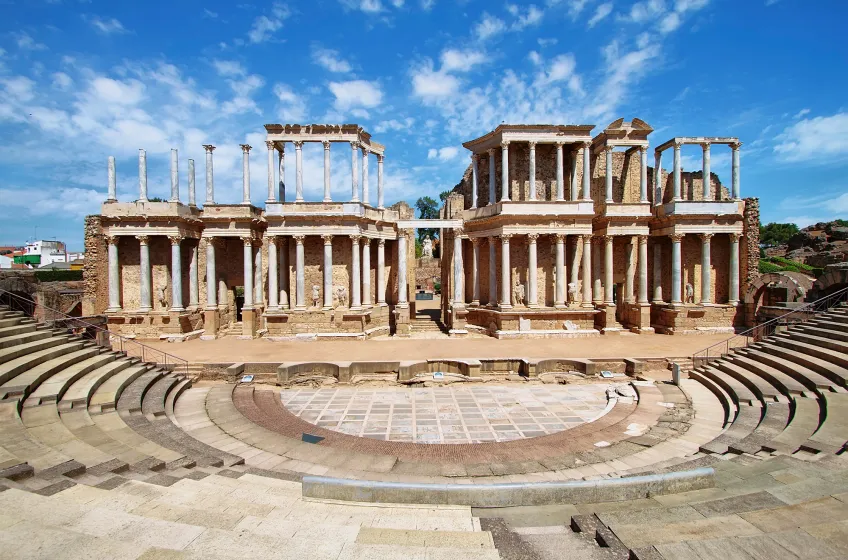
The Roman Theatre is the principal highlight, with a monumental stage façade and seating built into a natural slope. Beside it stands the amphitheatre, once used for gladiatorial contests and public spectacles.
Other major remains include the Temple of Diana, the Circus, the House of Mithraeum, the Aqueduct of Miracles and the Roman bridge across the River Guadiana. Allow at least a full day, and preferably two, to see the main sites without rushing.
Visit the National Museum of Roman Art
The National Museum of Roman Art in Mérida provides essential context for the city’s ruins.
Its vast brick interior displays mosaics, sculpture, coins, household objects and architectural fragments discovered in and around ancient Augusta Emerita. The scale of the building echoes Roman engineering without attempting to imitate it directly.
Visit the museum before or after the principal archaeological sites to understand how the city functioned and how its residents lived.
Discover Cáceres Old Town
Cáceres has one of Spain’s best-preserved medieval and Renaissance centres.
Stone palaces, towers, churches and narrow lanes stand inside and around the old walls. The historic district has relatively little modern signage, allowing it to retain an unusually atmospheric appearance.
Plaza Mayor forms the main entrance to the monumental centre. From there, climb towards the Arco de la Estrella and explore streets around Plaza de Santa María and Plaza de San Jorge.
Cáceres is particularly beautiful after dark, when the stone façades are illuminated and most day visitors have left.
See Cáceres from the Bujaco Tower
The Bujaco Tower rises beside Plaza Mayor and forms part of the old fortifications.
Visitors can climb to the upper walkway for views over the square, rooftops and surrounding countryside. Sections of the city wall may also be accessible from the tower.
The stairs are narrow and steep, but the panorama provides an excellent introduction to the layout of the historic centre.
Visit Trujillo
Trujillo is one of Extremadura’s most impressive small towns.
Its broad Plaza Mayor is surrounded by arcades, palaces, churches and traditional restaurants. At its centre stands an equestrian statue of Francisco Pizarro, the conquistador associated with the Spanish conquest of the Inca Empire.
Above the square, steep streets lead through the old town towards the castle. Noble houses and defensive towers reflect the wealth brought back by families connected with Spain’s overseas empire.
Trujillo is manageable as a day trip, but an overnight stay allows time to enjoy the square after sunset.
Climb to Trujillo Castle
Trujillo Castle occupies the highest point of the town.
Built on earlier Islamic foundations, the fortress has battlements, courtyards and broad views over the plains of Extremadura. The structure is relatively austere, but its position makes it one of the region’s most memorable viewpoints.
The climb from Plaza Mayor is steep, especially during summer heat. Take water and avoid the hottest part of the afternoon.
Explore Guadalupe
Guadalupe is a mountain village known for the Royal Monastery of Santa María de Guadalupe.
The monastery developed around a revered image of the Virgin and became one of Spain’s most important pilgrimage centres. Its architecture combines Gothic, Mudéjar, Renaissance and Baroque elements.
Guided tours may include cloisters, religious art, manuscripts and historic rooms. The village square outside is lined with traditional houses, cafés and shops.
Guadalupe is relatively remote, making it best reached by car or organised excursion.
Visit Monfragüe National Park
Monfragüe National Park protects river gorges, Mediterranean woodland and rocky cliffs in northern Extremadura.
It is one of Europe’s best places to observe large birds of prey. Griffon vultures are commonly seen, while black vultures, Spanish imperial eagles and other species may also appear.
Salto del Gitano is the park’s best-known viewpoint, overlooking a narrow gorge where vultures nest on the cliffs. The climb to Monfragüe Castle provides broader views across the landscape.
Spring and autumn are excellent times to visit. Summer can be extremely hot, and shade is limited at several viewpoints.
Explore Plasencia
Plasencia is a historic walled town beside the River Jerte.
Its most unusual landmark is a pair of connected cathedrals, one older and one later, creating a complex mixture of Gothic, Renaissance and Plateresque architecture.
The old centre contains arcaded streets, palaces, churches and sections of defensive wall. Plaza Mayor is the main gathering place and a good location for cafés and evening meals.
Plasencia makes an excellent base for the Jerte Valley, La Vera and Monfragüe.
Visit the Jerte Valley
The Jerte Valley lies between steep mountain slopes north-east of Plasencia.
It is famous for cherry orchards, which cover the lower slopes and valley floor. During the spring blossom period, the landscape turns white, although the timing varies with temperature and weather.
Later in the year, the valley offers waterfalls, river pools, walking routes and forest scenery. The Garganta de los Infiernos nature reserve is one of the principal outdoor destinations.
Blossom weekends can become extremely busy, so book accommodation and arrive early.
Walk in Garganta de los Infiernos
Garganta de los Infiernos is a protected landscape within the Jerte Valley.
Woodland paths follow streams and rocky gorges towards Los Pilones, a sequence of natural pools carved into smooth granite. The route is popular for walking and summer swimming.
The path involves steady climbing and can be exposed to heat. Wear proper footwear, carry water and avoid slippery rocks near fast-moving water.
Explore La Vera
La Vera is a green district on the southern slopes of the Sierra de Gredos.
Traditional villages, stone bridges, streams and wooded valleys create a cooler and more fertile landscape than the open plains farther south. Garganta la Olla, Cuacos de Yuste and Villanueva de la Vera are among the most attractive settlements.
The area is also associated with smoked paprika, known as pimentón de la Vera, one of Extremadura’s most important culinary products.
Visit the Monastery of Yuste
The Monastery of Yuste stands near Cuacos de Yuste in La Vera.
Emperor Charles V retired here after abdicating, spending the final part of his life in rooms attached to the monastery. Visitors can see monastic spaces, royal apartments and gardens.
The setting among wooded hills adds to the atmosphere. Allow time to explore nearby villages and sample local paprika-based dishes.
Discover Badajoz
Badajoz is the largest city in Extremadura and stands close to the Portuguese border.
Its Alcazaba is one of the largest Islamic fortresses in Spain. Walls, towers and elevated paths overlook the River Guadiana and the modern city.
The historic centre contains churches, squares and the distinctive Plaza Alta, surrounded by colourful decorative façades. Badajoz also has a lively restaurant and nightlife scene.
The city is a useful base for cross-border trips to Elvas in Portugal.
Explore Zafra
Zafra is an elegant market town in southern Extremadura.
Its two principal squares, Plaza Grande and Plaza Chica, are connected by an arched passage and surrounded by whitewashed buildings and arcades.
The former palace of the Dukes of Feria now operates as a historic hotel. Churches, convents and traditional streets add to the town’s appeal.
Zafra is a useful stop between Mérida, Seville and the rural south of Extremadura.
Visit Olivenza
Olivenza is a border town with a strong mixture of Spanish and Portuguese heritage.
It was under Portuguese control for centuries, and this influence remains visible in its architecture, decorative tiles and Manueline-style church features.
The old centre contains defensive walls, towers, churches and museums. Its bilingual and contested history gives Olivenza a character unlike that of most other towns in the region.
Explore Alcántara
Alcántara is best known for its monumental Roman bridge across the River Tagus.
The bridge was built in the early second century and remains one of the finest surviving examples of Roman engineering in Spain. Its tall arches span a dramatic river landscape near the Portuguese border.
The town also contains a historic convent and traditional centre. A car is the easiest way to reach the area.
Visit the Cornalvo and Proserpina Reservoirs
Ancient reservoirs near Mérida formed part of the Roman water-supply system.
Proserpina remains a popular recreational area, while Cornalvo lies within a protected natural park. Both show the scale and durability of Roman engineering beyond the city’s monumental centre.
They are easiest to visit by car and combine well with a longer stay in Mérida.
Practical Advice for Visitors
Getting There
Madrid, Seville and Lisbon are the principal gateways to Extremadura.
Trains and long-distance coaches connect Madrid with Cáceres, Mérida and Badajoz. Rail journeys can be slower and less frequent than on Spain’s high-speed routes, so compare them with coach services.
Seville Airport is convenient for southern Extremadura, including Zafra and Mérida. Madrid Airport generally provides the widest international flight choice.
Lisbon can be useful for Badajoz and western Extremadura, particularly as part of a Spain–Portugal road trip.
Getting Around
A car is the most practical way to explore Extremadura beyond its larger towns.
Distances are significant, and many villages, natural parks and archaeological sites have limited public transport. Roads are generally good and traffic is light outside urban areas.
Trains and coaches work reasonably well between Cáceres, Mérida, Badajoz and Plasencia, but carefully check departure times for day trips.
Avoid planning too many destinations in a single day. The region rewards slower travel.
Driving and Parking
Vehicles drive on the right.
Parking is generally easier than in Spain’s larger tourist cities. Public car parks are available near the historic centres of Mérida, Cáceres, Trujillo and Plasencia.
Avoid driving into medieval streets, where access may be restricted and lanes extremely narrow.
Carry water, keep the fuel tank reasonably full and check tyre condition before long rural journeys. Summer temperatures can be severe.
Dining
Extremaduran food is rustic, rich and closely connected with livestock farming.
Iberian pork is one of the region’s defining ingredients. It appears as cured ham, sausages, grilled cuts and slow-cooked dishes.
Other specialities include lamb, kid goat, game, breadcrumbs known as migas, tomato soups and stews made with beans or chickpeas.
Lunch is generally served from around 2pm, while dinner commonly begins after 9pm. Fixed-price weekday menus can offer very good value.
Iberian Ham
Extremadura is one of Spain’s principal regions for jamón ibérico.
The highest-quality versions come from Iberian pigs raised partly on acorns in the dehesa. Labels indicate the animal’s breed, diet and production method.
Jerez de los Caballeros, Montánchez and southern parts of the region are especially associated with cured ham.
Buy from established shops and ask for a small tasting before choosing an expensive whole piece.
Cheese
Extremadura produces several distinctive sheep’s- and goat’s-milk cheeses.
Torta del Casar is a soft, intensely flavoured sheep’s cheese with a creamy interior. The top is often cut away so the centre can be spooned onto bread.
Torta de la Serena is a related speciality from the province of Badajoz. Ibores cheese is generally firmer and made from goat’s milk.
Allow these cheeses to warm slightly before eating to appreciate their full flavour.
Paprika
Pimentón de la Vera is smoked paprika produced in northern Extremadura.
It is available in sweet, bittersweet and hot versions and is used in sausages, stews, potatoes and sauces. The smoke comes from traditional drying over oak fires.
Small tins are easy to carry home and make one of the region’s most characteristic purchases.
Wine
Extremadura’s principal protected wine area is Ribera del Guadiana.
The region produces reds, whites, rosés and sparkling wines using local and international grape varieties. Almendralejo is an important centre for wine and cava production.
Winery visits generally require advance booking. Use a designated driver or organised transport when tasting.
Shopping
Typical regional purchases include Iberian ham, Torta del Casar, paprika, olive oil, wine, honey and cherry products.
Cáceres, Mérida and Badajoz have the widest range of shops. Smaller towns often have excellent butchers, bakeries and food stores.
Pottery, leatherwork and woven textiles are also found in local craft shops.
Most ordinary shops close on Sundays, while smaller businesses may close for several hours during the afternoon.
When to Visit
March to May is one of the best periods, with wildflowers, green dehesa landscapes and comfortable temperatures.
October and November are also excellent for walking, food and autumn colour. Birdwatching remains rewarding during migration periods.
July and August can be intensely hot, with temperatures often becoming uncomfortable for afternoon sightseeing. Begin early, rest during the middle of the day and carry plenty of water.
Winter is usually mild in lower areas but can be cold in northern mountains and at night. Some rural attractions operate shorter hours.
Local Events
Mérida’s classical theatre festival presents drama in the Roman Theatre during summer.
Cáceres hosts music, theatre and historical events throughout the year, including celebrations in its monumental centre.
Trujillo has strong food and livestock traditions, with fairs connected to cheese and regional agriculture.
The cherry blossom season brings celebrations to the Jerte Valley during spring.
Carnival is particularly important in Badajoz, with costumes, parades and street festivities.
Event dates vary annually, so confirm the programme before arranging travel around a specific celebration.
Exploring Beyond Extremadura
Seville is the easiest major-city extension from southern Extremadura, offering the Alcázar, cathedral and Andalusian culture.
Madrid is convenient for travellers entering or leaving through the centre of Spain.
Salamanca lies north of Extremadura and has a magnificent university quarter and golden-stone Plaza Mayor.
Castile-La Mancha offers Toledo, windmill landscapes and further historic towns to the east.
Portugal is a natural addition. Elvas lies close to Badajoz and has vast fortifications, while Évora, Marvão and Castelo de Vide can be incorporated into a longer cross-border route.
Lisbon and the Portuguese Alentejo are practical extensions for travellers continuing west.
Shortlist
- Your Shortlist is empty