
Discover Toledo | A Visitor's Introduction to Toledo
Recommended places to stay, places to visit and things to do in and near Toledo
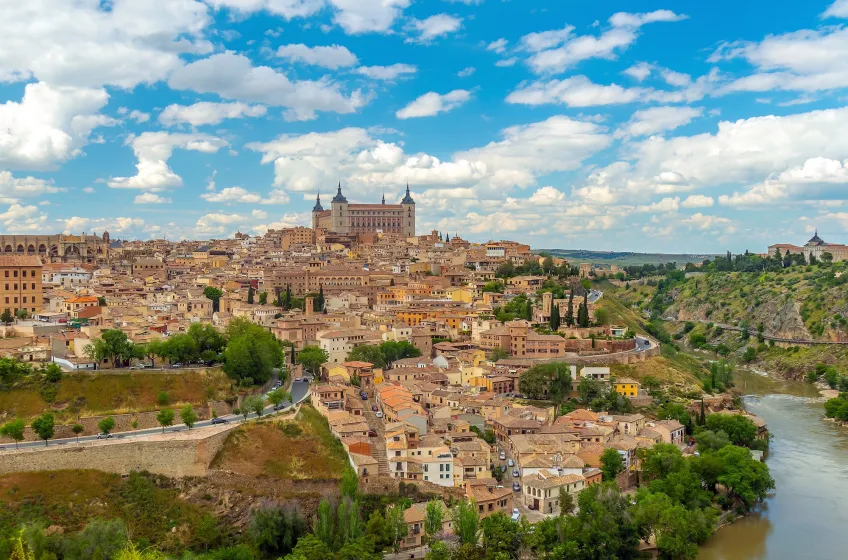
Toledo is a dramatic hilltop city in central Spain, set above a deep bend of the River Tagus around 70 kilometres south of Madrid. Known for its Gothic cathedral, medieval streets, El Greco paintings and remarkable mixture of Christian, Jewish and Islamic heritage, this compact city is a perfect destination for history lovers, architecture enthusiasts and travellers looking for an easy cultural escape from the capital. With stone lanes, fortified gates, synagogues, mosques and panoramic viewpoints, Toledo offers one of Spain’s most atmospheric historic city breaks.
Browse Toledo Hotels and Other Accommodation
Pre-book Toledo Activities, Tours and Experiences
Why is Toledo Worth a Visit?
Toledo is worth visiting because few Spanish cities preserve such a dense concentration of historic buildings within such a dramatic setting. The old town occupies a rocky ridge almost encircled by the River Tagus, with steep streets leading between churches, convents, palaces and defensive walls.
The city is often associated with the idea of coexistence between Christian, Jewish and Islamic communities. The reality was more complex than the romantic label suggests, but the surviving architecture still reveals centuries of cultural exchange. Gothic, Mudéjar, Renaissance and Baroque elements frequently appear within the same neighbourhood.
Toledo is also closely linked with El Greco, whose intensely spiritual paintings can be seen in churches and museums around the city. Its former importance as a royal, religious and military centre is visible in the cathedral, Alcázar and fortified gateways.
Many people visit from Madrid for the day, but Toledo is far more rewarding after the main excursion groups leave. An overnight stay allows time to enjoy the illuminated streets, quieter viewpoints and evening restaurants without rushing.
Toledo Highlights: Things to See and Do in Toledo
Explore Toledo Cathedral
Toledo Cathedral is one of Spain’s greatest Gothic buildings.
Its enormous interior contains elaborate chapels, carved choir stalls, stained glass, religious sculpture and major works of art. The sacristy displays paintings by El Greco, Goya, Velázquez and other important artists.
The Transparente, a theatrical Baroque installation behind the main altar, uses sculpture, painting and carefully directed natural light to create one of the cathedral’s most unusual features.
Allow at least 90 minutes for the visit. Dress respectfully and check access around religious services.
Walk Through the Historic Centre
Toledo’s old town is a dense network of narrow lanes, covered passages, small squares and steep stairways.
The most enjoyable approach is to wander without following only the main tourist streets. Quieter lanes often reveal carved doorways, tiled courtyards, convent walls and excellent views between buildings.
The centre is compact but physically demanding. Distances may appear short on a map, yet the slopes and cobbles make journeys slower than expected.
Comfortable shoes are essential.
Visit the Alcázar
The Alcázar dominates Toledo’s skyline from the highest part of the city.
The fortress has Roman origins and was rebuilt repeatedly as a royal residence, military stronghold and government building. Its present appearance reflects substantial reconstruction after major wartime damage.
The building now contains the Army Museum, with displays covering Spanish military history, weapons, uniforms and campaigns.
Even visitors who skip the museum should walk around the exterior and nearby viewpoints.
Explore the Jewish Quarter
Toledo’s former Jewish quarter occupies the south-western part of the old city.
Its narrow streets contain synagogues, monasteries, museums and historic houses. The district reflects the city’s once substantial Sephardic community and the later Christian reuse of Jewish religious buildings.
The area is less steep than some parts of Toledo but still contains uneven paving and occasional steps.
Visit the Synagogue of El Tránsito
The Synagogue of El Tránsito is one of Toledo’s most important historic interiors.
Its prayer hall contains exceptionally fine Hebrew inscriptions, carved plasterwork and geometric decoration. The building now houses the Sephardic Museum, which explores Jewish life, worship and history in Spain.
The contrast between the relatively plain exterior and richly decorated interior is striking.
Allow around an hour for the synagogue and museum.
See Santa María la Blanca
Santa María la Blanca was built as a synagogue and later converted into a Christian church.
Its interior is formed by rows of white horseshoe arches supported by octagonal columns. The design reflects Islamic artistic influence within a Jewish religious building in a Christian kingdom.
The result is one of Toledo’s clearest examples of overlapping cultural traditions.
The interior is relatively small, so it can be visited comfortably alongside other Jewish Quarter sites.
Visit the Monastery of San Juan de los Reyes
San Juan de los Reyes was founded by the Catholic Monarchs, Isabella of Castile and Ferdinand of Aragón.
Its church and two-storey cloister contain delicate Gothic tracery, carved decoration and a peaceful garden. Chains displayed on the exterior are traditionally associated with Christian captives freed after the conquest of Granada.
The cloister is the main highlight and provides a welcome quiet space away from Toledo’s busiest streets.
See El Greco’s Masterpiece
The Church of Santo Tomé contains El Greco’s famous painting The Burial of the Count of Orgaz.
The work depicts a local legend in which Saints Stephen and Augustine descend to bury a charitable nobleman. El Greco combines a realistic lower scene with an elongated, visionary heavenly section above.
The painting remains in the church for which it was created, adding greatly to the experience.
The viewing space can become crowded, so visit early or later in the day.
Visit the El Greco Museum
The El Greco Museum stands in Toledo’s former Jewish quarter.
It occupies a reconstructed historic house rather than the painter’s confirmed residence, but its rooms and courtyards evoke the period in which he lived. The collection includes works by El Greco and paintings connected with his workshop and influence.
The museum provides useful context for understanding his career, religious imagery and relationship with Toledo.
Discover the Mosque of Cristo de la Luz
The Mosque of Cristo de la Luz is one of Toledo’s best-preserved Islamic-period buildings.
Its small interior contains horseshoe arches, vaulted bays and decorative brickwork. After the Christian conquest, an apse and wall paintings were added.
The building stands close to the Puerta del Sol and can be included easily in a walking route through the northern old town.
Its modest size makes the survival of the structure particularly remarkable.
See the Puerta de Bisagra
The Puerta de Bisagra is Toledo’s grandest historic gateway.
Its outer façade, towers and large imperial coat of arms create a formal entrance into the city. The gateway reflects later rebuilding rather than a purely medieval design.
From here, steep streets climb towards the old centre. Travellers arriving by bus often pass nearby.
Visit the Puerta del Sol
The Puerta del Sol is a smaller but more architecturally distinctive city gate.
Its horseshoe arch, decorative brickwork and Mudéjar details reveal Islamic influence within a later Christian structure.
The gateway stands on the northern edge of the old town and provides a strong starting point for exploring the mosque and surrounding lanes.
Cross the San Martín Bridge
The medieval San Martín Bridge crosses the River Tagus west of the old town.
Its stone arches and defensive towers form one of Toledo’s classic views. From the far bank, paths and roads provide perspectives towards the walls, monasteries and hillside buildings.
The bridge is especially attractive in late afternoon light.
Walk Across the Alcántara Bridge
The Alcántara Bridge crosses the Tagus on the eastern side of Toledo.
Its origins are ancient, although the structure has been altered and rebuilt over time. Defensive towers and steep approaches reflect its former strategic importance.
The bridge can be combined with the railway station, riverside paths and viewpoints beneath the Alcázar.
Admire Toledo from Mirador del Valle
Mirador del Valle provides the classic panoramic view of Toledo.
From across the Tagus, the city appears as a dense mass of stone buildings crowned by the cathedral and Alcázar. The river, bridges and steep slopes are clearly visible from this side.
Sunrise and late afternoon usually provide the most attractive light. Sunset can also be impressive, though the viewpoint becomes busy.
It is reachable by taxi, tourist transport, car or a long uphill walk.
Walk the Tagus River Paths
Paths follow sections of the River Tagus beneath Toledo’s walls.
These routes provide quieter views of bridges, cliffs and the old city from below. They also reveal how strongly the river shaped Toledo’s defensive position.
Some sections are exposed to sun and have limited facilities. Carry water, particularly during warmer months.
Explore the Convents
Toledo has numerous historic convents, several of which sell traditional sweets through rotating hatches or small reception windows.
Marzipan, almond pastries and biscuits are common. Opening arrangements can be limited, especially around religious observances.
Buying convent-made sweets is one of the city’s most distinctive small experiences and provides support for active religious communities.
See Toledo at Night
Toledo becomes especially atmospheric after dark.
The cathedral, Alcázar, walls and major streets are illuminated, while many day visitors have returned to Madrid. Evening walks through the Jewish Quarter and around Plaza de Zocodover feel much calmer.
Night tours may focus on legends, underground spaces or the city’s religious history. Choose established guides and check what is included before booking.
Practical Advice for Visitors
Getting There
High-speed trains connect Madrid with Toledo in roughly half an hour.
Trains usually depart from Madrid Atocha and arrive at Toledo’s ornate railway station below the old town. From there, local buses, taxis and walking routes continue uphill.
Long-distance and regional buses also connect Madrid with Toledo and may arrive closer to the lower edge of the historic centre.
Driving normally takes around one hour, depending on traffic, but parking inside the old town is inconvenient.
Getting from the Station to the Old Town
Toledo railway station is around two kilometres from the historic centre.
Walking is possible, but the route includes a substantial climb. Public buses and taxis are easier, particularly with luggage or during hot weather.
Escalators near the Recaredo area provide another route into the upper city from lower parking areas.
Getting Around
The old town is best explored on foot.
Streets are steep, cobbled and occasionally stepped. Local buses are useful for reaching Mirador del Valle, outer districts and transport terminals.
Do not rely only on estimated walking times from digital maps, as some routes involve difficult gradients.
Visitors with limited mobility should plan carefully and consider taxis between the principal elevations.
Parking
Driving into Toledo’s historic centre is not recommended.
Narrow streets, access restrictions and limited spaces make it stressful, particularly for unfamiliar drivers. Use public car parks outside the walls or near the lower approaches.
Some hotels have arrangements with nearby garages, but confirm access before arrival.
Choosing Where to Stay
Staying inside the old town provides the strongest atmosphere and easy evening access to restaurants and landmarks.
Accommodation near Plaza de Zocodover is convenient but can be busy. The Jewish Quarter is quieter and more atmospheric, though streets are steep.
Hotels outside the walls may offer easier parking, larger rooms and simpler access by car.
Dining
Toledo’s cooking is strongly influenced by Castilian traditions.
Typical dishes include roast lamb, partridge, venison, pork, bean stews and rich game sauces. Menus can be heavy, particularly in colder months.
Local restaurants also serve lighter tapas, Manchego cheese, cured meats and seasonal vegetables.
Lunch usually begins after 1.30pm or 2pm, while dinner commonly starts after 8.30pm.
Try Carcamusas
Carcamusas are one of Toledo’s best-known local dishes.
They consist of slow-cooked pork in a tomato-based sauce, often with peas and a mildly spicy flavour. The dish is usually served as a tapa or small plate.
It is widely available in traditional bars around the old centre.
Marzipan
Toledo is famous for marzipan.
Traditional versions are made primarily from almonds and sugar, shaped into small figures, filled pastries or decorative forms. Quality varies, so established bakeries and convents are generally better choices than generic souvenir shops.
Marzipan is sold throughout the year but becomes especially prominent around Christmas.
Shopping
Toledo is known for metalwork, decorative damascene objects, swords, knives, ceramics and marzipan.
Damascene work involves inlaying gold or silver-coloured metal into a darker surface. Genuine handmade pieces are more expensive than factory-made souvenirs.
Decorative swords are widely sold, but travellers should check airline, customs and local transport rules before purchasing.
When to Visit
March to May is one of the best periods for mild temperatures and comfortable walking.
September to early November is also excellent, with warm days and cooler evenings.
July and August can be extremely hot. Begin sightseeing early, rest during the afternoon and avoid long exposed walks.
Winter is quieter and often atmospheric, though evenings are cold and some streets can feel damp or slippery.
Local Events
Corpus Christi is Toledo’s most important traditional celebration.
The city decorates streets with awnings, flowers, textiles and religious displays for a major procession through the historic centre. Accommodation becomes scarce and central access may be restricted.
Holy Week also brings religious processions and evening ceremonies.
Cultural festivals, concerts and historical events take place throughout the year, often using churches, courtyards and public squares.
Dates vary annually, so check the programme before booking around a specific event.
Safety and Common Visitor Problems
Toledo is generally safe, but crowded attractions and busy transport areas can attract pickpockets.
The greater everyday risk is the terrain. Cobblestones, steep slopes and steps can become slippery after rain.
Summer heat is serious. Carry water, wear sun protection and use buses or taxis rather than making repeated uphill walks during the hottest hours.
Exploring Beyond Toledo
Madrid is the easiest onward destination, with major museums, royal landmarks and extensive transport connections.
Aranjuez offers a royal palace, formal gardens and riverside landscapes.
Consuegra is known for a ridge of windmills and a castle associated with the landscapes of Don Quixote.
Tembleque has an attractive arcaded Plaza Mayor and a quieter La Mancha atmosphere.
The Cabañeros and Tablas de Daimiel national parks provide contrasting natural landscapes farther south.
Cuenca offers hanging houses, dramatic river gorges and an important modern-art collection.
Shortlist
- Your Shortlist is empty