
Discover The Murcia Region | A Visitor's Introduction to The Murcia Region
Recommended places to stay, places to visit and things to do throughout the Murcia Region
Murcia is a sun-baked region in south-eastern Spain, set between Andalucía, Castile-La Mancha and the Valencian Community. Known for its historic capital, productive market gardens, Mediterranean beaches, thermal resorts and the unusual saltwater lagoon of the Mar Menor, this compact region is a perfect destination for food lovers, families, walkers and travellers seeking a quieter alternative to the Costa del Sol or Costa Blanca. With Baroque architecture, Roman remains, mountain landscapes and distinctive coastal scenery, Murcia offers far more than a conventional beach holiday.
Browse Murcia Region Hotels and Other Accommodation
Pre-book Murcia Region Activities, Tours and Experiences
Why is The Murcia Region Worth a Visit?
Murcia is worth visiting because it combines historic cities, beaches, rural landscapes and excellent food within relatively short travelling distances. Murcia city has an elegant old centre and one of Spain’s most impressive Baroque cathedral façades, while Cartagena offers Roman archaeology, maritime history and a striking natural harbour.
The region’s coastline is unusually varied. The Mar Menor is a large saltwater lagoon separated from the Mediterranean by the narrow strip of La Manga, while farther south and west the Costa Cálida includes rocky coves, fishing towns and undeveloped stretches of coast.
Murcia is also one of Spain’s great agricultural regions. Its fertile irrigated areas produce vegetables, citrus fruit, rice and peppers, giving local cooking a freshness that is often overlooked. Seafood, rice dishes, salted fish and hearty inland stews add further variety.
The region works well for a road trip because its main destinations are manageable in scale. Four or five days are enough for Murcia city, Cartagena and one coastal base, while a week allows time for inland towns, wine country and natural parks.
Murcia Region Highlights: Things to See and Do in Murcia
Explore Murcia City
Murcia city is the regional capital and a lively university centre built around the River Segura.
Its historic core contains pedestrian streets, elegant squares, churches, cafés and colourful façades. The city feels relaxed and local, with fewer international visitors than nearby Alicante or Málaga.
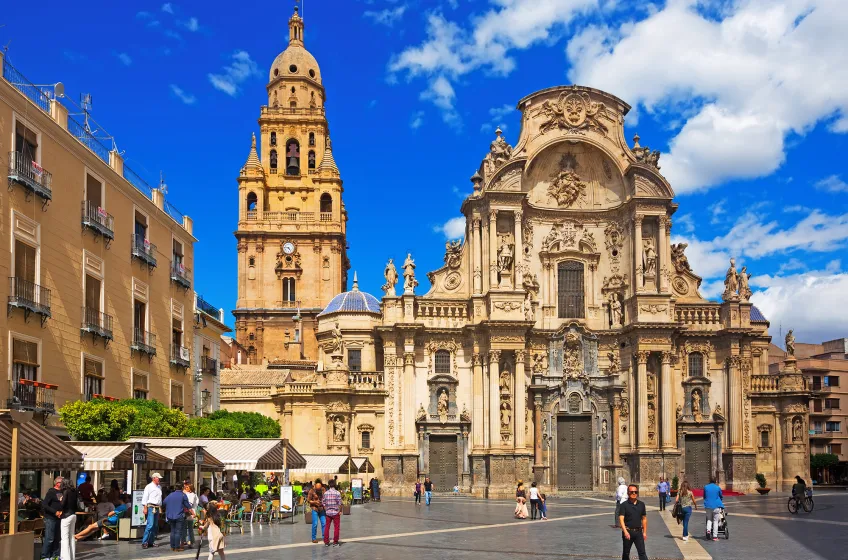
Plaza del Cardenal Belluga is the principal monumental space, overlooked by the cathedral, Episcopal Palace and modern municipal extension. The surrounding lanes are ideal for slow exploration, particularly in the evening.
Visit Murcia Cathedral
Murcia Cathedral is the city’s defining landmark.
Its façade is an elaborate masterpiece of Spanish Baroque architecture, filled with columns, sculpture and decorative detail. The tall bell tower developed over several centuries and incorporates different architectural styles.
Inside, the cathedral contains chapels, religious art and the burial place of the heart and internal organs of King Alfonso X of Castile.
The building remains active, so sightseeing access may be restricted during services.
See the Real Casino de Murcia
The Real Casino de Murcia is one of the city’s most unusual buildings.
Despite its name, it is a private social club rather than a gambling venue. Selected rooms are open to visitors and display a theatrical mixture of architectural styles.
Highlights include an elaborate Arab-style courtyard, ballroom, library and richly furnished reception rooms. The building stands on Calle Trapería, one of Murcia’s principal pedestrian streets.
Walk Along the River Segura
The River Segura passes through central Murcia and provides a useful route between the historic centre and quieter residential areas.
Bridges, gardens and riverside paths offer views towards the cathedral tower and surrounding buildings. The Puente de los Peligros is one of the city’s best-known crossings.
The riverside is most pleasant in the morning or evening, particularly during the hotter months.
Visit the Salzillo Museum
The Salzillo Museum is devoted to Francisco Salzillo, one of Murcia’s most important sculptors.
Its collection focuses on highly expressive religious figures created for churches and Holy Week processions. Even visitors without a strong interest in religious art may appreciate the craftsmanship, painted details and emotional intensity.
The museum provides useful context for Murcia’s major Semana Santa traditions.
Discover the Santa Clara Museum
The Santa Clara Museum occupies part of a functioning convent in central Murcia.
Its buildings preserve remains of an earlier Islamic palace alongside later Christian architecture. Archaeological displays, carved decoration and tranquil courtyards reveal layers of the city’s history.
Access may be limited in areas still used by the religious community.
Explore Cartagena
Cartagena is Murcia’s most important historic port and one of the region’s main visitor destinations.
The city has Phoenician, Roman, Byzantine, Islamic and naval heritage, much of it concentrated around the harbour and old centre. Art Nouveau façades line several streets, reflecting a period of prosperity linked with mining.
Cartagena is compact enough for a day trip, but two nights allow time for the Roman Theatre, museums, harbour and nearby coast.
Visit Cartagena’s Roman Theatre
Cartagena’s Roman Theatre is the city’s outstanding archaeological attraction.
The theatre was hidden beneath later buildings for centuries before being rediscovered and excavated. A well-designed museum route explains the site’s construction, decline and rediscovery before leading into the theatre itself.
Its position beside the old cathedral and central streets makes it easy to combine with other attractions.
Allow at least 90 minutes for the full visit.
Explore Cartagena’s Harbour
Cartagena’s natural harbour has shaped the city’s military and commercial importance.
A broad promenade passes museums, naval buildings, sculptures and cafés. Boat trips may provide views of coastal fortifications and the harbour entrance.
The National Museum of Underwater Archaeology is particularly worthwhile, with displays on shipwrecks, maritime trade and objects recovered from beneath the sea.
Visit the Naval Museum
Cartagena’s Naval Museum explores the city’s long association with the Spanish Navy.
Displays cover shipbuilding, submarines, navigation and naval warfare. One of the principal themes is the work of Isaac Peral, a Cartagena-born inventor associated with early electric submarine development.
The museum is especially suitable for visitors interested in engineering or maritime history.
See the View from Castillo de la Concepción
The Castle of the Conception occupies a hill above Cartagena.
The viewpoint provides an excellent overview of the Roman Theatre, harbour, rooftops and surrounding defensive hills. A panoramic lift can reduce the climb from the lower city.
The castle and interpretation centre explain Cartagena’s strategic geography and changing rulers.
Explore Caravaca de la Cruz
Caravaca de la Cruz is one of Murcia’s most important inland towns and a major Catholic pilgrimage destination.
Its sanctuary and castle stand on a hill above the historic centre. The town is associated with a revered cross relic and receives pilgrims throughout the year.
Below the sanctuary, narrow streets, churches and small squares retain a traditional atmosphere. Caravaca is easiest to reach by car or regional bus.
Visit Lorca
Lorca is a historic inland city known for its castle, Baroque buildings and elaborate Holy Week traditions.
Lorca Castle occupies a long ridge above the city and contains defensive walls, archaeological remains and interpretation of its frontier history. The views extend across the Guadalentín Valley.
The historic centre below includes churches, palaces and museums, though parts have undergone substantial restoration following earthquake damage.
Explore the Mar Menor
The Mar Menor is a shallow saltwater lagoon separated from the Mediterranean by La Manga.
Its warm, generally calm water has made it popular for swimming, sailing, kayaking and family holidays. Resorts and traditional settlements line different sections of the shore.
The lagoon has faced serious environmental pressures, including pollution and episodes of poor water quality. Visitors should check current official bathing guidance and respect protected areas.
Visit La Manga
La Manga is a narrow strip of land between the Mar Menor and the Mediterranean.
It is highly developed with apartments, hotels, marinas and beaches on both sides. The lagoon side is generally calmer, while the Mediterranean side is more exposed to waves.
La Manga suits travellers seeking straightforward beach facilities and water sports rather than historic atmosphere. Traffic can be heavy during summer because access relies on a limited road network.
Explore Calblanque Regional Park
Calblanque protects one of Murcia’s most attractive stretches of undeveloped coastline.
Golden beaches, dunes, dry hills and salt flats create a sharp contrast with the resort development around La Manga. The landscape feels remote despite its proximity to major tourist areas.
Vehicle access may be controlled during busy periods, with shuttle services used to reduce congestion. There is limited shade and few facilities, so carry water and sun protection.
Visit Cabo de Palos
Cabo de Palos is a coastal town at the southern entrance to the Mar Menor.
Its tall lighthouse overlooks rocky shoreline and clear water, while the harbour contains seafood restaurants, diving businesses and small boats.
The offshore marine reserve is one of Spain’s best-known diving areas. Strong currents and deep water mean that dives should be undertaken only with qualified local operators.
Discover Águilas
Águilas is a relaxed coastal town near Murcia’s border with Andalucía.
It has beaches, a harbour, a hilltop castle and a strong maritime character. The surrounding coast includes rocky bays, open viewpoints and less developed areas.
Águilas is particularly known for its colourful Carnival, one of the region’s largest annual events.
Visit Mazarrón and Bolnuevo
Mazarrón combines a traditional inland town with a separate coastal area around Puerto de Mazarrón.
The coastline includes beaches, cliffs and mining heritage. Near Bolnuevo, unusual sandstone formations have been shaped by erosion into tall, pale structures often compared with mushrooms or sculptures.
The formations are fragile and should be viewed without climbing on them.
Explore Sierra Espuña
Sierra Espuña is one of Murcia’s principal mountain and forest areas.
Pine woods, ridges, ravines and viewpoints provide opportunities for hiking, cycling and scenic driving. Temperatures are often cooler than on the coast or in Murcia city.
Marked routes vary from gentle forest walks to demanding mountain paths. Carry water, as conditions can remain dry even at higher altitude.
Visit the Ricote Valley
The Ricote Valley follows the River Segura through a landscape of palms, orchards, villages and dry surrounding hills.
Its agricultural terraces and irrigation systems reflect a long Islamic influence. Abarán, Blanca, Ojós and Ricote are among the principal settlements.
The valley is best explored slowly by car, with stops for viewpoints, short walks and local food.
Relax in Archena
Archena is known for its thermal spa complex beside the River Segura.
Mineral-rich waters have attracted visitors since ancient times, and the modern resort offers pools, treatments and accommodation.
Day access and treatment packages may require advance booking, particularly at weekends. Archena is easy to combine with Murcia city or the Ricote Valley.
Explore Jumilla
Jumilla is an inland town surrounded by vineyards and dry mountain landscapes.
Its hilltop castle overlooks the town, while museums and churches provide cultural interest. The area is best known for robust red wines made largely from the Monastrell grape.
Winery visits usually require advance booking. A car is the most practical way to explore the estates outside town.
Visit Yecla
Yecla lies in Murcia’s far north, close to the borders with Castile-La Mancha and the Valencian Community.
It is another important wine centre, with a strong tradition of Monastrell-based reds. The surrounding area also has archaeological sites, mountain walks and a major furniture-making industry.
Yecla and Jumilla can be combined on a wine-focused inland itinerary.
Practical Advice for Visitors
Getting There
The Region of Murcia International Airport serves selected domestic and European routes, though its network is smaller than that of Alicante Airport.
Alicante Airport is often the most practical gateway, particularly for Murcia city, the Mar Menor and the northern coast. It has a wide range of flights from the UK and northern Europe.
Long-distance trains and coaches connect Murcia with Madrid, Alicante, Valencia, Cartagena and Andalucía. Check which station a service uses, as local and long-distance routes may differ.
Getting Around
Regional trains and buses connect Murcia city with Cartagena, Alicante and several larger towns.
A car is much more useful for beaches, wine areas, Sierra Espuña, the Ricote Valley and smaller inland communities. Public transport to rural attractions can be limited or infrequent.
The region is compact, but coastal traffic and winding mountain roads can lengthen journey times.
Driving and Parking
Vehicles drive on the right.
Murcia and Cartagena have pedestrian streets, controlled parking and restricted central areas. Public garages are usually the easiest option.
Parking at popular beaches fills quickly during summer weekends. Calblanque and other protected areas may introduce seasonal access controls.
Rural roads are generally quiet, but flash flooding can affect low-lying routes after intense rain. Never drive through floodwater.
Choosing Where to Stay
Murcia city is best for historic architecture, dining and inland excursions.
Cartagena suits visitors interested in archaeology, maritime history and access to the southern Mar Menor.
Cabo de Palos is a good choice for diving, seafood and a smaller coastal atmosphere.
La Manga offers the widest range of resort accommodation and family facilities.
Águilas or Puerto de Mazarrón provide quieter beach bases farther west.
Dining
Murcian cooking is shaped by the region’s market gardens, coast and dry inland areas.
Zarangollo is a soft mixture of courgette, onion and egg. Pisto murciano combines cooked vegetables, while michirones are broad beans stewed with paprika and pork.
Pastel de carne is a savoury meat pie with a distinctive spiral pastry top. It is especially associated with Murcia city.
Lunch usually begins after 1.30pm, while dinner commonly starts after 8.30pm.
Rice and Seafood
Rice dishes are common throughout the region.
Caldero is a strongly flavoured fish and rice dish associated with the Mar Menor and coastal fishing communities. It is often served in stages, with fish and broth followed by rice.
Along the coast, look for red prawns, sea bream, mullet, octopus and salted fish products.
Seafood sold by weight can be expensive, so ask about the price before ordering.
Vegetables and Local Produce
Murcia is often described as one of Europe’s market gardens.
Peppers, tomatoes, artichokes, lettuce, citrus fruit and stone fruit are widely grown. Local menus often use vegetables as central ingredients rather than simple side dishes.
In spring, young broad beans and artichokes are especially prominent.
Wine
Murcia has three principal protected wine areas: Jumilla, Yecla and Bullas.
Monastrell is the dominant red grape and produces styles ranging from powerful, ripe wines to fresher and more refined versions. Rosé and white wines are also made.
Winery tours normally require advance booking. Use a designated driver, taxi or organised excursion when tasting.
Shopping
Typical regional purchases include wine, olive oil, paprika, preserved vegetables, salted fish, ceramics and regional pastries.
Murcia city and Cartagena have the broadest shopping choice. Smaller towns are better for wineries, food shops and local markets.
Lorca is associated with embroidery linked to its Holy Week traditions, while Totana has a long ceramics tradition.
Most ordinary shops close on Sundays.
Language
Spanish is spoken throughout Murcia.
English is widely used in major coastal resorts and tourist attractions but less consistently in inland villages. Basic Spanish phrases are useful in traditional restaurants and rural areas.
When to Visit
March to May is one of the best periods for sightseeing, walking and inland travel. Temperatures are generally warm without the intensity of midsummer.
September and October are also excellent for beaches and touring, although episodes of heavy rain can occur.
July and August are very hot inland and extremely busy around La Manga and the Mar Menor. Sightsee early and avoid strenuous afternoon activity.
Winter is mild near the coast and well suited to city breaks, cycling and walking. Higher inland areas can be cold at night.
Heat and Water Safety
Murcia is one of Spain’s driest and hottest regions.
Carry water, use strong sun protection and avoid exposed walks during the middle of summer days. Shade is limited in many coastal and inland landscapes.
Observe beach flags and official bathing advice, particularly around the Mar Menor. Conditions and water-quality guidance can change.
Heavy autumn rain may cause sudden flooding in normally dry channels. Move to higher ground and follow emergency instructions if warnings are issued.
Local Events
Murcia city’s Spring Festival includes parades, flowers, traditional dress and celebrations linked with local agriculture.
The Burial of the Sardine is an elaborate and playful procession held as part of the spring festivities.
Holy Week is important in Murcia, Cartagena and Lorca. Lorca is especially known for richly embroidered costumes and competitive processions.
Cartagena’s historical festival recreates episodes from the city’s Carthaginian and Roman past.
Águilas Carnival features colourful costumes, parades and large public celebrations.
Dates vary annually, so check the current programme before arranging travel around a particular event.
Exploring Beyond Murcia
The Valencian Community lies to the north, with Alicante, Elche and the southern Costa Blanca within easy reach.
Andalucía begins west of Águilas, offering Almería, Cabo de Gata and the Tabernas Desert.
Castile-La Mancha lies inland, with Albacete and the historic towns of eastern La Mancha accessible by road or rail.
Granada can be combined with western Murcia on a longer journey, while Valencia city is a natural extension north along the Mediterranean corridor.
Shortlist
- Your Shortlist is empty