
Discover The Basque Region | A Visitor's Introduction to The Basque Region
Recommended places to stay, places to visit and things to do throughout The Basque Region
The Basque Region is a culturally distinctive area in northern Spain, centred on the autonomous community of the Basque Country and closely linked with neighbouring Navarre and the French Basque coast. Known for its exceptional food, dramatic Atlantic shoreline, green mountains and strong linguistic identity, this region is a perfect destination for food lovers, city-break visitors, walkers and travellers interested in local culture. With Bilbao’s bold modern architecture, San Sebastián’s beaches and pintxos bars, and historic towns such as Hondarribia and Gernika, the Basque Region offers one of Spain’s most rewarding combinations of coast, countryside and urban life.
Browse Basque Region Hotels and Other Accommodation
Pre-book Basque Region Activities, Tours and Experiences
Why is the Basque Region Worth a Visit?
The Basque Region is worth visiting because it feels markedly different from much of the rest of Spain. The landscape is greener, the coastline is more rugged and the towns often combine industrial heritage with elegant architecture and a powerful sense of local identity.
Food is central to the region’s appeal. San Sebastián is internationally famous for fine dining, but everyday eating can be just as memorable. Pintxos bars, seafood restaurants, cider houses, food markets and traditional grills make the region one of Europe’s strongest destinations for culinary travel.
The area also offers a remarkable range of scenery within short distances. You can spend the morning in Bilbao’s museums, walk above Atlantic cliffs in the afternoon and eat in a fishing harbour that evening. Inland, wooded hills, vineyards and rural villages create a quieter contrast with the coast.
Basque culture is another major attraction. Euskara, the Basque language, is unrelated to the other major languages of western Europe and appears widely on signs and public information. Music, dance, rural sports and festivals reinforce the region’s distinctive character.
A week is enough for Bilbao, San Sebastián and several excursions. Ten days allow a more relaxed route including the coast, Rioja Alavesa and the French Basque Country.
Basque Region Highlights: Things to See and Do in the Basque Region
Explore Bilbao
Bilbao is the largest city in the Basque Country and one of Europe’s most successful examples of urban renewal.
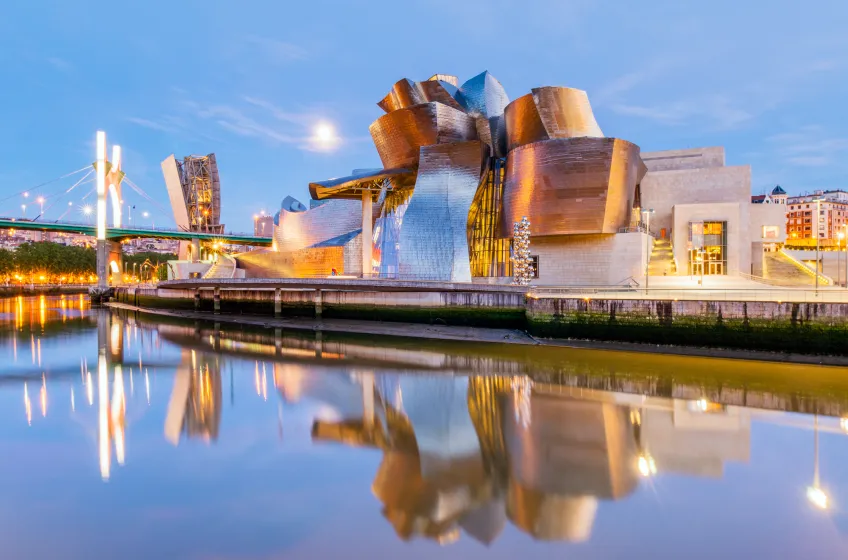
Its riverside has been transformed by contemporary architecture, pedestrian routes and cultural venues. The Guggenheim Museum is the best-known landmark, but the city’s appeal extends far beyond one building.
The Casco Viejo, or old town, contains narrow streets, churches, arcades and numerous pintxos bars. The central Ensanche district offers grander streets, shops and restaurants.
Bilbao works particularly well as a two- or three-night city break and as a base for excursions along the Biscay coast.
Visit the Guggenheim Museum Bilbao
The Guggenheim Museum is Bilbao’s defining modern landmark.
Designed by Frank Gehry, its curved titanium surfaces change appearance according to the weather and light. The riverside setting is as important as the galleries themselves.
Inside, the collection focuses on modern and contemporary art, with large-scale installations and temporary exhibitions. Outdoor works around the building add to the experience.
Book ahead during busy periods and allow time to walk around the exterior from both sides of the river.
Discover Bilbao’s Casco Viejo
Bilbao’s old town is centred on the traditional Seven Streets.
The district contains the Cathedral of Santiago, Plaza Nueva, Ribera Market and a dense concentration of bars. Its compact scale makes it ideal for walking without a fixed route.
Plaza Nueva is particularly good for pintxos, especially around lunchtime and early evening. Try one or two items in each bar rather than ordering a full meal in one place.
Ride the Artxanda Funicular
The Artxanda Funicular climbs from near the city centre to a viewpoint above Bilbao.
From the top, visitors can see the river, old town, modern centre and surrounding green hills. The ride is short and provides a useful introduction to the city’s geography.
Late afternoon often offers the best light. Visibility naturally depends on the weather.
Visit San Sebastián
San Sebastián, known as Donostia in Basque, is one of Spain’s most elegant coastal cities.
La Concha Bay forms the city’s defining view, with a broad beach, curved promenade and green hills at either end. The old town lies beneath Monte Urgull and contains one of Europe’s densest concentrations of pintxos bars.
The city combines beach life, refined architecture and outstanding food. It is compact enough to explore on foot, though two or three nights are recommended.
Walk Around La Concha Bay
La Concha is one of Europe’s most attractive urban beaches.
A long promenade curves around the bay from the old town towards Ondarreta Beach and the Peine del Viento sculpture. The walk is flat, scenic and suitable at almost any time of year.
The beach changes considerably with the tide. At low tide, the sandy area is broad; at high tide, it may narrow sharply.
Early morning is best for a quieter atmosphere.
Eat Pintxos in San Sebastián’s Old Town
The Parte Vieja is the traditional centre of San Sebastián’s pintxos culture.
Bars display small dishes on counters, while many also prepare hot specialities to order. The best experience comes from moving between several places rather than staying in one.
Popular bars become extremely crowded in the evening. Going at lunchtime or before the main dinner rush is often more comfortable.
Ask about the house speciality and avoid filling up on the first stop.
Climb Monte Urgull
Monte Urgull rises immediately behind San Sebastián’s old town.
Paths wind through wooded slopes, old fortifications and viewpoints towards a large hilltop statue. The climb is steady rather than severe, and several routes are possible.
The summit provides excellent views over La Concha, Zurriola Beach and the surrounding coast.
Wear shoes with reasonable grip, especially after rain.
Visit Monte Igueldo
Monte Igueldo stands at the western end of La Concha Bay.
A historic funicular climbs to an elevated viewpoint and old-fashioned amusement area. The panorama over the bay is one of the classic images of San Sebastián.
The setting is especially attractive around sunset, although the final funicular times should be checked.
Explore Hondarribia
Hondarribia is a colourful fortified town near the French border.
Its upper district contains stone streets, defensive walls and traditional houses, while the lower Marina neighbourhood is known for brightly painted balconies and excellent pintxos bars.
The town sits beside the Bidasoa estuary, facing Hendaye in France. Small boats may provide a cross-border link depending on conditions and season.
Hondarribia works well as a half-day excursion or a quieter alternative to staying in San Sebastián.
Visit Getaria
Getaria is a compact fishing town on the Gipuzkoa coast.
Its harbour is lined with seafood restaurants and grills, while narrow streets climb towards the historic centre. The town is associated with fashion designer Cristóbal Balenciaga, whose museum stands nearby.
Getaria is also surrounded by vineyards producing txakoli, a light, fresh local wine.
The coastal walk from Zarautz offers excellent sea views and is one of the best ways to arrive.
Walk from Zarautz to Getaria
The route between Zarautz and Getaria follows a coastal promenade beneath cliffs.
It provides broad Atlantic views and is generally straightforward, though sections can be exposed to wind and spray. The walk can be combined with lunch in Getaria and a bus return.
Zarautz itself has a long beach popular with surfers.
Explore the Flysch Coast
The coast between Zumaia, Deba and Mutriku is known for dramatic geological formations called flysch.
Tilted layers of rock extend into the sea, creating striped cliffs and wave-cut platforms. The formations reveal a long sequence of geological history.
Boat trips, guided walks and coastal viewpoints provide different perspectives. Tide times are important because some formations are best seen at low tide.
Never approach unstable cliffs or exposed platforms during rough sea conditions.
Visit Gernika
Gernika is one of the most symbolically important towns in Basque history.
It is associated with traditional Basque political assemblies and the famous oak under which representatives met. The town was heavily bombed during the Spanish Civil War, an event immortalised by Pablo Picasso’s painting Guernica.
Museums and memorial sites explain the bombing, peace movement and political significance of the town.
Market day adds local atmosphere, though the centre becomes busier.
See San Juan de Gaztelugatxe
San Juan de Gaztelugatxe is a rocky islet connected to the mainland by a stone bridge and a steep stairway.
A small hermitage stands at the summit, reached by a dramatic coastal path. The views are spectacular, but the route involves many steps and can be slippery.
Access may be regulated during busy periods, and reservations can be required. Weather and sea conditions also affect the experience.
Wear proper shoes and carry water.
Explore Bermeo and Mundaka
Bermeo is a working fishing port with a strong maritime identity.
Nearby Mundaka is a smaller estuary town internationally known for surfing. The Urdaibai Biosphere Reserve surrounds both places, combining wetlands, beaches, woodlands and birdlife.
The area works well for a coastal day trip from Bilbao, particularly when combined with Gernika.
Visit the Urdaibai Biosphere Reserve
Urdaibai protects an estuary and surrounding landscapes on the Biscay coast.
Salt marshes, sandbanks, forests and beaches support significant birdlife. Walking, kayaking and birdwatching are among the main activities.
The reserve is best explored slowly, using towns such as Gernika, Bermeo or Mundaka as bases.
Tides strongly influence the scenery, particularly around the estuary.
Discover Vitoria-Gasteiz
Vitoria-Gasteiz is the administrative capital of the Basque Country.
Its medieval centre rises on a low hill and contains narrow streets, restored buildings and the Gothic Cathedral of Santa María. Guided visits often focus on the cathedral’s long restoration and architectural structure.
The city is known for parks, cycling routes and a broad green belt. It has a calmer atmosphere than Bilbao or San Sebastián.
Vitoria also provides access to the Rioja Alavesa wine region.
Visit Rioja Alavesa
Rioja Alavesa lies south of the Cantabrian Mountains and forms the Basque portion of the wider Rioja wine region.
Vineyards surround fortified towns and hilltop villages such as Laguardia. Wineries range from traditional underground cellars to striking contemporary buildings.
Tempranillo-based red wines dominate, though other styles are produced.
Advance booking is normally required for winery visits. Use a designated driver or organised tour.
Explore Laguardia
Laguardia is a beautifully preserved walled town above the Rioja Alavesa vineyards.
Its pedestrian streets contain churches, stone houses and small squares. Beneath the town lies a network of wine cellars, some of which can be visited.
Views extend across vineyards towards the Sierra de Cantabria.
Parking is outside the walls, and the compact centre is easily explored on foot.
Visit the Añana Salt Valley
The Salt Valley of Añana is an unusual historic landscape west of Vitoria-Gasteiz.
Terraces, channels and evaporation beds have been used for salt production over many centuries. Guided visits explain the engineering, geology and restoration of the site.
The white salt structures create a striking contrast with the surrounding green countryside.
Explore the French Basque Coast
The French Basque Country lies immediately across the border and shares many cultural traditions with the Spanish side.
Bayonne has a cathedral, riverside old town and strong food culture. Biarritz is known for beaches, surfing and elegant architecture, while Saint-Jean-de-Luz has a sheltered harbour and traditional centre.
Regional trains and buses make cross-border day trips possible, though schedules should be checked carefully.
Practical Advice for Visitors
Getting There
Bilbao Airport is the main international gateway to the Basque Country.
It has good connections with the UK and major European cities. Buses link the airport with Bilbao and other regional destinations.
San Sebastián has a smaller airport near Hondarribia, while Biarritz Airport can be useful for the eastern coast. Santander Airport is another option for western Biscay.
High-speed and long-distance rail connections serve Bilbao, San Sebastián and Vitoria-Gasteiz, though journey times from Madrid vary by route.
Getting Around
Public transport is good between the principal cities.
Frequent buses and trains connect Bilbao, San Sebastián and Vitoria-Gasteiz. Local rail services also reach several coastal towns.
A car is useful for Rioja Alavesa, rural villages, remote beaches and parts of the inland mountains. However, parking can be difficult in coastal towns during summer.
The region is compact, but winding roads can make journeys slower than expected.
Driving and Parking
Vehicles drive on the right.
Bilbao and San Sebastián have restricted streets, paid parking and busy central traffic. Public transport is usually easier within both cities.
Historic towns such as Hondarribia and Laguardia have limited vehicle access. Use designated car parks outside the centre.
Mountain and coastal roads can be narrow, steep and wet. Fog is possible on higher routes.
Weather
The Basque coast has a mild but changeable Atlantic climate.
Rain is possible at any time of year, including summer. Pack a light waterproof jacket and shoes suitable for wet pavements.
Inland areas around Vitoria and Rioja Alavesa are generally drier, with colder winters and warmer summer afternoons.
Weather can differ sharply on opposite sides of the mountains.
Dining
Basque cooking places great emphasis on high-quality ingredients.
Grilled fish, beef, salt cod, shellfish, beans and seasonal vegetables feature prominently. Dishes are often relatively simple but carefully prepared.
San Sebastián has numerous prestigious restaurants, though reservations are essential and prices can be very high. Traditional grills, seafood taverns and cider houses offer more informal alternatives.
Lunch is usually served after 1.30pm, while dinner often begins after 8.30pm.
Pintxos
Pintxos are small dishes traditionally eaten with a drink.
Some are displayed on bread at the counter, while more elaborate hot versions are cooked to order. The best bars often specialise in only a few items.
Do not assume every dish on the counter costs the same. Ask how ordering and payment work, as systems vary between establishments.
A pintxos crawl normally involves one drink and one or two dishes in each bar.
Basque Cider Houses
Traditional cider houses, or sagardotegiak, are especially associated with the area around Astigarraga.
Meals often include salt-cod omelette, cod, grilled steak and cheese, accompanied by cider poured directly from large barrels.
The main cider-house season is traditionally in the cooler months, though some businesses operate more broadly.
Advance booking is strongly recommended, particularly for evening meals.
Wine
Txakoli is a fresh, high-acidity wine produced in several Basque coastal areas.
It is usually white and pairs well with seafood, though rosé and red versions also exist. Getaria is one of the best-known producing areas.
Rioja Alavesa offers a very different style, dominated by structured red wines.
Winery visits normally require booking.
Shopping
Typical regional purchases include cheese, cider, wine, canned seafood, peppers, chocolate and high-quality kitchen products.
Bilbao and San Sebastián offer the widest shopping choice. Food markets and specialist shops are often better than souvenir stores for authentic local products.
Idiazabal is a distinctive sheep’s-milk cheese, sometimes lightly smoked.
Most ordinary shops close on Sundays.
Language
Basque and Spanish are both official languages in the Basque Country.
Basque appears widely on signs, transport information and menus. Usage varies considerably between cities, coastal towns and rural areas.
Spanish is understood throughout the region, while English is common in hotels and major attractions.
A few Basque words, such as kaixo for hello and eskerrik asko for thank you, are appreciated.
When to Visit
May to June is excellent for green landscapes, city sightseeing and coastal walking.
September is one of the best months, with generally pleasant temperatures and fewer peak-summer crowds.
July and August are busiest, particularly in San Sebastián and coastal towns. Accommodation prices rise and parking becomes difficult.
October can be attractive for food and wine travel, though rain becomes more frequent.
Winter suits city breaks, museums, cider houses and quieter coastal travel, but daylight is limited and the weather can be wet.
Local Events
San Sebastián’s major summer celebrations include music, fireworks and cultural events.
Bilbao’s principal festival fills the city with concerts, street performances and public celebrations.
The San Sebastián International Film Festival is one of Spain’s leading cinema events and brings large crowds to the city.
Gernika, Vitoria-Gasteiz and smaller towns host food fairs, religious festivals and traditional Basque sporting events.
Dates vary annually, so confirm arrangements before booking around a particular event.
Exploring Beyond the Basque Region
Navarre lies to the east and offers Pamplona, Pyrenean valleys and the semi-desert landscape of Bardenas Reales.
La Rioja lies south of the Basque Country and provides further wine towns, monasteries and vineyard scenery.
Cantabria begins west of Biscay and offers Santander, prehistoric caves and mountain landscapes.
Castile and León lies inland, with Burgos, León and the Camino de Santiago among its main attractions.
The French Basque Country extends north-east through Saint-Jean-de-Luz, Biarritz and Bayonne, making it one of the easiest international additions to a Basque itinerary.
Shortlist
- Your Shortlist is empty