
Discover Castile & León | A Visitor's Introduction to Castile & León
Recommended places to stay, places to visit and things to do throughout Castile & León
Castile and León is Spain’s largest autonomous community, stretching across the northern plateau between Madrid, Galicia, Asturias, Cantabria, the Basque Country, La Rioja, Aragón, Castile-La Mancha, Extremadura and Portugal. Known for its monumental cities, medieval castles, Romanesque churches, pilgrimage routes and vast open landscapes, this region is a perfect destination for history enthusiasts, walkers, food lovers and road trippers. With cities such as Salamanca, Segovia, Burgos, León and Ávila, Castile and León offers one of Spain’s richest concentrations of cultural heritage.
Browse Castile & León Hotels and Other Accommodation
Pre-book Castile & León Activities, Tours and Experiences
Why is Castile & León Worth a Visit?
Castile and León is worth visiting because it contains some of Spain’s most impressive historic cities, many of them linked with the formation of the medieval kingdoms of Castile and León. Cathedrals, city walls, royal monasteries, castles and old universities appear across the region in remarkable numbers.
The landscape is equally distinctive. Much of Castile and León lies on the high northern plateau, where broad fields, dry grassland and distant mountain ranges create a powerful sense of space. Elsewhere, river canyons, vineyards, forested valleys and rugged sierras provide more varied scenery.
The region is also central to the Camino de Santiago. The French Way crosses Castile and León through places such as Burgos, Frómista, Carrión de los Condes, León and Astorga, bringing walkers into contact with Romanesque churches, monasteries and traditional towns.
Food and wine are major attractions. Roast lamb, suckling pig, cured meats, beans, river fish and sheep’s cheese are regional staples, while Ribera del Duero, Rueda, Toro and Bierzo are among Spain’s most important wine areas.
Castile & León Highlights: Things to See and Do in Castile & León
Explore Salamanca
Salamanca is one of Spain’s finest university cities and one of the region’s essential destinations.
Its historic centre is built largely from warm golden sandstone, which glows in the evening light. Plaza Mayor is the city’s social and architectural heart, surrounded by arcades, cafés and richly decorated façades.
The university is among the oldest in Europe. Its historic buildings, courtyards and famous carved façade reflect Salamanca’s importance as a centre of scholarship.
The city also has two connected cathedrals, the Casa de las Conchas and a lively student atmosphere that keeps the centre active well into the evening.
Visit Segovia
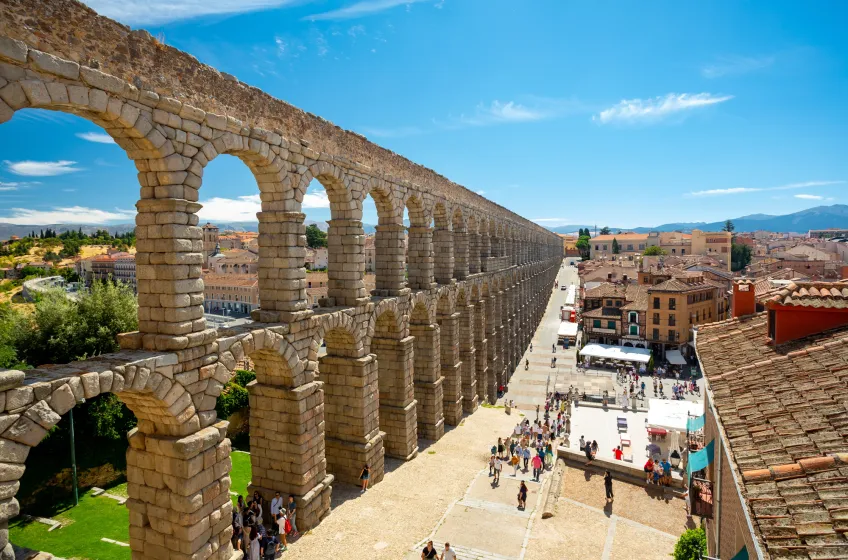
Segovia is known for its Roman aqueduct, Gothic cathedral and fairy-tale Alcázar.
The aqueduct crosses the lower city on tall granite arches and remains one of the best-preserved Roman engineering works in Spain. From there, the old town rises through pedestrian streets towards Plaza Mayor and the cathedral.
The Alcázar stands on a rocky ridge above the meeting of two rivers. Its pointed towers, ceremonial rooms and elevated views make it one of the country’s most recognisable castles.
Segovia is possible as a day trip from Madrid, but staying overnight reveals a much quieter historic centre.
Walk the Walls of Ávila
Ávila is surrounded by one of Europe’s most complete medieval defensive walls.
Visitors can walk along selected sections for views over the city, cathedral and surrounding plateau. The walls are particularly dramatic after dark, when they are illuminated.
Inside the fortifications, churches, convents and historic houses reflect the city’s association with Saint Teresa of Ávila. The Basilica of San Vicente and cathedral are among the principal sights.
The city stands at high altitude, so evenings can be cool even outside winter.
Discover Burgos
Burgos is a major stop on the Camino de Santiago and one of northern Spain’s most important historic cities.
Its cathedral is a masterpiece of Spanish Gothic architecture, with elaborate towers, chapels, sculpture and the tomb of El Cid. Allow plenty of time for the interior.
The old centre extends around Plaza Mayor and the River Arlanzón, while the Museum of Human Evolution explores archaeological discoveries from nearby Atapuerca.
Burgos has a lively tapas scene and makes a strong base for exploring the northern part of the region.
Visit Atapuerca
The archaeological sites of Atapuerca lie east of Burgos and are among Europe’s most important locations for the study of early humans.
Excavations have produced fossils, tools and evidence spanning a very long period of human occupation. Guided visits explain the discoveries and their significance.
The Museum of Human Evolution in Burgos provides valuable context and should ideally be visited before or after the site.
Advance booking is sensible, as access is organised and visitor numbers can be limited.
Explore León
León combines Roman origins, medieval pilgrimage heritage and a lively modern centre.
Its cathedral is famous for its extensive stained glass, which fills the interior with coloured light. The Romanesque Basilica of San Isidoro contains an extraordinary royal burial chamber with painted ceilings.
The Casa Botines, designed by Antoni Gaudí, adds an unexpected modernist landmark. Barrio Húmedo and Barrio Romántico are the main areas for tapas and evening activity.
León is also an important staging point on the Camino de Santiago.
Visit Astorga
Astorga lies west of León where several historic routes meet.
The town has Roman remains, a substantial cathedral and an Episcopal Palace designed by Antoni Gaudí. The palace’s towers and decorative stonework give it the appearance of a fantasy castle.
Astorga is also known for chocolate, reflecting a long connection with cocoa processing. Small museums and shops explore this history.
The town is easy to combine with León or the route towards El Bierzo.
See Las Médulas
Las Médulas is a dramatic landscape of red earth, chestnut woods and jagged cliffs in the province of León.
The terrain was transformed by large-scale Roman gold mining. Water channels and hydraulic methods were used to collapse parts of the mountain, creating the unusual formations visible today.
Walking routes lead through the lower landscape and towards panoramic viewpoints. Early morning and late afternoon provide the strongest colour.
Wear sturdy shoes, particularly after rain, when the red soil can become slippery.
Explore El Bierzo
El Bierzo is a green valley region in the far west of Castile and León.
Ponferrada is the main town and contains a substantial Templar castle. Villages, vineyards and wooded slopes surround the valley, creating a landscape that feels closer to Galicia than to the dry central plateau.
The area is known for Mencía red wine, roasted peppers, chestnuts and botillo, a strongly flavoured pork speciality.
El Bierzo is especially attractive in spring and autumn.
Visit Zamora
Zamora stands above the River Duero and is known for its concentration of Romanesque churches.
The old town contains a cathedral with a distinctive scaled dome, a castle, stone streets and viewpoints over the river. It feels quieter than Salamanca or Segovia and is ideal for travellers who prefer less crowded historic cities.
Zamora is also known for elaborate Holy Week processions and strong regional food traditions.
Explore Valladolid
Valladolid is the administrative capital of Castile and León.
The city has important museums, churches and historic associations with the Spanish monarchy, Christopher Columbus and writer Miguel de Cervantes. The National Sculpture Museum is one of its strongest attractions, with an exceptional collection of religious sculpture.
Valladolid also provides excellent rail connections and makes a useful base for wine excursions to Ribera del Duero and Rueda.
Visit Palencia
Palencia is a compact regional city beside the River Carrión.
Its cathedral is sometimes called the “Unknown Beauty” because of its rich interior and relatively low profile among visitors. The old centre contains arcaded streets, churches and pleasant public spaces.
A large statue of Christ overlooks the city from Cerro del Otero.
Palencia is a useful stop between Valladolid, Burgos and the Camino towns farther west.
Discover Soria
Soria is a small city on the River Duero surrounded by open, high-altitude landscapes.
Romanesque churches, riverside paths and literary associations give it a quiet, reflective character. The Monastery of San Juan de Duero and Church of Santo Domingo are particular highlights.
The province contains archaeological sites, castles, nature reserves and sparsely populated countryside.
Visit Numancia
Numancia lies near Soria and was an important Celtiberian settlement.
It is remembered for resisting Roman conquest before eventually falling after a long siege. Archaeological remains and reconstructed structures help visitors understand the settlement’s layout and daily life.
The exposed hilltop can be hot in summer and cold in winter, so dress for the weather.
Explore Peñafiel
Peñafiel lies in the Ribera del Duero wine region and is dominated by a long, narrow castle on a ridge.
The castle contains a wine museum and provides broad views over vineyards and surrounding countryside. The town below has a distinctive elongated square used historically for festivals and bullfighting.
Peñafiel is one of the best bases for combining wine, food and architecture.
Visit the Ribera del Duero Wineries
Ribera del Duero is one of Spain’s most prestigious red-wine regions.
Vineyards extend along the Duero corridor around towns such as Peñafiel, Aranda de Duero and Roa. Tempranillo, often called Tinta del País or Tinto Fino locally, is the principal grape.
Wineries range from traditional underground cellars to major modern estates. Visits almost always require advance booking.
Use an organised tour, taxi or designated driver when tasting.
Explore the Rueda Wine Region
Rueda lies south of Valladolid and is best known for fresh, aromatic white wines.
Verdejo is the principal grape, producing styles ranging from light and crisp to richer barrel-aged wines. Historic underground cellars can be seen in several towns.
Rueda is easy to combine with Valladolid, Medina del Campo or Tordesillas.
Visit Toro
Toro stands above the River Duero west of Valladolid.
Its Collegiate Church has a distinctive dome and fine Romanesque architecture, while the old town contains viewpoints, historic streets and wine cellars.
The Toro wine region is known for powerful reds based on Tinta de Toro, a local form of Tempranillo.
Discover Tordesillas
Tordesillas is associated with the treaty that divided newly explored territories between Spain and Portugal during the late 15th century.
The town also contains the Royal Convent of Santa Clara, with Mudéjar architecture and royal history. Its position on the River Duero adds to the visit.
Tordesillas works well as a stop between Valladolid, Zamora and Salamanca.
Explore La Alberca and the Sierra de Francia
La Alberca is one of the region’s most attractive traditional villages.
Timber-framed houses, narrow streets and a central square create a strong sense of local character. The surrounding Sierra de Francia contains forests, mountain roads and further villages such as Mogarraz and Miranda del Castañar.
The area is best explored by car, though roads are narrow and winding.
Visit the Arribes del Duero
The Arribes del Duero form a dramatic canyon landscape along the border with Portugal.
The River Duero cuts through steep cliffs, creating viewpoints, walking routes and boat excursions. Vultures and other birds of prey are commonly seen.
The area is remote, and public transport is limited. A car is the most practical option.
Spring and autumn offer the most comfortable conditions for walking.
Practical Advice for Visitors
Getting There
Madrid is the main gateway to Castile and León.
High-speed and regional trains connect Madrid with Segovia, Valladolid, Burgos, León, Palencia, Salamanca and Zamora. Journey times are often much shorter than road distances suggest.
Madrid Airport is the most convenient international airport for most of the region. Bilbao, Asturias, Santiago de Compostela and Porto may be useful for northern or western itineraries.
Long-distance buses serve cities and smaller towns not connected directly by rail.
Getting Around
Train travel works very well between the principal cities, especially along the Madrid–Segovia–Valladolid–León and Madrid–Burgos corridors.
A car is far more useful for villages, wineries, castles, archaeological sites and natural parks. Distances are large, so allow generous travel time.
Regional buses exist but may operate only a few times per day in rural areas.
Driving and Parking
Vehicles drive on the right.
Major roads are generally good and traffic outside the cities is light. Rural fuel stations can be widely spaced, so refill before long journeys.
Historic centres often have restricted access, narrow streets and limited parking. Use public car parks outside old-town areas.
Winter driving can be difficult on high ground and mountain routes, particularly around León, Soria, Ávila and the northern ranges.
Dining
Castile and León is known for substantial meat-based cooking.
Roast suckling pig is especially associated with Segovia, while roast lamb is common around Aranda de Duero and other parts of the region. Both are traditionally cooked in wood-fired ovens.
Other specialities include morcilla de Burgos, cured meats, beans from La Bañeza, chickpea stews and trout.
Lunch is usually the main meal and often begins after 2pm. Fixed-price weekday menus can offer excellent value.
Cheese and Charcuterie
Sheep’s-milk cheese is widely produced across the region.
Cured meats include chorizo, salchichón, cecina and ham. Cecina de León is air-dried beef with a deep, smoky flavour.
Markets, specialist food shops and village producers are the best places to compare regional products.
Wine
Castile and León contains several major wine regions.
Ribera del Duero and Toro are known primarily for powerful reds. Bierzo produces distinctive Mencía wines, while Rueda is associated with Verdejo whites.
Other areas include Cigales, Arribes and Arlanza. Restaurant wine lists often provide an excellent introduction to local producers.
Advance booking is normally required for winery tours.
Shopping
Typical purchases include wine, cheese, cured meat, ceramics, leather goods and regional sweets.
Salamanca, Valladolid, Burgos and León have the broadest shopping options. Smaller towns offer food shops, bakeries and craft businesses.
Most ordinary shops close on Sundays, and smaller businesses may shut during the afternoon.
When to Visit
April to June is one of the best periods for touring, with green landscapes, wildflowers and comfortable daytime temperatures.
September and October are ideal for wine regions, harvest activity and historic cities.
July and August can be very hot on the plateau, although evenings may cool quickly. Sightsee early and avoid strenuous activity during the hottest part of the day.
Winter can be cold, windy and snowy, particularly in high-altitude cities and mountain areas. Salamanca, Ávila, Burgos and Soria regularly experience freezing conditions.
Local Events
Semana Santa is especially important in Valladolid, Zamora, León and Salamanca, where processions feature historic religious sculpture and solemn music.
The medieval festival of Ávila transforms the old city with markets, costumes and performances.
Wine harvest celebrations take place in several producing regions during late summer and autumn.
Local festivals honour patron saints, traditional food and historic events throughout the year.
Dates vary annually, so confirm arrangements before travelling for a particular event.
Exploring Beyond Castile & León
Madrid is the easiest major-city extension, with world-class museums, royal landmarks and excellent transport links.
Galicia lies west of León and Zamora, offering Santiago de Compostela, Atlantic scenery and seafood.
Asturias and Cantabria provide green mountain landscapes, caves and a rugged northern coastline.
The Basque Country lies north-east of Burgos and offers Bilbao, San Sebastián and an exceptional food culture.
La Rioja is a natural continuation for wine travellers.
Portugal borders the western edge of the region, with Bragança, Guarda, Porto and the Douro Valley all possible additions to a longer itinerary.
Shortlist
- Your Shortlist is empty