
Discover Asturias | A Visitor's Introduction to Asturias
Recommended places to stay, places to visit and things to do throughout Asturias
Asturias is a green, mountainous region on Spain’s northern coast, set between the Cantabrian Sea and the dramatic peaks of the Cordillera Cantábrica. Known for its rugged shoreline, cider culture, fishing villages, prehistoric cave art and the Picos de Europa, this compact region is a perfect destination for walkers, food lovers, road trippers and travellers seeking a cooler alternative to Mediterranean Spain. With lively cities, wild beaches, forested valleys and stone-built villages, Asturias offers an unusually rich mix of coast, mountains and traditional culture.
Browse Asturias Hotels and Other Accommodation
Pre-book Asturias Activities, Tours and Experiences
Why is Asturias Worth a Visit?
Asturias is worth visiting because its landscapes feel very different from the dry plains and resort coasts often associated with Spain. The region is intensely green, with wooded hills, deep valleys and steep mountains rising close to the sea.
The contrast between coast and countryside is one of its greatest strengths. In a single day, visitors can walk beneath limestone peaks, eat seafood in a harbour village and watch the sun set from a clifftop viewpoint.
Asturias also has a strong regional identity. Traditional cider houses, bagpipe music, distinctive food and a long history linked with the early Christian kingdoms of northern Iberia give the region a character of its own.
Its cities are manageable and appealing. Oviedo offers pre-Romanesque churches, elegant streets and an excellent old centre, while Gijón combines beaches, maritime heritage and lively nightlife. Avilés has a carefully restored historic quarter and bold modern architecture.
Asturias suits a touring holiday especially well. Five to seven days allow time for the main cities and coast, while ten days provide a better introduction to the mountains, western villages and rural interior.
Asturias Highlights: Things to See and Do in Asturias
Explore Oviedo
Oviedo is the capital of Asturias and one of northern Spain’s most elegant small cities.
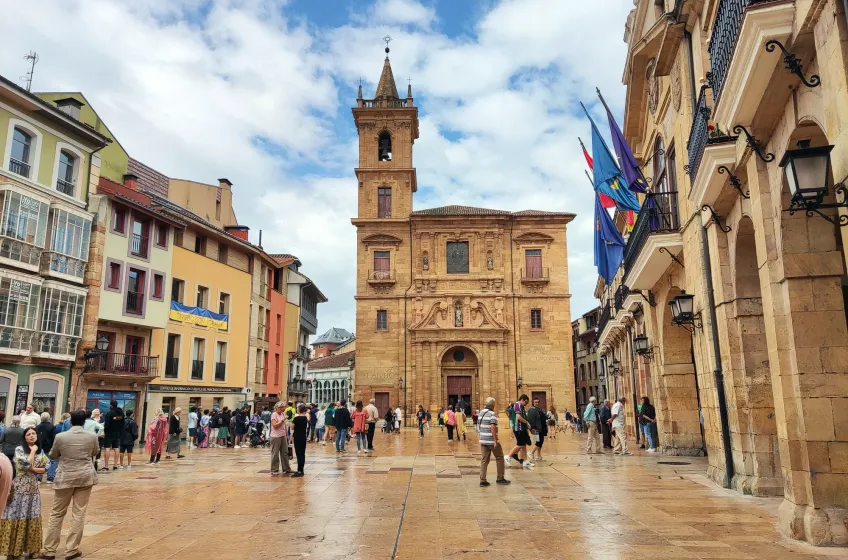
Its pedestrianised centre contains colourful façades, lively squares and a substantial Gothic cathedral. The old town is compact and easy to explore, with traditional cider houses, markets and museums close together.
The cathedral is an important pilgrimage stop on routes towards Santiago de Compostela. Its Holy Chamber contains historic religious objects and forms part of a much older complex.
Oviedo is also known for outdoor sculptures scattered around the city, including works associated with well-known local and national figures.
Visit Santa María del Naranco
Santa María del Naranco stands on the slopes of Monte Naranco above Oviedo.
Originally built as a royal hall in the ninth century, it later became a church. Its balanced proportions, arched openings and elevated setting make it one of the finest examples of Asturian pre-Romanesque architecture.
Nearby San Miguel de Lillo formed part of the same royal complex. The two buildings are best visited together.
Access may depend on guided arrangements or limited opening periods, so check locally before travelling up the hill.
Discover Gijón
Gijón is Asturias’ largest coastal city and has a more relaxed, maritime atmosphere than Oviedo.
The old fishing quarter of Cimavilla occupies a headland between the harbour and San Lorenzo Beach. Its narrow streets contain cider houses, bars and small squares.
San Lorenzo is a long urban beach backed by a promenade, while the Elogio del Horizonte sculpture stands on the headland above the sea.
Gijón is an excellent base for travellers who want beaches, restaurants and straightforward transport connections.
Walk Along San Lorenzo Beach
San Lorenzo is one of northern Spain’s most attractive urban beaches.
The broad sandy curve is exposed at low tide and significantly reduced when the tide rises. Swimmers should pay attention to flags, currents and changing conditions.
The promenade is ideal for walking, running and cycling, with views towards Cimavilla at one end.
Early morning provides the quietest atmosphere.
Explore Avilés
Avilés has one of Asturias’ best-preserved historic centres.
Arcaded streets, colourful buildings and public squares create a surprisingly attractive old town, contrasting with the city’s industrial past. Calle Galiana is especially characteristic, with covered walkways and traditional façades.
Near the waterfront, the Oscar Niemeyer International Cultural Centre presents a striking group of modern white-and-yellow buildings.
Avilés is easy to reach from Oviedo and Gijón and works well as a half-day or full-day visit.
Visit the Picos de Europa
The Picos de Europa are among Spain’s most dramatic mountain landscapes.
Limestone peaks, deep gorges, high pastures and isolated villages create excellent conditions for walking, climbing and scenic drives. The range extends across Asturias, Cantabria and Castilla y León.
Cangas de Onís, Arenas de Cabrales and Poncebos are important bases on the Asturian side. Mountain weather changes quickly, even in summer.
Popular routes and car parks become very busy during peak season, so early starts are essential.
Walk the Cares Gorge
The Cares Gorge route is one of the best-known walks in northern Spain.
The path follows a narrow ledge above the River Cares between Poncebos and Caín. Sheer cliffs, tunnels and mountain views make it spectacular, but it is also exposed in places.
The full return walk is long, and there is little shade. Carry enough water, wear proper footwear and avoid the route during extreme heat, storms or icy conditions.
Visitors uncomfortable with heights may find sections challenging.
Visit the Lakes of Covadonga
The Lakes of Covadonga lie high in the Picos de Europa above the sanctuary of Covadonga.
Enol and Ercina are surrounded by meadows, limestone ridges and grazing livestock. Short walks connect viewpoints and lakes, while longer routes continue into the mountains.
Private vehicle access is often restricted during busy periods, with shuttle buses operating from lower parking areas.
Conditions can be misty, wet and cold even when the coast is sunny.
Explore the Sanctuary of Covadonga
Covadonga is one of Asturias’ most important religious and historical sites.
A basilica stands in a wooded mountain setting below the road to the lakes. Nearby, a small chapel occupies a cave above a waterfall and pool.
The site is associated with the beginnings of the medieval Kingdom of Asturias and the figure of Pelayo.
It becomes extremely busy during summer and religious events. Arrive early or later in the afternoon for a calmer visit.
Visit Cangas de Onís
Cangas de Onís is a gateway town for Covadonga and the Picos de Europa.
Its best-known landmark is a medieval bridge crossing the River Sella, often called the Roman Bridge despite its later origins. A replica of the Cross of Victory hangs beneath the central arch.
The town has hotels, restaurants and outdoor-activity businesses, making it a practical base for mountain excursions.
Explore Llanes
Llanes is one of the most attractive towns on the eastern Asturian coast.
Its compact centre contains medieval walls, traditional houses and lively squares. The harbour is lined with brightly painted concrete blocks known as the Cubes of Memory.
Beaches, coastal paths and dramatic rock formations surround the town. Some sandy coves almost disappear at high tide, so tide times are important.
Llanes becomes busy during summer, but its location makes it an excellent touring base.
See the Bufones de Pría
The Bufones de Pría are natural blowholes in limestone cliffs near the village of Llames.
When sea conditions are strong, water and air are forced through openings in the rock, creating loud bursts and plumes of spray. At calmer times, the effect may be limited.
Keep well back from cliff edges and marked danger zones. Waves and spray can be unpredictable, particularly during rough weather.
The surrounding coastline is worth walking even when the blowholes are quiet.
Visit Ribadesella
Ribadesella stands where the River Sella meets the sea.
The town combines a harbour, historic centre and long beach backed by elegant villas. A clifftop chapel and viewpoint provide broad coastal views.
Ribadesella is also associated with a famous canoe race held on the River Sella.
The town is a useful base for nearby caves, beaches and eastern Asturias.
Explore Tito Bustillo Cave
Tito Bustillo Cave near Ribadesella contains important prehistoric paintings.
Its decorated chambers form part of a wider group of Palaeolithic cave sites in northern Spain. Visits are controlled to protect the art, and access may be limited by season or conservation requirements.
Advance booking is strongly advisable. A nearby interpretation centre explains the paintings and archaeological context.
Visit Lastres
Lastres is a steep fishing village on the central coast.
White houses with red roofs descend towards a small harbour, creating one of Asturias’ classic coastal views. Narrow lanes and stairways make the village highly photogenic but physically demanding.
A viewpoint above the settlement provides the best overall panorama.
Parking can be difficult in the lower streets, so use designated areas when available.
Explore Cudillero
Cudillero is one of Asturias’ most famous fishing villages.
Its houses rise in a colourful amphitheatre around a small harbour square. Steep paths and stairways lead to several viewpoints above the village.
The lower area becomes busy with day visitors, especially in summer. Walk beyond the main square to find quieter streets and better views.
Seafood restaurants are plentiful, but compare menus before choosing.
Visit Luarca
Luarca is a graceful harbour town in western Asturias.
Its white buildings, fishing port and hillside cemetery create an attractive setting around the river mouth. The upper viewpoints provide strong views over the harbour and coast.
Luarca is less dramatic than Cudillero but feels more like a working regional town.
It makes a good stop when travelling towards Galicia.
Discover Taramundi
Taramundi lies in the green hills of western Asturias near the Galician border.
The area is known for traditional knife making, watermills and rural crafts. Stone villages, streams and forest paths create excellent conditions for gentle walking.
The Museum of Mills and local craft workshops provide insight into the area’s working traditions.
A car is the easiest way to explore the surrounding villages.
Explore Somiedo Natural Park
Somiedo is a mountainous natural park in south-western Asturias.
Its high lakes, pastures and traditional thatched shelters known as teitos create one of the region’s most distinctive rural landscapes. The park is also associated with brown bears, though sightings are uncommon and should never be expected.
Walking routes vary from gentle valley paths to strenuous mountain trails.
Late spring to early autumn generally offers the best conditions, but weather remains changeable.
Visit Redes Natural Park
Redes protects forests, mountains and traditional villages south-east of Oviedo.
Beech woods, river valleys and limestone peaks make it attractive for hiking and wildlife observation. It is generally quieter than the Picos de Europa.
Small villages provide accommodation and local food, but services can be limited. A car is highly useful.
See Cabo Peñas
Cabo Peñas is the northernmost headland in Asturias.
Cliffs, grassland and open sea views create a wild coastal atmosphere. Walking paths lead around the lighthouse area and nearby viewpoints.
Wind can be strong even on sunny days. Keep away from unprotected cliff edges.
The headland combines well with Avilés, Luanco or Gijón.
Practical Advice for Visitors
Getting There
Asturias Airport lies west of Avilés and serves domestic and selected international routes.
Oviedo and Gijón are connected by rail and long-distance coach with Madrid, León and other northern Spanish cities. Journey times vary considerably depending on the service.
Santander Airport in neighbouring Cantabria can be useful for eastern Asturias, while Santiago de Compostela may suit travellers visiting the western coast.
Travelling by car from Madrid involves crossing the Cantabrian Mountains, with impressive scenery but possible winter weather.
Getting Around
A car is the best option for beaches, mountain valleys, villages and natural parks.
Oviedo, Gijón and Avilés are linked by frequent public transport, and regional trains or buses serve several coastal towns. However, services to remote villages and trailheads can be limited.
Mountain journeys take longer than distances suggest because of winding roads.
Build flexibility into the itinerary, especially when visiting places dependent on weather.
Driving and Parking
Vehicles drive on the right.
Main roads are generally good, but rural and mountain routes can be narrow, steep and occasionally shared with livestock. Fog is common on higher ground.
Historic fishing villages have limited parking and difficult access. Use designated car parks above or outside the centre.
Never leave valuables visible in a parked vehicle at beaches or trailheads.
Weather
Asturias is greener than most of Spain because it receives considerably more rain.
Showers can occur at any time of year, and mountain conditions may differ sharply from the coast. Pack a waterproof jacket even during summer.
Temperatures are usually milder than in central and southern Spain. Summer heat is possible, but prolonged extreme temperatures are less common near the coast.
Layered clothing is the most practical choice.
Dining
Asturian cuisine is rich, generous and strongly regional.
Fabada asturiana is the best-known dish, made with large white beans, sausage, black pudding and pork. It is substantial and usually better suited to lunch than a late evening meal.
Other specialities include bean dishes with clams, grilled meats, game, stews and seafood. Portions are often large, so ask before over-ordering.
Lunch generally begins after 1.30pm, while dinner often starts after 8.30pm.
Cider
Asturias is Spain’s principal cider-producing region.
Traditional natural cider is poured from a height into a wide glass to aerate it. Only a small amount is poured at a time and should be drunk promptly.
Cider houses, known as sidrerías, are central to local social life. Staff usually handle the pouring, though some establishments use mechanical devices.
The flavour is dry, tart and very different from sweet commercial cider.
Cheese
Asturias produces an exceptional variety of cheeses.
Cabrales is the most famous, a strong blue cheese traditionally matured in caves in the Picos de Europa. Gamonéu is another complex mountain cheese, while Afuega’l Pitu has several textures and styles.
Cheese boards are a good way to compare local varieties. Specialist shops in Oviedo, Gijón and market towns offer the widest choice.
Seafood
The Asturian coast provides excellent fish and shellfish.
Look for hake, sea bass, sardines, octopus, clams, spider crab and locally landed seasonal fish. Harbour towns such as Luarca, Cudillero and Lastres are natural places to try seafood.
Prices can vary significantly, especially for shellfish sold by weight. Ask before ordering.
Shopping
Typical regional purchases include cheese, cider, cured meat, honey, preserves and handmade knives from Taramundi.
Oviedo and Gijón have the broadest retail choice, while smaller towns are better for local food and crafts.
Vacuum-packed cheese and cured products travel more easily, though international customs rules should be checked.
Most ordinary shops close on Sundays.
When to Visit
May to June is excellent for green landscapes, spring flowers and relatively quiet sightseeing.
July and August offer the most dependable access to mountain routes and beaches, but popular coastal towns and the Picos become busy.
September is one of the best months, with warm conditions, fewer crowds and generally good walking opportunities.
October can be beautiful in the forests, though rain becomes more likely.
Winter suits city breaks, food tourism and a quieter coast, but snow and ice may affect mountain roads.
Local Events
The International Descent of the Sella is a major canoeing event and celebration centred on Arriondas and Ribadesella.
Asturias Day is marked with cultural events, music and regional traditions.
Gijón hosts festivals, concerts and summer activities, while Oviedo’s San Mateo celebrations bring performances and public events.
Cider festivals and food fairs take place throughout the region.
Dates vary annually, and accommodation can become scarce during major celebrations.
Exploring Beyond Asturias
Cantabria lies to the east and offers Santander, Santillana del Mar, prehistoric caves and further Picos de Europa scenery.
Galicia begins west of Asturias, with Ribadeo, Lugo and Santiago de Compostela forming natural extensions.
Castile and León lies south across the mountains, offering León, Astorga and extensive historic landscapes.
The Camino del Norte continues along the coast, while the Camino Primitivo begins in Oviedo and crosses the interior towards Galicia.
Shortlist
- Your Shortlist is empty