
Discover Castile-La Mancha | A Visitor's Introduction to Castile-La Mancha
Recommended places to stay, places to visit and things to do throughout Castile-La Mancha
Castile-La Mancha is a vast inland region in central Spain, stretching south and east of Madrid across open plains, vineyard country, mountain ranges and historic hill towns. Known for the landscapes of Don Quixote, the medieval city of Toledo, Manchego cheese, windmills and some of Spain’s finest Renaissance architecture, this region is a perfect destination for history enthusiasts, food lovers, road trippers and travellers seeking a quieter alternative to the country’s coastal resorts. With fortified towns, wetlands, castles and wide horizons, Castile-La Mancha offers a distinctive journey through the heart of Spain.
Browse Castile-La Mancha hotels and other accommodation
Pre-book Castile-La Mancha Activities, Tours and Experiences
Why is Castile-La Mancha Worth a Visit?
Castile-La Mancha is worth visiting because it contains some of Spain’s most important historic places while remaining much less crowded than Madrid, Barcelona or Andalusia. Toledo alone would justify a visit, but the region also includes Cuenca’s hanging houses, the Renaissance squares of Almagro, the castle of Belmonte and the monumental towns of Sigüenza and Alcalá del Júcar.
The landscape is equally important. Much of the region consists of broad plains, vineyards, olive groves and cereal fields beneath enormous skies. Windmills on low ridges reinforce the association with Miguel de Cervantes and Don Quixote, although many have been restored primarily as cultural landmarks.
Castile-La Mancha also has a strong food identity. Manchego cheese, saffron, game, garlic, lamb, local wine and rustic stews feature prominently. Regional cooking is generally hearty and closely connected with farming traditions.
A car is useful for exploring smaller towns and natural areas, but several major destinations can be reached by train from Madrid. Toledo and Cuenca are easy city breaks, while a week allows time for a broader circular journey.
Castile-La Mancha Highlights: Things to See and Do in Castile-La Mancha
Explore Toledo
Toledo is the region’s best-known destination and one of Spain’s greatest historic cities.
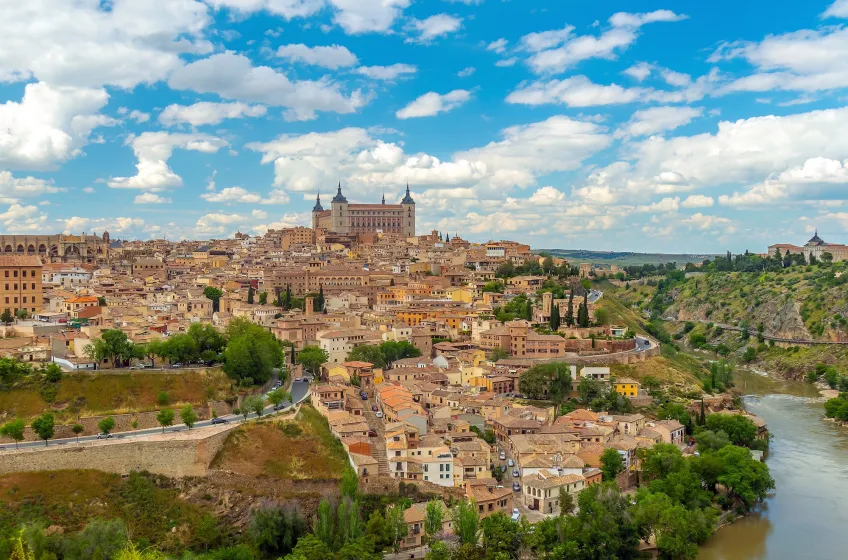
The old town occupies a rocky hill almost surrounded by the River Tagus. Its dense network of steep streets contains churches, synagogues, mosques, convents, palaces and defensive gates.
The cathedral is one of Spain’s most important Gothic buildings, with elaborate chapels, religious art and a richly decorated interior. The Alcázar dominates the skyline and now houses a military museum.
Toledo is closely associated with El Greco, whose paintings can be seen in churches and museums around the city. Stay overnight when possible, as the centre becomes much calmer after day visitors return to Madrid.
Visit Toledo Cathedral
Toledo Cathedral stands at the heart of the old city and rewards a detailed visit.
Highlights include the main chapel, choir stalls, treasury and sacristy, where major paintings are displayed. The interior is vast, so allow at least 90 minutes.
Dress respectfully and check access around services. Buying an audio guide can help explain the complex symbolism and history of the building.
Discover Toledo’s Jewish Quarter
Toledo’s former Jewish quarter contains some of the city’s most significant monuments.
The Synagogue of Santa María la Blanca has a striking interior of white horseshoe arches. The Synagogue of El Tránsito contains fine plasterwork and a museum devoted to Sephardic culture.
Nearby, the Monastery of San Juan de los Reyes has an elegant Gothic cloister and decorative chains displayed on its exterior.
The district’s lanes are steep and uneven, so comfortable shoes are essential.
See the View from Mirador del Valle
Mirador del Valle provides the classic panoramic view of Toledo.
From across the River Tagus, the city appears as a dense mass of stone buildings crowned by the cathedral and Alcázar. The viewpoint is especially attractive around sunrise or late afternoon.
It can be reached by car, taxi, tourist transport or a longer walk. Summer heat can make the uphill route demanding.
Explore Cuenca
Cuenca is a dramatic hill town built between the gorges of the Huécar and Júcar rivers.
Its old town is a UNESCO World Heritage Site, with steep streets, medieval buildings and viewpoints over the surrounding landscape. The Casas Colgadas, or Hanging Houses, project above the Huécar Gorge and form the city’s best-known sight.
Cuenca also has an unexpectedly strong collection of abstract art, partly housed in historic buildings. The contrast between medieval architecture and modern art is one of the city’s distinctive features.
Cross the San Pablo Bridge
The San Pablo Bridge spans the Huécar Gorge below Cuenca’s old town.
It provides excellent views towards the Hanging Houses and the former convent on the opposite side. The bridge is high and open-sided, so it may be uncomfortable for visitors nervous about heights.
Early morning and evening offer the best light and fewer people.
Visit the Museum of Spanish Abstract Art
The Museum of Spanish Abstract Art occupies part of Cuenca’s Hanging Houses.
Its collection includes important works by Spanish modern artists, presented in a dramatic historic setting above the gorge. The museum is relatively compact but exceptionally well curated.
Even visitors with only a casual interest in modern art may appreciate the relationship between the collection, architecture and landscape.
See the Windmills of Consuegra
Consuegra is one of the best places to see the windmills associated with Don Quixote.
A line of whitewashed mills stands along Cerro Calderico above the town, beside the remains of a castle. The elevated position provides broad views across the plains of La Mancha.
Some mills contain small exhibitions or preserved machinery. The ridge is exposed to sun and wind, so bring water and suitable clothing.
Sunset is particularly atmospheric, although parking and viewpoints can become busy.
Visit Campo de Criptana
Campo de Criptana has another famous group of La Mancha windmills.
Several stand within or beside the historic upper district, surrounded by whitewashed houses with blue-painted details. The setting feels more integrated with the town than at Consuegra.
Museums and cultural displays explore Cervantes, rural life and milling traditions. Walking between the mills and lower town involves slopes.
Explore Almagro
Almagro is one of Castile-La Mancha’s most elegant small towns.
Its Plaza Mayor is lined with distinctive green-framed galleries and arcaded buildings. The square forms the centre of a well-preserved historic district containing palaces, convents and traditional houses.
Almagro is especially associated with theatre. The Corral de Comedias is a rare surviving 17th-century open-air playhouse and remains in use.
The town is small enough for a day trip, but staying overnight allows time for a performance or a quieter evening meal.
Visit the Corral de Comedias
The Corral de Comedias is Almagro’s defining attraction.
Its wooden galleries, stage and enclosed courtyard preserve the atmosphere of Spain’s Golden Age theatre. Guided visits explain how performances were staged and how audiences were divided by status and gender.
During festivals and performances, access arrangements change, so check before visiting.
Discover Ciudad Real
Ciudad Real is the provincial capital and a useful transport base in central La Mancha.
Its historic centre is less monumental than Toledo or Cuenca, but it contains churches, museums and lively public squares. The Don Quixote Museum explores Cervantes’ novel and its relationship with the region.
Ciudad Real also provides access to Almagro, the volcanic landscapes of Campo de Calatrava and Tablas de Daimiel National Park.
Explore Sigüenza
Sigüenza is a fortified hill town in the province of Guadalajara.
Its castle dominates the skyline and now functions as a historic hotel. Below it, medieval streets descend towards a substantial cathedral combining Romanesque and Gothic elements.
The Plaza Mayor, defensive walls and old houses create a strong historic atmosphere. Sigüenza is especially attractive during spring and autumn, when temperatures are comfortable.
Visit Belmonte Castle
Belmonte Castle is one of the region’s most impressive fortresses.
Its unusual layout, towers and restored interiors reflect both military and aristocratic functions. Displays explain the castle’s construction, residents and later restoration.
The battlements provide broad views over the surrounding countryside. The site is easiest to reach by car.
See Alcalá del Júcar
Alcalá del Júcar is a striking village built into a steep bend of the River Júcar.
White houses climb the hillside beneath a castle, while caves and tunnels have been carved into the rock. A historic bridge crosses the river at the base of the settlement.
The village is highly photogenic, but the steep streets require good footwear. Parking near the centre can be difficult during weekends.
Explore the Tablas de Daimiel
Tablas de Daimiel National Park protects a rare wetland ecosystem on the plains of La Mancha.
Boardwalks and marked paths pass through reed beds, shallow water and bird habitats. The landscape changes significantly with water levels and season.
Birdwatching is best during migration periods and cooler parts of the day. Summer can be extremely hot and exposed.
Environmental conditions have varied over time, so check current access and water levels before making a special journey.
Visit Ruidera Lakes
The Lagunas de Ruidera are a chain of lakes connected by channels and waterfalls.
The area is popular for swimming, kayaking, walking and summer holidays. Clear water and limestone surroundings create a striking contrast with the dry plains nearby.
Some sections are highly developed, while others are quieter and more natural. Summer weekends become crowded, so early arrival is advisable.
Explore Cabañeros National Park
Cabañeros National Park protects Mediterranean woodland, grassland and wildlife in western Castile-La Mancha.
Deer, birds of prey and other animals inhabit the park. Guided vehicle excursions and walking routes provide access to selected areas.
Autumn is especially attractive for wildlife and colour. Advance booking may be required for certain tours.
Discover the Serranía de Cuenca
The Serranía de Cuenca is a mountainous landscape north and east of Cuenca.
Its forests, limestone formations, rivers and gorges provide excellent walking and scenic drives. The Ciudad Encantada, or Enchanted City, contains naturally eroded rock shapes along a marked route.
The source of the River Cuervo is another popular natural site, particularly after rain or snowmelt.
Weather can be much cooler than in the surrounding plains, especially outside summer.
Practical Advice for Visitors
Getting There
Madrid is the main gateway to Castile-La Mancha.
High-speed and regional trains connect Madrid with Toledo, Cuenca, Ciudad Real, Albacete and other larger towns. Toledo can be reached in around half an hour by fast train, while Cuenca is also accessible by high-speed services.
Madrid Airport is the nearest major international airport for most of the region. Alicante and Valencia airports may be convenient for Albacete and the eastern provinces.
Smaller towns and rural attractions often require a bus, taxi or car.
Getting Around
A car provides the greatest flexibility, particularly for windmill routes, castles, villages and national parks.
Rail travel works well between the largest cities, but services between smaller destinations may require returning through Madrid or using infrequent buses.
Roads are generally good and traffic outside major towns is light. Distances can be substantial, so avoid planning too many stops in one day.
Driving and Parking
Vehicles drive on the right.
Historic centres such as Toledo, Cuenca and Alcalá del Júcar have steep, narrow streets and restricted access. Use signed public car parks outside the oldest districts.
Fuel stations can be widely spaced in rural areas, so refill before long drives.
Summer heat can affect tyres, engines and passengers. Carry water and never leave children or animals inside a parked vehicle.
Dining
Castile-La Mancha’s cuisine is rustic and filling.
Typical dishes include pisto manchego, a mixture of cooked tomatoes, peppers and courgettes, often served with egg. Migas are fried breadcrumbs prepared with garlic, pork products or grapes depending on the local style.
Lamb, partridge, rabbit, game and garlic feature strongly. Atascaburras, made with potato, salted cod and garlic, is associated with colder weather.
Lunch is usually the main meal and often begins after 2pm. Many restaurants serve good-value fixed menus during weekdays.
Manchego Cheese
Manchego is the region’s most famous food product.
Made from sheep’s milk, it ranges from relatively mild younger cheese to firmer, more intensely flavoured aged versions. The patterned rind traditionally reflects the moulds used during production.
Specialist shops, markets and rural dairies are good places to compare different ages. Manchego is commonly served with bread, cured meat, olives or quince paste.
Saffron
La Mancha is one of Spain’s best-known saffron-producing regions.
The spice comes from the stigmas of crocus flowers and requires labour-intensive harvesting. Genuine saffron is expensive and should be sold in small quantities with clear labelling.
It is used in rice dishes, stews, sauces and sweets. Autumn harvest events take place in selected towns.
Wine
Castile-La Mancha is one of the world’s largest wine-producing areas.
La Mancha produces substantial quantities of wine, while Valdepeñas, Manchuela, Uclés and Almansa have their own identities and protected designations.
Airén is a widely planted white grape, while Tempranillo is often known locally as Cencibel. Modern producers also work with international varieties and older local grapes.
Many wineries require advance booking. A designated driver or organised tour is essential when tasting.
Shopping
Typical purchases include Manchego cheese, saffron, wine, olive oil, ceramics and local sweets.
Toledo is known for marzipan, metalwork and decorative damascene products. Quality varies considerably in tourist shops, so compare materials and workmanship.
Talavera de la Reina is associated with colourful ceramics, while Cuenca and smaller towns have craft and food shops.
Most ordinary shops close on Sundays, and some smaller businesses shut during the afternoon.
When to Visit
April to June is one of the best periods for touring, with green countryside, wildflowers and manageable temperatures.
September and October are also excellent, particularly for wine, saffron and harvest-related travel.
July and August can be extremely hot, especially across the plains and in cities such as Toledo and Ciudad Real. Sightsee early and rest during the hottest afternoon hours.
Winter can be cold, with frost and occasional snow in higher areas around Cuenca, Guadalajara and the Serranía.
Local Events
Semana Santa is marked by processions in many towns and cities, including Toledo, Cuenca and Ciudad Real.
Almagro’s classical theatre festival brings performances to historic venues during summer.
The saffron festival in Consuegra celebrates the autumn harvest with food, music and local traditions.
Corpus Christi is particularly important in Toledo, when streets are decorated for religious processions.
Wine festivals, medieval markets and local saint’s days take place throughout the region. Dates vary annually.
Exploring Beyond Castile-La Mancha
Madrid is the easiest major-city extension, offering world-class museums, royal landmarks and extensive transport connections.
Extremadura lies to the west and contains Roman Mérida, monumental Cáceres and historic Trujillo.
Andalusia begins to the south, with Córdoba and Jaén accessible from the southern parts of the region.
Valencia lies east of Cuenca and Albacete, combining a Mediterranean coast with major cultural attractions.
Castile and León offers further walled cities, castles and historic university towns to the north.
The mountains and villages of the Madrid region provide additional walking and heritage excursions near the northern edge of Castile-La Mancha.
Shortlist
- Your Shortlist is empty