
Discover El Escorial | A Visitor's Introduction to El Escorial
Recommended places to stay, places to visit and things to do in and near El Escorial
El Escorial, more formally San Lorenzo de El Escorial, is a historic town in the foothills of the Sierra de Guadarrama, around 50 kilometres north-west of Madrid. Known for its vast royal monastery, granite architecture, wooded surroundings and close links with King Philip II, this compact town is a perfect destination for history lovers, architecture enthusiasts and visitors looking for an easy cultural day trip from the capital. With royal tombs, formal gardens, mountain walks and traditional Castilian restaurants, El Escorial offers a striking contrast to central Madrid.
Browse El Escorial Hotels and Other Accommodation
Pre-book El Escorial Activities, Tours and Experiences
Why is El Escorial Worth a Visit?
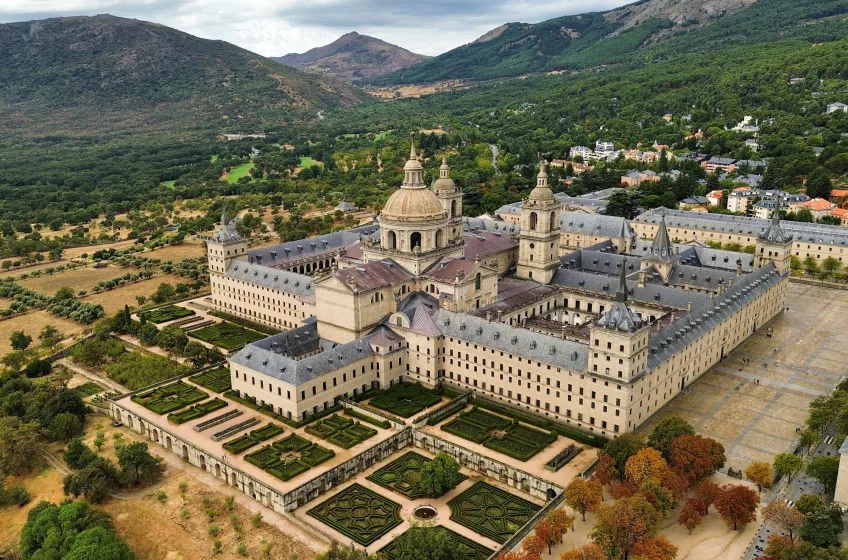
El Escorial is worth visiting because it contains one of Spain’s most important royal and religious complexes. The Royal Site of San Lorenzo de El Escorial combines a palace, monastery, basilica, library, school, museum and royal burial place within one enormous granite structure.
Its architectural character is unusually severe and controlled. Rather than relying on elaborate exterior decoration, the complex impresses through scale, symmetry and its powerful setting beneath the mountains. This restrained style reflects both the personal preferences of Philip II and the political ambitions of the Spanish monarchy at the height of its global power.
The surrounding town adds to the experience. Stone streets, traditional restaurants, gardens and mountain views make it worthwhile staying for more than a rushed palace tour. Nearby woodland paths and viewpoints also provide a chance to combine history with light walking.
El Escorial works very well as a day trip from Madrid, but an overnight stay is rewarding for travellers who want to see the town after the main visitor groups have departed.
El Escoral Highlights: Things to See and Do in El Escorial
Visit the Royal Monastery of San Lorenzo de El Escorial
The Royal Monastery is the town’s defining attraction and one of Spain’s most important historic sites.
Commissioned by Philip II in the 16th century, the complex was designed as a royal residence, monastery and memorial to the Spanish monarchy. Its immense rectangular plan contains courtyards, towers, galleries and institutional spaces organised with extraordinary precision.
A full visit usually includes royal apartments, religious rooms, museum galleries, sections of the monastery and ceremonial areas. Allow at least two to three hours, particularly when using an audio guide or joining a guided tour.
The building can feel cold even outside winter, so bring an extra layer.
See the Basilica
The basilica stands at the symbolic centre of the El Escorial complex.
Its vast dome and austere interior reflect the solemn religious purpose of the site. The scale is impressive, but the atmosphere is more restrained than in Spain’s richly decorated Baroque churches.
Look for the relationship between the basilica, monastery and royal apartments, which reveals how closely political power and religion were connected in Philip II’s court.
Access may be affected by services or official ceremonies.
Visit the Royal Pantheon
The Royal Pantheon contains the tombs of many Spanish kings and queens.
The principal chamber is circular and richly decorated with marble and gilded details, creating a dramatic contrast with the monastery’s plain granite exterior. Other burial areas contain princes, princesses and members of the wider royal family.
This is one of the most solemn parts of the visit. Photography and visitor movement may be restricted.
Explore the Historic Library
El Escorial’s library is one of the complex’s most beautiful interiors.
The long vaulted room contains historic books, manuscripts, scientific instruments and painted ceiling decoration. Its collection reflects Philip II’s ambition to make El Escorial a centre of knowledge as well as religion and royal authority.
The shelves are arranged in an unusual way, with book spines often turned inward to protect them and display the gilt-edged pages.
Visitors should move quietly and respect any restrictions on photography.
See the Royal Apartments
The royal apartments provide insight into court life at El Escorial.
Philip II’s rooms are especially striking for their relative simplicity. Their position allowed the king to remain close to the basilica, reflecting his deeply religious outlook.
Other rooms contain paintings, furniture, tapestries and decorative objects connected with later royal occupants.
The contrast between ceremonial spaces and private rooms is one of the most interesting aspects of the complex.
Visit the Battle Hall
The Battle Hall is decorated with large frescoes depicting Spanish military campaigns.
Its long gallery presents warfare as a demonstration of royal power and national achievement. The paintings are detailed, colourful and unusually expansive compared with the restrained architecture elsewhere.
Allow time to study the scenes rather than simply walking through.
Walk Through the Gardens
Formal gardens lie beside the palace and monastery.
Their clipped hedges, geometric paths and elevated position create excellent views over the surrounding countryside. The gardens are not enormous, but they provide a welcome outdoor break after the dense interiors.
Late spring and early autumn are especially pleasant. In summer, the open terraces can become hot and exposed.
Explore the Old Town
San Lorenzo de El Escorial grew around the royal complex and has a compact historic centre.
Granite buildings, sloping streets, cafés and traditional shops create a more intimate atmosphere than the monastery itself. Plaza de la Constitución is one of the main gathering places.
The town is easy to explore on foot, although some streets are steep. Evening is particularly pleasant once day visitors have left.
Visit the Casita del Príncipe
The Casita del Príncipe is a smaller royal residence set within landscaped grounds below the main town.
It was built for the future King Charles IV and offers a more domestic contrast to the scale of the monastery. The interiors contain decorative rooms, furniture and works of art.
Opening arrangements can be more limited than at the main complex, so check locally before making a special journey.
See the Casita del Infante
The Casita del Infante stands in a wooded setting outside the central town.
This elegant 18th-century residence was created for Prince Gabriel, a son of King Charles III. Its terraces provide broad views towards the monastery and surrounding landscape.
The site is particularly rewarding for architecture lovers and visitors interested in the later Bourbon history of El Escorial.
Access and opening times may vary.
Walk to La Silla de Felipe II
La Silla de Felipe II is a granite outcrop in the hills south of the monastery.
Tradition claims that Philip II watched the construction of El Escorial from this spot, although the exact historical basis is debated. Regardless of the story, the viewpoint provides an excellent panorama of the monastery, town and mountain setting.
The route can be reached on foot or by driving to nearby parking areas and continuing along woodland paths.
Wear sturdy shoes, especially after rain.
Explore the Bosque de la Herrería
The Bosque de la Herrería is a broad woodland area below the Sierra de Guadarrama.
Oak trees, granite outcrops, meadows and marked paths make it ideal for walking, picnics and cycling. Routes connect the town with La Silla de Felipe II and other local viewpoints.
Spring brings fresh greenery and wildflowers, while autumn provides attractive colour. Summer afternoons can still be hot despite the shade.
Visit the Abantos Mountain Area
Monte Abantos rises directly above San Lorenzo de El Escorial.
Walking routes climb through pine forest towards viewpoints over the monastery, Madrid plain and surrounding mountains. The ascent is more demanding than the town’s shorter woodland walks.
Carry enough water, check the weather and wear proper footwear. Snow and ice are possible during winter, while summer heat can make exposed sections uncomfortable.
See the Valley of Cuelgamuros
Cuelgamuros lies a short drive from El Escorial and contains a vast 20th-century monumental complex created during the Franco dictatorship.
The site includes a monumental cross, a basilica excavated into the rock and extensive surrounding woodland. It remains one of Spain’s most politically sensitive places because of its origins, use of political-prisoner labour and connection with dictatorship and historical memory.
Visitors should approach it as a complex historical site rather than simply an architectural attraction. Access, interpretation and opening arrangements may change, so check current information before travelling.
Practical Advice for Visitors
Getting There
El Escorial is easily reached from Madrid by train, regional bus or car.
Suburban trains connect Madrid with El Escorial station. The station lies in the lower town, roughly 20 to 30 minutes on foot from the Royal Monastery, with much of the route uphill.
Regional buses usually arrive closer to the centre of San Lorenzo de El Escorial and may therefore be more convenient for some visitors.
Driving from Madrid normally takes around an hour, depending on traffic.
Getting Around
The centre of San Lorenzo de El Escorial is compact and best explored on foot.
The monastery, old town and nearby restaurants are close together. However, the terrain is sloping, and attractions such as La Silla de Felipe II, the Casita del Infante and Monte Abantos require longer walks or local transport.
Taxis are useful for visitors with limited mobility or those combining several outlying sites.
Parking
Public car parks and controlled street parking are available around the town.
Spaces close to the monastery fill quickly during weekends, public holidays and summer. Arrive early or use parking farther from the centre.
Do not attempt to drive through narrow central streets without checking access restrictions.
Dining
El Escorial’s restaurants specialise in hearty Castilian cooking.
Common dishes include roast lamb, suckling pig, grilled meat, bean stews and soups. Game may appear on seasonal menus.
Restaurants around the monastery are convenient but can be tourist-oriented. Streets slightly farther from the main entrance often provide a quieter atmosphere and better value.
Lunch is usually served from around 1.30pm, while dinner begins later than in the UK.
Local Sweets
The town has a strong tradition of bakeries and pastry shops.
Typical purchases include almond-based sweets, sponge cakes, pastries and biscuits associated with local convents or family bakeries.
These are easy to carry home and make a practical alternative to heavier regional food products.
Shopping
Shopping in El Escorial is focused on food, books, religious items, crafts and souvenirs connected with the monastery.
Local delicatessens sell cheese, cured meat, wine and sweets from the wider Madrid and Castile regions.
The town is not a major retail destination, but its independent shops are pleasant to browse between attractions.
When to Visit
April to June is excellent for gardens, woodland walks and comfortable sightseeing.
September and October are also ideal, with cooler temperatures and autumn colour around the Sierra.
July and August can be hot and busy, particularly during weekends. The stone complex may remain cool inside, but outdoor areas are exposed.
Winter can be cold, windy and occasionally snowy. The monastery’s interiors may also feel chilly, so dress warmly.
Local Events
San Lorenzo de El Escorial hosts concerts, religious celebrations and cultural events throughout the year.
Summer programmes often include music, theatre and performances connected with the town’s royal and monastic setting.
Local religious festivals bring processions and public gatherings to the centre.
Event dates vary annually, so check the current programme before planning around a particular celebration.
Exploring Beyond El Escorial
Madrid is the obvious base or onward destination, with major museums, royal landmarks and extensive transport connections.
The Sierra de Guadarrama offers walking, cycling and winter scenery around Cercedilla, Navacerrada and Cotos.
Manzanares el Real has a well-preserved castle beneath the granite formations of La Pedriza.
Segovia is reachable by road and offers a Roman aqueduct, Gothic cathedral and distinctive Alcázar.
Ávila lies farther west and is known for its remarkably complete medieval walls.
The small mountain towns and reservoirs north of Madrid provide additional rural excursions for travellers with a car.
Shortlist
- Your Shortlist is empty