
Discover Segovia | A Visitor's Introduction to Segovia
Recommended places to stay, places to visit and things to do in and near Segovia
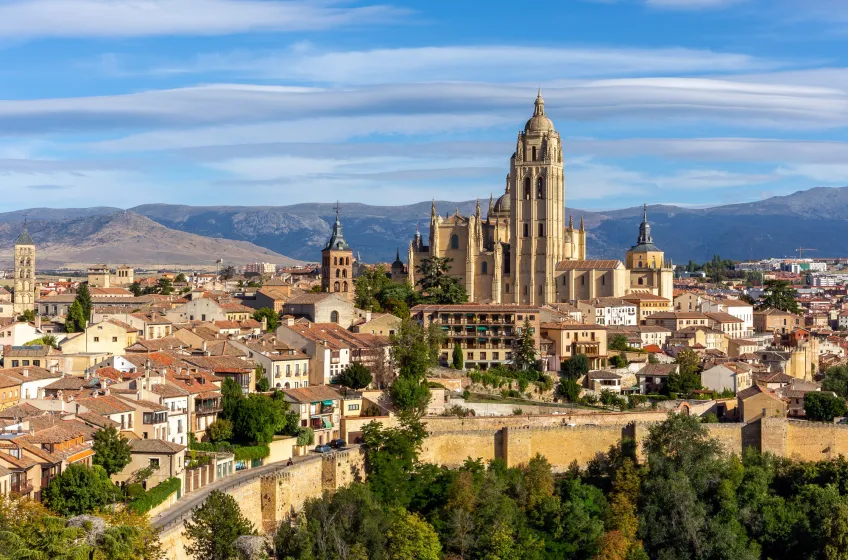
Segovia is a compact historic city in central Spain, set on a rocky ridge between the rivers Eresma and Clamores, around 90 kilometres north-west of Madrid. Known for its monumental Roman aqueduct, Gothic cathedral, fairy-tale Alcázar and excellent Castilian food, this atmospheric city is a perfect destination for history lovers, architecture enthusiasts and day trippers from the capital. With medieval streets, sweeping viewpoints and easy access to the Sierra de Guadarrama, Segovia offers one of the most rewarding short breaks in central Spain.
Browse Segovia Hotels and Other Accommodation
Pre-book Segovia Activities, Tours and Experiences
Why is Segovia Worth a Visit?
Segovia is worth visiting because it brings together three exceptional landmarks within a small and walkable historic centre. The Roman aqueduct dominates the lower city, the cathedral rises above Plaza Mayor and the Alcázar occupies a dramatic rocky spur at the far end of the old town.
The city’s setting adds greatly to its appeal. Segovia stands above deep valleys, with views towards the Castilian plain and the mountains beyond. Walking from the aqueduct to the Alcázar feels like moving through successive periods of Spanish history, from Roman engineering to medieval fortifications and royal architecture.
Segovia is also one of the best places to try traditional Castilian cooking. Roast suckling pig is the city’s most famous dish, while lamb, beans and local pastries also feature prominently.
Many visitors arrive on a day trip from Madrid, but staying overnight is worthwhile. The streets become quieter in the evening, the main monuments are attractively illuminated and the city feels far more relaxed once the excursion groups leave.
Segovia Highlights: Things to See and Do in Segovia
See the Roman Aqueduct
Segovia’s Roman aqueduct is the city’s defining landmark and one of the best-preserved ancient structures in Spain.
Built from massive granite blocks without mortar, it once carried water from the surrounding mountains into the city. Its tallest surviving section crosses Plaza del Azoguejo on two tiers of arches.
The engineering is impressive from ground level, but several nearby stairways and terraces provide elevated views across the arches and rooftops.
Early morning is the best time for quieter photographs. The aqueduct is also particularly dramatic after dark when it is illuminated.
Explore Plaza del Azoguejo
Plaza del Azoguejo sits directly beneath the aqueduct and forms the main entrance to Segovia’s old town.
The square is surrounded by cafés, restaurants and historic buildings. It is one of the busiest parts of the city, especially when tour groups arrive.
From here, Calle de Cervantes and Calle Juan Bravo climb towards the cathedral and Plaza Mayor. The route passes shops, churches and several attractive viewpoints.
Walk Through the Jewish Quarter
Segovia’s former Jewish quarter lies close to the cathedral.
Narrow streets, stone buildings and historic religious sites reflect the city’s once important Jewish community. The former main synagogue was later converted into the Church of Corpus Christi.
Interpretation centres and small exhibitions provide context on Sephardic life, worship and expulsion from Spain.
The district is quieter than the streets around the aqueduct and makes a pleasant route towards the city walls.
Visit Segovia Cathedral
Segovia Cathedral stands on Plaza Mayor and is one of the last great Gothic cathedrals built in Spain.
Its pale stone, tall pinnacles and elegant tower dominate the historic skyline. Inside, visitors can explore chapels, choir stalls, cloisters and religious artworks.
The interior feels unusually light and spacious. The cloister is especially peaceful and provides a useful break from the busier central streets.
Tower visits may be available separately and usually involve many steps.
Relax in Plaza Mayor
Plaza Mayor is the social centre of historic Segovia.
The cathedral occupies one side, while arcaded buildings, cafés and the Juan Bravo Theatre surround the rest of the square. It is an excellent place to stop between the aqueduct and Alcázar.
The square is especially attractive in the early evening, when residents gather and the light softens across the cathedral façade.
Visit the Alcázar of Segovia
The Alcázar stands on a rocky outcrop above the meeting of two river valleys.
Its pointed towers, slate roofs and dramatic position give it the appearance of a storybook castle. The building served as a royal palace, fortress, prison and military academy at different times.
Inside, visitors can see ceremonial rooms, armour, painted ceilings and displays connected with the Spanish monarchy. The Throne Room and Hall of Kings are among the principal highlights.
Allow at least 90 minutes for the palace and museum areas.
Climb the Tower of Juan II
The Tower of Juan II rises above the Alcázar entrance.
A steep spiral staircase leads to the upper platform, where views extend across Segovia, the cathedral, surrounding plains and distant mountains.
The climb is physically demanding and enclosed in places. It is not suitable for everyone, but the panorama is one of the best in the city.
Tower access usually requires a separate ticket or timed entry.
See the Alcázar from Mirador de la Pradera de San Marcos
The Pradera de San Marcos provides the classic view of the Alcázar from below.
From the grassy area beside the River Eresma, the castle appears to rise directly from the rocky ridge. The viewpoint is especially photogenic during late afternoon and early evening.
Reaching it involves a downhill walk from the old town, followed by a climb back. Comfortable footwear is essential.
Walk Along the City Walls
Sections of Segovia’s medieval walls and gateways remain around the historic centre.
The wall route offers views over the surrounding valleys, monasteries and countryside. The area near the former Jewish quarter and Puerta de San Andrés is particularly attractive.
Access to individual sections may vary, but walking around the outer edge of the old town provides a useful sense of Segovia’s defensive position.
Visit the Church of San Esteban
San Esteban is one of Segovia’s finest Romanesque churches.
Its tall bell tower is one of the most elegant in the city, while the arcaded exterior reflects the distinctive Romanesque style found throughout Segovia.
The interior is relatively restrained, but the church’s exterior and surrounding streets are well worth seeing.
Explore Segovia’s Romanesque Churches
Segovia has an exceptional collection of Romanesque churches.
San Martín stands beside an attractive square and has a richly arcaded exterior. San Millán resembles a simplified Romanesque basilica, while San Lorenzo occupies a quieter neighbourhood below the old town.
These churches distinguish Segovia from many other Spanish cities and can be explored on foot as part of a longer architectural walk.
Visit the Casa de los Picos
The Casa de los Picos is one of Segovia’s most recognisable historic houses.
Its façade is covered with projecting granite points, creating a distinctive geometric surface. The building now hosts exhibitions and cultural activities.
It stands conveniently on the route between the aqueduct and Plaza Mayor.
See the Monastery of El Parral
The Monastery of Santa María del Parral stands in the Eresma Valley below the old town.
Its quiet setting, Gothic church and monastic architecture create a strong contrast with the busy centre. Access may be limited because it remains an active religious community.
The surrounding valley walk offers excellent views towards Segovia’s walls and towers.
Visit the Monastery of San Antonio el Real
San Antonio el Real began as a royal hunting residence before becoming a convent.
Its interiors contain Mudéjar ceilings, decorative plasterwork and historic monastic rooms. It is one of Segovia’s most interesting but less visited attractions.
The monastery lies east of the old centre and can be reached on foot or by local transport.
Walk Through the Eresma Valley
The Eresma Valley provides one of Segovia’s best walking routes.
Paths pass beneath cliffs, monasteries, woodland and views towards the Alcázar. The route reveals how dramatically the old city rises above its surroundings.
The terrain is generally straightforward, but some sections may be muddy after rain.
Explore the Former Royal Mint
The Real Casa de Moneda stands beside the River Eresma below the Alcázar.
It was one of Europe’s earliest mechanised mints and used water power in the production of coins. Exhibitions explain the machinery, industrial process and history of the site.
The riverside location makes it easy to combine with the Alcázar viewpoint and valley walk.
Visit La Granja de San Ildefonso
La Granja lies in the foothills of the Sierra de Guadarrama, a short journey from Segovia.
Its Royal Palace was inspired partly by Versailles and is surrounded by formal gardens, fountains and woodland. The interiors contain royal rooms, tapestries and decorative collections.
The fountains operate only on selected dates and occasions, so check arrangements before travelling specifically to see them.
The town is also known for its beans and glassmaking heritage.
Explore the Royal Glass Factory
The Royal Glass Factory at La Granja reflects the town’s long association with decorative glass.
Displays cover glassmaking techniques, historic pieces and industrial production. Demonstrations may take place depending on the programme.
It combines well with the palace and gardens.
Practical Advice for Visitors
Getting There
High-speed trains connect Madrid Chamartín with Segovia-Guiomar station in under half an hour on many services.
Segovia-Guiomar lies several kilometres outside the historic centre. Local buses and taxis connect the station with the aqueduct and old town.
Regional buses from Madrid usually arrive closer to the centre and can be more convenient for day trippers staying near Moncloa.
Driving from Madrid generally takes around 90 minutes, depending on traffic and route.
Getting Around
Segovia’s historic centre is compact and best explored on foot.
The route from the aqueduct to the Alcázar is mostly uphill at first and then relatively level, though side streets and viewpoints involve slopes and steps.
Local buses are useful for the railway station, outer neighbourhoods and La Granja.
The descent to the Eresma Valley and Alcázar viewpoint is steep, so allow extra time for the return climb.
Parking
Driving into the historic centre is inconvenient because of narrow streets, pedestrian areas and access restrictions.
Public car parks are available near the aqueduct and around the outer edge of the old town. Spaces fill quickly during weekends and holidays.
Leave the car outside the centre and explore on foot.
Choosing Where to Stay
Accommodation near Plaza Mayor is ideal for historic atmosphere and evening dining.
The area around the aqueduct is more convenient for buses, shops and arrival from the lower city.
Hotels outside the walls may offer easier parking and better road access.
An overnight stay is especially worthwhile for photographers and travellers seeking a quieter old-town experience.
Dining
Segovian cuisine is rich, traditional and heavily influenced by Castilian cooking.
The city’s most famous dish is roast suckling pig, usually cooked until the skin is crisp and the meat extremely tender. Roast lamb is another common speciality.
Judiones de La Granja are large white beans served in a substantial stew with pork products. They are especially associated with the nearby royal town.
Lunch is generally served after 1.30pm, while dinner often begins after 8.30pm.
Try Cochinillo Asado
Cochinillo asado is Segovia’s signature dish.
Traditionally, the piglet is roasted whole in a wood-fired oven and divided into portions at the table. Some restaurants perform a ceremonial cutting with the edge of a plate to demonstrate the tenderness.
It is a rich meal and is often best shared. Reservations are advisable at the best-known restaurants, especially at weekends.
Local Sweets
Segovia’s traditional dessert is ponche segoviano.
This layered cake combines sponge, cream and marzipan, often with a decorated sugary top. It is rich but usually served in small portions.
Bakeries and restaurants throughout the centre sell it.
Shopping
Typical purchases include local pastries, ceramics, wine, cured meat and food products from Castile and León.
Souvenir shops cluster around the aqueduct and Plaza Mayor, while smaller food businesses provide more regional options.
Check customs restrictions before travelling internationally with meat or dairy products.
When to Visit
April to June is one of the best periods for mild weather, green valleys and comfortable walking.
September and October are also excellent, with clear light and fewer summer crowds.
July and August can be hot during the afternoon, though evenings are cooler than in Madrid because of Segovia’s elevation.
Winter is cold and can bring frost, wind and occasional snow. The city is particularly atmospheric in clear winter light, but warm clothing is essential.
Local Events
Segovia hosts religious festivals, music programmes, theatre and cultural events throughout the year.
Holy Week brings processions through the historic centre, while summer events often use courtyards, squares and heritage buildings.
La Granja has royal and fountain-related celebrations on selected dates.
Event arrangements vary annually, so check the programme before planning around a particular festival.
Safety and Common Visitor Problems
Segovia is generally safe and easy to explore.
The main practical risks are uneven paving, steep slopes and summer heat. Wear shoes with good grip and carry water.
Pickpocketing is less common than in Madrid but can still occur around crowded transport stops and major attractions.
Allow enough time to return to Segovia-Guiomar station, as it is well outside the centre.
Exploring Beyond Segovia
La Granja de San Ildefonso is the easiest nearby excursion for a royal palace, formal gardens and mountain scenery.
Pedraza is a beautifully preserved stone village with a castle and arcaded main square.
Sepúlveda is a historic hill town near the dramatic Duratón River gorges.
The Hoces del Río Duratón Natural Park offers canyon scenery, walking and large colonies of griffon vultures.
Ávila is known for its complete medieval walls and can be combined with Segovia on a longer central-Spain itinerary.
Madrid is easily reached by fast train, while the Sierra de Guadarrama offers further walking and mountain villages to the south.
Shortlist
- Your Shortlist is empty