
Discover Galicia | A Visitor's Introduction to Galicia
Recommended places to stay, places to visit and things to do throughout Galicia
Galicia is a green, Atlantic-facing region in north-western Spain, known for its dramatic coastline, pilgrimage traditions, Celtic-influenced culture, seafood and granite-built towns. With Santiago de Compostela at its heart and wild landscapes stretching from the Rías Baixas to the cliffs of the Costa da Morte, Galicia is a perfect destination for walkers, food lovers, history enthusiasts and travellers seeking a cooler, less crowded side of Spain. Its combination of religious heritage, fishing villages, vineyards, beaches and forested hills makes Galicia one of the country’s most distinctive regions.
Browse Galicia Hotels and Other Accommodation
Pre-book Galicia Activities, Tours and Experiences
Why is Galicia Worth a Visit?
Galicia is worth visiting because it feels markedly different from Mediterranean Spain. The climate is wetter, the countryside is intensely green and the coast is broken into long estuaries, rocky headlands and sheltered beaches.
The region’s strongest cultural landmark is Santiago de Compostela, the destination of the Camino de Santiago pilgrimage routes. Pilgrims arrive from across Europe, giving the city a remarkable international atmosphere despite its modest size.
Food is another major reason to visit. Galicia is famous for octopus, shellfish, fish, beef, empanadas, soft cheeses and crisp white wines. Even small coastal towns often have excellent restaurants, markets and harbour-side taverns.
The coastline offers enormous variety. The Rías Baixas are known for beaches, vineyards and island scenery, while the Costa da Morte is wilder and more exposed. Northern Galicia adds high cliffs, remote capes and quieter fishing communities.
A week allows time for Santiago, one coastal area and one inland city. Ten days to two weeks are better for exploring the region by car and experiencing its strong local contrasts.
Galicia Highlights: Things to See and Do in Galicia
Explore Santiago de Compostela
Santiago de Compostela is Galicia’s capital and one of Europe’s most important pilgrimage cities.
Its historic centre is built from granite and filled with arcaded streets, churches, monasteries and lively squares. The city is compact, atmospheric and easy to explore on foot.
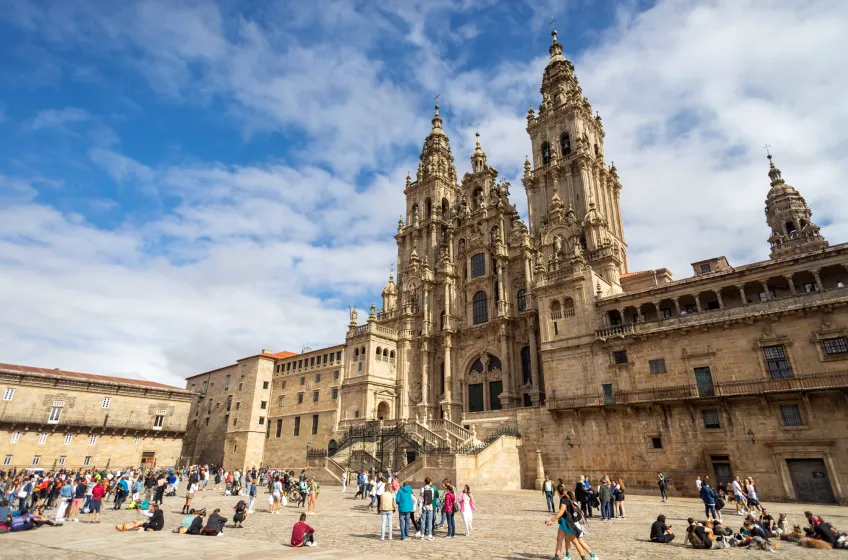
Praza do Obradoiro is the ceremonial heart of Santiago, where pilgrims gather at the end of their journey. The surrounding buildings include the cathedral, the former royal hospital and important university institutions.
Stay at least one night if possible. The city becomes quieter and more atmospheric after day visitors leave.
Visit Santiago Cathedral
Santiago Cathedral is the city’s defining landmark.
The building combines Romanesque, Gothic, Baroque and later elements, reflecting centuries of pilgrimage and rebuilding. Its western façade dominates Praza do Obradoiro.
Inside, visitors can see the shrine traditionally associated with Saint James, the main altar and historic chapels. The cathedral museum and rooftop areas add further context.
Religious services can affect visitor access. Dress respectfully and check arrangements before entering.
Experience the Camino de Santiago
The Camino de Santiago is not one route but a network of pilgrimage trails ending in Santiago.
The French Way is the best known, but Galicia also contains the Portuguese Way, Northern Way, Primitive Way, English Way and the route from Santiago towards Fisterra and Muxía.
Visitors do not need to walk for weeks to appreciate the Camino. Completing a shorter section, such as the final stage into Santiago, still provides insight into the rhythm of pilgrimage.
Accommodation fills quickly during peak periods, especially in summer and around religious festivals.
Explore the Rías Baixas
The Rías Baixas are a group of broad estuaries along Galicia’s south-western coast.
Sheltered water, sandy beaches, fishing towns and vineyard-covered slopes make this one of the region’s most popular areas. The coastline includes the rías of Vigo, Pontevedra, Arousa and Muros-Noia.
This is the heartland of Albariño wine and much of Galicia’s shellfish production. A car is useful for exploring smaller ports and beaches.
Visit the Cíes Islands
The Cíes Islands lie at the entrance to the Ría de Vigo and form part of the Atlantic Islands of Galicia National Park.
White beaches, clear water, cliffs and seabird colonies create one of Galicia’s most memorable coastal landscapes. Praia de Rodas is the best-known beach.
Visitor numbers are controlled, and boat tickets and permits may both be required during busy periods. Book well ahead in summer.
Facilities are limited, so carry water, sun protection and anything else needed for the day.
Discover Vigo
Vigo is Galicia’s largest city and an important Atlantic port.
Its compact old town rises above the harbour, while the waterfront reflects a long connection with fishing, shipbuilding and maritime trade. Seafood restaurants and oyster sellers are central to the city’s identity.
The Castro viewpoint provides broad views over the estuary and Cíes Islands. Vigo is also the principal departure point for many island boat services.
The city is hilly, so comfortable footwear is useful.
Explore Pontevedra
Pontevedra has one of Galicia’s most attractive and walkable historic centres.
Granite squares, arcaded streets, churches and small palaces create an intimate atmosphere. The centre is largely pedestrianised, making it pleasant for slow exploration.
Praza da Leña and Praza da Ferrería are among the best-known public spaces. The city also lies on the Portuguese Way to Santiago.
Pontevedra is an excellent base for the Rías Baixas and often feels calmer than Vigo.
Visit Combarro
Combarro is a small coastal village known for its waterfront granaries, or hórreos.
These narrow raised structures were traditionally used to store grain away from damp and animals. Several stand directly beside the water, creating one of Galicia’s most recognisable village scenes.
The old lanes are compact but become very busy with day visitors. Arrive early or later in the afternoon for a quieter visit.
Explore Cambados
Cambados is one of the principal towns of the Albariño wine region.
Its stone streets, squares and historic houses reflect a long connection with wine and maritime trade. The ruins of Santa Mariña Dozo are especially atmospheric.
Wineries in and around the town offer tastings and tours, usually by advance arrangement.
Cambados also makes a useful base for exploring the Ría de Arousa.
Visit A Coruña
A Coruña is a lively Atlantic city built around a sheltered harbour.
Its waterfront is lined with distinctive glass-fronted buildings, giving parts of the city a bright, reflective appearance. The old town contains churches, squares and traditional restaurants.
The Tower of Hercules stands on a headland north of the centre and is the city’s most important landmark.
A Coruña works well for a two-night city break and as a base for the northern coast.
See the Tower of Hercules
The Tower of Hercules is an ancient lighthouse overlooking the Atlantic.
Its origins date to the Roman period, though the exterior was altered in later centuries. It remains one of the world’s most remarkable surviving historic lighthouses.
Paths around the headland lead through open coastal scenery, sculptures and viewpoints. Wind can be strong, even on bright days.
The interior climb involves stairs and may be limited by visitor controls.
Explore Lugo
Lugo is best known for its complete Roman walls.
The walls encircle the historic centre and can be walked along for views over rooftops, towers and surrounding districts. The circuit is one of the most distinctive urban walks in Spain.
Inside the walls are a cathedral, squares, markets and lively tapas streets. Lugo is also known for generous food culture and traditional dishes.
The city makes a useful inland stop between Santiago and eastern Galicia.
Visit Ourense
Ourense is a historic inland city on the River Miño.
Its cathedral, old streets and Roman bridge reflect a long urban history, but the city is especially known for thermal springs. Public and private bathing areas are located both in the centre and along the river.
Thermal facilities vary in style, temperature and access arrangements. Check current conditions before planning a visit.
Ourense also provides a gateway to the Ribeira Sacra wine region.
Explore the Ribeira Sacra
The Ribeira Sacra is a dramatic inland landscape where the Sil and Miño rivers cut through steep canyons.
Vineyards cling to terraced slopes, often worked largely by hand. The region is particularly associated with Mencía red wine and monastic heritage.
Boat trips provide views from the river, while roadside viewpoints reveal the scale of the canyon. Monasteries and Romanesque churches are scattered throughout the area.
A car is the most practical way to explore, but roads can be narrow and winding.
Visit the Sil Canyon
The Sil Canyon is one of inland Galicia’s most striking natural features.
Several viewpoints overlook steep, wooded slopes and vineyard terraces descending towards the river. Popular stops include high roadside lookouts and trailheads around the canyon rim.
Boat excursions offer a different perspective and are less physically demanding than hiking.
Morning light, afternoon light and seasonal vegetation can change the appearance dramatically.
Explore the Costa da Morte
The Costa da Morte stretches along Galicia’s exposed western coast.
It is known for shipwreck history, lighthouses, granite headlands, fishing villages and powerful Atlantic weather. The coast feels rougher and less developed than the Rías Baixas.
Muxía, Camariñas and Fisterra are among the principal stops. A car is highly useful because public transport is limited.
Never underestimate waves or cliff edges, especially during storms.
Visit Fisterra
Fisterra, or Finisterre, was long regarded as the western edge of the known world.
Its lighthouse stands on a rocky headland facing the Atlantic and has become a symbolic destination for pilgrims continuing beyond Santiago.
The village below has a harbour, restaurants and beaches. Sunset attracts many visitors, but cloud and fog are common.
The headland is exposed, so bring a warm layer even in summer.
Explore Muxía
Muxía is a small coastal town associated with pilgrimage traditions and the Costa da Morte.
The Sanctuary of Virxe da Barca stands beside large granite rocks and open sea. The setting is dramatic in both calm and stormy weather.
Muxía feels quieter than Fisterra and offers a stronger sense of a working coastal community.
Visit Ézaro Waterfall
Ézaro Waterfall is unusual because the River Xallas reaches the sea in a dramatic coastal setting.
A short walkway leads towards the base of the falls, while nearby viewpoints overlook the estuary and coast. Water flow can vary according to rainfall and river management.
The site is easy to combine with Fisterra or the southern Costa da Morte.
Discover Muros and Noia
Muros and Noia are historic towns on the Ría de Muros e Noia.
Muros has arcaded streets, a fishing harbour and an attractive maritime atmosphere. Noia lies farther inland and contains medieval churches, stone squares and a strong local market tradition.
Both are less crowded than the best-known Rías Baixas destinations.
Visit the Beach of the Cathedrals
Praia das Catedrais, or Beach of the Cathedrals, lies on Galicia’s northern coast.
At low tide, visitors can walk among enormous rock arches, caves and pillars shaped by the sea. At high tide, much of the beach disappears.
Access may be controlled during busy periods, and the timing of tides is essential. Never enter caves or isolated sections when the sea is rising.
The experience is weather-dependent but can be spectacular.
Explore Ribadeo
Ribadeo stands on the estuary marking the border between Galicia and Asturias.
Its centre contains elegant houses, harbour views and buildings reflecting former trading wealth. The town is a practical base for Praia das Catedrais and the northern coast.
Ribadeo also works well as a stop between Galicia and western Asturias.
Visit O Cebreiro
O Cebreiro is a small mountain village on the Camino Francés.
It is known for traditional round stone houses with thatched roofs, called pallozas, and for its historic pilgrimage church.
The village is highly atmospheric in mist, rain or snow, though mountain weather can make access difficult.
O Cebreiro is one of the strongest places to experience Galicia’s highland landscape and Camino culture.
Explore the Fragas do Eume
Fragas do Eume is one of Galicia’s most important Atlantic forest landscapes.
Wooded valleys, rivers and steep paths create excellent conditions for walking. The Monastery of Caaveiro stands within the forest and adds a strong historic focus.
Access arrangements and shuttle systems may vary during busy periods. Wear shoes suitable for damp and uneven ground.
Practical Advice for Visitors
Getting There
Galicia has airports at Santiago de Compostela, A Coruña and Vigo.
Santiago Airport is usually the most convenient for central and western Galicia. Vigo suits the southern Rías Baixas, while A Coruña is useful for the northern coast.
Long-distance trains connect Galicia with Madrid and other Spanish cities. Journey times have improved on several routes, but local connections can still be slower.
Coaches provide extensive coverage, including towns not served directly by rail.
Getting Around
A car is the best option for the Costa da Morte, Ribeira Sacra, small fishing villages and rural beaches.
Trains and buses connect the principal cities, including Santiago, A Coruña, Vigo, Pontevedra, Lugo and Ourense. Services are less frequent in rural areas.
Journey times can be longer than expected because of winding roads, estuaries and mountainous terrain.
Avoid trying to cover too much in a single day. Galicia rewards slow travel.
Driving and Parking
Vehicles drive on the right.
Motorways are generally good, while rural roads can be narrow, steep and lined with stone walls. Fog and heavy rain may reduce visibility.
Historic centres often have pedestrian zones and restricted traffic. Use public car parks outside the oldest streets.
Parking near famous beaches and coastal viewpoints fills quickly during summer.
Weather
Galicia has an Atlantic climate and receives more rain than much of Spain.
Showers are possible throughout the year, including summer. Pack a waterproof jacket, layers and shoes suitable for wet streets.
The coast is usually mild, while inland and mountain areas can be much colder in winter.
Weather often changes quickly, so plan flexible outdoor days.
Dining
Galician food is strongly connected with the sea and countryside.
Pulpo á feira is octopus served with olive oil, paprika and coarse salt, often on a wooden plate. Empanadas are filled pies made with fish, seafood or meat.
Other specialities include pork shoulder with turnip greens, Galician beef, peppers, shellfish and hearty broths.
Lunch commonly begins after 1.30pm, while dinner often starts after 8.30pm.
Seafood
Galicia is one of Europe’s great seafood destinations.
Mussels, clams, scallops, razor clams, spider crab, goose barnacles and octopus appear widely. Availability and price depend on season, weather and local harvesting restrictions.
Some shellfish is priced by weight, so ask before ordering. Goose barnacles can be especially expensive.
Harbour towns and fish markets often provide the strongest sense of local seafood culture.
Cheese
Galicia produces several well-known cheeses.
Tetilla is a mild, soft cheese with a distinctive rounded shape. San Simón da Costa is often lightly smoked, while Arzúa-Ulloa is creamy and delicate.
Cebreiro cheese is associated with the eastern mountains.
Specialist food shops and markets are the best places to compare regional varieties.
Wine
Galicia has several important wine regions.
Rías Baixas is best known for fresh Albariño whites. Ribeira Sacra produces Mencía reds and Godello whites from steep river valleys.
Ribeiro, Valdeorras and Monterrei add further styles, including aromatic whites and increasingly refined reds.
Advance booking is often required for winery visits.
Shopping
Typical regional purchases include wine, cheese, canned seafood, ceramics, leather goods and products linked with the Camino.
Santiago has the broadest range of pilgrimage and craft shops, while coastal towns are better for preserved fish and seafood.
Sargadelos ceramics are among Galicia’s most recognisable design products.
Most ordinary shops close on Sundays, apart from selected tourist locations.
Language
Galician and Spanish are both official languages.
Galician is closely related to Portuguese and appears widely on signs, public information and menus. Spanish is understood throughout the region.
English is common in major tourist centres but less dependable in rural areas.
Simple Galician words such as grazas for thank you are appreciated.
When to Visit
May to June is excellent for green landscapes, walking and quieter cities.
July and August offer the warmest weather but bring larger crowds to Santiago, the islands and popular beaches.
September is one of the best months, with fewer visitors and often pleasant conditions.
October can be attractive for wine and woodland colour, though rain becomes more likely.
Winter suits city breaks, food tourism and quiet coastal travel, but daylight is limited and storms can be severe.
Local Events
The Feast of Saint James is Santiago’s principal celebration, with religious events, concerts and public activities.
Albariño festivals take place in the Rías Baixas, particularly around Cambados.
Seafood festivals are held in many coastal towns, celebrating products such as octopus, mussels and shellfish.
Lugo’s Roman festival transforms the walled city with costumes and historical re-enactments.
Dates vary annually, so confirm current programmes before planning a visit around a specific event.
Exploring Beyond Galicia
Asturias lies to the east and offers cider culture, fishing villages and further Atlantic scenery.
Castile and León lies south-east, with León, Ponferrada, Zamora and the Camino de Santiago route.
Northern Portugal is a natural extension from southern Galicia. Porto, Braga, Guimarães and the Minho region combine easily with Vigo and the Rías Baixas.
The Portuguese Way also links Galicia directly with towns and cities across northern Portugal.
Shortlist
- Your Shortlist is empty