
Discover The Rhine Valley | A Visitor's Introduction to The Rhine Valley
Recommended places to visit, places to stay and things to do in and around The Rhine Valley
The Rhine Valley is a historic river region in western Germany, best known for the castle-lined Rhine Gorge between Bingen and Koblenz. With steep vineyards, medieval wine towns, hilltop fortresses and busy passenger boats, the valley is a perfect destination for walkers, cyclists, wine lovers and travellers exploring Germany by rail. Its combination of dramatic scenery, Rhine legends and remarkably dense heritage makes it one of the country’s most rewarding touring regions.
Recommended Rhine Valley hotels and other accommodation
Pre-book Rhine Valley Attractions, Tours & Experiences
Why is the Rhine Valley Worth a Visit?
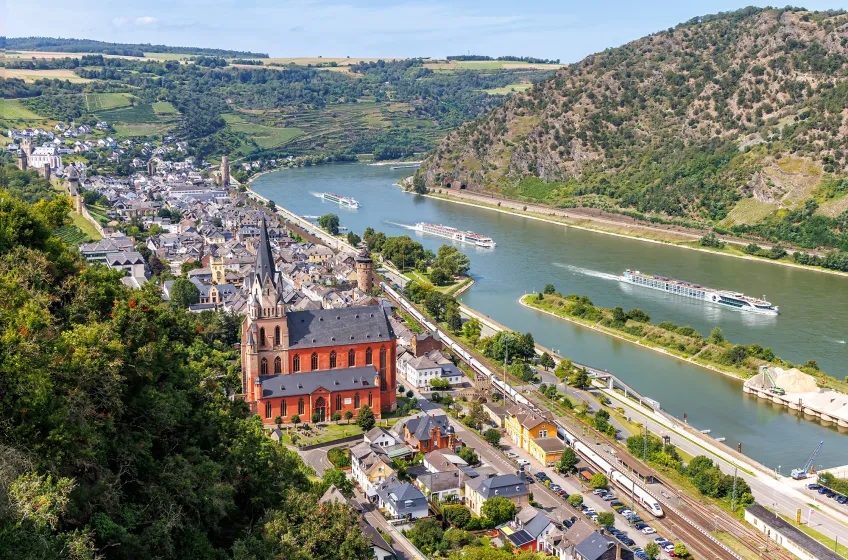
The Rhine Valley is worth visiting for its extraordinary concentration of castles, vineyards and historic settlements. The most celebrated section is the Upper Middle Rhine Valley, a UNESCO World Heritage Site extending for roughly 65 kilometres between Bingen, Rüdesheim and Koblenz.
Here, the river cuts through a narrow gorge beneath wooded and vine-covered slopes. Castles stand above bends in the Rhine, freight barges pass through the channel, and compact towns occupy the limited level ground beside the water.
The region is closely associated with German Romanticism. During the 19th century, artists and writers popularised its ruined castles, dramatic cliffs and legends, particularly the story of the Loreley. Many castles were later restored in an intentionally romantic style, contributing to the valley’s distinctive appearance.
The Rhine is also unusually easy to explore without a car. Railway lines run along both banks, passenger boats connect the principal towns during the main season, and long-distance trails follow the slopes above the river. Visitors can therefore combine a train journey, castle visit, vineyard walk and river cruise in a single day.
Rhine Valley Highlights: Things to See and Do in the Rhine Valley
See the Loreley
The Loreley is a steep slate rock beside one of the Rhine’s narrowest and historically most dangerous sections. It became famous through legends about a mysterious woman whose beauty and singing distracted passing boatmen.
The best-known viewpoints are on the eastern bank above St Goarshausen. A visitor area on the plateau includes walking paths and elevated views across the river towards St Goar and Rheinfels Castle.
The rock itself is easier to appreciate from the western bank or from a boat. River cruises pass directly beneath it, providing a clear sense of the gorge’s steep sides and restricted channel.
The Loreley plateau is exposed to sun and wind. Carry water in summer and allow enough time to walk between the viewpoints rather than treating it as a quick roadside stop.
Explore Bacharach
Bacharach is one of the Rhine Valley’s most appealing small towns. Its centre contains half-timbered houses, narrow lanes, sections of medieval wall and a lively collection of wine taverns.
The ruined Gothic Werner Chapel stands above the town and is one of Bacharach’s most distinctive landmarks. Continue uphill to Stahleck Castle, now used as a youth hostel, for broad views across the Rhine.
Several towers in the former town wall can be reached on foot. The climb is steep in places, but it provides excellent rooftop and river views.
Bacharach is compact and can be visited in a few hours. Staying overnight reveals a much quieter atmosphere once afternoon excursion groups have left.
Visit Rheinfels Castle
Rheinfels Castle rises above St Goar and is one of the largest castle ruins in the Middle Rhine region. Originally founded during the 13th century, it developed into an extensive fortress before being destroyed by French forces at the end of the 18th century.
Visitors can explore defensive walls, courtyards, underground passages and viewpoints overlooking the Rhine. Some tunnels are dark and narrow, so a torch can be useful even when basic lighting is provided.
The castle can be reached by a steep walk from St Goar. Seasonal transport may reduce the climb, but access arrangements vary.
Allow at least 90 minutes to explore properly. Wear sturdy shoes, as the ruins contain steps, uneven surfaces and low passages.
Wander Through St Goar and St Goarshausen
St Goar occupies the western bank beneath Rheinfels Castle, while the smaller St Goarshausen lies opposite near the Loreley.
St Goar is the more convenient base for many visitors because it has railway connections, accommodation, restaurants and easy access to river cruises. Its compact centre contains souvenir shops, cafés and buildings associated with Rhine tourism.
St Goarshausen provides access to Katz Castle, the Loreley plateau and the eastern-bank walking trail. Although Katz Castle is privately owned and cannot generally be visited, it forms one of the valley’s classic views.
A small passenger ferry connects the two towns. There is no bridge at this point, so check the final crossing time when moving between the riverbanks.
Discover Boppard
Boppard stands on a broad bend of the Rhine and offers a useful combination of history, restaurants, transport connections and walking routes.
The town preserves sections of Roman fortifications, medieval churches and attractive squares. Its riverside promenade is lined with hotels, cafés and landing stages.
One of the best local excursions is the climb or chairlift journey towards the Vierseenblick and Gedeonseck viewpoints. From above, overlapping hills make the Rhine appear to form four separate lakes.
The walk through the vineyards is steep but rewarding. The chairlift normally operates seasonally and may close in poor weather, so check before relying on it.
Boppard is a strong base for travellers who want more facilities than Bacharach or St Goar without staying in a large city.
Explore Rüdesheim am Rhein
Rüdesheim stands at the southern entrance to the Rhine Gorge and is one of the region’s busiest wine towns.
The narrow Drosselgasse is its most famous street, filled with restaurants, music venues, wine taverns and souvenir shops. It is highly commercial but lively, particularly during summer evenings.
A cable car climbs above the vineyards to the Niederwald Monument, which commemorates the unification of Germany. The elevated paths provide wide views over the Rhine, Bingen and the surrounding wine country.
A popular circular excursion combines the cable car, a walk through the Niederwald landscape, a chairlift descent to Assmannshausen and a boat journey back to Rüdesheim.
Visit Marksburg Castle
Marksburg Castle stands above Braubach on the eastern bank and is the only major hilltop castle in the Middle Rhine that was never destroyed.
Its preserved medieval features include defensive gateways, living rooms, a kitchen, chapel, armour displays and battlements. The interior is normally explored on a guided tour.
Unlike the romantic reconstructions found elsewhere in the valley, Marksburg gives visitors a clearer impression of how a medieval fortress functioned. Its position also provides sweeping views across the Rhine.
The climb from Braubach railway station is steep and takes roughly 30 to 45 minutes for many visitors. Limited parking is available closer to the castle, though the final approach still involves slopes and uneven ground.
Tour Rheinstein Castle
Rheinstein Castle occupies a dramatic rocky position above the river between Bingen and Trechtingshausen.
Originally constructed during the Middle Ages, it was restored in the 19th century as part of the Romantic movement’s fascination with the Rhine. Its compact interior contains furnished rooms, stained glass, armour and historic objects.
Terraces and gardens offer excellent river views, while the castle’s position directly above the railway and water makes it especially photogenic from passing boats.
Reaching the entrance requires a steep uphill walk with numerous steps. Visitors with limited mobility should check current access arrangements before travelling.
See Pfalzgrafenstein Castle
Pfalzgrafenstein Castle occupies a tiny island in the Rhine near Kaub. Its white walls, black roof and ship-like shape make it one of the valley’s most unusual landmarks.
The castle was built as a toll station, allowing rulers to control river traffic. Unlike many hilltop castles, it was designed around the practical business of collecting money from passing vessels.
Access normally involves a small ferry from Kaub when river and weather conditions permit. Service can be suspended when water levels are unsuitable.
Even without entering, the castle is easily viewed from trains, riverside paths and boats. Gutenfels Castle, standing above Kaub, completes the scene.
Visit Koblenz and the Deutsches Eck
Koblenz stands where the Moselle joins the Rhine and forms the northern gateway to the Middle Rhine Valley.
The meeting point is marked by the Deutsches Eck, a monumental headland dominated by an equestrian statue of Emperor Wilhelm I. Riversides on both the Rhine and Moselle provide broad promenades.
A cable car crosses the Rhine to Ehrenbreitstein Fortress, one of Europe’s largest preserved fortress complexes. Its walls, courtyards and museums occupy a commanding plateau above the city.
Koblenz is larger and busier than the valley’s wine towns, but its railway connections make it a practical starting or finishing point. It also allows visitors to combine the Rhine with a journey into the Moselle Valley.
Explore Eltville and the Rheingau
Eltville lies upstream from the Rhine Gorge in the Rheingau wine region. Its historic centre contains timber-framed houses, a rose garden and the remains of an electoral castle beside the river.
The town is especially associated with Riesling and sparkling wine. Estate shops, wine bars and seasonal tasting stands provide opportunities to sample local producers.
Nearby wine villages include Hattenheim, Oestrich-Winkel and Johannisberg. Schloss Johannisberg occupies a prominent vineyard setting and has played an important role in the history of Riesling.
Eltville is easily reached by regional train from Wiesbaden, Mainz and Rüdesheim, making it a good alternative for visitors who prefer a quieter wine-town atmosphere.
Take a Rhine Cruise
A passenger-boat journey is one of the best ways to experience the Rhine Gorge. From the water, the concentration of castles and steep vineyards becomes far more apparent than it does from the road.
The most scenic section lies between Rüdesheim or Bingen and St Goar or St Goarshausen. This route passes Rheinstein, Reichenstein, Sooneck and Pfalzgrafenstein castles before reaching the Loreley.
Longer services continue towards Boppard and Koblenz. These journeys are attractive but slow, particularly when travelling against the river’s current.
Scheduled boats generally operate most frequently between spring and autumn. Services become much more limited in winter, and departures can change because of high or low water.
Treat the cruise as an excursion rather than the quickest way to travel. Regional trains are considerably faster for returning to your starting point.
Walk the Rheinsteig
The Rheinsteig is a long-distance walking trail following the eastern side of the Rhine between Bonn, Koblenz and Wiesbaden.
Within the Middle Rhine Valley, it climbs through forests, vineyards and rocky slopes above the river. The frequent ascents provide outstanding views but make the route more demanding than a flat riverside walk.
Popular sections include the paths around Rüdesheim, the Loreley, Braubach and the area opposite Boppard. Railway stations and ferries make it possible to complete individual stages without walking the entire route.
Wear proper walking shoes and carry water. Some sections contain narrow paths, steep drops or slippery rock, particularly after rain.
Walk the RheinBurgenWeg
The RheinBurgenWeg follows the western bank between Bingen and Remagen, passing vineyards, forests, castles and historic towns.
It provides access to places such as Bacharach, Oberwesel, St Goar and Boppard. Individual stages can be combined with regional trains, making it suitable for day walks.
The trail often leaves the immediate riverbank to reach viewpoints above the valley. Expect repeated climbs and descents even when the distance appears modest.
Route diversions can occur after storms, landslides or forestry work. Follow current signs rather than relying entirely on an older map.
Practical Advice for Visitors
Getting There
Frankfurt Airport is the most convenient major international gateway for the southern and central Rhine Valley. Direct or connecting trains travel to Mainz, Wiesbaden, Bingen, Rüdesheim, Koblenz and other regional centres.
Cologne Bonn Airport is useful for Koblenz and the northern Rhine. Düsseldorf Airport can also work, though the onward journey is longer.
Mainz, Wiesbaden, Koblenz and Bingen have strong railway connections. Smaller destinations such as Bacharach, Oberwesel, St Goar, Boppard, Braubach and Rüdesheim are served by regional trains.
High-speed services between Frankfurt and Cologne often use an inland route and avoid the Rhine Gorge. Choose regional trains or long-distance services travelling via Mainz, Bingen and Koblenz when the scenery matters.
Choosing Where to Stay
Bacharach is ideal for medieval atmosphere, half-timbered streets and a peaceful overnight stay. Its selection of restaurants and hotels is relatively small.
St Goar is centrally positioned for the Loreley, Rheinfels Castle, ferries and boat services. It is one of the most practical bases for a short visit.
Boppard offers more restaurants, hotels and evening activity while retaining an attractive riverside setting. Its railway station makes day trips straightforward.
Rüdesheim is convenient for wine, cruises and access from Frankfurt, although its central streets can be crowded and commercial.
Koblenz provides the widest range of accommodation and transport. It is best for travellers combining the Rhine with the Moselle but feels less intimate than the smaller towns.
Getting Around Without a Car
Two railway lines serve the Rhine Gorge, one on each bank. The western-bank route is generally the most useful for visitors because it connects Bingen, Bacharach, Oberwesel, St Goar, Boppard and Koblenz.
The eastern line serves Rüdesheim, Assmannshausen, Lorch, Kaub, St Goarshausen and Braubach. Local ferries connect the banks at selected points.
There are few bridges within the central gorge. Road and passenger ferries are therefore important, but evening crossings may finish earlier than expected.
Passenger boats are scenic but slower and less frequent than trains. A practical itinerary often uses a boat in one direction and a train for the return journey.
Driving and Parking
A car is useful for remote castles, vineyard viewpoints and villages away from the railway. However, the main river roads can be busy, narrow and slow.
Parking is limited in historic centres. Use designated riverside or station car parks rather than attempting to enter narrow old-town streets.
Railway lines often separate towns from the river, and level crossings can create delays. Freight traffic, cyclists and tour coaches add further congestion during summer.
Do not plan to visit numerous castles by car in one day. Access roads and uphill walks usually make each stop take longer than expected.
Dining
Traditional Rhine dishes include pork, sausages, schnitzel, game and seasonal asparagus. Regional menus may also feature sauerbraten, potato dishes and river fish.
Wine taverns are generally the most characteristic places to eat. Some serve full hot meals, while others offer only cheese, cold meats, bread and simple snacks.
Restaurant hours can be limited in smaller towns, particularly outside summer. Kitchens may close earlier than visitors from the UK expect, and some establishments take one or two rest days each week.
Reserve dinner on Friday and Saturday evenings. During winter, confirm that a restaurant is open before choosing accommodation in a small village.
Wine
Riesling is the defining grape of the Middle Rhine and Rheingau. The steep slate slopes produce wines ranging from dry and mineral to richly sweet.
Trocken indicates a dry wine, while halbtrocken and feinherb generally suggest some sweetness. Pinot Noir, known locally as Spätburgunder, is particularly associated with places such as Assmannshausen.
Family wineries may offer tastings by appointment rather than maintaining regular visitor hours. Contact producers in advance when a tasting is central to your trip.
Wine stands and seasonal taverns provide a more informal experience. Drink-driving rules are strict, making trains, walking and ferries the safest options for a tasting day.
Shopping
Wine is the most obvious regional purchase. Estate shops provide better opportunities to compare vineyards and vintages than general souvenir retailers.
Other local products include sparkling wine, fruit preserves, spirits, honey, mustard and grape-based foods.
Rüdesheim and Koblenz have the widest souvenir selection. Smaller towns such as Bacharach and St Goar offer wine shops, crafts and locally themed gifts.
Ask for protective packaging when carrying bottles by train or plane. Check airline baggage rules and customs allowances before buying large quantities.
When to Visit
May, June and September provide the best balance of pleasant weather, operating boat services and manageable crowds. Vineyards are green, walking conditions are usually comfortable and most attractions maintain regular hours.
July and August bring long days and the fullest transport schedules. They also bring heat, crowds and busy roads. Vineyard trails offer limited shade.
September and October are particularly attractive during the grape harvest. Wine festivals and autumn colours create a lively atmosphere, but popular accommodation fills quickly.
Winter is quiet and many castles, chairlifts and boat services reduce their opening times. Christmas markets provide seasonal interest in larger towns, while smaller villages can feel almost deserted.
Local Events
Rhine in Flames is the valley’s best-known series of events, combining illuminated boats, riverside festivities and evening displays at several locations along the river.
Wine festivals take place throughout the region from spring into autumn. Rüdesheim, Boppard, Bacharach, Oberwesel and Rheingau communities all host seasonal celebrations.
The Middle Rhine Wine Forum and numerous smaller tasting events allow visitors to compare producers from different parts of the valley.
Christmas markets are held in Koblenz, Rüdesheim and several smaller towns. Rüdesheim’s market has a particularly international character.
Dates vary each year, and accommodation prices rise sharply during major events. Confirm schedules before making non-refundable bookings.
Exploring Beyond the Rhine Valley
The Moselle Valley begins at Koblenz and leads towards Cochem, Bernkastel-Kues and Trier. Its tighter river bends, smaller wine villages and Riesling vineyards make it a natural extension to a Rhine itinerary.
Mainz lies just upstream from the Rheingau and offers a cathedral, Roman remains, the Gutenberg legacy and a lively wine culture.
Wiesbaden stands opposite Mainz and is known for thermal springs, grand 19th-century architecture and the Neroberg hillside.
Cologne is easily reached from Koblenz by train. Its enormous cathedral, museums and urban riverfront provide a strong contrast to the small towns of the Rhine Gorge.
The Ahr Valley, north-west of Koblenz, is known for Pinot Noir, walking trails and steep vineyards. Visitors should check current access and reconstruction conditions before travelling, as some communities continue to recover from the severe flooding of July 2021.
Shortlist
- Your Shortlist is empty