
Discover The Moselle Valley | A Visitor's Introduction to The Moselle Valley
Recommended places to visit, places to stay and things to do in and around The Moselle Valley
The Moselle Valley is a winding river region in western Germany, stretching from the Roman city of Trier towards Koblenz, where the Moselle meets the Rhine. Known for its steep vineyards, Riesling wines, medieval castles and half-timbered villages, this scenic region is a perfect destination for wine lovers, cyclists, walkers and travellers seeking a slower-paced touring holiday. With its dramatic river bends, historic towns and family-run wineries, the German Moselle offers one of the country’s most distinctive landscapes.
Recommended Moselle Valley hotels and other accommodation
Pre-book Moselle Valley Attractions, Tours & Experiences
Why is the Moselle Valley Worth a Visit?
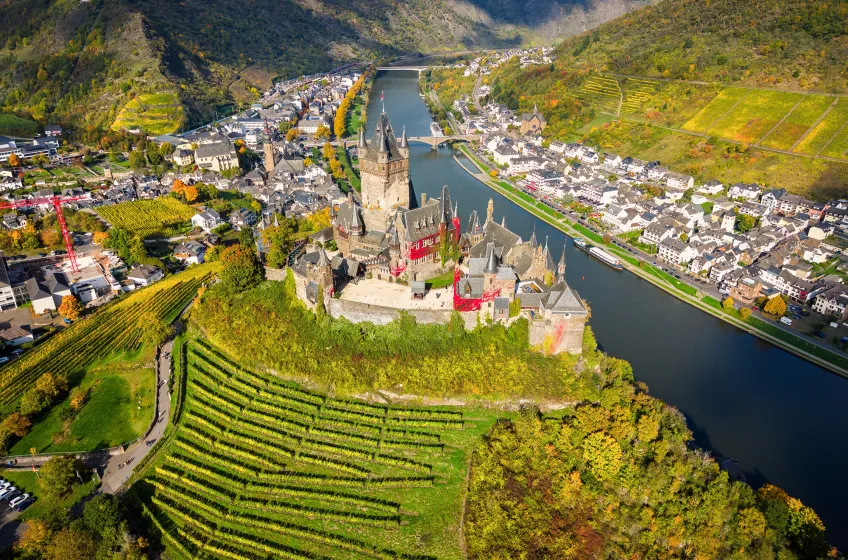
The Moselle Valley is worth visiting for the remarkable relationship between its river, vineyards and historic settlements. The Moselle twists through a narrow valley beneath slopes that are sometimes so steep that vines must be tended almost entirely by hand. Castles, ruined fortresses and small wine villages appear around almost every bend.
Riesling is central to the region’s identity. The slate soils and sheltered slopes produce wines ranging from crisp and dry to intensely sweet, and tastings are often available directly from small family-run estates. You do not need to be a wine expert to enjoy the experience; producers are generally happy to explain their vineyards and styles.
The valley is also unusually easy to explore by several forms of transport. Regional trains connect Trier, Cochem, Koblenz and a number of smaller communities. Passenger boats travel between popular towns during the main season, while the riverside cycle route is largely level and suitable for leisure riders.
Although it is possible to see one or two highlights on a day trip, the Moselle is best experienced over several days. Staying in different towns allows you to appreciate the quieter mornings and evenings after coach groups and day visitors have left.
Moselle Valley Highlights: Things to See and Do in the Moselle Valley
Explore Trier
Trier stands near the western end of the German Moselle and is one of the country’s most important historic cities. Founded during the Roman period, it contains an exceptional collection of ancient monuments.
The Porta Nigra is the city’s best-known landmark. This massive Roman gate is remarkably well preserved and can be explored inside. Other important sites include the Imperial Baths, the Roman amphitheatre and the vast Constantine Basilica.
Trier Cathedral incorporates architecture from several periods and stands beside the Gothic Church of Our Lady. The Hauptmarkt, with its colourful buildings, fountain and market cross, forms the centre of the old town.
Allow at least one full day for Trier. Two nights are worthwhile when combining the Roman attractions with museums, restaurants and nearby wineries.
Visit Cochem and Reichsburg Castle
Cochem is one of the most popular towns in the valley, set beneath a dramatic hilltop castle. Its riverfront, half-timbered centre and surrounding vineyards create the classic image of the Moselle.
Reichsburg Castle dominates the skyline from a rocky hill above the town. Although its origins are medieval, much of its present appearance comes from a romantic 19th-century reconstruction. Guided visits reveal decorative rooms, historic furniture and broad views over the river.
The climb from the centre is steep but manageable for most visitors with reasonable mobility. A shuttle service may operate during busier periods.
Cochem is very crowded during summer afternoons, so stay overnight or explore early in the morning. The quieter lanes away from the main market square are often more atmospheric than the busiest riverfront streets.
Wander Through Bernkastel-Kues
Bernkastel-Kues is one of the Moselle’s most attractive wine towns. Bernkastel occupies the historic side of the river, while Kues lies opposite and has close associations with the philosopher and theologian Nicholas of Cusa.
The medieval market square is surrounded by richly decorated half-timbered houses. The narrow Spitzhäuschen, or Pointed House, is particularly distinctive because its upper floors project above an extremely small base.
Above the town stand the ruins of Landshut Castle. The uphill walk passes through vineyards and leads to sweeping views over the river bend. A road and seasonal transport options provide easier access for visitors who do not want to climb.
Bernkastel-Kues has numerous wine taverns and estate shops. It makes a convenient base for boat trips, vineyard walks and excursions to nearby villages.
Discover Beilstein
Beilstein is a tiny settlement on the river’s northern side, often described as one of the prettiest villages on the Moselle. Its steep lanes, timber-framed houses and ruined castle create an intimate atmosphere.
The village is small enough to explore in an hour, but it is worth staying longer for lunch or a glass of wine. Steps lead uphill to the Carmelite church and the ruins of Metternich Castle, where the terrace offers excellent river views.
Beilstein receives many daytime visitors arriving by boat or coach. Early morning and late afternoon are the best times to experience its quieter character.
Parking is generally outside the historic centre, which contains steep, uneven streets and many steps.
Visit Eltz Castle
Eltz Castle stands in a wooded side valley north of the Moselle and is one of Germany’s most memorable castles. Its cluster of towers and timber-framed upper floors rises from a rocky setting surrounded by forest.
The castle has remained in the same family for many centuries and contains furnished rooms, armour, artworks and historic household objects. Interior access is usually through guided visits.
Eltz is not directly beside the Moselle. Drivers reach it through the countryside near Wierschem, followed by a walk or seasonal shuttle from the visitor car park.
Visitors using public transport can travel to a nearby railway station and continue by bus or on foot, but the journey requires more planning. Walking routes through the Eltz Forest provide the most rewarding approach for active travellers.
See the Moselle Bend at Bremm
The dramatic river loop near Bremm is one of the valley’s most photographed landscapes. The Moselle curves around a steep ridge covered by the Calmont vineyard, creating an almost complete horseshoe.
Calmont is among Europe’s steepest vineyard areas. A demanding climbing trail crosses the slope using narrow paths, ladders, fixed cables and rocky sections. It is suitable only for walkers who are comfortable with heights and properly equipped.
Less strenuous viewpoints can be reached from roads and ordinary walking paths above the valley. These provide impressive views without requiring the exposed climbing route.
Avoid the steepest paths during rain, ice or extreme heat. The slate surface can become slippery, while shade is very limited.
Explore Traben-Trarbach
Traben-Trarbach straddles both sides of the Moselle and has a different character from the region’s medieval villages. It became wealthy through the international wine trade during the late 19th and early 20th centuries.
The town is known for its Art Nouveau and Belle Époque architecture, including villas, hotels and commercial buildings. Large underground cellars beneath the streets were once used to store and export enormous quantities of wine.
Guided cellar tours reveal a hidden side of the town. During Advent, some underground spaces host an atmospheric Christmas market.
The ruined Grevenburg Castle stands above Trarbach and can be reached on foot for views across the town and valley.
Visit Zell and the Zeller Hamm
Zell lies on one of the Moselle’s largest river bends, known as the Zeller Hamm. The surrounding hills are covered with vineyards and provide excellent walking viewpoints.
The town is closely associated with the wine label Zeller Schwarze Katz, or Black Cat of Zell. Images of the black cat appear throughout the centre and on many local wine bottles.
Zell is less monumental than Cochem or Bernkastel-Kues, but it has a pleasant riverside setting and a more relaxed atmosphere. It is a useful stop for cyclists and visitors interested in tasting wine without the largest crowds.
Explore Koblenz and the Deutsches Eck
Koblenz marks the meeting point of the Moselle and Rhine. The two rivers converge at the Deutsches Eck, a monumental headland dominated by an equestrian statue.
A cable car crosses the Rhine to Ehrenbreitstein Fortress, which provides extensive views over both rivers and the surrounding city. The fortress contains exhibitions, courtyards and defensive structures.
Koblenz is larger and more urban than the Moselle’s wine towns, but it is a practical starting or finishing point for a valley journey. It has strong railway connections and easy access to the Rhine Valley.
The old town, riverside promenades and Electoral Palace can be explored within a day.
Cycle the Moselle Route
The Moselle Cycle Route follows the river from France and Luxembourg through Germany towards Koblenz. The German section passes vineyards, castles and numerous wine villages.
Much of the route is flat because it remains close to the river. This makes it suitable for leisure cyclists, families and riders carrying luggage, although some sections share space with pedestrians or local traffic.
Trier to Koblenz is a popular multi-day journey. Most cyclists take several days, allowing time for tastings, castle visits and detours into historic centres.
Bicycle hire is available in larger towns, and e-bikes are particularly useful for vineyard excursions. Check whether your accommodation provides secure storage and charging facilities.
Walk the Moselsteig
The Moselsteig is a long-distance walking trail following the valley between Perl, near Luxembourg, and Koblenz. It is divided into stages that can be tackled individually.
Unlike the largely flat cycle path, the walking route frequently climbs into vineyards and forests above the river. These ascents provide outstanding views but can be more demanding than the modest elevations suggest.
Popular sections include routes around Bernkastel-Kues, Cochem, Bremm and the lower Moselle near Kobern-Gondorf. Local connecting paths allow shorter circular walks.
Carry water and sun protection. Vineyard slopes can be extremely exposed, and shops or cafés may be limited outside the towns.
Take a Moselle River Cruise
Seasonal passenger boats connect many of the valley’s principal towns. Cruises offer an easy way to appreciate the steep vineyards, riverside castles and frequent bends without driving.
Short trips operate around places such as Cochem, Bernkastel-Kues and Trier. Longer services can be used to travel between neighbouring towns, though journey times are often much slower than by train.
Locks form part of many routes and can add considerable time to a sailing. Treat the boat as a scenic experience rather than the quickest form of transport.
Schedules are reduced outside the main visitor season. Check the final return departure carefully, especially when planning a one-way walk or cycle ride.
Taste Moselle Riesling
Riesling is the Moselle Valley’s defining grape. The region’s slate slopes produce wines with high acidity, mineral character and flavours that can include citrus, apple, peach and herbs.
German wine labels can initially seem complicated. Trocken normally indicates a dry wine, while halbtrocken or feinherb generally suggests some sweetness. Wines labelled Kabinett, Spätlese or Auslese refer primarily to grape ripeness rather than a simple sweetness scale.
Family wineries often offer informal tastings, sometimes without fixed opening hours. Contacting the producer in advance is polite and helps ensure that someone is available.
Drink-driving limits are strict, so use public transport, walk or designate a driver when visiting several estates.
Practical Advice for Visitors
Getting There
The Moselle Valley is most easily reached through Koblenz, Trier, Cologne, Frankfurt, Luxembourg or Saarbrücken.
Koblenz has strong rail connections with Cologne, Frankfurt and the Rhine Valley. Trier is accessible from Koblenz, Saarbrücken and Luxembourg. Regional trains run along much of the valley between Koblenz and Trier, stopping at Cochem, Treis-Karden, Bullay and other communities.
Some famous wine towns, including Bernkastel-Kues and Beilstein, do not have central railway stations. Reaching them requires a bus, boat, taxi or bicycle connection.
Frankfurt-Hahn Airport is geographically close to the central Moselle but has limited public transport and a flight network that changes frequently. Luxembourg Airport may be convenient for Trier and the upper valley.
Choosing Where to Stay
Trier is the best base for Roman history, museums and city restaurants. It suits travellers who prefer urban facilities and strong transport connections.
Cochem is convenient for first-time visitors, with a railway station, castle, boat services and a wide choice of accommodation. It is also one of the busiest places in the valley.
Bernkastel-Kues offers a classic wine-town atmosphere and good access to the central Moselle, but onward travel is more dependent on buses and boats.
Traben-Trarbach suits visitors interested in architecture, wine cellars and a quieter base. Koblenz is best for combining the Moselle with the Rhine Valley.
Smaller villages provide greater peace and more personal winery accommodation, although restaurants and evening transport may be limited.
Getting Around Without a Car
The railway between Koblenz and Trier is useful but does not follow every river bend. Stations may be some distance from the historic villages they serve.
Regional buses fill some gaps, although evening and Sunday services can be limited. Check the return journey before setting out, rather than assuming services run late.
Boats are enjoyable during the main season but are too infrequent to replace buses and trains entirely. Combining rail, boat, walking and cycling is often the most effective approach.
Some accommodation providers issue regional guest cards that include local transport or attraction discounts. Benefits vary, so ask what is included when booking.
Driving and Parking
A car provides access to hilltop viewpoints, remote wineries and villages without railway stations. However, driving through the valley can be slow because the river roads are narrow and winding.
Historic centres often have limited vehicle access. Cochem, Bernkastel-Kues and Beilstein are easier to explore after parking on the outskirts or beside the river.
Parking charges and restrictions vary between towns. Carry a payment card and some euro coins, as not every machine accepts the same methods.
Cyclists, tractors and pedestrians frequently share narrow roads. Drive cautiously around blind bends and vineyard access points.
Dining
Moselle food is hearty and straightforward. Typical dishes include pork, schnitzel, sausages, potato specialities and seasonal game.
The region’s vineyards influence local menus. Wine sauces, grape-based desserts and dishes designed to accompany Riesling are common. Autumn brings seasonal ingredients and newly fermented wine.
Look for a Straußwirtschaft or Weinstube. These small wine taverns often serve estate wines with simple regional food, though opening periods may be restricted.
Restaurants in small villages can close one or two days each week, and kitchens may finish earlier than expected. Reserve dinner during weekends and the autumn wine season.
Shopping
Wine is the principal local purchase. Buying directly from a winery provides the widest selection and an opportunity to learn about individual vineyards.
Other regional products include grape juice, wine jelly, spirits, mustard, honey and vineyard-themed crafts.
Ask wineries for protective boxes when transporting bottles by car or rail. Travellers flying home should check luggage limits and customs allowances.
Trier and Koblenz offer the broadest general shopping, while smaller towns focus on wine, food and souvenirs.
When to Visit
May and June are excellent for walking and cycling, with green vineyards, long days and generally moderate visitor numbers.
July and August provide the warmest weather and the fullest boat schedules. They also bring busy roads, crowded towns and exposed heat on vineyard paths.
September and October are particularly atmospheric during the grape harvest. Wine festivals, autumn colours and seasonal taverns create a lively mood, although accommodation can fill quickly.
Winter is quiet, and many boat services and attractions reduce their opening hours. Christmas markets in Trier, Koblenz and Traben-Trarbach provide a reason to visit, but smaller villages may feel very sleepy.
Local Events
Wine festivals take place throughout the valley from late spring into autumn. They usually combine local producers, regional food, music and public wine tastings.
The Bernkastel-Kues wine festival is among the region’s largest celebrations. Cochem also hosts seasonal wine events and a castle festival, while smaller villages organise more intimate celebrations linked to the harvest.
Trier and Koblenz hold large Christmas markets. Traben-Trarbach is known for an underground Advent market staged in historic wine cellars.
Dates change annually, and accommodation prices rise around major events. Check the local tourism calendar before booking.
Exploring Beyond the Moselle Valley
The Rhine Valley begins at Koblenz and continues past castles, vineyards and towns such as Boppard, St Goar and Bacharach. It combines easily with a Moselle itinerary.
Luxembourg City is a straightforward excursion from Trier. Its fortified old quarters, ravines and European institutions provide a strong contrast to the wine villages.
The Eifel region north of the Moselle contains volcanic lakes, forests and walking routes. It is particularly accessible from the central and lower valley.
Saarburg, south-west of Trier, has a waterfall running through its old centre and makes an attractive half-day trip.
For a broader wine itinerary, continue towards the Saar and Ruwer valleys, where cooler conditions produce elegant Rieslings with a different character from those of the central Moselle.
Shortlist
- Your Shortlist is empty