
Discover Trier | A Visitor's Introduction to Trier
Recommended places to visit, places to stay and things to do in and around Trier
Trier is Germany’s self-styled oldest city, tucked into a bend of the Moselle River near the Luxembourg border. Known for its extraordinary cluster of Roman monuments and handsome medieval squares, this compact university city is a gem for history lovers, wine fans and weekend flâneurs alike. With vine-striped hills, grand churches and a lively café scene, Trier offers a relaxed Moselle escape with serious cultural clout.
Recommended Trier Hotels & Other Accommodation
Pre-book Trier Attractions, Tours & Experiences
Why is Trier Worth a Visit?
Trier is worth visiting for its unique layering of eras: imperial Rome, the early Christian world and the Middle Ages all left showpiece landmarks within easy walking distance. Once Augusta Treverorum, a major Roman capital in the west, the city preserves a mighty city gate, monumental bath complexes and an amphitheatre—unmatched elsewhere in Germany. Add the country’s oldest cathedral and one of the world’s great hoards of Roman gold, and you have a destination where big sights come thick and fast yet the atmosphere remains mellow and small-town. The riverside, lined with wine taverns and boat piers, brings everything back to the Moselle’s unhurried rhythm.
Trier Highlights: Things to See and Do in Trier
Porta Nigra
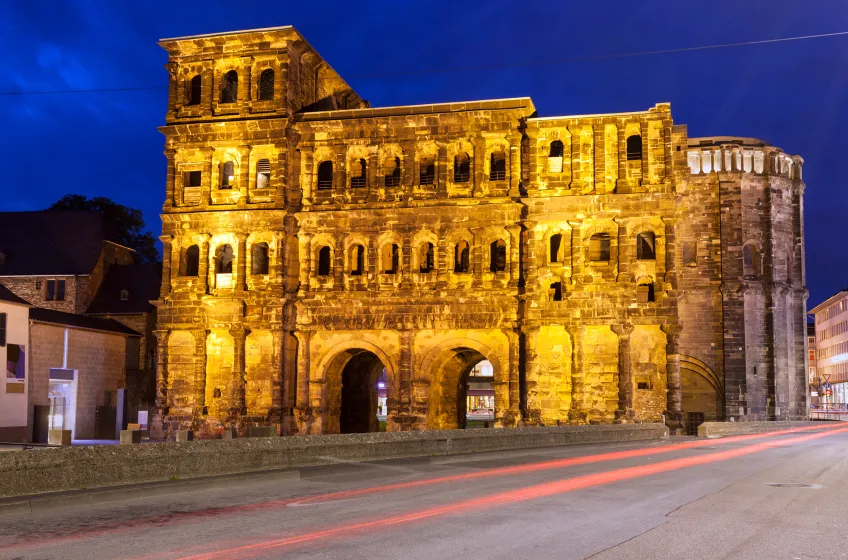
Trier’s signature sight is the brooding Porta Nigra, a colossal 2nd-century city gate whose darkened sandstone gives it its name. Climb the internal stairways to appreciate the engineering and the sweeping views down Simeonstraße towards the Hauptmarkt. Early or late in the day is best for softer light and fewer crowds.
Trier Cathedral (Dom St Peter) and the Church of Our Lady (Liebfrauenkirche)
Germany’s oldest cathedral stands shoulder-to-shoulder with the exquisite Gothic Liebfrauenkirche. Step inside the Dom for layers of architecture spanning Roman to Baroque, and don’t miss the serene cloister. Visiting hours can vary around services, so it’s wise to pop by earlier in the day.
Aula Palatina (Basilica of Constantine)
This vast red-brick palace hall from Constantine’s day—now a Protestant church—is one of the largest surviving Roman halls anywhere. The cavernous, unadorned interior really shows Roman scale; look for the apse where the emperor once sat in state.
Imperial Baths (Kaiserthermen)
A monumental 4th-century bath complex with a maze of underground service tunnels you can walk through. It pairs nicely with a breather in the adjacent Palastgarten on sunny days.
Roman Amphitheatre
Built into the slope below Petrisberg, the amphitheatre once hosted gladiatorial spectacles. Descend to the arena and cellars to get a sense of the choreography of ancient shows; summertime interpretations and events occasionally bring the site to life.
Rheinisches Landesmuseum Trier
One of Germany’s foremost archaeology museums, with intricate mosaics, funerary monuments and the spectacular Trier Gold Hoard—tens of thousands of Roman gold coins. Allow a couple of hours; it’s riveting even if you’re “not really a museum person”.
Hauptmarkt and the Old Town
Trier’s “living room” bustles with flower and produce stalls, framed by gabled townhouses, the Market Cross and the tower of St Gangolf. Radiating pedestrian streets like Simeonstraße and Fleischstraße keep shoppers busy between coffees and Riesling spritzers.
Moselle Boat Trips from Zurlauben
Down on the river at Zurlauben you can hop on short panorama cruises, half-day outings to Saarburg or full-day rides to Bernkastel-Kues. It’s an easy way to see vineyard scenery if you’re short on time. Schedules are seasonal and more frequent in spring–autumn.
Karl Marx House
Trier is Karl Marx’s birthplace, and his baroque childhood home now hosts a modern museum on his life, times and legacy. Exhibits are thoughtfully presented and accessible, with English information throughout.
Roman Bridge (Römerbrücke)
Still in daily use, the Moselle bridge stands on 2nd-century stone piers and forms part of Trier’s UNESCO ensemble. Stroll across for views to the Mariensäule on the opposite bluff and the waterside inns of Zurlauben.
Palastgarten and the Electoral Palace
The rococo pink palace beside the Basilica fronts a lovely formal garden—the city’s go-to picnic lawn. It’s also handy green space between big-ticket sights.
Igel Column and Barbara Baths
If you’ve time to venture slightly out, the richly carved 3rd-century Igel Column, a Roman funerary monument near Trier, and the Barbara Baths remains add depth to the Roman story beyond the core sights.
Views from Petrisberg or the Mariensäule
For a postcard panorama of Trier’s spires and the Moselle loop, walk or bus up to the Petrisberg lookout, or cross the river to the Mariensäule. Sunset is particularly rewarding.
Practical Advice for Visitors
Getting There
By rail, Trier Hauptbahnhof is well connected across the region. Direct trains link Trier and Luxembourg City in roughly three-quarters of an hour. Services to Koblenz and Cologne are straightforward with changes, and Frankfurt connections typically run via Koblenz. For flights, Luxembourg Airport is the closest gateway by road; Frankfurt-Hahn and Frankfurt Main are further options with coach or train connections.
Parking
Driving in is simple thanks to a citywide parking guidance system that routes you to central multi-storey garages and shows live space counts. Good, central options include the Basilika/Konstantin and Hauptmarkt facilities; follow signs for “Centrum” and then the electronic displays.
Dining
You’re in Moselle wine country, so seek out a glass of dry Riesling or the local apple wine, Viez, alongside hearty Rhineland-Palatinate fare. Around the Dom and Hauptmarkt you’ll find relaxed wine taverns and cafés for Flammkuchen, seasonal game and regional classics; along the Zurlauben waterfront there are terraces perfect for a lazy lunch or a sundowner before a boat cruise. For tastings, look for vinotheques in town or plan a day among nearby wineries up the Moselle.
Shopping
The Old Town is compact and walkable. Simeonstraße runs from the Porta Nigra to the Hauptmarkt and is Trier’s main shopping artery, with side streets like Fleischstraße and Dietrichstraße adding more boutiques and chains. If the weather turns, duck into the modern Trier Galerie mall just off the centre. Mosel wines, local mustards and sweet treats make easy-to-pack souvenirs.
When to Visit
Late spring to early autumn is prime for vineyard greens, outdoor dining and river trips. September and early October bring grape harvest bustle and Federweißer (new wine). Advent is gorgeous, too: Trier’s Christmas Market fills the Hauptmarkt and Domfreihof from late November to just before Christmas, with traditional stalls and warming mugs of Glühwein. Winters are generally quiet, making museum-hopping a breeze.
Local Events
Trier’s calendar is lively for a city its size. The Altstadtfest takes over the Old Town in late June with live music and food. In July, the Zurlaubener Heimatfest brings wine, music and fireworks to the riverside. Early August sees the Olewig Wine Festival unfold in the vineyard-fringed district just east of the centre. The Mosel Musikfestival and summer open-air concerts round out the warm-weather programme.
Exploring Beyond Trier
Follow the Moselle upstream to Bernkastel-Kues for half-timbered charm, or down to Cochem for castle views—both easy day trips by boat, bus or train. Closer still, Saarburg enchants with its little waterfall and hillside lanes. For a grand natural panorama, drive to the Saarschleife viewpoint above the Saar loop. Luxembourg City is an effortless cross-border hop for ramparts, museums and café culture before you’re back in Trier for dinner. Hikers should consider the Teufelsschlucht (Devil’s Gorge) in the Südeifel for fantastical sandstone formations on well-waymarked trails.
A final tip: if you plan to tour multiple Roman sites, the AntikenCard is a simple, good-value bundle that covers key monuments and often the archaeology museum as well. Pair that with a short Moselle cruise and a glass of local Riesling, and you’ve basically nailed Trier.
Shortlist
- Your Shortlist is empty