
Discover Mainz | A Visitor's Introduction to Mainz
Recommended places to visit, places to stay and things to do in and around Mainz
Mainz is the capital of Rhineland-Palatinate, standing on the western bank of the Rhine opposite Wiesbaden. Known as the birthplace of Johannes Gutenberg, the city combines Roman remains, a monumental cathedral, colourful old-town streets and a lively wine culture. With its museums, riverside promenades and relaxed taverns, Mainz is a perfect destination for history enthusiasts, wine lovers and travellers seeking an easy city break near Frankfurt.
Recommended Mainz hotels and other accommodation
Pre-book Mainz Attractions, Tours & Experiences
Why is Mainz Worth a Visit?
Mainz is worth visiting for its unusually broad history. The city began as an important Roman military settlement, became a powerful ecclesiastical centre during the Middle Ages and later gave the world Johannes Gutenberg’s method of printing with movable metal type.
These different periods remain visible across the centre. Roman ruins survive beside modern streets, Mainz Cathedral dominates the old town, and museums explain the city’s role in printing, shipping and regional history.
Mainz is also the urban gateway to Germany’s largest wine-producing region. Vineyards begin just beyond the suburbs, while local Riesling, Silvaner and Pinot varieties are served in traditional taverns throughout the city. During warmer months, the weekly Market Breakfast turns the area beside the cathedral into one of Mainz’s most sociable meeting places.
The centre is compact and easy to explore on foot. Mainz also has excellent rail connections, making it suitable for a day trip from Frankfurt or as a base for excursions along the Rhine and into the Rheinhessen wine region.
Mainz Highlights: Things to See and Do in Mainz
Mainz Cathedral
Mainz Cathedral, or Mainzer Dom, is the city’s defining landmark. Founded more than a thousand years ago, the enormous red-sandstone building reflects Romanesque, Gothic and Baroque architectural periods.
Its interior contains bishops’ tombs, chapels, monuments and historic furnishings connected with Mainz’s long importance as an archiepiscopal city. The adjoining cloister provides a quieter space away from the busy squares outside.
The cathedral stands directly beside the Market Square and is easy to include at the beginning of an old-town walk. As it remains an active place of worship, sightseeing may be restricted during services, concerts and religious ceremonies.
Gutenberg Museum
The Gutenberg Museum celebrates Johannes Gutenberg and the development of printing. Its most important exhibits include original Gutenberg Bibles, historic printing equipment and demonstrations of early printing methods.
The museum’s former building beside the cathedral is being replaced as part of a major redevelopment. During this work, the main exhibition operates from an interim location within the Natural History Museum on Reichklarastrasse.
The temporary display is smaller than the former museum but still presents the essential story of Gutenberg, movable type and the impact of printed books on European society. Check the current address and opening arrangements before visiting, rather than relying on older guidebooks or signs.
The associated printing workshop offers a more hands-on introduction to traditional techniques and may run demonstrations or activities on scheduled dates.
Market Square
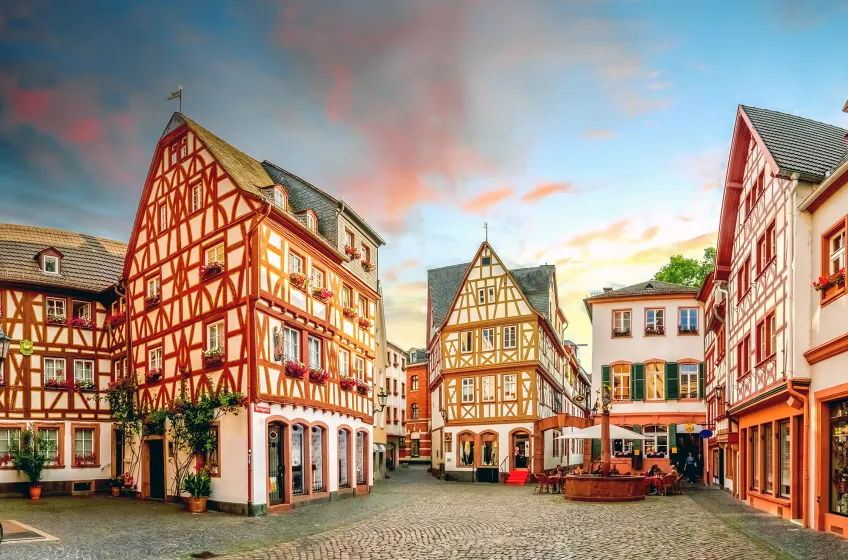
Mainz’s Market Square lies in the shadow of the cathedral and is surrounded by colourful historic façades. It is one of the city’s most attractive public spaces and a natural starting point for exploring the centre.
The Renaissance-style market fountain is a particularly elaborate feature. Nearby buildings have brightly painted fronts, decorative details and steep roofs that create a distinctive setting for cafés, market stalls and public events.
Regular markets sell fruit, vegetables, flowers, cheese and regional products. The square is busiest on market mornings and during major festivals.
From spring into autumn, the Saturday Market Breakfast brings local wine producers and food stalls to the area. The atmosphere is informal and lively, with people standing around shared tables or sitting on the surrounding steps and walls.
Mainz Old Town
The old town spreads south and west of the cathedral, with narrow lanes, small squares and carefully restored houses. Much of Mainz was heavily damaged during the Second World War, but surviving structures and sympathetic reconstruction have preserved a strong historic character.
Augustinerstrasse is the principal old-town street. Its pastel façades, independent shops, cafés and restaurants make it one of the most pleasant areas for an evening walk.
Kirschgarten is especially picturesque, with half-timbered houses surrounding a small square. Look for carved beams, old shop signs and architectural details above street level.
The old town is compact, but its side streets reward unhurried exploration. Early morning is best for photographs, while evenings bring a livelier restaurant and wine-bar atmosphere.
St Stephen’s Church
St Stephen’s Church stands on a hill above the old town and is best known for its luminous blue stained-glass windows by Marc Chagall.
Created during the later years of Chagall’s life, the windows use biblical imagery and deep shades of blue to create a striking interior. Additional windows were completed by his collaborator Charles Marq.
The church is particularly atmospheric when daylight is strong enough to illuminate the glass. Morning and early afternoon often provide the clearest colours, though conditions vary with the weather.
The climb from the old town is moderately steep. Visitors should also remember that the building remains a functioning church, so quiet behaviour is expected.
Roman Theatre
The remains of Mainz’s Roman theatre stand close to the Mainz Römisches Theater railway station. Built beside the ancient settlement of Mogontiacum, it was once one of the largest theatres north of the Alps.
Only the foundations and lower structural remains survive, but the scale of the site is still apparent. Information panels explain the original form of the building and its importance within Roman Mainz.
The site is free to view and works well as part of a walk between the old town, Citadel and southern railway station. There is relatively little shelter, so it is best visited in dry weather.
Museum of Ancient Seafaring
The Museum of Ancient Seafaring explores Roman ships, river transport and naval technology. Its centrepieces include reconstructions based on vessels discovered during construction work near the Rhine.
Displays explain how military and commercial boats were built, rowed and used along the Roman frontier. The reconstructed ships help make technical details more accessible than archaeological fragments alone.
The museum is close to the Roman Theatre and can easily be combined with it. Opening arrangements may change during refurbishment or exhibition work, so confirm access before making a special journey.
Mainz Citadel
Mainz Citadel occupies an elevated position south of the old town. Built during the 17th century, it formed part of the city’s extensive defensive system.
The complex contains bastions, courtyards, historic buildings and the Roman Drusus Stone, a monument traditionally associated with the Roman commander Drusus.
Parts of the Citadel are used by public offices and cultural organisations, so not every area is freely accessible. The grounds can still be explored, and guided tours occasionally provide entry to tunnels or less accessible sections.
The elevated location also offers pleasant routes towards St Stephen’s Church and the Roman Theatre.
Landesmuseum Mainz
The Landesmuseum presents art, archaeology and cultural history from Rhineland-Palatinate. Its collections range from Roman stone monuments and medieval sculpture to paintings, decorative arts and more recent works.
The museum is particularly useful for visitors interested in Mainz’s broader regional context. Roman objects provide additional background to the city’s archaeological sites, while later galleries cover the importance of the archbishops and local artistic traditions.
Allow at least 90 minutes for a general visit. Temporary exhibitions may justify a longer stay.
Isis and Mater Magna Sanctuary
The remains of a Roman sanctuary dedicated to Isis and Mater Magna were discovered beneath a modern shopping complex in central Mainz.
The archaeological site has been preserved below street level and includes altars, offerings, inscriptions and other objects associated with Roman religious practice. Atmospheric lighting and sound help recreate the sense of an ancient sacred space.
This unusual attraction is easy to miss because of its modern surroundings. Access is normally through the Römerpassage shopping centre, making it a convenient indoor stop during an old-town walk.
Rhine Promenade
The Mainz riverfront provides a broad open space for walking, cycling and watching boats on the Rhine. Paths extend north and south of the city centre, passing lawns, sculptures, landing stages and outdoor seating areas.
The promenade is busiest on sunny evenings and weekends. Views extend across the river towards Wiesbaden and the wooded slopes beyond.
Passenger boats leave from central landing stages for sightseeing trips and longer journeys into the Middle Rhine Valley. The riverfront is also an easy place to pause between museum visits.
For a longer walk, continue towards the Winterhafen, a former harbour area with modern housing, restaurants and waterside paths.
Fastnacht Fountain and Schillerplatz
Schillerplatz is a handsome square lined with Baroque buildings, trees and cafés. Its most distinctive feature is the Fastnacht Fountain, covered with more than 200 figures connected with Mainz Carnival.
The fountain reflects the city’s strong carnival identity, including fools, mythical creatures and symbolic characters. It is worth walking around the monument slowly, as many details are difficult to see from a single angle.
Schillerplatz forms part of the route used by carnival processions and hosts stalls during seasonal markets. It is also a useful connection between the main shopping streets and old town.
Electoral Palace
The Electoral Palace is a large red-sandstone Renaissance building near the Rhine. It once served as the residence of Mainz’s prince-electors.
The exterior is its main attraction for casual visitors, as the building is now used for conferences, ceremonies and events. Its symmetrical riverfront façade and decorative details are especially impressive when seen from the promenade.
The palace can be combined with the Landesmuseum, St Peter’s Church and a walk along the Rhine.
Practical Advice for Visitors
Getting There
Mainz is exceptionally well connected by rail. Mainz Hauptbahnhof has regional and long-distance services to Frankfurt, Cologne, Koblenz, Mannheim and other major German cities.
Trains from Frankfurt Hauptbahnhof generally take around 30 to 40 minutes, depending on the service. Local S-Bahn trains also connect Mainz with Frankfurt Airport, usually in approximately 30 minutes.
The main railway station is around a 15-minute walk from the old town and cathedral. Trams and buses run frequently through the centre.
Drivers can reach Mainz using the A60, A63 and A643 motorways. Traffic can become heavy during weekday commuting periods and major events.
Parking
Central Mainz has several underground and multi-storey car parks, including facilities near the cathedral, theatre, railway station and Rhine.
Street parking is limited and often subject to resident restrictions or short maximum stays. Using a central car park is generally easier than searching for an individual space.
Parking areas near the old town fill quickly during Saturday markets, wine festivals, carnival and the Christmas season. Park-and-ride facilities or suburban railway stations can provide a less stressful alternative.
Most main attractions are within walking distance once you reach the centre.
Dining
Mainz cuisine reflects the food traditions of Rheinhessen. A classic local snack is Spundekäs, a seasoned cream-cheese mixture usually served with pretzels, raw onion and sometimes radishes.
Other regional dishes include Handkäse mit Musik, sausages, pork dishes and seasonal asparagus. Onion tart is popular during the autumn wine season.
Traditional wine taverns are concentrated in and around the old town, particularly near Augustinerstrasse and Grebenstrasse. These range from simple, sociable bars to more formal restaurants serving regional menus.
Mainz’s university population also supports international restaurants, vegetarian choices, cafés and inexpensive lunch options. Reserve tables on Friday and Saturday evenings, especially during festival periods.
Wine
Mainz is surrounded by the Rheinhessen wine region, known for Riesling, Silvaner, Pinot Gris and Pinot Noir.
Traditional wine taverns may serve local wines by the glass, carafe or bottle. Ask for a tasting selection when available, particularly when unfamiliar with German wine labels.
Trocken indicates a dry wine, while feinherb usually suggests some residual sweetness. A Weinschorle mixes wine with sparkling water and is a popular, refreshing choice during summer.
The Saturday Market Breakfast is one of the easiest ways to sample regional wines informally. It can become crowded, so arrive earlier in the morning for more space.
Shopping
The main shopping streets extend around Ludwigsstrasse, Schusterstrasse and the area between the railway station and old town.
Independent shops, delicatessens and boutiques can be found in the historic lanes, while larger retailers occupy the central pedestrian areas and shopping arcades.
Regional wine is the most characteristic purchase. Wine shops can advise on bottles from specific Rheinhessen villages and vineyards.
Other local products include fruit preserves, spirits, mustard and carnival-themed souvenirs. The Gutenberg Museum shop is useful for books, stationery and printing-related gifts.
When to Visit
April to June and September to October are excellent times to visit Mainz. Temperatures are generally comfortable, outdoor wine events are active and the surrounding vineyards are attractive.
July and August bring long evenings and riverfront activity, but the city can become hot. Shade is limited on some sections of the promenade.
Late August and September are especially appealing for wine festivals and the grape harvest. Accommodation may become scarce during major events.
December brings a large Christmas market around the cathedral and smaller seasonal markets elsewhere in the centre.
The most intense period is Mainz Carnival, particularly during the days before Ash Wednesday. The city becomes extremely crowded, public transport changes and many streets close for processions.
Local Events
Mainz Carnival, known locally as Fastnacht, is the city’s defining annual celebration. Satirical speeches, costumes, marching bands and street events build towards the major Rose Monday procession.
The Market Breakfast takes place on selected Saturdays from spring into autumn. Local wine producers set up near the cathedral, and visitors gather for wine, food and conversation.
The Mainz Wine Market is usually held in late summer in the Stadtpark and Rosengarten. Producers from across the region serve wines alongside food and live entertainment.
Johannisnacht celebrates Johannes Gutenberg with music, food, public demonstrations and cultural events around the old town.
The Christmas market fills the Market Square beneath the cathedral during Advent. In 2026, the main market is scheduled from 26 November to 23 December.
Event dates and access arrangements can change, so confirm details before booking accommodation.
Exploring Beyond Mainz
Wiesbaden lies directly across the Rhine and can be reached in around 15 minutes by local train. It is known for elegant 19th-century architecture, thermal springs and the Neroberg hillside.
The Rheingau wine region begins west of Wiesbaden. Towns such as Eltville and Rüdesheim provide vineyards, wine estates, river views and historic centres.
The Middle Rhine Valley begins downstream towards Bingen and Koblenz. Castles, steep vineyards and the Loreley make this one of Germany’s most scenic rail and boat journeys.
Frankfurt is an easy day trip for museums, shopping and modern architecture. Frequent trains make it possible to combine Mainz’s historic atmosphere with a larger city visit.
The Rheinhessen countryside south and west of Mainz contains wine villages, walking routes and family-run estates. Ingelheim, Nierstein and Oppenheim are particularly useful destinations for visitors interested in vineyards and local history.
Shortlist
- Your Shortlist is empty