
Discover Styria | A Visitor's Introduction to Styria
Recommended places to visit, places to stay and things to do in and around Styria
Styria is Austria’s second-largest federal state, stretching from the high peaks and lakes of the northern Alps to vineyards, orchards and thermal springs near the Slovenian border. Known as Austria’s Green Heart, the region is a perfect destination for hikers, food lovers, spa visitors and travellers seeking a mixture of historic towns and countryside. With its lively capital Graz, dramatic mountain roads, wine routes and distinctive regional cuisine, Styria offers one of Austria’s most varied holiday experiences.
Recommended Styria hotels and other accommodation
Pre-book Styria Attractions, Tours & Experiences
Why is Styria Worth a Visit?
Styria is worth visiting because it combines several contrasting landscapes within one region. Northern Styria is mountainous, with limestone peaks, deep valleys, ski resorts and clear lakes. Southern and eastern Styria feel softer and warmer, with vineyards, pumpkin fields, orchards and hilltop villages.
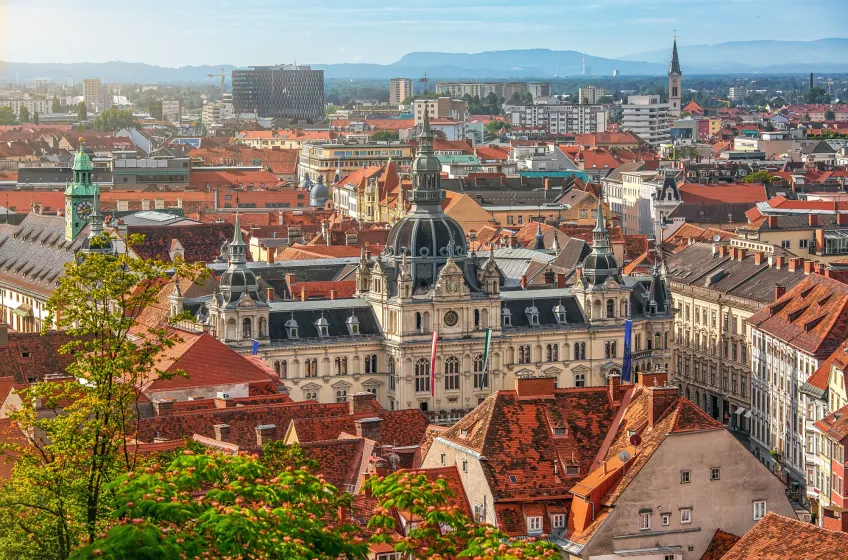
Graz provides the cultural centre. Its UNESCO-listed old town mixes Renaissance courtyards and Baroque architecture with striking modern buildings, while a strong student population supports an excellent restaurant, café and nightlife scene.
Food and drink are central to Styrian identity. The state is famous for dark green pumpkin-seed oil, crisp white wines, apples, cured meats and hearty mountain cooking. Small farms, winery taverns and produce markets make it easy to sample these specialities close to where they are made.
Styria is also a strong choice for outdoor activities. Visitors can walk beneath the peaks of the Gesäuse, drive the scenic routes around the Dachstein, swim in mountain lakes or relax in the thermal spas of the south-east.
Styria Highlights: Things to See and Do in Styria
Explore Graz
Graz is Styria’s capital and one of Austria’s most appealing cities. Its compact old town contains arcaded courtyards, narrow lanes, colourful façades and red-tiled rooftops.
The Hauptplatz forms the historic centre, overlooked by the Town Hall and surrounded by cafés and shops. Nearby Herrengasse is lined with grand buildings, including the elaborately painted Herzogshof.
Graz also has a strong contemporary side. The blue, biomorphic Kunsthaus art museum and the artificial Murinsel platform in the River Mur provide deliberate contrasts with the historic centre.
Allow at least two full days for the principal attractions, markets and neighbourhoods. Graz is particularly rewarding in the evening, when day visitors leave and the restaurants and courtyards become livelier.
Climb the Schlossberg
The Schlossberg is a wooded hill rising directly above central Graz. It was once the site of a powerful fortress, although only parts of the defensive complex survive.
Its best-known landmark is the Uhrturm, a clock tower that has become a symbol of the city. The clock’s large and small hands appear reversed because the original design displayed only the hour.
Visitors can reach the hill by stairs, funicular or lift. Several terraces provide views over Graz and towards the surrounding countryside.
The walk down through the gardens is particularly pleasant. An underground slide offers a more unusual descent from within the hill.
Visit the Styrian Armoury
The Styrian Armoury contains one of the world’s largest surviving collections of historic weapons and armour in its original setting.
More than 30,000 objects were stored here to equip regional forces during periods of conflict with the Ottoman Empire and neighbouring territories. Rows of helmets, breastplates, swords, firearms and horse armour fill several floors.
The presentation is atmospheric rather than heavily interactive. A guided tour or audio explanation is useful for understanding how the equipment was organised and used.
The building is close to Graz’s Hauptplatz and can easily be combined with the Landhaus courtyard next door.
See Eggenberg Palace
Eggenberg Palace stands west of central Graz and is Styria’s most important palace complex.
Its design is filled with symbolic references to calendars, seasons and astronomy. The state rooms contain elaborate wall paintings, decorative interiors and historic furnishings.
The surrounding park is home to mature trees, lawns, gardens and free-roaming peacocks. It provides a peaceful contrast to the city centre.
Interior access may depend on guided tours and seasonal schedules. Check which rooms are available before travelling, particularly outside the main visitor season.
Explore the South Styrian Wine Road
The South Styrian Wine Road follows rolling hills, vineyards and small settlements close to the Slovenian border. It is one of Austria’s most attractive wine landscapes.
The region is especially known for Sauvignon Blanc, Welschriesling, Chardonnay and Muscat varieties. Vineyards often occupy steep slopes with views extending across both Austria and Slovenia.
Gamlitz, Ehrenhausen, Leutschach and Kitzeck are useful stops. Many wineries combine tasting rooms with restaurants, guest accommodation or seasonal taverns.
A car provides the greatest flexibility, but wine tasting and driving should not be combined. Stay overnight, arrange taxis or join an organised tour when visiting several estates.
Eat at a Buschenschank
A Buschenschank is a traditional winery tavern serving its own wine with simple cold food.
Typical platters include cured meats, cheese, spreads, pickled vegetables, bread and hard-boiled eggs. Styrian pumpkin-seed oil appears frequently as a dressing or flavouring.
Opening periods vary, and many taverns close on one or more days each week. Some operate only for limited seasons.
Look for a hanging bundle of branches or a sign indicating that the tavern is open. Reservations are advisable during sunny weekends and the autumn harvest.
Visit Riegersburg Castle
Riegersburg Castle occupies the summit of an extinct volcanic hill in eastern Styria. Its dramatic position made it one of the region’s strongest fortresses.
Visitors can reach the upper complex on foot or by inclined lift. The approach passes defensive gates and steep walls before arriving at museums, courtyards and viewpoints.
Exhibitions cover the castle’s history, the Liechtenstein family and regional witch trials. Seasonal bird-of-prey demonstrations may also take place.
The elevated setting is exposed to wind and sun. Wear suitable shoes and allow at least half a day.
Explore the Styrian Thermal Region
Eastern Styria has a cluster of thermal spa towns supplied by naturally heated mineral water.
Bad Waltersdorf, Bad Blumau, Loipersdorf and Bad Radkersburg are among the best-known destinations. Facilities range from family pools and slides to quieter wellness areas and extensive sauna complexes.
Rogner Bad Blumau is particularly distinctive for its colourful architecture designed by Friedensreich Hundertwasser. The complex combines irregular forms, planted roofs and thermal bathing.
Austrian sauna areas commonly operate without swimwear and may be mixed-gender. Check the rules for each section before entering.
Discover the Gesäuse National Park
The Gesäuse is a dramatic mountain region where the River Enns cuts through steep limestone peaks.
The national park is known for hiking, climbing, white-water scenery and relatively wild Alpine landscapes. Trails range from riverside walks to demanding summit routes.
Admont is the most practical nearby base, while smaller settlements provide access to trailheads and mountain huts.
Weather conditions can change quickly, and some routes involve exposed terrain. Choose walks suited to your experience and check conditions locally before starting.
Visit Admont Abbey
Admont Abbey stands near the entrance to the Gesäuse and contains one of the world’s most spectacular monastic libraries.
The long Baroque hall is decorated with ceiling frescoes, gilded details, statues and white bookcases holding thousands of historic volumes. Concealed staircases and architectural illusions add to its theatrical appearance.
The abbey museum complex also contains art, natural-history collections and changing exhibitions. It deserves more time than a brief stop for the library alone.
Allow at least two to three hours. Photography rules and access arrangements may vary between sections.
Explore Schladming and the Dachstein
Schladming is a major Alpine resort in north-western Styria. It is known for winter sports but also provides extensive summer hiking and mountain-bike routes.
Cable cars climb towards the Planai and neighbouring peaks, opening access to family walks, panoramic trails and more demanding routes. The town itself has restaurants, sports shops and a lively central area.
The nearby Dachstein massif provides glaciers, limestone peaks and high-altitude viewpoints. Attractions may include suspended walkways, ice features and viewing platforms, depending on current conditions and seasonal operations.
Even during summer, the upper mountain can be cold, windy or snowy. Take warm clothing and proper footwear.
Visit the Salzkammergut Lakes of Styria
The western part of the Salzkammergut extends into Styria and includes some of Austria’s most dramatic lake scenery.
Grundlsee is the largest lake entirely within Styria. Its clear water, mountain backdrop and quiet villages make it suitable for swimming, walking and boat trips.
Nearby Altaussee has an especially beautiful setting beneath the Loser mountain. A path circles the lake, providing a relatively gentle walk with changing views.
Bad Aussee is the region’s main town and a useful base for exploring both lakes. It is also associated with distinctive local traditions and traditional clothing.
Explore the Erzberg
The Erzberg is a vast iron-ore mine near Eisenerz and one of Austria’s most unusual industrial landscapes.
Terraces cut into the mountain create a huge stepped appearance. Visitor tours explain the scale of the operation, mining history and the importance of iron production to the region.
Some experiences involve large mining vehicles or underground sections. Warm clothing and closed footwear may be required.
The Erzberg is best combined with Eisenerz, Leopoldsteiner See or a wider northern Styria itinerary.
Walk Around Leopoldsteiner See
Leopoldsteiner See is a mountain lake near Eisenerz, surrounded by forest and steep limestone peaks.
A mostly gentle path follows the shore and provides attractive reflections in calm weather. The walk is suitable for many visitors, though sections can be uneven.
Swimming is possible during warmer conditions, but the water remains cool. A lakeside restaurant or seasonal facilities may operate near the main access point.
The lake is an excellent quieter stop between the Erzberg and Gesäuse.
Visit Mariazell
Mariazell is Austria’s most important Catholic pilgrimage town. Its basilica contains a revered wooden statue of the Virgin Mary and attracts visitors from across Central Europe.
The basilica’s Gothic core is framed by a later Baroque façade with three towers. Inside, richly decorated chapels surround the central shrine.
The town is also known for gingerbread, herbal liqueur and traditional shops. Mountain scenery and walking routes begin close to the centre.
Mariazell becomes especially busy during pilgrimages and religious festivals. Those seeking a quieter visit should avoid major feast days.
Practical Advice for Visitors
Getting There
Graz Airport is the main airport within Styria, although its international route network is smaller than Vienna’s.
Vienna Airport is a useful alternative, particularly for eastern and central Styria. Direct and connecting trains link Vienna with Graz and other regional centres.
Graz Hauptbahnhof has rail connections with Vienna, Salzburg, Linz, Klagenfurt, Ljubljana and other destinations. The main north–south rail routes make Graz a practical base for car-free travel.
Salzburg and Ljubljana airports may suit visitors heading to western or southern parts of Styria.
Choosing Where to Stay
Graz is the best base for museums, restaurants, public transport and short excursions into wine country.
Schladming suits visitors interested in skiing, hiking and mountain activities. Bad Aussee is ideal for the Styrian Salzkammergut and lake scenery.
Gamlitz, Ehrenhausen and Leutschach provide atmospheric bases for the South Styrian Wine Road. Staying at a winery or rural guesthouse reduces the need to drive after tastings.
Bad Waltersdorf, Bad Blumau and Loipersdorf are best for spa-focused holidays. Admont provides access to the abbey and Gesäuse National Park.
Getting Around
Regional trains connect Graz with towns such as Bruck an der Mur, Leoben, Schladming, Bad Aussee and several spa destinations.
Buses serve smaller villages and rural attractions, though frequencies can be limited during evenings and weekends.
A car is particularly useful for the wine roads, castles, rural taverns and scattered attractions of eastern Styria.
Guest cards issued by some resorts and accommodation providers may include local buses, cable cars or attraction discounts. Benefits differ considerably between areas.
Driving and Parking
Austria requires a vignette for vehicles using most motorways and expressways. Certain tunnels and major Alpine routes charge additional tolls.
The South Styrian Wine Road contains steep, narrow and winding sections. Drive cautiously and do not rely on roadside parking where it may obstruct farm or vineyard traffic.
Mountain routes can be affected by snow, ice, storms or roadworks. Check conditions before setting out, especially outside summer.
Central Graz has controlled parking zones and pedestrian restrictions. Park-and-ride facilities are generally more convenient than driving into the old town.
Dining
Styrian cuisine is strongly regional and seasonal. Pumpkin-seed oil is its most famous ingredient and is used on salads, soups, eggs, cheese and even ice cream.
Other specialities include Backhendl, or fried chicken; Brettljause, a wooden platter of cold meats and cheese; dumplings; game; river fish and mushroom dishes.
Scarlet runner beans, known as Käferbohnen, are frequently served with onion and pumpkin-seed oil.
Apples are another major product, appearing in juice, cider, spirits, strudel and desserts.
Traditional rural restaurants may close early or take several weekly rest periods. Reserve dinner when staying in a small village.
Wine
Southern and western Styria are primarily known for fresh white wines. Sauvignon Blanc is particularly important, alongside Welschriesling, Muscat, Pinot Blanc and Chardonnay, locally called Morillon.
Schilcher is a sharp, pink wine made from the Blauer Wildbacher grape in western Styria. It has a distinctive acidity and is often served chilled.
Many smaller wineries accept visitors only by appointment. Contact producers ahead when a formal tasting is important.
Wine festivals and open-cellar events provide a more informal way to compare several producers. Use taxis, organised transport or an overnight stay rather than driving between tastings.
Shopping
Styrian pumpkin-seed oil is the most characteristic purchase. Look for bottles carrying recognised regional quality markings and protect them from heat and direct sunlight.
Other local products include wine, apple juice, fruit spirits, honey, cured meats, cheese and scarlet runner beans.
Graz has the broadest conventional shopping selection. Farmers’ markets such as Kaiser-Josef-Platz and Lendplatz are excellent for regional food.
Winery shops and farm stores often provide better-quality souvenirs than general tourist retailers.
When to Visit
April to June is excellent for Graz, vineyard walks and lower-level hiking. Spring blossom is particularly attractive in orchard areas.
July and August provide the widest range of cable-car operations, festivals and mountain activities. They can also be hot in Graz and southern Styria.
September and October are ideal for wine tourism, harvest events and autumn colour. Accommodation in the wine districts becomes busy during sunny weekends.
December to March is the main ski and winter-sports period. Snow reliability is best at higher resorts.
November and parts of spring are transition seasons. Some mountain lifts, rural hotels and seasonal attractions close temporarily.
Local Events
The Styriarte festival presents classical music and performance in Graz and other regional venues during summer.
The Formula 1 Austrian Grand Prix is held at the Red Bull Ring near Spielberg and creates heavy demand for accommodation across the surrounding area.
The Erzbergrodeo is a major off-road motorcycle event staged around the Erzberg.
Autumn brings wine festivals, open-cellar days and harvest celebrations throughout southern Styria.
Graz’s Christmas markets spread across several central squares during Advent, offering crafts, food and seasonal performances.
Event dates change annually, so confirm schedules before booking non-refundable travel.
Exploring Beyond Styria
Vienna is easily reached from Graz by train and offers imperial palaces, museums and classical music.
Carinthia lies west and south-west, with warm bathing lakes, Alpine roads and cities including Klagenfurt and Villach.
Slovenia begins directly south of Styria. Maribor is the easiest city excursion from Graz, while Ljubljana and the Pohorje mountains are suitable for longer trips.
Burgenland lies east of Styria and offers vineyards, thermal areas, castles and Lake Neusiedl.
Upper Austria and Salzburg state can be reached from northern and western Styria, providing access to additional Salzkammergut lakes and Alpine destinations.
Shortlist
- Your Shortlist is empty