
Discover Lower Austria | A Visitor's Introduction to Lower Austria
Recommended places to visit, places to stay and things to do in and around Lower Austria
Lower Austria is Austria’s largest federal state, surrounding Vienna and stretching from the Danube vineyards of the Wachau to Alpine foothills, forests, castles and the Czech and Slovak borders. Known for its magnificent monasteries, medieval towns, wine villages and varied countryside, the region is a perfect destination for cyclists, walkers, history enthusiasts and food and wine lovers. With its river valleys, thermal spa towns and easy access from Vienna, Lower Austria offers some of the country’s most rewarding day trips and touring routes.
Recommended Lower Austria hotels and other accommodation
Pre-book Lower Austria Attractions, Tours & Experiences
Why is Lower Austria Worth a Visit?
Lower Austria is worth visiting because it brings together an unusually broad range of landscapes and historic attractions. The Danube passes through vineyard terraces, abbey towns and old trading centres, while the Vienna Woods provide forest walks and wine taverns immediately beyond the capital.
The Wachau is the region’s best-known destination. This UNESCO-listed stretch of the Danube between Melk and Krems contains terraced vineyards, apricot orchards, ruined castles and villages such as Dürnstein, Spitz and Weissenkirchen. It is particularly enjoyable by bicycle, boat or a combination of both.
Elsewhere, Lower Austria becomes quieter and more rural. The Waldviertel in the north has granite landscapes, forests, ponds and monasteries, while the Mostviertel in the west is known for pear orchards and gentle Alpine scenery. South of Vienna, elegant spa towns and the Semmering Railway lead towards higher mountains.
Many of Lower Austria’s principal destinations can be visited from Vienna, but the region rewards a longer stay. Spending two or three nights in the Wachau, Vienna Woods or Alpine south allows you to explore beyond the busiest sights and enjoy local restaurants and wine taverns after day visitors have gone.
Lower Austria Highlights: Things to See and Do in Lower Austria
Explore the Wachau Valley
The Wachau is a particularly scenic stretch of the Danube between Melk and Krems. Steep vineyard terraces rise above the river, while villages, church towers and castle ruins occupy narrow areas of level ground.
The region is famous for Grüner Veltliner and Riesling wines, as well as Wachau apricots. Seasonal products include apricot jam, juice, brandy, dumplings and pastries.
Cycling is one of the best ways to explore the valley. Relatively level riverside paths connect many settlements, while ferries allow visitors to move between the two banks.
Passenger boats operate during the main visitor season. A practical day trip can combine a boat journey in one direction with a train or bus for the return.
Visit Melk Abbey
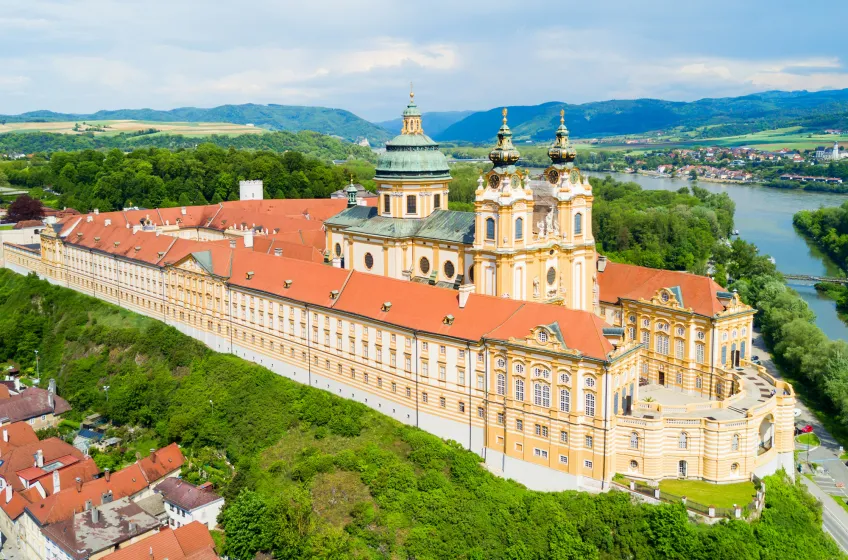
Melk Abbey stands on a rocky hill above the Danube and is one of Austria’s greatest Baroque monuments. Its golden exterior, twin-towered church and extensive monastic buildings dominate the town below.
The visitor route generally includes imperial rooms, exhibitions on monastic history, the Marble Hall and the remarkable library. The abbey church is richly decorated with frescoes, gilding and elaborate sculpture.
The library is a particular highlight, containing historic manuscripts and thousands of printed volumes. Photography restrictions may apply in parts of the interior.
Allow at least two hours for the abbey and gardens. Melk’s old town and riverfront can add another hour or two, particularly when combining the visit with a boat trip.
Wander Through Dürnstein
Dürnstein is one of the Wachau’s most recognisable villages, known for its blue-and-white abbey tower and narrow streets beneath vineyard-covered slopes.
The ruined castle above the village is traditionally associated with Richard the Lionheart, who was imprisoned in the region during the late 12th century. The uphill path is steep and rocky but provides excellent views over the Danube.
Within the village, small shops sell wine, apricot products and regional gifts. Restaurants and courtyards become busy during boat-arrival times.
Visit early or stay until late afternoon for a calmer atmosphere. The narrow centre is largely pedestrianised, with parking outside the village.
Discover Krems and Stein
Krems is one of the principal towns of the Wachau and a useful base for exploring the Danube region. Its historic centre contains old town houses, churches, courtyards and the distinctive Steiner Tor gateway.
The adjoining district of Stein has a quieter atmosphere, with historic buildings extending along the river. Together, Krems and Stein form an important centre for wine, education and culture.
Museums around the Kunstmeile focus on modern art, caricature and regional themes. Temporary exhibitions make the area especially useful in poor weather.
Krems has direct rail connections with Vienna and regular buses into the Wachau. It offers more restaurants, shops and year-round facilities than the smaller wine villages.
Cycle the Danube
The Danube Cycle Path is one of Europe’s best-known long-distance cycling routes. In Lower Austria, it passes through the Wachau, Tulln, Klosterneuburg and several riverside communities.
The route is generally easy and mostly level, making it suitable for leisure cyclists and families. Distances can be shortened by using trains, boats or ferries.
The section between Melk and Krems is especially scenic. The northern and southern banks offer different perspectives, so crossing the river can make the journey more varied.
Bicycle hire is available in several towns, although availability may be limited during busy weekends. E-bikes are useful for vineyard detours and routes away from the river.
Visit Klosterneuburg Abbey
Klosterneuburg Abbey stands immediately north of Vienna and is one of Lower Austria’s easiest cultural excursions.
The large complex contains medieval and Baroque architecture, religious art, imperial rooms and an important treasury. Its most famous object is the Verdun Altar, a masterpiece of medieval enamel work.
The abbey also maintains a long winemaking tradition. Tours and tastings may be available alongside visits to the historic interiors.
Klosterneuburg can be reached by suburban train or bus from Vienna. Combine the abbey with a walk through nearby vineyards or a traditional wine tavern.
Explore the Vienna Woods
The Vienna Woods form a broad area of hills and forests west and south-west of Vienna. They provide walking routes, viewpoints, monasteries, wine villages and historic sites within easy reach of the capital.
Popular destinations include Kahlenberg and Leopoldsberg near Vienna, as well as more rural areas around Mödling, Baden and Heiligenkreuz.
Walking routes range from gentle woodland paths to longer ridge trails. Some villages are connected by regional buses, though a car provides more flexibility for remote trailheads.
Spring and autumn are particularly attractive. Summer woodland offers shade, while winter paths can become muddy, icy or snow-covered.
See Heiligenkreuz Abbey
Heiligenkreuz Abbey is a Cistercian monastery in the Vienna Woods, founded during the 12th century.
Its architecture includes Romanesque and Gothic elements, with a particularly atmospheric cloister and medieval chapter house. The abbey remains an active religious community rather than simply a historic attraction.
Guided visits provide access to areas that may otherwise be closed. Visitors should dress and behave respectfully, especially during services.
Heiligenkreuz is easiest to reach by car, though buses connect it with nearby towns. It combines well with Mayerling and a wider drive through the Vienna Woods.
Visit Mayerling
Mayerling is associated with one of the Habsburg monarchy’s most famous tragedies. Crown Prince Rudolf and Baroness Mary Vetsera died here in 1889 under circumstances that remain the subject of debate.
The former hunting lodge was converted into a convent, and a small museum presents the events, personalities and surviving objects connected with the incident.
The site is compact and best visited as part of a wider Vienna Woods itinerary. Much of the interpretation focuses on the historical context rather than sensational detail.
Mayerling is close to Heiligenkreuz Abbey, making the two easy to combine by car or organised excursion.
Relax in Baden bei Wien
Baden is an elegant spa town south of Vienna, known for thermal springs, parks, historic villas and associations with composers including Beethoven.
The centre contains Biedermeier architecture, pedestrian streets and the large Kurpark. Paths rise through the park towards woodland viewpoints above the town.
Thermal bathing remains central to Baden’s appeal. Modern facilities provide pools and wellness areas, though sauna sections may follow Austrian no-swimwear customs.
Baden is surrounded by vineyards and traditional wine taverns. It is easily reached from Vienna by regional train or the Badner Bahn tram service.
Explore Laxenburg Palace Park
Laxenburg lies south of Vienna and was once a favourite summer residence of the Habsburg family.
The extensive palace park contains lakes, woodland, ornamental bridges and several historic buildings. Its most distinctive feature is Franzensburg, a romantic castle constructed on an island in the lake.
Visitors can walk through the grounds, hire small boats when available and join tours of Franzensburg. The park is particularly attractive during spring blossom and autumn colour.
Laxenburg is popular with families and local residents at weekends. Public transport is available from Vienna, though a car or direct regional bus can simplify the journey.
Ride the Semmering Railway
The Semmering Railway crosses the mountains between Lower Austria and Styria and is one of Europe’s most important historic railway routes.
Built during the 19th century, it passes through tunnels, over viaducts and along steep forested slopes. The railway and surrounding landscape form part of a UNESCO World Heritage Site.
Travelling by ordinary train provides impressive views, though some of the engineering is easier to appreciate from nearby walking trails. The Railway Hiking Trail follows sections of the route and passes several viewpoints.
Semmering is also a base for hiking and winter sports. Weather conditions can differ significantly from Vienna, particularly during autumn and winter.
Discover the Ötscher Region
The Ötscher mountain and surrounding landscape form one of Lower Austria’s most dramatic natural areas.
Ötschergräben is known for deep ravines, clear streams, waterfalls and rocky paths. It is sometimes described as the Grand Canyon of Austria, though its scale and character are distinctly Alpine.
Walks vary from manageable valley routes to strenuous mountain ascents. Some itineraries depend on seasonal trains, chairlifts or buses, so check final departure times carefully.
Wear proper walking footwear and carry food, water and weather protection. Paths can be slippery after rain, and mobile reception may be limited.
Visit Schallaburg Castle
Schallaburg Castle stands near Melk and is known for its Renaissance arcaded courtyard.
The complex combines medieval defensive features with later residential architecture. Decorative terracotta figures line the courtyard and give it a particularly distinctive appearance.
Major temporary exhibitions are regularly staged inside, often focusing on historical or cultural themes. The subject changes, so checking the programme before travelling is worthwhile.
Gardens, family activities and seasonal events add to the visit. Schallaburg is easiest to reach by car, although occasional public transport connections may operate.
Explore the Waldviertel
The Waldviertel occupies northern Lower Austria near the Czech border. It is a quiet region of forests, granite outcrops, ponds, small towns and monasteries.
Zwettl Abbey is one of its principal historic attractions, with medieval cloisters and later Baroque additions. The town of Gmünd provides access to narrow-gauge railways and natural areas near the border.
Rosenburg Castle overlooks the Kamp Valley and is known for its Renaissance courtyard and seasonal bird-of-prey displays.
The Waldviertel is particularly appealing to walkers, cyclists and travellers interested in rural food. A car is useful because attractions are widely dispersed and public transport can be infrequent.
Discover the Mostviertel
The Mostviertel lies in western Lower Austria and takes its name from Most, the local pear cider.
The region’s northern areas contain rolling farmland, orchards and traditional farmhouses, while the south rises towards Alpine foothills and mountains.
The Moststrasse touring route passes pear orchards, cider farms and viewpoints. Spring blossom and autumn harvest are particularly attractive seasons.
Waidhofen an der Ybbs is one of the region’s most appealing towns, with a compact historic centre beside the river. Farther south, Mariazell and the Ötscher area offer pilgrimage, hiking and winter activities.
Practical Advice for Visitors
Getting There
Vienna International Airport is the main international gateway for Lower Austria, even though it lies outside Vienna’s city boundary within Lower Austria itself.
Vienna’s major railway stations provide frequent connections to St Pölten, Krems, Melk, Baden, Wiener Neustadt and other regional centres.
St Pölten is the state capital and an important rail junction on the main east–west route. Fast trains connect it with Vienna, Linz and Salzburg.
Drivers can reach most parts of the state through Austria’s motorway and main-road network. A motorway vignette is required on most motorways and expressways, with additional tolls applying on certain routes elsewhere in Austria.
Choosing Where to Stay
Krems is the strongest all-round base for the Wachau. It offers rail connections, restaurants, museums and buses to smaller villages.
Dürnstein, Weissenkirchen and Spitz provide more romantic wine-village settings but have fewer shops and evening transport options.
Baden suits visitors interested in spas, wine and easy access to Vienna. Semmering is better for mountain walks and railway scenery.
St Pölten is practical for transport but is less atmospheric than the Wachau towns. Rural inns in the Waldviertel and Mostviertel are ideal for travellers with a car seeking peace and local food.
Getting Around Without a Car
Regional trains connect many of Lower Austria’s larger towns. The transport network is integrated with Vienna and Burgenland through the VOR fare system.
Buses reach smaller villages, though frequencies may be limited in the evening and at weekends. Always check the final return connection before leaving a railway town.
In the Wachau, buses travel along the river and seasonal boats provide additional links. Bicycles are particularly useful for moving between nearby villages.
Some rural attractions, castles and walking routes remain difficult to reach without a car. Taxis may need to be booked in advance outside larger towns.
Driving and Parking
A car is useful for the Vienna Woods, Waldviertel, Mostviertel and remote castles. Roads are generally well maintained, but rural and mountain routes can be narrow.
Parking in the Wachau is controlled in popular villages. Use signed visitor car parks rather than entering narrow historic streets.
Wine festivals, summer weekends and autumn harvest events can create congestion. Arrive early or stay overnight to avoid the busiest period.
Austria has strict drink-driving limits. Use public transport, taxis or a designated driver when visiting wineries and taverns.
Dining
Lower Austrian food reflects its varied landscapes. Wachau menus frequently include fish, dumplings and seasonal apricot dishes, while the Mostviertel is associated with pear cider and farmhouse cooking.
The Waldviertel is known for potatoes, carp, poppy seeds and hearty meat dishes. Venison and other game appear during autumn.
Traditional restaurants may be described as Gasthaus, Wirtshaus or Landgasthaus. Portions are often generous, particularly in rural areas.
Village kitchens may close early or take one or two weekly rest days. Reserve dinner when staying outside a major town.
Wine and Heurigen
Lower Austria is Austria’s largest wine-producing state. Important areas include the Wachau, Kamptal, Kremstal, Wagram, Weinviertel, Carnuntum and Thermenregion.
Grüner Veltliner is the most characteristic white variety, while Riesling is especially important in the Wachau and neighbouring Danube regions. Zweigelt and Blaufränkisch are among the principal reds.
A Heuriger or Buschenschank serves estate wine with simple food, often in a garden or courtyard. Opening periods vary, and some establishments operate only for a few weeks at a time.
Look for local signs or online calendars showing which taverns are currently open. Smaller wineries often require advance appointments for formal tastings.
Shopping
Wine is the most obvious regional purchase. Buying directly from an estate gives you access to local vineyard bottlings and expert advice.
Wachau apricot products include jam, juice, brandy, chocolate and soap. Check labels carefully, as not every souvenir sold in the region is made with locally grown fruit.
The Waldviertel is known for poppy-seed products, potatoes, beer and craft goods. The Mostviertel specialises in pear cider, juice and fruit spirits.
Farm shops and weekly markets are useful for cheese, bread, honey, cured meats and seasonal produce.
When to Visit
April to June is excellent for spring blossom, cycling and lower-level walking. Vineyard landscapes are fresh and green, though river weather can be changeable.
July and August provide long days, boat services and extensive attraction opening hours. They also bring heat and crowds to the Wachau’s best-known villages.
September and October are ideal for wine tourism, harvest events and autumn colour. Accommodation becomes busy during major festivals and sunny weekends.
December brings Advent markets to towns, monasteries and castles. Rural transport and attraction hours may be limited.
Winter is quiet outside spa and mountain areas. Some hotels, boats, castles and wine taverns close between seasons.
Local Events
The Wachau hosts wine tastings, apricot celebrations, harvest events and riverside festivals throughout the warmer months.
Krems and neighbouring towns present contemporary art, music and theatre programmes in museums and cultural venues.
Grafenegg hosts major concerts in and around its castle grounds, particularly during summer.
Advent markets take place at abbeys, castles and historic towns across the state. Melk, Göttweig, Krems, Baden and several Vienna Woods locations offer particularly atmospheric settings.
Dates change annually, so confirm programmes before booking accommodation or transport.
Exploring Beyond Lower Austria
Vienna is enclosed by Lower Austria and is the easiest addition to any regional itinerary. Its palaces, museums and transport network make it a practical arrival and departure point.
Burgenland lies to the south-east and offers Lake Neusiedl, wetlands and warm-climate vineyards.
Upper Austria begins west of the Mostviertel, with Linz, the Danube and the Salzkammergut all within reach.
Styria lies beyond the Semmering and provides mountain scenery, thermal spas, Graz and additional wine regions.
The Czech towns of Znojmo, Mikulov and České Budějovice are possible cross-border extensions from northern Lower Austria. Carry valid identification and check transport connections carefully, as rural international services can be limited.
Shortlist
- Your Shortlist is empty