
Discover Salzburg | A Visitor's Introduction to Salzburg
Recommended places to visit, places to stay and things to do in and around Salzburg
Salzburg is a compact Baroque city in western Austria, set beside the River Salzach beneath the northern Alps. Known as the birthplace of Wolfgang Amadeus Mozart, the setting of The Sound of Music and the home of the prestigious Salzburg Festival, this historic city is a perfect destination for music lovers, architecture enthusiasts and travellers combining culture with mountain scenery. With its fortress, church-filled old town and easy access to lakes and Alpine landscapes, Salzburg offers one of Austria’s most complete city-break experiences.
Recommended Salzburg hotels and other accommodation
Pre-book Salzburg Attractions, Tours & Experiences
Why is Salzburg Worth a Visit?
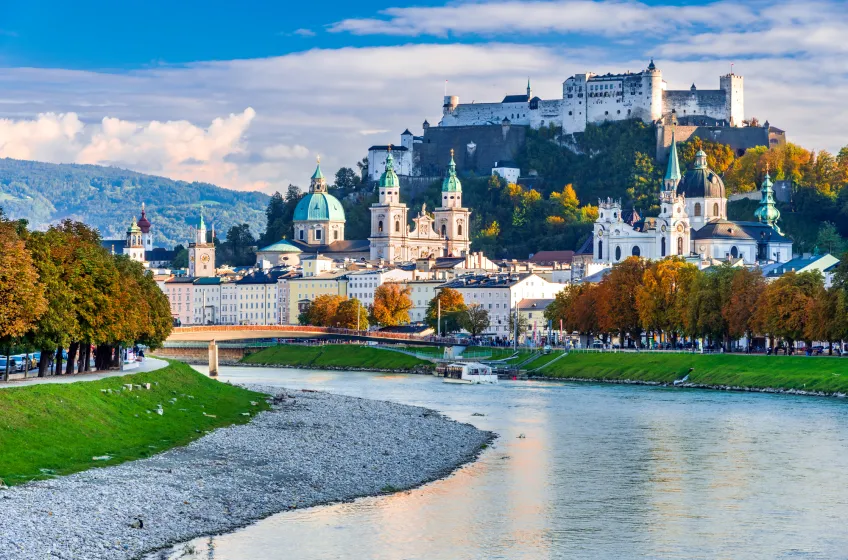
Salzburg is worth visiting for the remarkable relationship between its architecture and natural setting. Domes, church towers and tightly packed historic houses stand below the wooded Mönchsberg and Kapuzinerberg hills, while mountains rise beyond the southern edge of the city.
Its historic centre reflects the wealth and influence of Salzburg’s prince-archbishops. Italian-inspired squares, elaborate churches and ceremonial buildings give it a distinctly Baroque appearance, earning the old town UNESCO World Heritage status.
Music is equally important to Salzburg’s identity. Mozart was born and raised here, while the annual Salzburg Festival brings internationally recognised opera, theatre and concerts to the city. Visitors can also explore locations used in The Sound of Music, although the film is generally better known among international travellers than among local residents.
Salzburg’s manageable size is another advantage. Most central sights can be reached on foot, and wooded hills provide panoramic walks directly from the old town. Three full days allow time for the main attractions, while a longer stay makes it possible to visit nearby lakes, salt mines or mountain communities.
Salzburg Highlights: Things to See and Do in Salzburg
Hohensalzburg Fortress
Hohensalzburg Fortress dominates the city from a steep hill above the old town. Construction began in 1077, and successive prince-archbishops expanded it into one of Europe’s largest preserved medieval fortress complexes.
Visitors can explore courtyards, defensive rooms, museums and the elaborate Princes’ Chambers. Exhibitions cover the fortress’s military history, court life and the development of Salzburg.
The terraces provide outstanding views over the old town, Salzach Valley and surrounding mountains. Visibility is generally clearest during the morning, although sunset creates especially attractive views over the rooftops.
A funicular runs from Festungsgasse to the fortress. Walking up is also possible but involves a steep paved route. The site opens throughout the year, with longer hours during the warmer months.
Salzburg Cathedral
Salzburg Cathedral stands at the centre of the old town and is one of the city’s finest Baroque buildings. Its pale stone façade, large dome and twin towers dominate Domplatz.
The spacious interior contains elaborate plasterwork, frescoes, side chapels and a large organ arrangement. Mozart was baptised in the cathedral and later worked for Salzburg’s ecclesiastical court.
The crypt contains archaeological remains and burial places connected with the prince-archbishops. Admission arrangements may include access to exhibitions or an audio guide.
The cathedral remains an active place of worship, so sightseeing may be restricted during services, concerts and religious ceremonies.
DomQuartier
The DomQuartier connects the former state rooms of the prince-archbishops with the cathedral galleries, art collections and monastic spaces around Residenzplatz.
The visitor route provides an excellent introduction to the power, wealth and cultural ambitions of Salzburg’s rulers. Highlights include ceremonial rooms, paintings, cathedral views and elevated passages above the main squares.
Allow at least two hours. The route includes numerous rooms and staircases, so it is better treated as a major attraction rather than a quick museum visit.
Parts of the complex may close for restoration or exhibition changes. The Residenzgalerie is undergoing a longer closure, so check which collections are accessible before visiting.
Mozart’s Birthplace
Mozart was born in 1756 in an apartment on Getreidegasse. The narrow yellow building now contains a museum devoted to his childhood, family and early career.
Displays include portraits, documents, instruments and objects associated with the Mozart family. The rooms also help visitors understand the relatively confined domestic conditions in which the family lived.
The museum can become congested because of its narrow staircases and small rooms. Visit shortly after opening or later in the afternoon for a more comfortable experience.
The attraction is important for Mozart enthusiasts, although visitors expecting a fully furnished preserved home may find it more exhibition-based than atmospheric.
Mozart Residence
The Mozart family later moved to a larger home on Makartplatz, across the river from the old town. Part of the building was destroyed during the Second World War and subsequently reconstructed.
The museum concentrates on Mozart’s years in Salzburg, his family relationships and his growing career as a performer and composer. It provides broader context than the birthplace and is often less crowded.
A joint ticket may be available for the two Mozart museums. Visiting both gives the clearest account of his early life, though casual visitors may prefer to choose only one.
Mirabell Palace and Gardens
Mirabell Palace was built by Prince-Archbishop Wolf Dietrich for Salome Alt and their children. The building now contains municipal offices and ceremonial rooms.
The Marble Hall is known for weddings and concerts, although public access may be restricted by private events. The principal staircase is decorated with sculpted cherubs and mythological figures.
Outside, the formal gardens provide one of Salzburg’s classic views, with fountains and statues aligned towards Hohensalzburg Fortress. Several scenes from The Sound of Music were filmed here.
The gardens are free and most attractive early in the morning, before tour groups arrive. Seasonal planting makes late spring and summer particularly colourful.
Getreidegasse
Getreidegasse is Salzburg’s best-known historic shopping street. Its tall, narrow buildings contain enclosed courtyards, passageways and decorative wrought-iron trade signs.
Mozart’s Birthplace is its most famous address, but the street also contains fashion shops, delicatessens, cafés and traditional businesses. Some of the most interesting details are above eye level or inside the connecting courtyards.
The central section becomes extremely crowded during the day. Visit early, then explore the quieter lanes and passages towards Universitätsplatz, Goldgasse and the river.
St Peter’s Abbey and Cemetery
St Peter’s Abbey is among the oldest continuously operating monasteries in the German-speaking world. Its church combines Romanesque foundations with later Baroque decoration.
The adjoining cemetery is one of Salzburg’s most atmospheric locations, with wrought-iron grave markers, flower-filled plots and arcaded burial chapels beneath the Mönchsberg cliffs.
Early Christian catacombs are cut into the rock above the cemetery and can usually be entered for a small fee. Reaching them involves steep steps.
Although the cemetery appeared as inspiration for a scene in The Sound of Music, it remains an active burial ground and should be visited respectfully.
Mönchsberg
The Mönchsberg is the long wooded ridge rising immediately above the old town. Its paths provide panoramic views, forest walks and a quick escape from the crowded central streets.
A lift from Anton-Neumayr-Platz reaches the Museum der Moderne and one of the main viewpoints. From there, paths continue towards Hohensalzburg Fortress and other overlooks.
The ridge is suitable for a relaxed walk, though some routes contain slopes, steps and uneven surfaces. Allow two or three hours to explore without rushing.
The Museum der Moderne presents modern and contemporary exhibitions in a striking hilltop building. Even visitors who skip the galleries can enjoy its terrace and surroundings.
Kapuzinerberg
Kapuzinerberg rises on the eastern side of the Salzach and is generally quieter than Mönchsberg.
Several paths climb through woodland towards the Capuchin monastery and higher viewpoints. The route from Steingasse passes historic defensive walls and steep stairways.
The hill provides excellent views back towards the fortress and old town. It is also a useful place for a morning walk before museums and shops open.
Wear shoes with reasonable grip, particularly after rain or during winter. Some sections are poorly lit after dark.
Hellbrunn Palace and Trick Fountains
Hellbrunn Palace was created as a summer retreat for Prince-Archbishop Markus Sittikus during the early 17th century.
Its gardens are best known for the Trick Fountains, a playful arrangement of concealed water jets, mechanical figures and artificial grottos designed to surprise guests. Guided or timed visits demonstrate the water features.
The palace interior contains decorated rooms and exhibitions on court entertainment. Extensive grounds provide space for walking and picnics.
Hellbrunn is several kilometres south of the centre and is easily reached by bus or bicycle. The fountains are seasonal, so this attraction is most rewarding from spring to early autumn.
Salzburg Museum and Neue Residenz
The Salzburg Museum occupies the Neue Residenz on Mozartplatz and explores the city’s artistic, political and social history.
Displays provide useful context for Salzburg’s development under the prince-archbishops, its musical traditions and its transition into modern Austria.
The building’s tower contains a historic carillon that plays at scheduled times. Guided visits to the mechanism may be offered separately.
Museum displays and opening arrangements may be affected by redevelopment plans, so check the current programme before making it the centre of your itinerary.
Steingasse and the Right Bank
Steingasse runs beneath Kapuzinerberg on the eastern side of the river. It was once an important route towards the south and retains narrow houses, old inns and a more local atmosphere than Getreidegasse.
Nearby Linzergasse is busier, with shops, cafés and access to the Kapuzinerberg paths. The surrounding district contains independent restaurants and bars that are often less tourist-focused than those in the old town.
Crossing the Salzach by one of the central bridges provides the classic view towards the fortress, cathedral domes and Mönchsberg.
Untersberg
The Untersberg is a prominent mountain south of Salzburg, straddling the Austrian–German border.
A cable car climbs from near Grödig to a high station with views across Salzburg, the Alpine foothills and surrounding peaks. Snow may remain at altitude even when the city is warm.
Short walks are possible near the upper station, but the terrain quickly becomes rugged and exposed. Proper mountain footwear and suitable clothing are necessary for longer routes.
Cloud can completely obscure the panorama. Check the summit conditions before paying for the cable car, rather than judging the weather only from central Salzburg.
Practical Advice for Visitors
Getting There
Salzburg Hauptbahnhof has frequent trains to Vienna, Munich, Innsbruck, Graz and other Austrian and German cities. Faster services reach Vienna in under three hours and Munich in approximately one and a half to two hours.
Salzburg Airport lies only a few kilometres west of the centre. Public buses connect it with the old town and railway station.
Munich Airport has a much broader international network and is a practical alternative, though the onward journey requires considerably more time.
The railway station is roughly a 20-minute walk from the historic centre. Trolleybuses provide easy connections with most central districts.
Getting Around
Salzburg’s old town is compact and largely pedestrianised. Walking is usually the fastest way to travel between the cathedral, Getreidegasse, Mozart museums and fortress funicular.
Trolleybuses and conventional buses serve the railway station, airport, Hellbrunn, Untersberg cable car and outer districts. Tickets are normally cheaper when bought in advance rather than from the driver.
The Salzburg Card is available for 24, 48 or 72 hours. It includes one-time admission to many principal attractions and travel on specified city buses and trolleybuses, though ordinary S-Bahn trains are generally not included.
The card can provide strong value when visiting the fortress, Mozart museums, Hellbrunn and several other paid sights within a short period. Compare its cost with your actual itinerary before purchasing.
Parking
Driving into central Salzburg is inconvenient and rarely necessary. The old town contains pedestrian zones, restricted streets and retractable vehicle barriers.
During July and August 2026, additional restrictions apply to tourist vehicles entering parts of the historic centre. Hotel guests and certain authorised vehicles may be exempt, but day visitors should use park-and-ride facilities rather than attempting to drive centrally.
Large park-and-ride sites connect with the centre by public transport. Combined parking and group transport tickets may be available.
Central garages are convenient but expensive and fill during the Salzburg Festival, Christmas markets and summer weekends. Confirm hotel parking separately, as it is not always included.
Dining
Salzburg’s best-known savoury speciality is Bosna, a spiced sausage served in a white bread roll with onion, mustard and seasoning.
Traditional dishes also include schnitzel, dumplings, roast pork, Kasnocken and freshwater fish. Regional influences come from both Austria and neighbouring Bavaria.
Salzburger Nockerl is the city’s signature dessert: a sweet baked soufflé shaped to represent surrounding mountains. It is often large enough to share and may require advance preparation.
St Peter Stiftskulinarium provides historic surroundings and a broad traditional menu, while the Augustiner Bräu at Mülln offers beer-hall dining and food stalls in a large communal setting.
Restaurants immediately around the main squares can be expensive. More local choices are found around Linzergasse, Steingasse, Nonntal and the streets north of the railway line.
Coffee and Confectionery
Salzburg has a strong café tradition, with historic establishments serving coffee, cakes and light meals.
Café Tomaselli on Alter Markt is one of the city’s most famous coffee houses. Café Bazar, beside the Salzach, has long associations with artists and festival visitors.
The original Mozartkugel was created by the Fürst confectionery. Its handmade version differs from the mass-produced Mozart-branded chocolates sold throughout Austria.
Expect table service in traditional cafés. Ask for the bill when ready, as staff will not necessarily bring it automatically.
Shopping
Getreidegasse contains international fashion brands, traditional signs and specialist shops. Its side passages often lead to smaller businesses and quieter courtyards.
Alter Markt, Goldgasse and Linzergasse offer confectionery, jewellery, clothing and regional products.
Popular purchases include Mozartkugeln, Austrian wine, schnapps, Christmas decorations and traditional clothing. Check the place of manufacture when looking for genuinely local products.
Most ordinary shops close on Sundays. Souvenir businesses, bakeries and selected shops around the main tourist streets may remain open.
When to Visit
April to June offers spring gardens, comfortable walking weather and fewer crowds than the main summer period. Rain remains common, so carry a lightweight waterproof layer.
July and August bring the Salzburg Festival, long days and the fullest attraction schedules. They also bring high accommodation prices and considerable crowds.
September and early October are excellent for city walks and nearby mountain excursions. Conditions are often mild, though mountain services may begin reducing their schedules later in autumn.
Late November and December are popular for Christmas markets and Advent concerts. The old town is atmospheric but exceptionally busy at weekends.
January to March is quieter outside festival and holiday periods. Snow in the city is possible but not guaranteed, while nearby mountains generally have more reliable winter conditions.
Local Events
The Salzburg Festival is the city’s most important cultural event, presenting opera, theatre and concerts at venues throughout the centre. In 2026, the main summer festival runs from 17 July to 30 August.
Tickets for major productions can be expensive and highly sought after. Less formal concerts, public broadcasts and associated events provide alternatives for visitors without main-stage tickets.
The Salzburg Easter Festival presents major orchestral and operatic performances. From 2026, the Berlin Philharmonic again plays a central role in the festival programme.
Salzburg’s Christmas markets take place around the cathedral, Residenzplatz, Mirabell and several smaller locations. Advent weekends create strong demand for hotels and restaurants.
Rupertikirtag is a traditional fair held around the cathedral squares in September, with food, rides, music and regional clothing.
Exploring Beyond Salzburg
The Salzkammergut begins east of the city and contains lakes, mountains and historic settlements. St Gilgen, St Wolfgang and Mondsee are among the easiest destinations for a day trip.
Hallstatt is possible as a long day excursion, but transport takes time and the village becomes extremely crowded. Staying elsewhere in the Salzkammergut often creates a more relaxed experience.
Berchtesgaden lies across the German border and provides access to Königssee, mountain walks and historic sites. Carry valid identification for cross-border travel.
The Hallein Salt Mine explores the region’s ancient salt industry through underground passages, slides and a subterranean boat journey. It is particularly suitable for families.
Werfen is known for Hohenwerfen Castle and the Eisriesenwelt ice cave. Visiting the cave requires uphill walking, warm clothing and sufficient time for the combined bus, cable-car and foot journey.
Bad Ischl is an elegant former imperial spa town and a useful base for exploring the central Salzkammergut.
Shortlist
- Your Shortlist is empty