
Discover Carinthia | A Visitor's Introduction to Carinthia
Recommended places to visit, places to stay and things to do in and around Carinthia
Carinthia is Austria’s southernmost federal state, bordering Italy and Slovenia beneath the eastern Alps. Known for its warm bathing lakes, rounded mountain landscapes and mix of Austrian, Slovene and Italian influences, the region is a perfect destination for families, swimmers, hikers, cyclists and travellers seeking a quieter alternative to Austria’s busiest Alpine areas. With its clear water, scenic roads, medieval castles and relaxed lakeside resorts, Carinthia combines outdoor adventure with an unusually sunny, southern atmosphere.
Recommended Carinthia hotels and other accommodation
Pre-book Carinthia Attractions, Tours & Experiences
Why is Carinthia Worth a Visit?
Carinthia is worth visiting because it brings lakes and mountains together in a particularly accessible way. You can spend the morning walking through high Alpine scenery, return by cable car and swim in warm lake water during the afternoon.
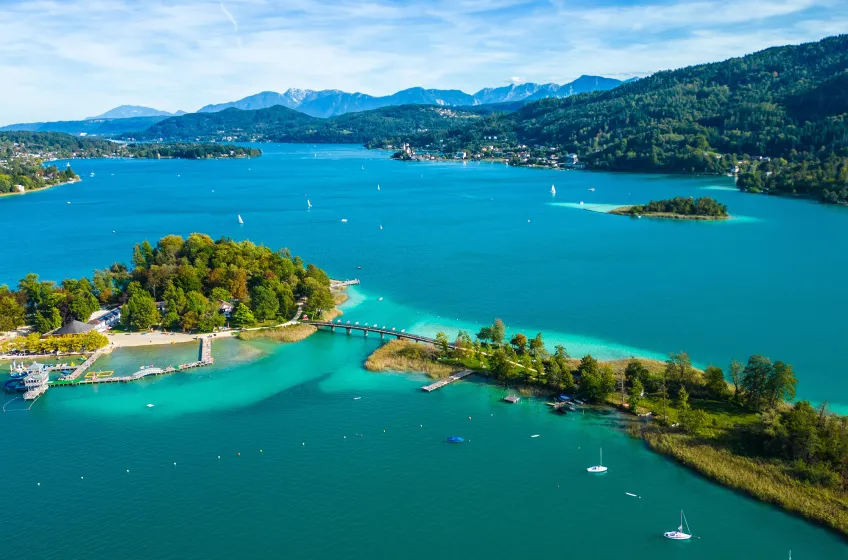
The state contains several of Austria’s best-known bathing lakes, including Wörthersee, Millstätter See, Ossiacher See, Faaker See and Weissensee. Each has a different character, ranging from lively waterfront resorts to quiet, largely undeveloped shores.
Carinthia’s mountain landscapes are equally varied. The Hohe Tauern contain glaciers and Austria’s highest peak, while the Nockberge are known for gentler, rounded summits, larch forests and accessible walking routes. Ski resorts such as Nassfeld, Bad Kleinkirchheim and Gerlitzen provide winter activities as well as summer cable cars and hiking.
The region also has a strong historical identity. Klagenfurt and Villach provide urban culture, while Hochosterwitz Castle, Gurk Cathedral and the old towns of Friesach and Gmünd offer worthwhile alternatives to outdoor activities.
Carinthia is well suited to a one- or two-week holiday. A car is useful for moving between lakes, valleys and castles, though several major destinations can also be reached by train.
Carinthia Highlights: Things to See and Do in Carinthia
Lake Wörthersee
Wörthersee is Carinthia’s best-known lake and its most glamorous summer destination. Stretching between Klagenfurt and Velden, it is surrounded by wooded hills, elegant villas, bathing areas and waterfront resorts.
The lake warms considerably during summer, making it suitable for swimming, paddleboarding, sailing and other watersports. Public beaches provide organised access, as much of the immediate shoreline is privately owned.
Klagenfurt occupies the eastern end, while Velden is known for its castle hotel, restaurants and lively summer atmosphere. Pörtschach offers attractive villas, a long lakeside peninsula and a more relaxed resort setting.
Passenger boats connect several communities during the main season. Boat services are scenic but relatively slow, so check the final return sailing before planning an evening elsewhere on the lake.
Klagenfurt
Klagenfurt is Carinthia’s capital and the main cultural centre beside Wörthersee. Its Renaissance old town contains arcaded courtyards, colourful façades and broad pedestrian squares.
The central Neuer Platz is dominated by the Lindwurm Fountain, which depicts a dragon associated with the city’s founding legend. Nearby Alter Platz is lined with shops, cafés and historic town houses.
The Carinthian Museum explores the state’s archaeology, natural history and cultural development. The Museum of Modern Art provides a useful alternative for visitors interested in more recent work.
Klagenfurt’s centre is several kilometres from the lakeshore. Local buses connect it with the Strandbad, Europapark and Minimundus.
Pyramidenkogel
The Pyramidenkogel observation tower stands on a hill south of Wörthersee and provides one of Carinthia’s finest panoramic views.
Its wooden and steel structure rises high above the surrounding forest. From the viewing platforms, you can see across the lake towards Klagenfurt, the Karawanken range and, in clear weather, distant Alpine peaks.
A lift reaches the upper platform, while a staircase provides a more energetic descent. An enclosed slide offers an additional way down when operating.
Visibility is central to the experience, so check the weather before travelling. Early morning and late afternoon usually provide softer light and fewer visitors.
Minimundus
Minimundus is an open-air miniature park near the eastern shore of Wörthersee in Klagenfurt. It contains detailed models of famous buildings, bridges, trains and engineering landmarks from around the world.
The displays are built to a consistent scale and include moving elements that appeal particularly to younger visitors. An indoor section provides additional exhibitions and activities during poor weather.
Minimundus is easy to combine with the nearby lake beach and Europapark. Allow around two to three hours, depending on children’s ages and interest.
Hochosterwitz Castle
Hochosterwitz Castle is one of Austria’s most dramatic fortresses. It stands on an isolated limestone hill north-east of Klagenfurt, visible from far across the surrounding countryside.
The traditional approach passes through 14 fortified gateways, each designed to slow or trap attackers. Reaching the upper complex requires a sustained uphill walk, although a lift may operate separately.
Inside are courtyards, a chapel, armour displays and viewpoints across central Carinthia. The defensive route itself is the main attraction and gives the castle a stronger sense of authenticity than many heavily reconstructed sites.
Wear suitable footwear and take water during hot weather. Opening is seasonal, and poor conditions can affect access.
Villach
Villach is Carinthia’s second-largest city, positioned near the meeting point of several valleys and close to the borders with Italy and Slovenia.
Its pedestrian centre stretches around Hauptplatz, where pastel façades, cafés and shops create a relaxed atmosphere. The parish church tower provides views over the rooftops when open.
The River Drau passes through the city and has riverside paths suitable for walking or cycling. Villach is also known for its thermal spa district at Warmbad.
The city makes a practical base for excursions to Faaker See, Ossiacher See, Gerlitzen, Landskron Castle and the Italian border.
Landskron Castle and Monkey Mountain
The ruins of Landskron Castle occupy a hill north-east of Villach and provide broad views across the lakes and mountains.
The site is known for seasonal demonstrations involving birds of prey. Eagles, vultures and other large birds fly above the castle grounds while handlers explain their behaviour and conservation.
Nearby Monkey Mountain is home to a large group of Japanese macaques living in a spacious forested enclosure. Visits generally follow a guided route that explains the animals’ social behaviour.
Both attractions are especially popular with families. They can become busy during school holidays, and parts of the castle approach are steep.
Lake Faak
Faaker See is a striking turquoise lake south-east of Villach, beneath the Karawanken mountains.
Its clear colour comes partly from fine mineral particles carried by mountain streams. The lake is smaller and generally quieter than Wörthersee, though its campsites and beaches become busy during summer.
Swimming, paddleboarding and canoeing are popular. Reed-lined sections and a small island give parts of the lake a more natural appearance than larger resort lakes.
Many sections of shoreline are connected with private accommodation or paid bathing facilities. Confirm access before assuming you can stop beside the water anywhere.
Lake Ossiach and Gerlitzen
Ossiacher See lies north-east of Villach beneath the Gerlitzen mountain. The lake is used for swimming, sailing and paddleboarding, while cycle paths connect several communities around the shore.
Ossiach village is known for its former Benedictine abbey and summer music events. Bodensdorf and Annenheim provide accommodation and access to lakeside facilities.
From Annenheim, lifts climb towards Gerlitzen, a broad mountain used for hiking and paragliding in summer and skiing in winter.
Gerlitzen has relatively gentle upper slopes and is suitable for families seeking easy mountain views without a major climb. Weather can still change quickly, so carry an extra layer even on warm days.
Lake Millstatt
Millstätter See is a long, deep lake surrounded by wooded hills and the mountains of the Nockberge region.
Millstatt is the principal historic settlement, with a former monastery, lakeside promenade and traditional villas. Seeboden and Döbriach provide further beaches, hotels and family facilities.
The lake is suitable for swimming, boating and paddleboarding. Walking routes climb into the surrounding hills, while gentler paths follow sections of the shore.
A lakeside bathhouse in Millstatt provides saunas, wellness facilities and views over the water. Austrian sauna areas commonly operate without swimwear, so check the rules before entering.
Nockberge Biosphere Park
The Nockberge are known for their rounded, grass-covered mountains, pine forests and broad Alpine pastures. They provide a gentler contrast to the sharper peaks of the Hohe Tauern and Karawanken.
Bad Kleinkirchheim, Turracher Höhe and the villages around Lake Millstatt are useful bases for exploring the region. Cable cars provide access to high walking routes during the summer season.
The Nockalm Road is a scenic driving route through the mountain landscape, with bends, viewpoints and walking stops. It generally operates only during the snow-free part of the year and charges a toll.
Although many Nockberge routes are accessible, they still involve mountain conditions. Carry waterproof clothing and do not rely solely on warm weather in the valley.
Grossglockner and Heiligenblut
The Grossglockner is Austria’s highest mountain and rises on the border between Carinthia and East Tyrol. The village of Heiligenblut provides the classic Carinthian approach.
Heiligenblut is known for its picturesque Gothic church framed by high peaks. It serves as a base for hiking, mountaineering and winter sports within the Hohe Tauern National Park.
The Grossglockner High Alpine Road begins nearby and climbs through spectacular mountain scenery towards Salzburg state. It includes hairpin bends, visitor centres and viewpoints towards glaciers and surrounding peaks.
The road normally opens only during the warmer months and may close temporarily because of snow or severe weather. Check conditions before setting out and allow much longer than a navigation app suggests.
Malta High Alpine Road
The Malta Valley leads into a dramatic high-mountain landscape of waterfalls, cliffs and reservoirs.
A toll road climbs towards the Kölnbrein Dam, Austria’s highest dam. The route includes tunnels, narrow passages and controlled sections where vehicles may have to wait.
At the reservoir, visitors can walk across the dam, learn about hydroelectric engineering and explore surrounding trails. A viewing platform projects over the steep downstream face.
The road is seasonal and weather dependent. Large vehicles, nervous drivers and anyone uncomfortable with narrow mountain roads should review conditions carefully before travelling.
Lake Weissensee
Weissensee is one of Carinthia’s most peaceful lakes. Much of its shoreline remains undeveloped, and surrounding mountains descend directly towards clear blue-green water.
The lake is popular for swimming, walking, mountain biking and slow-paced family holidays. Boats connect settlements and trailheads during summer.
Weissensee is also known for winter ice skating when conditions allow, although natural ice can never be guaranteed. Use only officially approved areas and follow local safety instructions.
The absence of a continuous busy road along the shore gives the lake a quieter atmosphere than Wörthersee or Ossiacher See.
Gmünd
Gmünd is a small medieval town in northern Carinthia, with preserved walls, gates and an attractive central square.
The town is particularly associated with Ferdinand Porsche, who moved his design operation here following the Second World War. A small museum displays historic vehicles and explores the company’s period in Gmünd.
The ruined castle above the centre hosts cultural events and provides views over the surrounding valley.
Gmünd is a useful stop between the Lake Millstatt area and the Malta Valley.
Practical Advice for Visitors
Getting There
Klagenfurt Airport is the state’s main airport, though its route network is limited and can change seasonally. Ljubljana, Graz, Salzburg and Venice airports may offer more useful international connections depending on your destination within Carinthia.
Klagenfurt and Villach are the principal railway hubs. Direct or connecting trains link them with Vienna, Salzburg, Graz, Munich, Ljubljana and northern Italy.
The Koralmbahn rail connection has significantly improved travel between Carinthia and Styria, making journeys towards Graz and eastern Austria faster than older itineraries may suggest. Check current timetables rather than relying on previous journey times.
Drivers can enter Carinthia through motorways and major Alpine routes from Salzburg, Styria, Italy and Slovenia. Tunnels, toll roads and motorway vignettes may add to the cost.
Choosing Where to Stay
Klagenfurt is the best choice for urban attractions, museums and access to the eastern end of Wörthersee.
Velden and Pörtschach suit visitors seeking a lively lakeside holiday with restaurants, swimming and boat connections. They are among the more expensive bases during summer.
Villach is practical for public transport and excursions to several lakes, mountains and neighbouring countries.
Millstatt, Seeboden and Döbriach provide access to Millstätter See and the Nockberge. Weissensee suits travellers seeking peace, walking and outdoor activity.
Heiligenblut is ideal for high-mountain scenery, while Bad Kleinkirchheim combines hiking or skiing with thermal spas.
Getting Around
Trains connect Klagenfurt, Villach, Spittal an der Drau and several towns along the main valleys. They are useful for larger settlements but do not reach every lake resort or mountain attraction.
Regional buses fill many gaps, though evening and weekend services can be limited. Check the return journey before leaving for a remote trail or village.
Seasonal lake boats operate on Wörthersee, Millstätter See, Ossiacher See and Weissensee. They are best treated as scenic transport rather than frequent commuter services.
A car provides the greatest flexibility for castles, mountain roads, smaller lakes and rural accommodation.
The Kärnten Card
The Kärnten Card can offer good value for an active sightseeing holiday. It normally includes admission to numerous attractions such as cable cars, museums, panoramic roads and family destinations.
The summer 2026 card is valid from 4 April to 1 November. Different durations are available, so compare the cost with the attractions you genuinely plan to visit.
Some accommodation providers also issue local guest cards with public transport benefits, discounts or regional activities. These are separate from the main Kärnten Card and vary between resorts.
Always check exclusions, seasonal openings and whether reservations are still required.
Driving and Parking
Austria requires a vignette for vehicles using motorways and expressways. Some tunnels, panoramic roads and high-mountain routes charge additional tolls.
Mountain roads can include steep gradients, tight bends and narrow tunnels. Descend in a low gear rather than relying continuously on the brakes.
Winter tyres are legally required in Austria under specified wintry conditions during the colder months. Snow chains may also be necessary on mountain approaches.
Parking at popular lakes can be difficult during sunny summer weekends. Use official beach, cable-car or town car parks and arrive early.
Swimming and Water Safety
Many Carinthian lakes are warm enough for comfortable summer swimming. Public beaches often charge admission but provide changing facilities, toilets, lawns and supervised areas.
Large sections of shoreline are private. Do not cross hotel grounds, gardens or farmland to reach the water.
Thunderstorms can develop rapidly during hot afternoons. Leave the lake when warnings are issued or when thunder is audible.
Water temperatures fall sharply outside high summer, particularly in deeper lakes. Boats and paddleboards should carry appropriate safety equipment.
Dining
Carinthian cooking combines Alpine ingredients with influences from Italy and Slovenia.
The best-known regional dish is Kärntner Kasnudeln, pasta parcels filled with potato, curd cheese and herbs. Their carefully pinched edges are traditionally known as krendeln.
Other specialities include Ritschert, a barley and bean stew; freshwater fish; game; cured meats; and Reindling, a sweet yeast cake filled with cinnamon, sugar and raisins.
Mountain huts usually serve soups, dumplings, sausages and substantial desserts. Carry cash, as remote huts may not accept cards.
Restaurants in small resorts can have fixed rest days or limited afternoon service. Reserve dinner during peak summer and ski periods.
Shopping
Typical purchases include Carinthian honey, cheese, cured meats, fruit spirits, pumpkin-seed products and locally brewed beer.
Reindling is widely available from bakeries, although it is best eaten fresh. Some shops package it for travel.
Farm shops and village markets are useful for regional produce. Klagenfurt and Villach offer the broadest general shopping.
Check customs rules when making day trips into nearby Slovenia or Italy, particularly when carrying larger quantities of alcohol or tobacco.
When to Visit
June to September is the best period for swimming, high-level hiking, lake boats and mountain roads. July and August bring the warmest water but also the largest crowds.
May and early June are well suited to lower-level walking and cycling. Some high routes and cable cars may not yet be open.
September is often excellent, with warm lake temperatures, quieter resorts and generally pleasant walking conditions. Mountain facilities begin closing as the season progresses.
December to March is the main period for skiing and winter activities, though snow reliability varies by altitude. Higher resorts such as Nassfeld and the Mölltal area generally have longer seasons than low valleys.
Spring and late autumn are quieter, but many lakeside hotels, boats, cable cars and seasonal attractions close temporarily.
Local Events
The Carinthian Summer music festival presents classical and contemporary performances around Ossiacher See and other regional venues.
Villach Carnival is one of Austria’s best-known carnival traditions, combining satirical performances with public celebrations before Lent.
Villacher Kirchtag is a major summer folk festival featuring traditional clothing, music, food and processions.
Ironman Austria takes place around Klagenfurt and Wörthersee, bringing road closures and heavy accommodation demand.
Lake festivals, concerts and sporting events occur throughout the summer. Dates and formats change annually, so check local calendars before booking.
Exploring Beyond Carinthia
Ljubljana is within day-trip range from southern and central Carinthia. Slovenia’s capital has a compact historic centre, riverside cafés and architecture associated with Jože Plečnik.
Lake Bled can be reached from Villach or the southern valleys, though border traffic may increase during summer weekends.
Tarvisio in Italy offers markets, mountain scenery and access to the Fusine Lakes. It is particularly convenient from Villach.
Udine provides a larger Italian cultural excursion, with Venetian-style squares, cafés and regional food.
East Tyrol lies west of Carinthia and offers quieter high mountains, traditional valleys and access to the southern side of the Hohe Tauern.
Shortlist
- Your Shortlist is empty