
Discover Linz | A Visitor's Introduction to Linz
Recommended places to visit, places to stay and things to do in and around Linz
Linz is the capital of Upper Austria, set on both banks of the River Danube between Vienna and Salzburg. Known for its combination of historic streets, contemporary art, digital culture and industrial heritage, this lively city is a perfect destination for museum visitors, families, architecture enthusiasts and travellers exploring Austria by rail. With its riverside promenades, hilltop viewpoints and innovative cultural institutions, Linz offers a modern alternative to Austria’s more traditionally imperial cities.
Recommended Linz hotels and other accommodation
Pre-book Linz Attractions, Tours & Experiences
Why is Linz Worth a Visit?
Linz is worth visiting because it combines a compact historic centre with an unusually strong interest in science, technology and contemporary culture. Baroque buildings surround the enormous Hauptplatz, while the futuristic Ars Electronica Center and glass-fronted Lentos Art Museum face one another across the Danube.
The city has successfully transformed its industrial identity into part of its visitor appeal. Former manufacturing areas, harbour buildings and riverside spaces now contain murals, cultural venues and modern architecture. Linz feels more experimental and less dependent on imperial nostalgia than Vienna or Salzburg.
Linz is also closely associated with composer Anton Bruckner, who worked in the city and nearby St Florian. Music remains an important part of local life through the Brucknerhaus concert hall, festivals and performances.
The city’s position on Austria’s main railway line makes it especially convenient for a weekend break or overnight stop. Vienna and Salzburg are both within straightforward reach, while the Danube Valley, Steyr and Upper Austria’s monasteries provide worthwhile excursions.
Linz Highlights: Things to See and Do in Linz
Hauptplatz
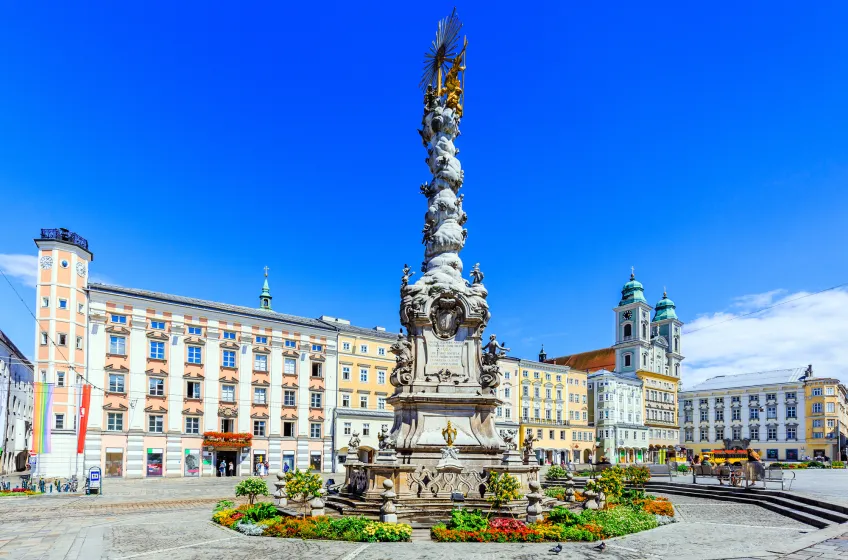
Hauptplatz is the heart of central Linz and one of Austria’s largest enclosed public squares. It is surrounded by pastel-coloured Baroque buildings, cafés, shops and historic passageways.
At its centre stands the Trinity Column, erected as an expression of gratitude for protection from war, fire and disease. Its elaborate figures and pale stone contrast with the colourful façades around the square.
The square connects directly with Landstrasse, Linz’s principal shopping street, and lies only a short walk from the Danube. Markets, concerts and public celebrations are regularly held here.
Visit early in the morning for quieter photographs, then return in the evening when the surrounding restaurants and bars become livelier.
Ars Electronica Center
The Ars Electronica Center is Linz’s most distinctive attraction. Often called the Museum of the Future, it explores artificial intelligence, robotics, biotechnology, digital art and the relationship between people and technology.
Many exhibitions are interactive, making the centre suitable for adults, teenagers and families. Displays encourage visitors to experiment with technology rather than simply read about it.
The Deep Space presentation is a particular highlight. Large wall and floor projections create immersive experiences using scientific imagery, artworks, satellite views and three-dimensional visualisations.
Check the programme on arrival, as guided demonstrations significantly improve the experience. Allow at least two to three hours.
Lentos Art Museum
The Lentos Art Museum occupies a long glass building on the southern bank of the Danube. It faces the Ars Electronica Center and forms part of Linz’s modern riverside skyline.
Its collection focuses on modern and contemporary art, including painting, photography, sculpture and installation. Temporary exhibitions frequently examine Austrian and international artists.
The building itself is especially striking after dark, when its illuminated façade reflects across the river.
The riverside café and nearby promenade make Lentos a pleasant stop even for visitors who do not plan to spend several hours in the galleries.
Pöstlingberg
Pöstlingberg rises above the northern side of Linz and provides extensive views over the city, Danube and surrounding countryside.
The historic Pöstlingbergbahn tram climbs from central Linz to the hilltop. The steep journey through residential districts is part of the attraction.
At the summit stands the twin-towered pilgrimage basilica. Viewing terraces and woodland paths provide opportunities for a short walk, while clear weather may reveal distant Alpine peaks.
Pöstlingberg is particularly attractive around sunset, although visibility is generally clearest earlier in the day.
Grottenbahn
The Grottenbahn is a family attraction inside one of the former defensive towers on Pöstlingberg.
A dragon-shaped railway carries passengers through scenes populated by dwarfs and figures from fairy tales. A recreated historic town square occupies the lower level, with displays based on familiar stories.
The attraction is aimed primarily at younger children, though its nostalgic atmosphere also appeals to adults.
Opening can be seasonal, so check before travelling to Pöstlingberg specifically for the railway.
Linz Castle Museum
Linz Castle stands on a low hill above the old town, occupying a site with medieval origins.
The museum’s collections cover archaeology, art, technology, traditional culture and the natural history of Upper Austria. Modern exhibition areas sit alongside surviving historic sections of the castle.
One of the best features is the view from the castle terrace across the Danube and rooftops of central Linz.
Allow at least two hours for a broad visit, although visitors interested in regional history could easily stay longer.
Mariendom
The Mariendom, also known as the New Cathedral, is Austria’s largest church by capacity.
Its Gothic Revival structure dominates part of central Linz with a tall tower, stained-glass windows and an extensive interior. Construction began during the 19th century and continued over several decades.
The cathedral’s windows include scenes connected with Linz and Upper Austrian history. Tower or roof visits may be available through guided arrangements.
The scale of the interior is impressive, but the atmosphere is generally calmer than that of more famous Austrian cathedrals.
Old Cathedral
The Old Cathedral stands close to Hauptplatz and provides a smaller, more intimate contrast with the Mariendom.
Its Baroque interior contains decorative plasterwork, side chapels and a historic organ. Anton Bruckner served here as organist during his years in Linz.
The church remains active, so visitor access may be limited during services and concerts.
Combining the Old Cathedral with the nearby Hauptplatz and Bruckner-related sites creates a useful short musical itinerary.
Brucknerhaus
The Brucknerhaus is Linz’s principal concert hall, standing beside the Danube.
Named after Anton Bruckner, it hosts orchestral performances, chamber music, jazz, world music and major cultural events. Its modernist architecture reflects Linz’s post-war development.
Visitors interested in classical music should check the performance programme before travelling. Attending an evening concert is one of the best ways to experience the city’s musical character.
The riverside setting is particularly attractive before or after a performance.
Mural Harbor
Mural Harbor is an open-air collection of large-scale street art in Linz’s working harbour district.
International and Austrian artists have covered warehouses, silos and industrial surfaces with murals, transforming the area into one of Europe’s more unusual urban-art locations.
Access is generally through organised tours because the harbour remains an active industrial zone. Tours may take place on foot, by boat or in combination with workshop activities.
Advance booking is advisable. Do not attempt to enter restricted port areas independently.
Botanical Garden
Linz Botanical Garden lies on a hillside west of the centre and contains thousands of plant species from around the world.
Outdoor sections include themed gardens, woodland plants, flowers and collections adapted to different climates. Glasshouses contain tropical, subtropical and desert species.
The garden is especially attractive from spring to early autumn but also provides indoor interest during colder weather.
Its elevated position creates a peaceful atmosphere away from the city centre. Buses provide easier access than the uphill walk.
Höhenrausch and Rooftop Culture
Linz has developed a reputation for using rooftops and elevated urban spaces for cultural projects.
Seasonal exhibitions have previously connected roof terraces, towers and temporary structures above the city centre. The precise programme changes, but contemporary art and unusual viewpoints remain characteristic of Linz’s cultural scene.
Check local listings for current installations, as these projects do not necessarily operate every year or throughout the year.
Danube Promenade
The Danube promenade provides one of the best ways to appreciate Linz’s relationship with the river.
Paths connect the Lentos Art Museum, Brucknerhaus, riverside parks and bridges. The opposite bank offers views back towards the old town and modern cultural buildings.
Cyclists use the same riverside corridor as part of the long-distance Danube Cycle Path. Walkers should remain aware of designated cycling sections.
Evening is particularly attractive when the museums and bridges are illuminated.
Practical Advice for Visitors
Getting There
Linz is one of Austria’s main railway hubs. Frequent trains connect it with Vienna, Salzburg, Graz, Passau and Munich.
The fastest services from Vienna or Salzburg generally take around one hour and 15 minutes. This makes Linz practical as either a day trip or a stop on a longer Austrian rail itinerary.
Linz Hauptbahnhof lies south of the historic centre. Trams run frequently along Landstrasse towards Hauptplatz and the Danube.
Linz Airport is outside the city and has a limited route network. Vienna, Salzburg or Munich may provide more convenient international flight options, depending on your itinerary.
Getting Around
Linz has a compact central area, and most old-town attractions can be reached on foot.
Trams form the backbone of public transport, connecting the railway station, Landstrasse, Hauptplatz and northern districts. Buses serve Pöstlingberg, the Botanical Garden and other outer areas.
Short-term public-transport passes can offer better value than repeated single tickets. Validate paper tickets where required before travelling.
The Danube divides parts of the city, but several bridges and frequent tram services make crossing straightforward.
Parking
Central Linz has underground and multi-storey car parks near Hauptplatz, the old town and major shopping areas.
Street parking is controlled by time limits and payment zones. Read signs carefully, as regulations vary between districts.
Park-and-ride facilities connected to tram routes are usually more economical for day visitors.
Driving within the central pedestrian areas is unnecessary. Park once and use public transport or walk between attractions.
Dining
Upper Austrian food is hearty and influenced by farming traditions. Typical dishes include roast pork, dumplings, sausages and filled potato or bread dumplings.
Linz is most famous for Linzer Torte, a spiced nut pastry filled with redcurrant or raspberry preserve and covered with a lattice crust. Several cafés and bakeries claim historic recipes, so comparing versions can be part of the visit.
Traditional inns are found around the old town, while the streets beyond the centre offer international and contemporary restaurants.
The Südbahnhofmarkt area is useful for casual food, fresh produce and regional specialities.
Coffee and Nightlife
Central Linz has a mixture of traditional Austrian cafés, modern coffee shops and bars.
Hauptplatz and the nearby old-town streets are convenient for evening drinks. Areas around the university and former industrial districts offer more contemporary venues.
Linz’s nightlife is smaller than that of Vienna or Graz but benefits from a strong cultural and student population.
During warm weather, riverside bars and outdoor events add life to the Danube area.
Shopping
Landstrasse is the city’s principal shopping street, running between the railway station and Hauptplatz.
Larger chains, department stores and shopping arcades are concentrated along this route. Independent shops can be found in the old town and side streets close to Hauptplatz.
Typical regional purchases include Linzer Torte, Upper Austrian beer, fruit preserves, cheese and craft products.
Most ordinary shops close on Sundays, although selected businesses at the railway station and tourist locations remain open.
When to Visit
April to June is excellent for city walks, parks and riverside sightseeing. Temperatures are generally mild, although rain is possible.
July and August bring long evenings and outdoor events but can become hot. Museums provide useful relief during the warmest part of the day.
September is particularly pleasant, with comfortable temperatures and an active cultural calendar.
December brings Christmas markets, illuminated streets and seasonal performances. Weekends can be busy around Hauptplatz and the central shopping streets.
Winter outside Advent is quieter and well suited to museums, concerts and cafés.
Local Events
The Ars Electronica Festival is Linz’s best-known international event. It brings together digital art, technology, science, performance and public debate.
Brucknerfest celebrates Anton Bruckner through orchestral concerts, chamber music and performances in venues across the city.
The Linz Klangwolke presents large-scale outdoor music and visual events beside the Danube.
The Pflasterspektakel street-art festival fills central streets with theatre, acrobatics, music and performance.
Christmas markets take place around Hauptplatz, Volksgarten and other central locations during Advent.
Dates vary annually, so check the current programme before arranging accommodation around a particular event.
Exploring Beyond Linz
St Florian Abbey lies south-east of Linz and contains an extraordinary Baroque library, church and rooms associated with Anton Bruckner.
Steyr is one of Upper Austria’s most attractive historic towns, with colourful façades and a dramatic position at the meeting of two rivers.
The Danube Valley west of Linz contains the Schlögener Schlinge, where the river forms a striking double bend through wooded hills.
Mauthausen Memorial stands east of Linz at the site of the former concentration camp. It is an important and emotionally demanding place of remembrance that deserves sufficient time and respectful preparation.
Gmunden and Traunsee provide an accessible introduction to the Salzkammergut, with lake views, boat trips and Schloss Ort.
Passau lies across the German border where the Danube, Inn and Ilz rivers meet. Frequent trains make it a straightforward international day trip.
Shortlist
- Your Shortlist is empty