
Discover Graz | A Visitor's Introduction to Graz
Recommended places to visit, places to stay and things to do in and around Graz
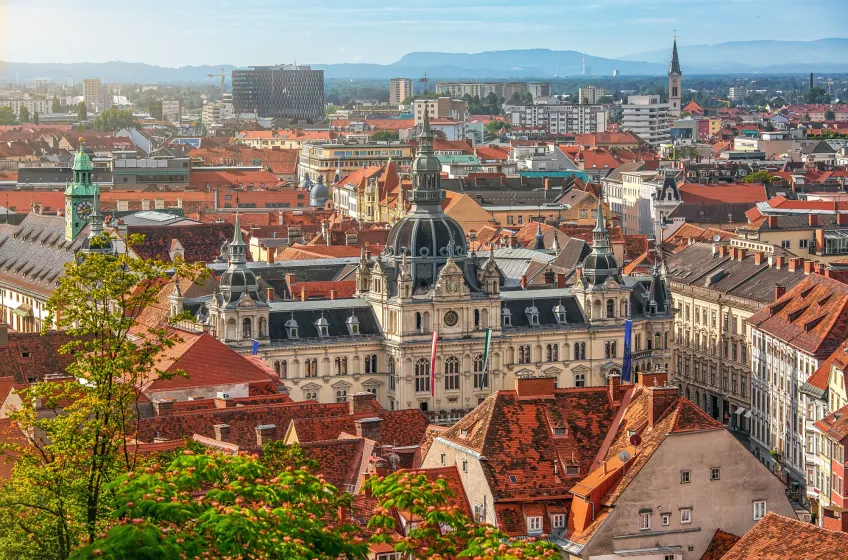
Graz is the capital of Styria and Austria’s second-largest city, set on the River Mur amid wooded hills and fertile countryside. Known for its UNESCO-listed old town, red-tiled roofs, Renaissance courtyards and bold contemporary architecture, this lively university city is a perfect destination for culture lovers, foodies and travellers seeking a relaxed alternative to Vienna or Salzburg. With its hilltop clock tower, excellent museums and easy access to Styrian wine country, Graz offers an appealing blend of history, design and regional flavour.
Recommended Graz hotels and other accommodation
Pre-book Graz Attractions, Tours & Experiences
Why is Graz Worth a Visit?
Graz is worth visiting because it combines one of Central Europe’s best-preserved historic centres with a confident modern identity. Medieval lanes, Baroque churches and Italian-influenced courtyards stand beside the futuristic Kunsthaus and the steel-and-glass Murinsel.
The city feels grand without being overwhelming. Most central sights are within walking distance, while trams make it easy to reach attractions such as Eggenberg Palace. A large student population supports independent cafés, affordable restaurants, bars and cultural events throughout the year.
Graz is also widely regarded as one of Austria’s strongest food destinations. Farmers’ markets sell Styrian apples, scarlet runner beans, cheeses and dark green pumpkin-seed oil, while traditional inns and contemporary restaurants make good use of regional produce.
Two full days are enough for the principal landmarks, although three or four nights allow time for museums, neighbourhoods and an excursion into southern Styria’s vineyard-covered hills.
Graz Highlights: Things to See and Do in Graz
Schlossberg and Clock Tower
The Schlossberg is the wooded hill rising directly above Graz’s old town. It once supported a major fortress, most of which was demolished after the city surrendered to Napoleon’s forces.
The Uhrturm, or Clock Tower, survived and became Graz’s defining symbol. Its unusually large hour hand reflects the clock’s original design, when minutes were considered less important.
Several terraces provide panoramic views across the red rooftops towards the surrounding Styrian hills. The hill also contains gardens, surviving fortifications, a museum and the Bell Tower.
You can climb the staircase from Schlossbergplatz, ride the funicular or use the lift inside the hill. For an unusual descent, a long underground slide operates within the former tunnel system.
Graz Old Town
Graz’s historic centre is a UNESCO World Heritage Site filled with courtyards, narrow lanes, arcades and buildings from several architectural periods.
Hauptplatz forms the centre of the old town, surrounded by colourful façades and dominated by the Town Hall. Herrengasse continues south past shops, historic buildings and the elaborately painted Herzogshof.
Explore the smaller lanes around Sporgasse, Stempfergasse and Glockenspielplatz rather than following only the main shopping route. Many of Graz’s finest Renaissance courtyards are hidden behind plain street entrances.
The centre is quietest during the morning. Evenings bring a livelier atmosphere as restaurants, bars and outdoor terraces fill.
Styrian Armoury
The Styrian Armoury, or Landeszeughaus, contains one of the world’s largest surviving collections of historic weapons and armour in its original setting.
More than 30,000 objects are displayed across several floors, including helmets, breastplates, swords, firearms and equipment for horses. The collection was assembled to arm regional forces during periods of conflict with the Ottoman Empire and neighbouring territories.
The densely arranged displays are impressive even without detailed military knowledge. A guided visit or audio guide provides valuable context, as the museum deliberately retains the appearance of a working historic armoury rather than a modern interactive exhibition.
Allow around 90 minutes and note that access to upper floors involves stairs, although alternative arrangements may be available.
Landhaus Courtyard
The Styrian Landhaus stands beside the Armoury and contains one of Graz’s most elegant Renaissance courtyards.
Its three levels of arcades, rounded arches and decorative well reflect strong northern Italian influence. The courtyard is free to enter during normal opening periods and is often used for concerts, ceremonies and seasonal displays.
During Advent, the courtyard sometimes contains a large ice nativity scene. At other times, it provides a peaceful architectural stop only moments from busy Herrengasse.
Kunsthaus Graz
The Kunsthaus Graz is the city’s most recognisable modern building. Its curved blue exterior, covered with circular windows and projecting nozzles, has earned it the nickname “the Friendly Alien”.
The museum presents changing exhibitions of modern and contemporary art rather than a fixed permanent collection. The programme can include installation, design, photography, video and experimental work.
Even visitors who do not enter should walk around the exterior and view it from across the River Mur. Its unusual shape forms a striking contrast with the historic buildings on the opposite bank.
Check the current exhibitions before buying a ticket, as the experience depends heavily on the programme.
Murinsel
The Murinsel is an artificial steel-and-glass platform floating in the River Mur. Created when Graz was European Capital of Culture in 2003, it was initially intended as a temporary structure but became a permanent landmark.
Curving footbridges connect both riverbanks through the island, which contains seating, a café and a small performance space.
The Murinsel is especially attractive after dark, when coloured lighting reflects on the water. Crossing it also provides an easy route between the old town and the Lend district.
Eggenberg Palace
Eggenberg Palace stands west of the centre and is Graz’s most important palace complex. Its design incorporates an elaborate symbolic scheme based on calendars, seasons, planets and the passage of time.
The state rooms contain hundreds of ceiling paintings, ornate furnishings and decorative details. Interior visits are generally organised as guided tours and may operate seasonally.
The palace grounds include lawns, formal areas, mature trees and free-roaming peacocks. The park is worth visiting even when the state rooms are unavailable.
Trams provide straightforward access from the centre. Allow at least half a day when combining the palace interior, museums and gardens.
Graz Cathedral and Mausoleum
Graz Cathedral was built during the 15th century for Emperor Frederick III. Its relatively restrained exterior hides a spacious Gothic interior with later Baroque additions.
On an outside wall, the partially preserved Landplagenbild depicts disasters that affected Styria, including war, plague and locusts.
Beside the cathedral stands the monumental mausoleum of Emperor Ferdinand II. Its turquoise dome and decorative interior form one of Graz’s most distinctive Baroque sights.
Both buildings remain religious sites, so access may be restricted during services and ceremonies.
Double Spiral Staircase
The double spiral staircase inside Graz Castle is a small but fascinating architectural feature.
Constructed around the beginning of the 16th century, it consists of two stairways that separate, meet and separate again as they rise. The design is sometimes interpreted as a symbol of reconciliation or eternity.
The staircase can usually be visited free of charge during public access hours. Graz Castle houses government offices, so visitors should remain within the permitted area.
Graz Museum
The Graz Museum occupies the Palais Khuenburg in the old town and explores the city’s political, social and cultural development.
Its displays provide context for Graz’s growth from a medieval settlement into a regional capital, industrial centre and university city. Temporary exhibitions often address local identity, architecture or contemporary urban issues.
A separate branch on the Schlossberg explains the history of the hill, fortress and surviving structures.
Joanneumsviertel
The Joanneumsviertel is a museum complex in the city centre built around a sunken public plaza.
Its institutions include the Neue Galerie, which focuses on modern and contemporary art, and natural-history collections covering geology, zoology and regional ecosystems.
The complex is useful during wet weather and works particularly well for families or visitors interested in combining art and science.
A combined museum ticket may provide better value when visiting several institutions belonging to the Universalmuseum Joanneum.
Graz Farmers’ Markets
Graz’s markets are among the best places to experience Styrian food culture.
Kaiser-Josef-Platz has a busy morning market selling fruit, vegetables, bread, cheese, meat, flowers and regional specialities. Lendplatz offers a similar mixture with a more neighbourhood-focused atmosphere.
Look for Styrian pumpkin-seed oil, scarlet runner beans, apples, horseradish, local cheese and seasonal mushrooms. Small food stands and cafés make both markets suitable for breakfast or lunch.
Arrive during the morning, as many produce stalls close around midday.
Lend and Gries
The districts of Lend and Gries lie west of the River Mur and reveal a more diverse, contemporary side of Graz.
Lendplatz is surrounded by cafés, bars and independent businesses, while streets closer to the Kunsthaus contain small galleries, design shops and creative venues.
Gries has a stronger multicultural character, reflected in its Turkish, Balkan, Middle Eastern and Asian shops and restaurants.
These neighbourhoods are less polished than the historic centre, but they are useful for visitors interested in everyday city life, affordable food and evening activity.
Mariatrost Basilica
Mariatrost Basilica stands on a wooded hill on the north-eastern edge of Graz.
A long ceremonial staircase leads to the pale yellow Baroque church, whose twin towers can be seen from across the surrounding district. The interior contains frescoes, gilded decoration and an elaborate high altar.
Tram services reach the base of the hill from central Graz. The climb is moderately demanding, but the elevated setting and woodland walks make it worthwhile.
Practical Advice for Visitors
Getting There
Graz Hauptbahnhof has frequent rail connections with Vienna, Salzburg, Linz, Klagenfurt and other Austrian cities. International or connecting services also run towards Slovenia, Croatia and Germany.
Rail travel between Vienna and Graz has become significantly faster following improvements to the southern railway route. Check current schedules, as older journey estimates may no longer be accurate.
Graz Airport lies south of the city. Regional trains and buses connect the airport area with Graz Hauptbahnhof and central districts, although very early or late flights may require a taxi.
The main railway station is roughly 20 minutes on foot from Hauptplatz. Trams provide a faster and easier connection.
Getting Around
Central Graz is compact and best explored on foot. The old town, Schlossberg, Kunsthaus and major central museums are close together.
Trams serve the railway station, Eggenberg Palace, Mariatrost and outer neighbourhoods. Buses fill gaps in the suburban network.
A central section of the tram system can normally be used without charge within the designated old-town zone. Check the current boundaries before relying on this arrangement.
Short-term public-transport passes and versions of the Graz Card may provide good value when visiting several paid attractions or travelling frequently.
Parking
Driving in the historic centre is unnecessary and can be inconvenient because of pedestrian areas, one-way streets and controlled parking zones.
Central garages are available near Andreas-Hofer-Platz, Kastner & Öhler, the opera house and other locations. Charges can be high for a full day.
Park-and-ride sites connected to tram routes are generally better value. These are especially useful during festivals, Christmas markets and busy weekends.
Check hotel parking before arrival, as central accommodation may offer only limited spaces or use a separate public garage.
Dining
Graz is an excellent destination for regional Austrian food. Typical Styrian ingredients include pumpkin-seed oil, scarlet runner beans, apples, horseradish, mushrooms and locally raised meat.
Try Backhendl, or fried chicken, served with potato or bean salad. A Brettljause is a wooden board covered with cured meats, cheese, spreads, pickled vegetables and bread.
Pumpkin-seed oil has a dark green colour and nutty flavour. It is used on salads, soups, cheese and occasionally vanilla ice cream.
Traditional restaurants can be found around the centre, while Lend, Gries and the university districts provide international food and more affordable options.
Reserve popular restaurants on Friday and Saturday evenings.
Coffee and Nightlife
Graz’s student population supports a lively café and bar culture.
The streets around the university, Lendplatz and the old town contain coffee shops ranging from traditional Austrian cafés to modern speciality roasters.
Evening activity is concentrated around the Bermuda Triangle near Mehlplatz, the university district and venues around Lend and the River Mur.
Graz nightlife is generally more relaxed than Vienna’s, with many people gathering in bars, courtyards and outdoor seating areas rather than large clubs.
Shopping
Herrengasse and the streets around Hauptplatz form the principal central shopping area. Larger chains are mixed with Austrian retailers, department stores and specialist shops.
Sporgasse, Sackstrasse and the lanes around the old town contain antiques, design objects, fashion and food shops.
Regional purchases include pumpkin-seed oil, Styrian wine, scarlet runner beans, apple products and handmade chocolates.
Visit farmers’ markets or specialist food shops for more authentic products than those found in general souvenir stores.
Most ordinary shops close on Sundays.
When to Visit
April to June offers mild weather, green parks and comfortable conditions for sightseeing. Rain is possible throughout spring, so bring a light waterproof layer.
July and August can be hot, with temperatures sometimes exceeding 30°C. Early sightseeing, shaded courtyards and museums provide relief during the afternoon.
September and October are especially attractive for food and wine tourism. Harvest events, autumn markets and trips into southern Styria are easy to combine with a city visit.
December brings Christmas markets, lights and seasonal events. Weekends become busy, particularly around Hauptplatz and Schlossbergplatz.
January and February are quieter and often offer better accommodation value, although outdoor attractions are less colourful.
Local Events
Styriarte presents classical music and performance in Graz and other Styrian locations during summer.
La Strada brings street theatre, circus, puppetry and outdoor performance to the city during the warmer months.
The steirischer herbst festival focuses on contemporary art, theatre and political culture, generally taking place during autumn.
Springfestival celebrates electronic music, visual art and digital culture at venues around Graz.
Advent markets are held across the centre from late November, including Hauptplatz, Schlossbergplatz and the Landhaus courtyard.
Event dates vary annually, so confirm schedules before booking accommodation around a particular festival.
Exploring Beyond Graz
The South Styrian Wine Road lies roughly an hour south of Graz by car. Vineyards, hilltop wineries and villages such as Gamlitz, Ehrenhausen and Leutschach make it one of the best regional excursions.
Riegersburg Castle stands on an extinct volcanic hill east of the city. Its fortress, exhibitions and extensive views can be combined with nearby food producers or thermal spas.
The open-air museum at Stübing preserves historic rural buildings from across Austria. It is especially rewarding from spring to autumn.
Bärenschützklamm offers a dramatic gorge walk with wooden ladders and bridges, though access is seasonal and may change because of weather, maintenance or safety work.
Maribor in Slovenia is an easy international excursion by train or car. Its riverside district, historic centre and surrounding vineyards provide a useful contrast to Graz.
The thermal resorts of Bad Blumau, Bad Waltersdorf and Loipersdorf offer pools, saunas and wellness facilities within day-trip range.
Shortlist
- Your Shortlist is empty