
Discover Salamanca | A Visitor's Introduction to Salamanca
Recommended places to stay, places to visit and things to do in and near Salamanca
Salamanca is a golden-stone university city in western Spain, set beside the River Tormes in the autonomous community of Castile and León. Known for its magnificent Plaza Mayor, historic university, twin cathedrals and lively student atmosphere, this elegant city is a perfect destination for architecture lovers, history enthusiasts, foodies and travellers exploring central Spain. With its arcaded squares, carved façades, rooftop views and energetic nightlife, Salamanca offers a compact but richly rewarding city break.
Browse Salamanca Hotels and Other Accommodation
Pre-book Salamanca Activities, Tours and Experiences
Why is Salamanca Worth a Visit?
Salamanca is worth visiting because it combines monumental architecture with the everyday energy of a major university town. Its historic centre is built largely from warm Villamayor sandstone, which takes on a deep golden colour in late-afternoon light and gives the city an unusually unified appearance.
The University of Salamanca is one of the oldest and most important universities in Europe. Its historic colleges, courtyards and ceremonial rooms help explain the city’s long association with scholarship, theology, law and the Spanish language.
Salamanca is also highly walkable. The principal sights are concentrated around Plaza Mayor, the university quarter and the cathedrals, while the Roman bridge and riverside can be reached easily on foot.
The city works well for a two-night break, but three nights allow time for museums, rooftop viewpoints, relaxed meals and a day trip into the surrounding province. Salamanca is also an excellent overnight stop between Madrid, Ávila, Zamora and Portugal.
Salamanca Highlights: Things to See and Do in Salamanca
Experience Plaza Mayor
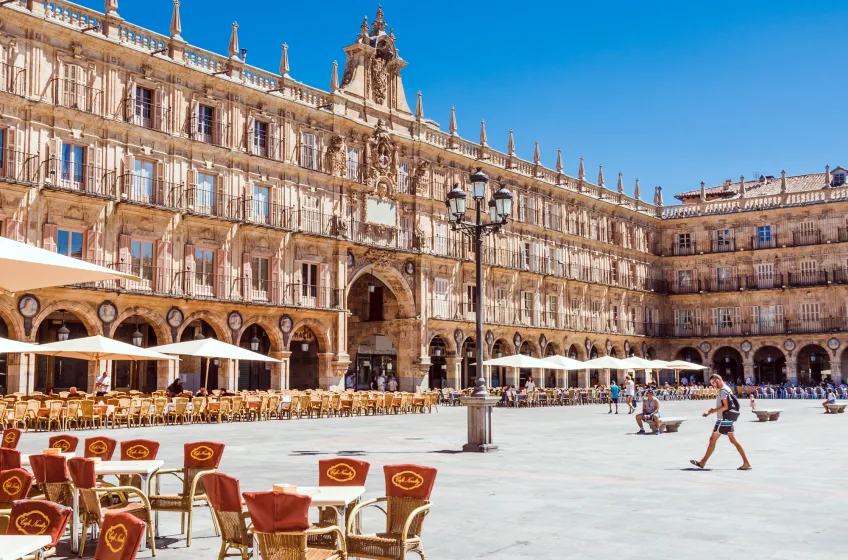
Plaza Mayor is Salamanca’s social and architectural centre.
The square is enclosed by harmonious Baroque façades and arcades, with cafés and restaurants occupying much of the ground level. Medallions decorating the buildings represent monarchs, scholars and other historical figures.
The atmosphere changes throughout the day. Morning is best for admiring the architecture, while evening brings students, families and visitors into the square.
After dark, the illuminated sandstone gives Plaza Mayor its most memorable appearance.
Visit the University of Salamanca
The historic University of Salamanca is one of the city’s defining attractions.
Founded in the medieval period, it became one of Europe’s leading centres of learning. Its ceremonial buildings contain courtyards, lecture rooms, chapels and historic academic spaces.
The highly decorated Plateresque façade is particularly famous. Visitors traditionally search for a small carved frog hidden among the ornament, although the symbolism and origin of the custom are debated.
Allow time to examine the façade closely before entering, as many of its details are easy to miss.
Explore the Old Cathedral
Salamanca’s Old Cathedral is a Romanesque and Gothic building incorporated into the larger cathedral complex.
Its interior feels darker and more intimate than the adjoining New Cathedral. Historic chapels, tombs and wall paintings reveal the city’s medieval religious importance.
The Torre del Gallo, with its distinctive ribbed dome, is one of the cathedral’s most recognisable external features.
Visiting both cathedrals together provides a clear view of how architectural tastes changed over several centuries.
Visit the New Cathedral
The New Cathedral stands immediately beside the older building and dominates Salamanca’s skyline.
Its architecture combines late Gothic, Renaissance and Baroque elements. The interior is vast, with tall columns, side chapels, choir stalls and an elaborate dome.
The exterior carvings include several later restoration details that have become popular curiosities. These should not distract from the wider craftsmanship and scale of the building.
Check access around religious services, particularly on Sundays and festival days.
Climb the Ieronimus Towers
The Ieronimus route provides access to the upper levels of Salamanca’s cathedral complex.
Visitors move through towers, galleries and rooftop walkways for close views of domes, pinnacles and stone decoration. The route also opens onto elevated platforms overlooking the city.
There are many stairs, narrow passages and exposed sections. Visitors uncomfortable with heights or confined staircases may find parts challenging.
Late afternoon is especially attractive when the sandstone rooftops begin to glow.
See the Casa de las Conchas
The Casa de las Conchas is one of Salamanca’s most distinctive historic houses.
Its façade is covered with carved scallop shells, a symbol associated with pilgrimage, nobility and the Order of Santiago. The building combines Gothic and Renaissance features.
Inside, a two-storey courtyard provides another attractive architectural space. The building now has a public cultural function, so access to some areas may depend on current use.
It stands opposite the Clerecía, making the two sites easy to combine.
Visit the Clerecía
The Clerecía is a monumental former Jesuit complex beside the university quarter.
Its church has an imposing Baroque interior, while the adjoining buildings form part of the Pontifical University. The twin towers rise prominently above the old town.
The Scala Coeli route gives access to elevated galleries and towers, providing some of Salamanca’s best views.
Explore the Convent of San Esteban
The Convent of San Esteban is one of Salamanca’s finest religious buildings.
Its elaborate Plateresque façade resembles a carved stone altarpiece. Inside are a large church, cloisters, staircases and rooms associated with Dominican history.
The convent has connections with major theological and political debates of the early modern period. It is also traditionally linked with Christopher Columbus’s efforts to gain support for his Atlantic voyage.
The cloister is particularly peaceful and deserves time for a slow visit.
Visit the Convent of Las Dueñas
Las Dueñas is a quieter convent close to San Esteban.
Its cloister has an unusual irregular shape and is decorated with finely carved capitals. The contrast between the peaceful courtyard and the busy streets nearby makes it one of Salamanca’s most pleasant smaller attractions.
Convent-made sweets may be available depending on the day and current arrangements.
Walk Across the Roman Bridge
The Roman Bridge crosses the River Tormes south of the historic centre.
Only part of the present structure dates from the Roman period, but the bridge remains an important symbol of Salamanca’s long history. It also formed part of historic routes across western Spain.
From the southern bank, visitors gain one of the best broad views of the cathedral skyline.
Sunset and early evening are especially attractive.
Explore the Huerto de Calixto y Melibea
The Huerto de Calixto y Melibea is a small garden near the old city walls.
It is associated with the characters of La Celestina, one of the most important works of early Spanish literature. Trees, flowers and shaded paths create a quiet retreat with views towards the river.
The garden is small, so it works best as part of a wider walk around the cathedral and riverside quarter.
Visit the Art Nouveau and Art Deco Museum
The museum occupies Casa Lis, a striking early 20th-century mansion above the River Tormes.
Its stained-glass façade is one of Salamanca’s most attractive modern buildings. Inside, the collection includes decorative arts, glass, furniture, sculpture and objects from the Art Nouveau and Art Deco periods.
The building provides a refreshing contrast with the medieval and Renaissance architecture elsewhere in the city.
Discover the Unamuno House-Museum
The Unamuno House-Museum is associated with writer, philosopher and university rector Miguel de Unamuno.
Its furnished rooms, books and personal objects introduce visitors to his intellectual life and his complicated relationship with Spanish politics and the university.
The museum is particularly rewarding for visitors interested in literature, philosophy or modern Spanish history.
Visit the Museum of Salamanca
The Museum of Salamanca occupies a historic house near the university.
Its collections cover archaeology, fine art and regional history. Displays may include Roman objects, medieval sculpture, paintings and material from the wider province.
It is a useful addition for travellers spending more than one day in the city.
Explore the Cave of Salamanca
The Cave of Salamanca is associated with legends of magic, occult teaching and hidden knowledge.
The surviving site is modest, but the stories attached to it became influential in Spanish and Latin American folklore. According to legend, students learned forbidden subjects there under supernatural instruction.
It is best appreciated as a piece of literary and cultural history rather than a major archaeological attraction.
Walk Through the University Quarter
The streets around the university contain colleges, courtyards, bookshops and historic academic buildings.
This is one of the most rewarding parts of Salamanca for unhurried exploration. Decorative façades appear around small squares, while students keep the area lively throughout the academic year.
Early morning is ideal for quiet photography, while evenings bring a more sociable atmosphere.
Enjoy the View from the Riverbank
The southern bank of the River Tormes provides a broad panorama of Salamanca.
The cathedral, university towers and old centre rise above the river and Roman Bridge. The viewpoint is particularly attractive when the stone buildings catch low sunlight.
Walking paths continue along sections of the river, offering a calmer alternative to the central streets.
Practical Advice for Visitors
Getting There
Salamanca is connected with Madrid by train and long-distance coach.
Rail services usually depart from Madrid Chamartín, while coaches can be faster or more frequent depending on the timetable. The journey generally takes between roughly two and three hours.
Salamanca’s railway and bus stations are both outside the immediate historic centre but remain within a manageable walk or short taxi ride.
Madrid Airport is the most practical international gateway for most visitors. Porto Airport can also be useful for travellers combining western Spain with northern Portugal.
Getting Around
Central Salamanca is compact and best explored on foot.
Most principal attractions lie within a 15-minute walk of Plaza Mayor. Streets are generally easier than in Toledo or Ávila, though the route towards the river includes slopes and cobbles.
Local buses are useful for the railway station, outer neighbourhoods and accommodation beyond the centre.
Parking
Driving inside Salamanca’s historic centre is unnecessary.
Pedestrian streets, one-way systems and restricted access can make central driving awkward. Public garages are available around the edge of the old town.
Hotels may have parking arrangements, but confirm directions before arrival rather than relying entirely on navigation software.
Choosing Where to Stay
Accommodation near Plaza Mayor is ideal for first-time visitors who want to be close to restaurants and evening activity.
The university and cathedral quarter offers a more historic atmosphere, though some streets are quieter after dark.
Properties slightly outside the old centre may provide easier parking and better value while remaining within walking distance.
Rooms facing busy central streets can be noisy, particularly during weekends and the academic term.
Dining
Salamanca’s food reflects the substantial traditions of Castile and León.
Roast lamb, suckling pig, grilled meat, lentils and chickpea stews are common. Chanfaina, a strongly flavoured rice and offal dish, is one of the more traditional local specialities.
Tapas bars provide lighter alternatives, particularly around Plaza Mayor, Calle Van Dyck and the university district.
Lunch usually begins after 1.30pm or 2pm, while dinner commonly starts after 8.30pm.
Try Hornazo
Hornazo is Salamanca’s best-known savoury speciality.
It is a firm pastry filled with pork loin, chorizo, ham and sometimes boiled egg. Traditionally associated with spring celebrations, it is now sold throughout the year.
Hornazo is rich and portable, making it suitable for a picnic or train journey. Bakeries often sell it in several sizes.
Taste Guijuelo Ham
The town of Guijuelo, south of Salamanca, is known for high-quality cured ham.
The cool, dry climate supports long ageing, and local producers offer a range of Iberian pork products. Specialist shops in Salamanca sell sliced portions and vacuum-packed selections.
Check customs rules before taking meat products outside Spain.
Tapas
Salamanca has a lively and generally good-value tapas culture.
In some bars, a small tapa may be included with a drink; elsewhere, dishes are ordered separately. The system varies, so watch what local customers do or ask staff.
Calle Van Dyck is particularly well known for casual tapas bars and a less tourist-oriented atmosphere than Plaza Mayor.
Shopping
The streets around Plaza Mayor and Calle Toro contain the main retail areas.
Typical purchases include hornazo, cured ham, cheese, wine, leather goods and university-related souvenirs.
Bookshops and specialist shops around the academic quarter reflect Salamanca’s literary and educational identity.
Most ordinary shops close on Sundays, apart from selected tourist businesses.
When to Visit
April to June is one of the best periods for mild weather, outdoor dining and comfortable sightseeing.
September and October are also excellent, especially when the university term brings renewed energy to the city.
July and August can be hot during the afternoon, although evenings are often cooler than in Madrid.
Winter is cold and sometimes foggy or frosty. Clear winter days can be beautiful, but warm clothing is essential.
Local Events
Holy Week brings religious processions through the historic centre.
The city’s main September celebrations include concerts, fairs, cultural activities and public events.
Academic ceremonies and university traditions add atmosphere throughout the year, particularly during term time.
The Lunes de Aguas celebration is associated with picnics and the traditional eating of hornazo after Easter.
Dates and programmes vary annually, so check current arrangements before planning around a specific event.
Safety and Common Visitor Problems
Salamanca is generally safe and straightforward to explore.
Pickpocketing is possible around crowded squares, nightlife areas and transport stations, so keep valuables secure.
Stone paving can become slippery after rain, particularly near the cathedral and older lanes.
The city’s nightlife can be noisy, so light sleepers should check room location before booking central accommodation.
Exploring Beyond Salamanca
Ávila lies east of Salamanca and is known for its complete medieval walls and links with Saint Teresa.
Zamora offers Romanesque churches, a cathedral and a quieter historic centre above the River Duero.
Ciudad Rodrigo is a fortified town near the Portuguese border, with walls, a castle and attractive central streets.
La Alberca is a traditional village in the Sierra de Francia, surrounded by wooded mountain scenery.
The Arribes del Duero form a dramatic canyon landscape along the Portuguese border.
Portugal is a natural extension, with Guarda, the Douro Valley, Coimbra and Porto all possible additions to a longer western Iberian itinerary.
Shortlist
- Your Shortlist is empty