
Discover León | A Visitor's Introduction to León
Recommended places to stay, places to visit and things to do in and near León
León is a historic city in north-western Spain, set on the Camino de Santiago in the autonomous community of Castile and León. Known for its luminous Gothic cathedral, Roman walls, lively tapas districts and rich medieval heritage, this compact city is a perfect destination for history lovers, foodies, pilgrims and architecture enthusiasts. With Romanesque frescoes, a Gaudí-designed building and a strong regional identity, León offers a rewarding city break with easy access to mountain landscapes and historic towns.
Browse León Hotels and Other Accommodation
Pre-book León Activities, Tours and Experiences
Why is León Worth a Visit?
León is worth visiting because it combines exceptional monuments with a relaxed, highly walkable centre. The cathedral is one of Spain’s great Gothic buildings, while the Basilica of San Isidoro preserves some of the country’s most important Romanesque art.
The city also sits directly on the Camino de Santiago. Pilgrims pass through its streets throughout much of the year, adding an international atmosphere to a place that otherwise feels strongly local.
León’s architecture spans an unusually broad range. Roman walls survive around the old city, medieval churches stand beside Renaissance buildings, and Antoni Gaudí’s Casa Botines introduces a distinctive modernist note.
Food is another major attraction. The Barrio Húmedo and Barrio Romántico are packed with bars serving tapas, local wine and regional dishes. León is especially known for cured meats, hearty stews and generous portions.
Two nights are enough for the principal sights and evening dining, while three or four allow time for museums and an excursion to Astorga, Las Médulas or the surrounding mountains.
León Highlights: Things to See and Do in León
Visit León Cathedral
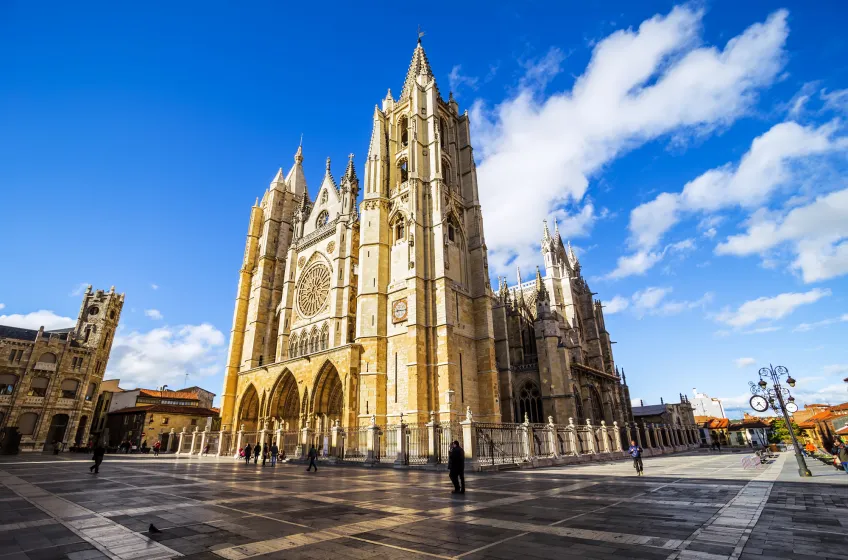
León Cathedral is the city’s defining landmark and one of Spain’s finest Gothic churches.
Its interior is famous for an extraordinary expanse of medieval stained glass. The windows fill the nave with coloured light, giving the building a much lighter and more delicate atmosphere than many other Gothic cathedrals.
The western façade, rose windows and sculpted portals are also impressive. Inside, visitors can explore chapels, choir stalls and religious artworks.
Visit on a bright day when possible, as sunlight transforms the stained glass. Allow at least an hour.
Explore the Cathedral Museum and Cloister
The cathedral complex includes a museum and cloister containing religious sculpture, paintings, manuscripts and historic objects.
These quieter areas provide useful context for the cathedral’s construction, decoration and role in León’s religious life.
Access arrangements can vary, particularly around services and ceremonies.
Visit the Basilica of San Isidoro
The Basilica of San Isidoro is one of León’s most important historic sites.
Its Romanesque church contains royal tombs, religious objects and architecture associated with the medieval Kingdom of León. The complex developed around a major royal and monastic centre.
The exterior is relatively restrained, but the historic significance of the site is considerable.
See the Royal Pantheon
The Royal Pantheon at San Isidoro is often described as one of the finest surviving ensembles of Romanesque painting in Spain.
Its vaulted ceilings are covered with biblical scenes, rural calendar imagery and decorative motifs. The colours and compositions remain remarkably vivid.
The chamber also contains the tombs of medieval kings and queens of León.
Access may be controlled through timed or guided visits, so check arrangements before arrival.
Explore Casa Botines
Casa Botines is a striking building designed by Antoni Gaudí.
Its stone façade, pointed towers and defensive appearance reflect Gaudí’s adaptation to León’s historic architecture and colder climate. The building was originally designed for commercial and residential use.
Today, its interior contains exhibitions on Gaudí, the building’s history and art. The rooftop may provide views over central León.
It stands close to Plaza de San Marcelo and is easy to combine with the cathedral and old town.
See the Palacio de los Guzmanes
The Palacio de los Guzmanes stands beside Casa Botines.
This Renaissance palace has a harmonious courtyard, carved stone details and an imposing civic presence. It is now used by the provincial government.
Access to the interior may depend on official use or guided visits, but the façade and courtyard are worth seeing.
Walk Through the Barrio Húmedo
The Barrio Húmedo is León’s best-known tapas district.
Its narrow streets around Plaza de San Martín contain bars, taverns and restaurants. Many establishments serve a small tapa with each drink, although the custom and quality vary.
The area becomes busiest in the evening, especially from Thursday to Saturday. Move between several bars rather than staying in one place.
Explore the Barrio Romántico
The Barrio Romántico lies north of the old centre and has developed into another major dining and nightlife area.
Its bars often feel slightly more contemporary than those in the Barrio Húmedo. Small streets and squares around San Isidoro are lively without being as intensely crowded.
It is particularly good for wine, craft beer and modern tapas.
Visit Plaza Mayor
León’s Plaza Mayor is an arcaded Baroque square in the old town.
It has long served as a market and civic space. Traditional buildings, balconies and cafés surround the open centre.
Markets and public events may still take place here. The square is especially attractive in the morning and early evening.
Walk Along Calle Ancha
Calle Ancha is the principal pedestrian route through historic León.
It links the cathedral area with Plaza de San Marcelo and passes shops, cafés and important buildings. Its name means “wide street”, although by modern standards it feels relatively compact.
The route is busy throughout the day and provides an easy introduction to the city centre.
See León’s Roman Walls
León developed from a Roman military camp, and sections of its walls remain visible around the old centre.
The best-preserved stretches can be seen near the cathedral and along the northern side of the historic district. Medieval modifications were added to the Roman foundations.
Walking the perimeter reveals the compact scale of the original city.
Visit the Roman Interpretation Centre
A local interpretation centre explains León’s Roman origins as Legio, a base associated with Roman legions.
Displays cover military life, urban development and archaeological discoveries beneath the modern city.
It is particularly useful for visitors interested in understanding the surviving walls and street layout.
Explore MUSAC
The Museum of Contemporary Art of Castile and León, known as MUSAC, is one of the city’s principal modern cultural institutions.
Its colourful glass façade is inspired by stained-glass colours, creating a visual connection with the cathedral. Inside, temporary exhibitions focus on contemporary art and social themes.
The programme changes regularly, so the experience varies from visit to visit.
Visit the Museum of León
The Museum of León presents the history of the city and province through archaeology, art and historic objects.
Collections cover the Roman period, medieval kingdoms, religious art and later regional development.
The museum is compact and provides a useful overview for visitors exploring León for more than one day.
Walk Along the Bernesga River
The River Bernesga runs through the western side of León.
Paths, parks and bridges create an easy walking route away from the historic centre. The riverside is popular with runners, cyclists and local families.
It is a pleasant option before dinner or after a morning of museum visits.
Visit the Convent of San Marcos
San Marcos is one of León’s most impressive Renaissance buildings.
Its richly decorated Plateresque façade stretches across a broad square beside the River Bernesga. The complex has served as a monastery, pilgrim hospital, prison and other institutional uses.
Part of the building now operates as a historic hotel, while church and museum areas may be accessible separately.
The façade is especially impressive in late-afternoon light.
Explore the Camino de Santiago Route
The Camino enters León from the east, passes the cathedral and old centre, and continues west towards San Marcos and Astorga.
Walking a short urban section reveals the city’s long role in pilgrimage. Shell markers, hostels and pilgrim services appear along the route.
The stretch from the cathedral to San Marcos is particularly easy and scenic.
Visit the Plaza del Grano
Plaza del Grano is one of León’s most atmospheric small squares.
Its uneven stone paving, traditional houses and quiet church create a more intimate setting than the grander central spaces. The square has a strong historic character and is particularly attractive in the early morning.
The irregular paving can be slippery after rain.
Explore the Market Areas
León’s markets and food shops provide an excellent introduction to regional produce.
Look for cured meat, cheese, dried beef, beans, peppers and bakery products. Markets are busiest during the morning and may close by early afternoon.
Local specialist shops are often better than tourist outlets for edible souvenirs.
Practical Advice for Visitors
Getting There
León is connected with Madrid, Valladolid, Oviedo, Burgos and other northern cities by train and long-distance coach.
Fast rail services make León accessible from Madrid in roughly two hours on some journeys. The railway station lies west of the centre, within walking distance or a short taxi ride of the old town.
The nearest airports have more limited route networks, so Madrid or Asturias may be more practical for international arrivals.
Getting Around
Central León is compact and best explored on foot.
The cathedral, San Isidoro, Barrio Húmedo, Casa Botines and most major sights are close together. San Marcos and the railway station lie slightly farther west but remain walkable.
Local buses serve outer districts and museums beyond the centre.
Parking
Driving inside the old town is unnecessary and often inconvenient.
Pedestrian streets, resident zones and narrow roads limit central access. Public garages are available around the outer centre and near major approaches.
Hotels with parking should provide precise arrival instructions, which are worth following carefully.
Choosing Where to Stay
The cathedral and Barrio Húmedo areas are best for atmosphere and nightlife, though they can be noisy.
The Barrio Romántico offers excellent dining with a slightly calmer feel. Accommodation near San Marcos or the river is quieter and still within walking distance of the centre.
Properties near the railway station are convenient for early departures but less atmospheric.
Dining
León’s cooking is rich and well suited to its cold winters.
Typical dishes include stews, roast meat, cured pork, game and beans. Portions are often substantial, particularly in traditional restaurants.
Tapas are a major part of the city’s evening culture. In many bars, a small dish is included with a drink, though offerings vary widely.
Lunch commonly begins after 1.30pm or 2pm, while dinner usually starts after 8.30pm.
Try Cecina de León
Cecina de León is one of the region’s most distinctive foods.
It is air-dried beef, usually sliced thinly and served with olive oil, cheese or bread. The flavour is deep, savoury and sometimes lightly smoky.
Good-quality cecina is widely available in tapas bars and specialist food shops.
Taste Morcilla de León
León-style morcilla is a soft blood sausage typically made with onion and spices.
Unlike firmer versions, it is often served spread onto bread or presented as a hot tapa. Its flavour is rich and slightly sweet from the cooked onion.
It is best tried in small portions.
Try Cocido Maragato
Cocido maragato is a substantial regional stew associated especially with the area around Astorga.
It is traditionally served in reverse order, beginning with meat, followed by chickpeas and vegetables, and ending with soup.
The meal is very filling and better suited to lunch than dinner. Some restaurants require advance booking.
Wine
León province has two important wine areas.
Bierzo, in the west, is known especially for Mencía red wines and Godello whites. The León wine designation farther south is associated with varieties including Prieto Picudo.
Wine bars in the city provide an easy introduction without the need for a vineyard excursion.
Shopping
Typical purchases include cecina, cheese, wine, cured meat, pulses and sweets.
Central food shops and markets provide the best choice. Vacuum-packed products are easier to transport, though international customs rules should be checked.
Most ordinary shops close on Sundays.
When to Visit
April to June is excellent for mild weather, green countryside and walking.
September and October are also attractive, with harvest-season food, wine and cooler evenings.
July and August are generally warm but less extreme than southern Spain. Nights can still feel cool.
Winter is cold, with frost, fog and occasional snow. León’s historic buildings can be atmospheric in winter, but proper layers are essential.
Local Events
Holy Week is one of León’s most important annual celebrations.
Processions feature historic religious sculpture, traditional brotherhoods and music. Central streets become crowded, and accommodation should be booked early.
San Juan and San Pedro festivities bring concerts, markets and public events in early summer.
The San Froilán celebrations include traditional dress, food, processions and regional customs during autumn.
Dates vary annually, so check the programme before arranging travel around a specific event.
Safety and Common Visitor Problems
León is generally safe and easy to explore.
Pickpocketing is possible in crowded nightlife areas, festivals and transport hubs, so keep valuables secure.
Winter ice and rain can make old paving slippery. Wear shoes with good grip.
Nightlife districts remain busy late, so light sleepers should check room location before booking.
Exploring Beyond León
Astorga is an easy excursion for its cathedral, Gaudí-designed Episcopal Palace, Roman remains and chocolate tradition.
Las Médulas offers a spectacular red landscape shaped by Roman gold mining.
Ponferrada has a substantial Templar castle and provides a gateway to the Bierzo wine region.
The Picos de Europa and the mountains of northern León offer walking, scenic drives and traditional villages.
Sahagún and other Camino towns contain Romanesque and Mudéjar heritage east of the city.
Oviedo lies north across the mountains, while Burgos and Valladolid make convenient onward stops within Castile and León.
Shortlist
- Your Shortlist is empty