
Discover Ávila | A Visitor's Introduction to Ávila
Recommended places to stay, places to visit and things to do in and near Ávila
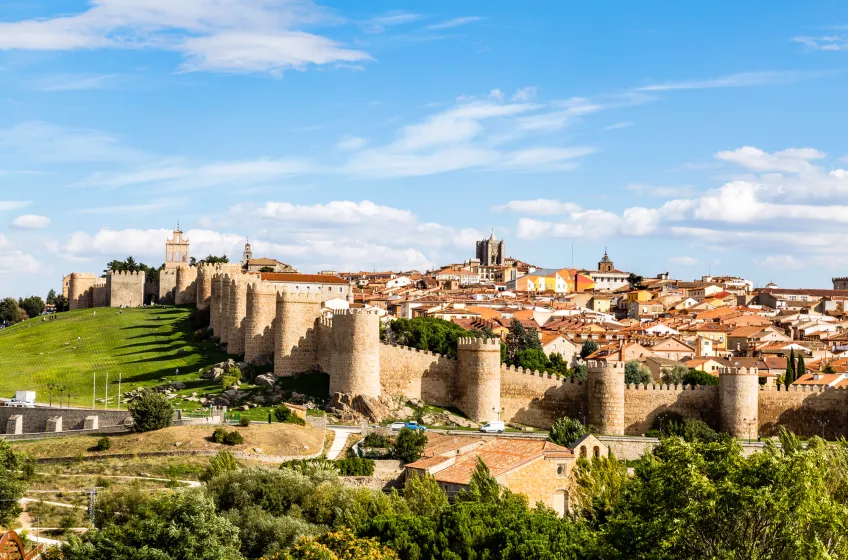
Ávila is a remarkably well-preserved medieval city in central Spain, set on a high plateau north-west of Madrid and surrounded by an almost complete circuit of stone walls. Known for its fortified skyline, Romanesque churches, links with Saint Teresa and broad views across the Castilian countryside, this compact city is a perfect destination for history lovers, walkers and travellers seeking an atmospheric day trip or overnight stop. With its austere architecture, quiet lanes and dramatic evening illumination, Ávila offers one of Spain’s clearest impressions of a medieval walled city.
Browse Ávila Hotels and Other Accommodation
Pre-book Ávila Activities, Tours and Experiences
Why is Ávila Worth a Visit?
Ávila is worth visiting above all for its walls. Their towers, gateways and battlements encircle much of the historic centre and remain the city’s defining feature. Walking along the ramparts gives visitors an unusual opportunity to understand how a medieval city was organised and defended.
The city also has a strong religious identity. It is closely associated with Saint Teresa of Ávila, the 16th-century Carmelite reformer and writer, whose life is remembered through convents, churches and museums. Even visitors without a particular interest in religious history will find that these sites help explain Ávila’s restrained atmosphere and cultural importance.
Ávila feels markedly different from nearby Segovia or Salamanca. Its granite buildings are more austere, its streets quieter and its setting higher and more exposed. The surrounding plateau gives the city an impressive sense of isolation, especially in winter or during misty weather.
A day trip from Madrid is possible, but staying overnight is rewarding. The illuminated walls are especially beautiful after dark, and the old centre becomes much calmer once most excursion groups have left.
Ávila Highlights: Things to See and Do in Ávila
Walk the Medieval Walls
Ávila’s medieval walls are among the best-preserved urban fortifications in Europe.
The circuit extends for roughly two and a half kilometres and includes numerous towers and gateways. Visitors can walk along selected elevated sections for views over the cathedral, rooftops and surrounding plain.
The eastern section near the cathedral is particularly dramatic, while the western stretch offers broader views towards the countryside. Not every part of the wall is open to visitors, so access points and routes may vary.
There are steps, uneven surfaces and exposed sections. Wear comfortable shoes and bring an extra layer outside summer, as the walls can be windy.
See the Puerta del Alcázar
The Puerta del Alcázar is one of Ávila’s grandest gateways.
Two massive towers flank the entrance, creating one of the city’s most recognisable views. The gateway stands close to Plaza de Santa Teresa and provides a dramatic introduction to the walled centre.
The area is especially attractive in the evening when the stone is illuminated.
Explore Plaza del Mercado Chico
Plaza del Mercado Chico is the civic heart of Ávila’s old town.
Arcaded buildings surround the square, which has long served as a centre for markets, public life and local government. Cafés and restaurants make it a pleasant place to pause between the cathedral and religious sites associated with Saint Teresa.
The square feels livelier than many of the quieter streets nearby and is particularly pleasant around lunchtime or early evening.
Visit Ávila Cathedral
Ávila Cathedral is one of Spain’s earliest Gothic cathedrals and forms part of the city’s defensive structure.
Its apse projects directly into the walls, giving the building both religious and military importance. The exterior is severe and fortress-like, while the interior contains chapels, choir stalls, sculpture and a striking mixture of reddish and pale stone.
Allow at least an hour to explore the church and cloister. Access may be affected by services or religious events.
Visit the Basilica of San Vicente
The Basilica of San Vicente stands outside the walls and is one of Ávila’s finest Romanesque buildings.
Its warm-toned stone, sculpted portals and balanced architecture contrast with the darker granite of much of the city. Inside, the elaborate tomb of Saints Vincent, Sabina and Cristeta is the principal highlight.
The surrounding area also provides excellent views towards the walls, especially in late afternoon.
Explore the Convent of Saint Teresa
The Convent of Saint Teresa was built on the site traditionally associated with the saint’s birthplace.
The complex includes a Baroque church, chapels and displays connected with her life and religious work. It remains an important pilgrimage destination.
The convent provides useful context for understanding Teresa’s influence on Ávila and the wider Carmelite tradition. Visitors should dress respectfully and remain quiet around active religious areas.
Visit the Monastery of the Incarnation
The Monastery of the Incarnation lies outside the northern walls.
Saint Teresa lived here for many years before beginning her programme of Carmelite reform. The site contains rooms, relics and exhibits associated with her life.
Its quieter location makes it feel more contemplative than the better-known sites in the centre. A taxi or local bus may be useful for visitors with limited time.
See the Four Posts Viewpoint
Los Cuatro Postes is the classic panoramic viewpoint over Ávila.
A small stone monument stands on a low rise west of the city, framing a broad view of the walls and towers. Sunrise, sunset and the period after dark are especially attractive.
The viewpoint can be reached by car, taxi or a walk from the old town. The walking route involves a descent followed by a climb, so allow extra time.
Walk Around the Exterior of the Walls
The streets and paths outside the fortifications provide some of the best views of Ávila.
The northern and western sides reveal long uninterrupted sections of wall, while the eastern side is more closely integrated with the cathedral and urban centre.
Walking outside the walls also helps visitors appreciate their height and scale more effectively than from the ramparts alone.
Visit the Church of San Pedro
The Church of San Pedro stands on Plaza de Santa Teresa outside the main walls.
Its Romanesque façade, rose window and restrained interior make it an important part of Ávila’s architectural heritage. The open square in front gives the building more space than many churches within the old centre.
The church is easy to combine with the Puerta del Alcázar and the start of a wall walk.
Explore the Palace of the Superunda
The Palace of the Superunda is a Renaissance mansion within the old town.
Its rooms contain furniture, decorative objects and an art collection associated with painter Guido Caprotti, who lived in Ávila. The building provides a more domestic perspective on the city’s history.
It is a useful addition for visitors interested in historic interiors rather than only churches and fortifications.
Visit the Palace of the Verdugos
The Palace of the Verdugos is one of several noble residences within the walls.
Its stone façade, courtyard and heraldic decoration reflect the wealth of Ávila’s aristocratic families. Access may depend on exhibitions or cultural use, but the exterior is worth seeing during a walk through the centre.
Discover the Convent of San José
The Convent of San José was the first foundation created by Saint Teresa during her reform of the Carmelite order.
Its relatively modest architecture reflects the simplicity she wanted for the new communities. The site remains active and has a more intimate atmosphere than some of the city’s larger religious buildings.
Explore the Museum of Ávila
The Museum of Ávila presents the city and province through archaeology, art and traditional culture.
Exhibits may include Roman objects, medieval sculpture, rural tools and domestic material. It is a useful place to understand the wider region beyond the walls.
The museum is compact enough to combine with a day of walking around the old town.
Practical Advice for Visitors
Getting There
Ávila can be reached from Madrid by train, coach or car.
Rail services usually depart from Madrid’s northern stations and take longer than the high-speed journey to Segovia. Long-distance coaches may be more convenient depending on your starting point in Madrid.
The railway and bus stations are both outside the walls but within walking distance of the historic centre. The route is straightforward, though slightly uphill in places.
Driving from Madrid generally takes around 90 minutes, depending on traffic.
Getting Around
Ávila’s historic centre is compact and best explored on foot.
The streets are generally less steep than those of Toledo, but cobbles, steps and wall access can still be challenging. Most principal sights are within a short walk of one another.
Taxis are useful for the Four Posts viewpoint, Monastery of the Incarnation and visitors with limited mobility.
Parking
Public car parks are available near the walls and around the outer centre.
Driving inside the historic district is unnecessary and can be inconvenient because of narrow streets, pedestrian areas and access restrictions.
Parking near the main gateways becomes busy at weekends and during festivals, so arrive early.
Choosing Where to Stay
Hotels inside the walls offer the strongest historic atmosphere and easy evening access to restaurants and landmarks.
Accommodation near Plaza de Santa Teresa is convenient for transport and wall access. Properties outside the centre may offer easier parking and larger rooms.
An overnight stay is particularly worthwhile for seeing the walls illuminated and enjoying the old town after dark.
Dining
Ávila’s food is hearty and suited to its cold highland climate.
The best-known dish is chuletón de Ávila, a large grilled beef steak. It is usually served simply and may be priced by weight.
Other traditional dishes include bean stews, roast meat, soups and pork products. Portions are often generous, so ask before ordering several substantial plates.
Lunch generally begins after 1.30pm, while dinner commonly starts after 8.30pm.
Try Judías del Barco
Judías del Barco are large white beans associated with the nearby Barco de Ávila area.
They are commonly served in slow-cooked stews with pork, sausage or vegetables. The dish is especially popular during colder weather.
It is filling and often works best as a main course rather than a starter.
Taste Yemas de Santa Teresa
Yemas de Santa Teresa are Ávila’s best-known sweet.
Made primarily from egg yolks and sugar, they are shaped into small round pieces and sold in bakeries and specialist shops. Their rich sweetness means a small box is usually enough.
They travel well and make one of the easiest local products to take home.
Shopping
Typical purchases include sweets, cured meat, cheese, wine and religious items connected with Saint Teresa.
Small bakeries and food shops around the old centre are better choices than generic souvenir outlets for regional products.
Most ordinary shops close on Sundays, although businesses near major attractions may remain open.
When to Visit
April to June is excellent for comfortable sightseeing and greener countryside.
September and October are also attractive, with clear light and fewer peak-season visitors.
July and August can be hot during the day, though evenings are cooler than in Madrid because of Ávila’s altitude.
Winter is cold, windy and occasionally snowy. The city can look especially atmospheric in winter, but warm clothing is essential.
Local Events
Holy Week is marked with processions through the old town and around the walls.
Celebrations connected with Saint Teresa bring religious services, processions and cultural activities to the city.
Medieval-themed events may transform the historic centre with markets, costumes and performances.
Dates and programmes vary annually, so check current arrangements before planning around a particular festival.
Safety and Common Visitor Problems
Ávila is generally safe and easy to explore.
The main practical risks are slippery paving, uneven wall surfaces and exposure to sun or wind. Shoes with good grip are advisable.
The high altitude means temperatures can drop quickly after sunset. Carry an extra layer even when the day feels warm.
Pickpocketing is uncommon but still possible around crowded attractions and transport areas.
Exploring Beyond Ávila
Salamanca lies to the west and offers a magnificent Plaza Mayor, historic university and golden sandstone architecture.
Segovia is known for its Roman aqueduct, Gothic cathedral and Alcázar.
Madrid is the main gateway and provides extensive museums, nightlife and transport connections.
The Sierra de Gredos offers mountain walking, granite scenery and rural villages south-west of the city.
El Barco de Ávila is associated with regional beans and provides access to the western Gredos landscape.
The walled town of Madrigal de las Altas Torres and the historic centre of Arévalo offer quieter excursions across the province.
Shortlist
- Your Shortlist is empty