
Discover Burgos | A Visitor's Introduction to Burgos
Recommended places to stay, places to visit and things to do in and near Burgos
Burgos is a historic city in northern Spain, set beside the River Arlanzón in the autonomous community of Castile and León. Known for its magnificent Gothic cathedral, medieval streets, Camino de Santiago heritage and association with the legendary warrior El Cid, this compact city is a perfect destination for history lovers, architecture enthusiasts, pilgrims and foodies. With elegant promenades, important museums and easy access to the archaeological sites of Atapuerca, Burgos offers a rewarding cultural break in northern Spain.
Browse Burgos Hotels and Other Accommodation
Pre-book Burgos Activities, Tours and Experiences
Why is Burgos Worth a Visit?
Burgos is worth visiting because it combines one of Spain’s greatest cathedrals with a highly walkable historic centre and several attractions of national importance. The city was once the capital of the medieval Kingdom of Castile, and its former political and religious importance remains visible in churches, monasteries, gateways and noble buildings.
The Camino de Santiago runs directly through Burgos, bringing a steady flow of pilgrims into the city. This adds a distinctive atmosphere to the old centre, especially around the cathedral and the riverside route westwards.
Burgos is also closely connected with El Cid, the medieval military leader Rodrigo Díaz de Vivar. Monuments, churches and local traditions refer to his life, although history and legend are often intertwined.
The city is an excellent base for exploring Atapuerca, one of Europe’s most important archaeological areas, as well as monasteries, castles and wine country elsewhere in the province. Two nights are enough for the main sights, while three or four allow for a day trip.
Burgos Highlights: Things to See and Do in Burgos
Visit Burgos Cathedral
Burgos Cathedral is the city’s defining landmark and one of Spain’s finest Gothic buildings.
Its elaborate western façade, delicate spires and sculpted portals dominate the historic centre. Inside, the cathedral contains richly decorated chapels, carved choir stalls, royal tombs and major works of religious art.
The Chapel of the Constables is one of the most impressive sections, with a richly ornamented interior and elaborate star-shaped vaulting. The tomb traditionally associated with El Cid and his wife Jimena is another major focus.
Allow at least 90 minutes for a careful visit. The cathedral remains active, so access can be affected by services and religious events.
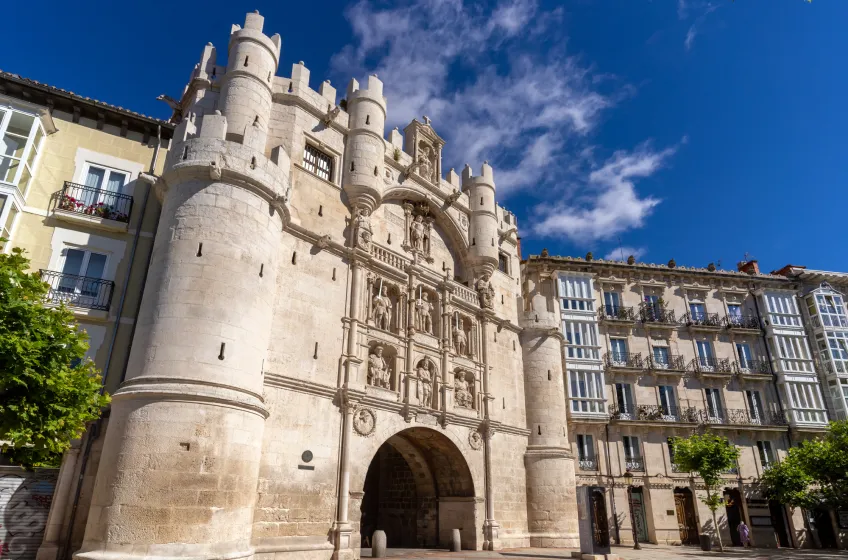
Walk Through the Arco de Santa María
The Arco de Santa María is Burgos’ grand ceremonial gateway.
It stands between the river and the cathedral and was rebuilt as an elaborate Renaissance entrance to the old city. Its façade contains sculpted figures connected with Castilian history.
Passing through the gateway provides one of the most dramatic approaches to the cathedral square.
The interior may contain temporary exhibitions or small displays, depending on current use.
Explore Plaza del Rey San Fernando
Plaza del Rey San Fernando lies directly in front of the cathedral.
The square is surrounded by historic buildings, cafés and restaurants, with several narrow streets leading into the old centre. It is one of the best places to appreciate the cathedral’s scale.
Early morning is ideal for quieter views, while evening brings a lively atmosphere and attractive lighting.
Walk Along the Paseo del Espolón
The Paseo del Espolón is Burgos’ elegant riverside promenade.
Tree-lined paths, statues, gardens and cafés stretch beside the River Arlanzón between the Arco de Santa María and central shopping streets. It is one of the city’s main social spaces.
The promenade is especially pleasant in spring and autumn and offers a relaxed route away from traffic.
Visit the Museum of Human Evolution
The Museum of Human Evolution is one of Burgos’ strongest modern attractions.
Its exhibitions explain human evolution, archaeology and the discoveries made at nearby Atapuerca. Fossils, reconstructions, scientific displays and audiovisual material help visitors understand the significance of the excavations.
The museum is spacious and well designed, making it suitable for both adults and families.
Visit before travelling to Atapuerca, as the museum provides useful background.
Explore the Atapuerca Archaeological Sites
The Atapuerca sites lie east of Burgos and have produced some of Europe’s most important evidence relating to early humans.
Excavations have revealed fossils, tools and traces of occupation spanning a very long period. The discoveries have transformed understanding of human settlement in Europe.
Access is organised through guided visits, and advance booking is usually advisable. Some tours combine the excavation areas with an archaeological interpretation centre.
The terrain is exposed, so bring water, sun protection or warm clothing depending on the season.
Walk the Camino de Santiago Route Through Burgos
The Camino enters Burgos from the east and passes through the historic centre before continuing west.
Walking even a short section provides insight into the city’s role as a major pilgrimage stop. Shell symbols, hostels, churches and pilgrim services appear along the route.
The western stretch towards the Monastery of Las Huelgas is particularly pleasant and can be combined with riverside paths.
Visit the Monastery of Las Huelgas
The Royal Monastery of Santa María la Real de Las Huelgas lies west of the city centre.
Founded by the Castilian monarchy, it became an important royal convent and burial place. The complex contains Romanesque, Gothic and Mudéjar elements, along with royal tombs, textiles and historic religious objects.
Guided access may be required for some areas. The monastery remains an active religious site, so visitors should dress and behave respectfully.
See the Cartuja de Miraflores
The Cartuja de Miraflores is a Carthusian monastery in a wooded setting east of Burgos.
Its church contains an extraordinary gilded altarpiece and the tombs of King John II of Castile and Queen Isabella of Portugal. The carved stonework and funerary sculpture are among the finest in the region.
The monastery is outside the centre and is easiest to reach by taxi, bus or bicycle.
Visit the Church of San Nicolás de Bari
San Nicolás de Bari stands close to the cathedral but is often overlooked.
Its principal attraction is a spectacular stone altarpiece filled with carved figures and decorative detail. The restrained exterior gives little indication of the richness inside.
It is an easy addition to a cathedral visit.
Explore the Church of San Esteban
San Esteban stands on the hillside above the cathedral.
The church contains a museum of altarpieces, bringing together examples from churches across the diocese. The building also offers an elevated perspective over the old town.
The approach involves a short uphill walk.
See the Castle Viewpoint
Burgos Castle once occupied the hill above the historic centre.
The surviving remains are limited, but the surrounding park and viewpoints provide broad views across the cathedral, rooftops and River Arlanzón.
The climb is worthwhile for orientation and sunset views. Paths may be steep or slippery after rain.
Visit the Casa del Cordón
The Casa del Cordón is a historic palace in central Burgos.
Its façade is marked by a carved Franciscan cord, which gives the building its name. The palace has associations with the Catholic Monarchs and important diplomatic events.
The interior is not always open as a conventional visitor attraction, but the exterior is worth seeing during a walk through the city centre.
See the Statue of El Cid
A large equestrian monument to El Cid stands near the River Arlanzón.
The statue reflects Burgos’ strong identification with the medieval warrior. Nearby streets, bridges and public spaces also carry references to him.
The monument is easy to include when walking between the historic centre and the Museum of Human Evolution.
Explore the Old Town
Burgos’ historic centre is compact and lively.
Calle San Lorenzo, Plaza Mayor and surrounding lanes contain bars, restaurants and traditional shops. Churches and historic façades appear between more modern businesses.
The centre is especially atmospheric in the evening, when residents and pilgrims fill the streets.
Walk Beside the River Arlanzón
Paths along the Arlanzón provide an easy, mostly flat walk through the city.
Bridges, gardens and tree-lined banks connect the museum district, historic centre and western monasteries. The river route is a useful alternative to busy streets.
Cyclists also use parts of the path, so remain aware on shared sections.
Visit the Castle of Burgos Interpretation Area
Although little of the medieval castle survives, interpretation around the hill explains its strategic role and military history.
The site was important during several periods of conflict and once overlooked the city as a major defensive stronghold.
The principal reason to visit today is the view rather than the ruins themselves.
Practical Advice for Visitors
Getting There
Burgos is connected with Madrid, Valladolid, León, Bilbao and other northern cities by rail and long-distance coach.
Journey times vary depending on the service, so compare trains and buses before booking. High-speed rail connections have improved access from Madrid and other major cities.
The main railway station lies outside the historic centre. Local buses and taxis provide the easiest connection.
Bilbao and Madrid are the most practical major airports for many international visitors.
Getting Around
Central Burgos is compact and best explored on foot.
The cathedral, river, old town and Museum of Human Evolution are all close together. Las Huelgas is reachable by a longer walk, while Miraflores and Atapuerca require transport.
Local buses cover outer districts and the railway station.
Parking
Driving into the historic centre is unnecessary.
Public garages are available near the river, shopping areas and outer edge of the old town. Street parking is controlled and can be difficult during busy periods.
Use designated parking and explore the centre on foot.
Choosing Where to Stay
Accommodation near the cathedral provides the strongest historic atmosphere and easy access to restaurants.
The riverfront and museum district are quieter while remaining within walking distance of the old town.
Hotels near the railway station are less convenient for sightseeing unless you have an early departure.
Central rooms can be noisy on weekend evenings, so check the location carefully.
Dining
Burgos is known for substantial Castilian cooking.
Roast lamb is one of the city’s best-known specialities, often prepared slowly in a wood-fired oven. Soups, stews, grilled meat and game also feature widely.
The old town has traditional restaurants, tapas bars and modern dining options.
Lunch usually begins after 1.30pm or 2pm, while dinner commonly starts after 8.30pm.
Try Morcilla de Burgos
Morcilla de Burgos is the city’s most famous food product.
This blood sausage is traditionally made with rice, onion, pork fat and spices. It may be fried, grilled or incorporated into tapas and stews.
Its texture is softer and grainier than many British black puddings because of the rice.
Specialist food shops sell vacuum-packed versions, though customs rules should be checked before international travel.
Taste Queso de Burgos
Queso de Burgos is a mild, fresh cheese traditionally made from sheep’s milk or a mixture of milks.
It has a soft texture and delicate flavour and is often served with honey, fruit or preserves.
Because it is fresh and perishable, it is better enjoyed locally than transported over long distances.
Tapas
The streets around San Lorenzo, Sombrerería and Plaza Mayor are popular for tapas.
Bars serve croquettes, morcilla, mushrooms, cured meat and small hot dishes. Some establishments specialise in one or two items.
The atmosphere is liveliest in the evening and at weekends.
Shopping
Typical purchases include morcilla, cheese, cured meat, wine and sweets.
Central food shops and markets provide the best regional selection. Burgos is also a good place to buy products from Ribera del Duero and Arlanza wine areas.
Most ordinary shops close on Sundays, though tourist businesses may remain open.
When to Visit
April to June is excellent for sightseeing, green riverbanks and mild daytime temperatures.
September and October are also attractive, with clear light and harvest-season food and wine.
July and August are generally comfortable compared with hotter parts of central Spain, though warm afternoons are possible.
Winter is cold, windy and sometimes snowy. Burgos has a reputation for chilly weather, so bring proper layers.
Local Events
Burgos celebrates religious, cultural and food-related events throughout the year.
Holy Week brings processions through the old centre, while summer includes concerts, public festivities and local celebrations.
Camino-related events and pilgrim activity are strongest during the warmer months.
Festival dates vary annually, so check the programme before planning a trip around a specific event.
Safety and Common Visitor Problems
Burgos is generally safe and straightforward to explore.
The main practical issue is weather. Temperatures can drop quickly, and wind is common, even outside winter.
Stone streets and hillside paths may become slippery after rain or snow.
Pickpocketing is possible around crowded attractions and transport hubs, but it is less of a concern than in Spain’s largest cities.
Exploring Beyond Burgos
Atapuerca is the most important nearby excursion for archaeology and human evolution.
Lerma is an elegant historic town known for its ducal palace and arcaded square.
Covarrubias is a picturesque village with timbered houses, a collegiate church and strong medieval character.
The Monastery of Santo Domingo de Silos is known for its cloister and monastic traditions.
Frías is a striking hill town dominated by a castle and medieval bridge.
Ribera del Duero lies south of Burgos and offers winery visits around Aranda de Duero.
La Rioja is within easy reach for further wine tourism, while León and Palencia provide additional historic stops along the Camino de Santiago.
Shortlist
- Your Shortlist is empty