
A Visitor's Introduction to The Louvre Museum, Paris
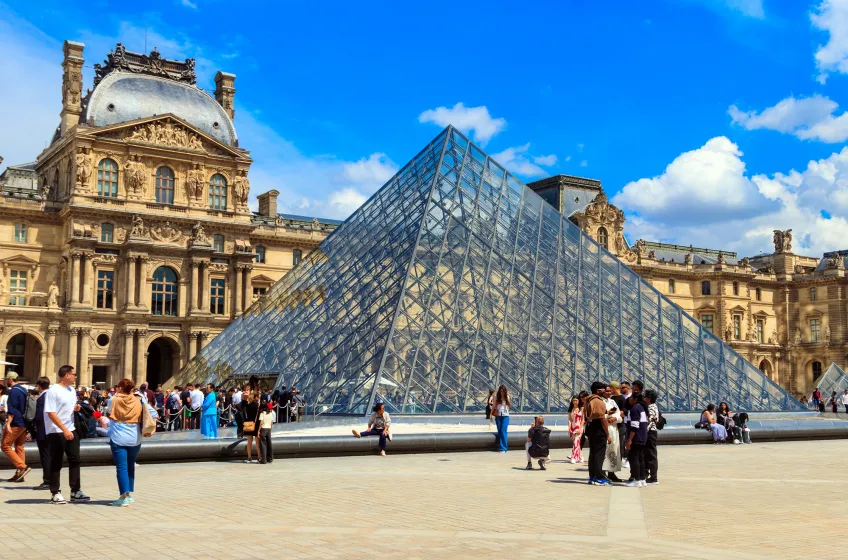
The Louvre Museum, or Musée du Louvre, located in the heart of Paris, is one of the most significant and widely visited art museums in the world. Set on the Right Bank of the River Seine, within the 1st arrondissement, the Louvre is housed in a former royal palace that dates back to the 12th century. With its distinctive glass pyramid entrance designed by architect I. M. Pei and an expansive collection spanning thousands of years, the Louvre presents an encyclopaedic overview of human artistic expression, from ancient civilisations to 19th-century European masterpieces. The museum is a central feature of Parisian cultural life and a defining element of the city’s historical and artistic identity.
Recommended accommodation near The Louvre Museum: Hotels
Pre-book Paris Attractions, Tours & Experiences, including The Louvre Museum
Why is The Louvre worth a visit?
The Louvre’s appeal lies in both the breadth and depth of its collections, making it a compelling destination for anyone with an interest in art, history, archaeology, or architecture. Housing over 480,000 objects, including more than 35,000 works of art on public display, it offers a journey through human creativity from prehistory to the 19th century. Iconic pieces such as Leonardo da Vinci’s Mona Lisa, the Greek statue Venus de Milo, and Eugène Delacroix’s Liberty Leading the People are among the highlights, but the museum’s value goes well beyond a few famous works. The diversity of its galleries—ranging from Ancient Egypt and Mesopotamia to Renaissance Italy and Islamic art—makes the Louvre a richly layered experience, offering insights into cultures from across the world. Visitors are not only drawn by the objects themselves but also by the historical setting, as the palace structure reveals elements of French political and architectural history, with rooms that once served monarchs and courtiers now displaying some of the finest works of art ever produced.
Louvre Highlights
The Mona Lisa
Leonardo da Vinci’s Mona Lisa is perhaps the most famous painting in the world, and the Louvre is its permanent home. Displayed behind bulletproof glass in the Denon Wing, the portrait attracts large crowds, but its enigmatic expression and subtle use of sfumato continue to fascinate visitors.
Venus de Milo
This iconic ancient Greek statue, believed to depict the goddess Aphrodite, dates from around 100 BC. Found on the island of Milos in 1820, the Venus de Milo is notable for its elegant form and mysterious missing arms. It remains one of the Louvre’s most recognisable sculptures.
Winged Victory of Samothrace
Positioned atop the Daru staircase, the Winged Victory of Samothrace is a Hellenistic sculpture from the 2nd century BC. Depicting the goddess Nike, it conveys a powerful sense of motion and triumph, making it one of the museum’s most dramatic installations.
The Grande Galerie
The Grande Galerie is a long and elegant space in the Denon Wing that features some of the finest paintings of the Italian Renaissance. Works by artists such as Raphael, Caravaggio, and Titian line the gallery, offering a coherent survey of Italian art from the 14th to the 17th centuries.
Egyptian Antiquities
The Louvre’s Egyptian collection spans from prehistoric times to the 4th century AD. Highlights include the seated statue of the scribe Kai, sarcophagi, mummies, and temple reliefs. The Salle des Sarcophages and the Room of Columns offer immersive environments that reconstruct ancient Egyptian religious and burial practices.
Islamic Art Galleries
The Islamic Art galleries, located under a distinctive glass and metal canopy in the Cour Visconti, showcase artefacts from across the Islamic world, from Spain to India. Ceramics, textiles, metalwork, and manuscripts illustrate the rich aesthetic and cultural traditions of Islamic civilisation.
Mesopotamian and Persian Collections
The Department of Near Eastern Antiquities includes objects from ancient Mesopotamia, Persia, and the Levant. One of the standout features is the Code of Hammurabi, one of the oldest deciphered writings of significant length in the world. Reliefs from the Palace of Sargon II and Assyrian winged bulls also feature prominently.
French Painting and Decorative Arts
The museum holds an extensive collection of French art, including works by Poussin, Watteau, Fragonard, David, and Ingres. The Decorative Arts section features furniture, tapestries, and items once used in royal courts. Rooms recreating the interiors of 18th-century Parisian residences offer insight into aristocratic life before the French Revolution.
The Galerie d’Apollon
This ornate gallery, with its richly gilded ceiling and decorative scheme, is a masterpiece in its own right. Originally designed by Louis XIV's architect Charles Le Brun, the room now houses the French Crown Jewels and examples of royal goldsmithing.
The Medieval Louvre
Beneath the museum’s ground level, visitors can explore the remains of the original medieval fortress, including part of the moat and the base of the original keep. This area gives a clear sense of the Louvre’s transformation from a fortress to a royal palace and eventually a museum.
Facilities
The Louvre provides a wide range of visitor facilities designed to make the museum experience as smooth and accessible as possible. There are several entrances, with the main one being beneath the Pyramid, where visitors pass through security to access ticket desks, information points, cloakrooms, and other services. Toilets and baby-changing facilities are available throughout the building. The museum is accessible to those with reduced mobility, with lifts and adapted routes provided.
A number of cafés and restaurants are situated within the museum complex. Le Café Marly, overlooking the Cour Napoléon, offers full meals in a stylish setting, while Café Richelieu and Café Mollien provide lighter options. There are also vending machines and picnic areas for those who prefer to bring their own food. The museum bookshop and gift shops stock an extensive range of exhibition catalogues, art books, and souvenirs.
Audio guides are available in multiple languages, including English, and visitors can also download the official Louvre app, which features maps, curated tours, and information on major artworks. Guided tours led by museum staff or independent guides are available and can be booked in advance.
Nearby Attractions
The Louvre’s central location in Paris makes it an excellent starting point for exploring other major landmarks. Just outside the museum is the historic Jardin des Tuileries, a formal French garden with statues, fountains, and tree-lined avenues, offering a peaceful contrast to the museum's interior.
A short walk west through the gardens leads to Place de la Concorde and onwards to the Champs-Élysées, while to the east lies the Île de la Cité, home to Sainte-Chapelle and the reconstruction site of Notre-Dame Cathedral. Just across the Seine is the Musée d’Orsay, which focuses on 19th-century art, particularly Impressionism, and is a natural continuation for visitors interested in the progression of European art history.
Other nearby cultural institutions include the Palais Royal and its elegant gardens, the Comédie-Française theatre, and the Musée de l'Orangerie, which houses Monet’s monumental Water Lilies. The surrounding area also offers excellent shopping, particularly along Rue de Rivoli and within the nearby Forum des Halles.
Practical Advice
The Louvre is open every day except Tuesdays, from 9:00 to 18:00, with extended evening hours until 21:45 on Fridays. It is advisable to book tickets in advance online, especially during peak seasons, to avoid long queues. Admission is free for visitors under 18, and for EU residents under 26, with proof of age and residency. Entry is also free for all visitors on the first Saturday of each month from 18:00 to 21:45.
The museum is vast, and attempting to see everything in one visit is not realistic. It is worth planning your route or focusing on a particular wing or theme to make the most of your time. A typical visit lasts between two and four hours, though art enthusiasts may wish to spend longer. Comfortable footwear is recommended, as the floors are extensive and there is a fair amount of walking involved.
The nearest Métro stations are Palais Royal–Musée du Louvre (Lines 1 and 7) and Louvre-Rivoli (Line 1), both within a short walking distance. Several bus lines also serve the museum area. Visitors with large bags or luggage should note that only small bags are permitted inside, and there are size limits for lockers. Photography is allowed in most areas but without flash.
Finally, while the museum is popular year-round, weekdays in the morning or early evening tend to be quieter. Weekends and holidays can be crowded, especially in front of major works like the Mona Lisa. Visiting less frequented departments, such as Islamic Art or Near Eastern Antiquities, can offer a more peaceful experience.
Shortlist
- Your Shortlist is empty