
A Visitor's Introduction to The Arc de Triomphe, Paris
The Arc de Triomphe is one of the most recognisable monuments in Paris and stands at the centre of the Place Charles de Gaulle, historically known as Place de l'Étoile. Commissioned by Napoleon Bonaparte in 1806 to honour the Grande Armée and their victories, the arch is both a symbol of French national pride and a site of reflection and remembrance. Completed in 1836, the structure has since become an integral part of Parisian identity, offering historical insight, architectural beauty and panoramic views of the French capital.
Towering at 50 metres high, 45 metres wide and 22 metres deep, the Arc de Triomphe commands attention at the western end of the Champs-Élysées, one of the most famous avenues in the world. It serves not only as a grand monument but also as a site of ceremonial importance, particularly during national celebrations such as Bastille Day and the annual Armistice Day commemorations.
Recommended accommodation near The Arc de Triomphe: Hotels
Pre-book Arc de Triomphe Rooftop Tickets & Relevant Tours
Why is The Arc de Triomphe worth a visit?
The Arc de Triomphe is worth visiting for its combination of historical significance, impressive architecture, and its central role in the cultural and political life of France. Visitors are drawn to its commanding presence and the opportunity it provides to engage directly with pivotal moments in French history.
The monument honours those who fought and died for France during the French Revolutionary and Napoleonic Wars, and its interior and surroundings bear the names of generals and battles from these conflicts. At its base lies the Tomb of the Unknown Soldier, added in 1921, with an eternal flame that is rekindled every evening in a daily ritual of remembrance. This adds a moving and solemn layer to a visit.
Beyond its historical and symbolic value, the Arc offers one of the finest panoramic views in Paris. A climb to the viewing platform at the top reveals a striking twelve-point radial layout of avenues stretching out from the monument, with particularly clear lines of sight towards the Eiffel Tower, La Défense, Montmartre, and the Louvre. Whether visited during the day or illuminated at night, the arch delivers a compelling experience that blends history, architecture and urban geography.
Arc de Triomphe Highlights
Exterior architecture and sculpture
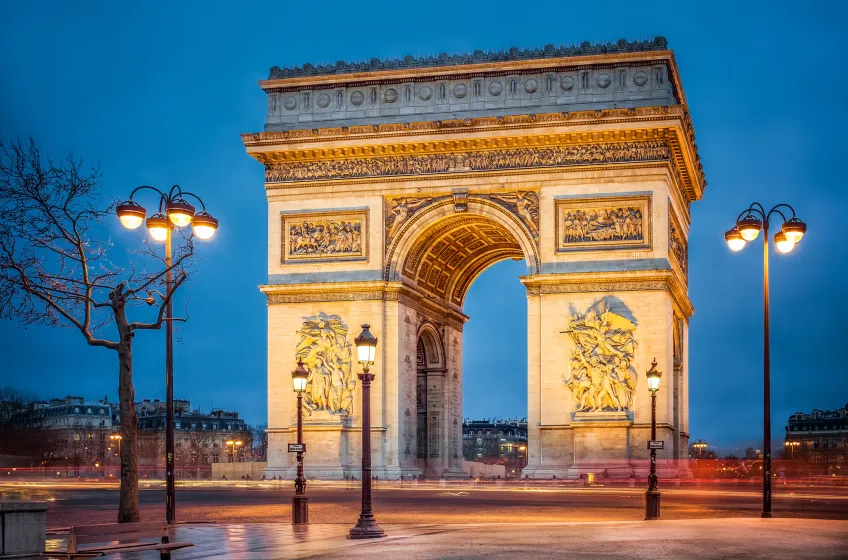
The Arc de Triomphe is an exemplary piece of Neoclassical architecture, influenced by the Roman Arch of Titus. Designed by Jean Chalgrin, its façades feature intricately sculpted reliefs and high-relief friezes that depict key moments in French military history. Among the most notable sculptures are Le Départ des Volontaires de 1792 (also known as La Marseillaise) by François Rude, Le Triomphe de 1810 by Jean-Pierre Cortot, and La Résistance and La Paix by Antoine Étex. These works are dramatic in scale and expression, designed to evoke emotion and national pride.
Tomb of the Unknown Soldier
Beneath the arch lies the Tomb of the Unknown Soldier from World War I, marked by an eternal flame that has been burning continuously since 1923. Every evening at 6:30 pm, a ceremony takes place to rekindle the flame, led by veteran associations. It serves as a poignant reminder of the human cost of war and remains one of the most visited commemorative sites in France.
Panoramic terrace
Access to the top of the arch requires a climb of 284 steps (or a lift for those with mobility needs), culminating in a terrace offering expansive views over Paris. The symmetrical city layout is best appreciated from this vantage point, especially the alignment of the Champs-Élysées with the Louvre in one direction and the modern skyscrapers of La Défense in the other. The Eiffel Tower and Montmartre are also clearly visible, making it a popular photography spot.
Interior exhibition space
Inside the arch is a small museum and interpretative space that offers context on the history of the monument, the architectural process behind its creation, and the historical events associated with it. Exhibits include scale models, wartime memorabilia, and multimedia displays. These help visitors understand how the arch fits into the broader story of French national identity.
Historical inscriptions
On the inner and outer surfaces of the arch are inscribed the names of 660 generals and the major French victories during the Revolutionary and Napoleonic Wars. Names underlined indicate generals who died in battle. These inscriptions provide both a genealogical and educational dimension to the structure, allowing for deeper engagement with the events it commemorates.
Ceremonial and national importance
The Arc de Triomphe plays a central role in many of France's major national events. It is the focal point of the Bastille Day military parade every 14 July and serves as the finish line for the Tour de France. These occasions reinforce the arch’s continuing relevance in the country's civic life.
Illumination at night
After dark, the Arc de Triomphe is elegantly lit, highlighting its sculptural features and enhancing its visibility across the city. The play of light on stone makes evening visits a popular option, especially for those interested in night photography or wishing to see the monument in a quieter setting.
Accessibility
While the main structure is historic, modern adaptations have improved access. A pedestrian underpass leads visitors safely to the monument from the surrounding traffic-heavy Place Charles de Gaulle. A lift inside the arch takes those unable to climb to the mezzanine level, though some stairs are still required to reach the terrace.
Temporary art installations
Occasionally, the Arc de Triomphe becomes the site of contemporary art projects. Most notably, in 2021 it was wrapped in fabric by artists Christo and Jeanne-Claude, transforming the monument into a temporary public art installation. While such events are rare, they demonstrate the arch’s flexibility as a cultural space and a canvas for artistic reinterpretation.
Strategic location
The Arc stands at the centre of the Axe Historique, a line of monuments, buildings and thoroughfares that extends from the Louvre to La Défense. This central location makes it an ideal point of orientation for exploring western Paris and offers direct connections to many other iconic sites.
Nearby attractions
The Arc de Triomphe’s position at the western end of the Champs-Élysées places it within walking distance of several notable attractions. The avenue itself is lined with shops, restaurants and cultural venues, leading eastward towards Place de la Concorde and the Tuileries Garden.
To the west, the modern business district of La Défense features striking contemporary architecture, including the Grande Arche, which mirrors the Arc de Triomphe in both form and alignment. Slightly to the south, the Eiffel Tower is a 25-minute walk or a short metro ride away, providing another elevated viewpoint and a very different historical context.
Further south-east lies the Palais de Tokyo and the Musée d’Art Moderne de Paris, offering contemporary and modern art collections. Art lovers may also enjoy the nearby Petit Palais and Grand Palais, both located close to the Champs-Élysées and housing temporary exhibitions and permanent collections.
For visitors interested in military history, the Musée de l’Armée at Les Invalides is not far, and houses an extensive collection of weapons, uniforms, and the tomb of Napoleon himself.
Practical advice
The Arc de Triomphe is open every day of the year except 1 January, 1 May and 25 December. Opening hours typically run from 10:00 am to 11:00 pm during peak season, though hours can vary, especially in winter. It is advisable to check the official website in advance for current times and any closures due to official ceremonies or weather conditions.
Tickets can be purchased online or on site. Admission is free for visitors under 18, EU residents under 26, and for everyone on the first Sunday of each month between November and March. Entry is included with the Paris Museum Pass.
The monument is accessible via the Charles de Gaulle–Étoile metro and RER station, which serves lines 1, 2, 6 and the RER A, providing easy access from most parts of the city. Visitors are strongly advised not to attempt crossing the traffic circle at street level, as the roads are exceptionally busy. Instead, designated pedestrian underpasses lead safely to the monument.
While the climb to the top is relatively short, it may still be challenging for some due to the narrow spiral staircase. Comfortable footwear is recommended, and those with reduced mobility should enquire about lift access.
Security checks are in place at the entrance, and large bags or luggage are not permitted. Lockers are not available on site, so visitors should plan accordingly.
Photography is allowed, and the viewing terrace is particularly popular for sunrise or sunset views over Paris. Early morning or late evening visits are often quieter and more conducive to a relaxed experience.
In summary, the Arc de Triomphe offers a compelling blend of historical importance, architectural grandeur and urban views, making it a key stop for anyone seeking to understand Paris both past and present.
Shortlist
- Your Shortlist is empty