
A Visitor's Introduction to The Eiffel Tower, Paris
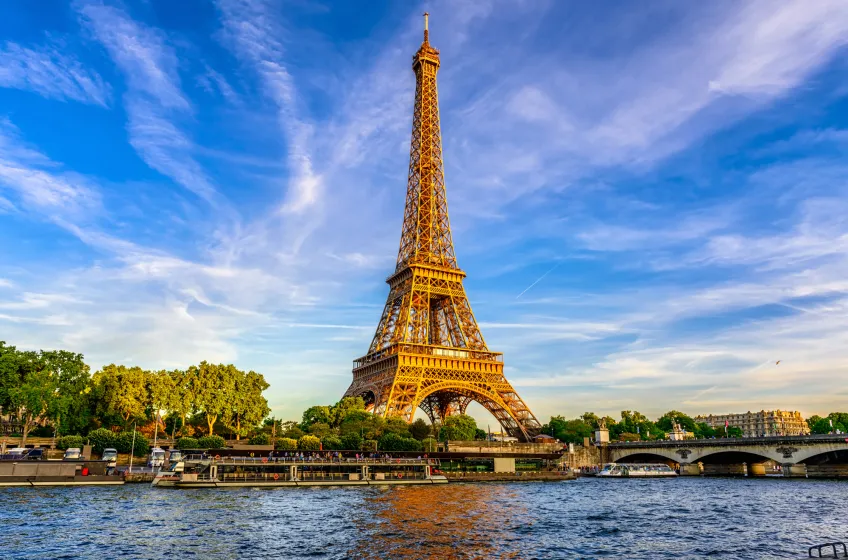
The Eiffel Tower, or La Tour Eiffel, stands as the quintessential symbol of Paris and is among the most famous landmarks in the world. Constructed between 1887 and 1889 for the Exposition Universelle, the World’s Fair commemorating the centenary of the French Revolution, it was designed by the engineer Gustave Eiffel and his company. When completed, it became the tallest structure on earth, a record it held for over 40 years.
Today, the tower rises to a height of 330 metres, including its antenna, and dominates the Champ de Mars, a large public park stretching from its base towards the École Militaire. Its immense lattice of ironwork, once regarded as controversial and even unsightly, is now celebrated as an elegant feat of engineering and a bold artistic statement of the industrial age.
Visiting the Eiffel Tower offers more than simply seeing a monument: it combines the experience of ascending one of the world’s most recognisable structures, learning about the history of its construction, enjoying exhibitions and restaurants, and above all, experiencing Paris from a unique perspective. The tower attracts nearly seven million visitors annually, making it one of the most visited paid attractions worldwide.
Recommended accommodation near The Eiffel Tower: Hotels
Pre-book Eiffel Tower Tickets & Relevant Tours
Why is the Eiffel Tower worth a visit?
The Eiffel Tower is worth a visit because it represents both the technological ambition and artistic daring of its time. It was built to showcase French engineering expertise and industrial progress, and it continues to serve as a testament to innovation, adaptability, and cultural identity.
For many visitors, ascending the tower is a highlight of their trip to Paris, not only for the extraordinary views but also for the chance to walk within the structure’s ironwork, observing how its design balances lightness with immense strength. From the top, the panorama reveals Paris in all directions, with views stretching to the outskirts of the city and beyond on a clear day. The river Seine winds through the landscape, the golden dome of Les Invalides gleams to the south-east, Sacré-Cœur crowns Montmartre to the north, and the axis of the Champs-Élysées runs directly towards the Arc de Triomphe.
At night, the tower itself becomes part of the city’s spectacle. Illuminated by golden lights and sparkling displays, it offers one of the most photographed and admired sights in Europe. Whether viewed from a nearby bridge, across the lawns of the Champ de Mars, or from the Trocadéro, the tower is as much an experience from the outside as it is from within.
The tower is also worth visiting because it is not static. It has adapted continuously to changing times, serving as a radio transmission tower, a site for scientific experiments, a venue for exhibitions, and a cultural stage for countless events. To see the Eiffel Tower is to connect with more than 130 years of history and with an enduring symbol of Paris that has shaped how the world perceives the city.
Eiffel Tower highlights
A landmark of engineering
The Eiffel Tower was a technical achievement of its age. Constructed of wrought iron, its 18,038 pieces are held together by over 2.5 million rivets. At the time of its completion, critics were divided: many artists and intellectuals condemned it as a “metal monstrosity” that clashed with Paris’s classical architecture. Yet its structural form, with sweeping curves designed to withstand wind pressure, has since been recognised as both functional and graceful. The design was calculated precisely, with each part prefabricated in a factory before being assembled on site with remarkable speed and accuracy.
The esplanade and base
The experience begins at the esplanade beneath the tower, where visitors can stand directly under the vast iron legs and look up at the latticework above. This area features ticket offices, information points, and security checks, but it also allows a first appreciation of the structure’s scale. Models and displays explain the tower’s history, and from here visitors may choose to ascend by lift or staircase.
The first floor (57 metres)
The first floor is home to exhibitions about the tower’s history and role in French culture. Glass panels in the floor allow visitors to look directly down onto the ground below, an experience that many find both thrilling and vertigo-inducing. Historical displays feature photographs, models, and multimedia presentations about the construction process and the tower’s changing uses over time.
Dining options on this level include the 58 Tour Eiffel restaurant, offering French cuisine in a relaxed setting, as well as buffets and snack outlets. This floor also has souvenir shops and is a good place to pause before continuing upwards.
The second floor (115 metres)
The second floor provides one of the most popular viewing platforms. From this height, Paris landmarks can be identified clearly without being too distant, making it ideal for photography. Visitors can spot the Louvre, Notre-Dame, the Musée d’Orsay, and the dome of Les Invalides.
This level is also home to Le Jules Verne, the Eiffel Tower’s Michelin-starred restaurant, which combines fine dining with panoramic views. The atmosphere is refined, and reservations are essential. More casual dining is available at buffets and shops.
The summit (276 metres)
The top platform, accessible by lift from the second floor, offers the highest viewing point. Visibility can extend for 70 kilometres on a clear day. At the summit, visitors can see a reconstruction of Gustave Eiffel’s private office, with wax figures of Eiffel and Thomas Edison symbolising their historic meeting.
The summit also features a champagne bar, providing visitors with the opportunity to celebrate their ascent with a glass of sparkling wine while overlooking the city. Historical panels mark the distances from Paris to other world capitals, giving an international dimension to the view.
Night-time illumination
The Eiffel Tower is illuminated by 336 projectors that bathe it in a golden light each evening. Since 2000, an additional light display of 20,000 bulbs sparkles for five minutes every hour on the hour until 11 pm. This illumination transforms the tower into a luminous beacon visible across Paris, and watching the display is an essential part of the visitor experience.
Seasonal and cultural events
The tower frequently hosts temporary exhibitions and events, ranging from art installations to cultural festivals. In winter months, the first floor has occasionally featured an ice rink, adding a seasonal attraction. National celebrations, such as Bastille Day on 14 July, often include fireworks launched from or around the tower, reinforcing its role as the centrepiece of Parisian festivities.
The Champ de Mars
The park at the base of the tower, stretching towards the École Militaire, is one of the best places for photography. Its lawns provide open space for picnics and relaxation, particularly popular in summer. The Champ de Mars has also hosted historical events, including World’s Fairs, military parades, and public gatherings.
The Trocadéro
On the opposite bank of the Seine, the Palais de Chaillot and its gardens form the Trocadéro, offering wide terraces with some of the finest views of the Eiffel Tower. At sunset and during the evening light displays, this vantage point is one of the most popular for both tourists and photographers.
Nearby attractions
The Eiffel Tower’s central position makes it a starting point for exploring several nearby sites. To the south-east is Les Invalides, which houses the Musée de l’Armée and the tomb of Napoleon. Walking along the Seine leads to the Musée d’Orsay, celebrated for its Impressionist collections, and further to the Louvre, the world’s largest art museum.
To the west, the Palais de Chaillot houses the Cité de l’Architecture et du Patrimoine and the Musée d’Homme, combining architecture and anthropology in striking surroundings. Beyond this lies the Arc de Triomphe and the Champs-Élysées, both easily reachable by metro or a long but rewarding walk.
The nearby Seine embankments also serve as departure points for boat cruises. These excursions, lasting from one to two hours, pass by major landmarks including Notre-Dame, the Louvre, and the Musée d’Orsay, offering an alternative way to experience the city.
For those seeking more green space, the Bois de Boulogne lies a short journey west of the tower, while the Champ de Mars itself provides ample room for leisure directly at its foot.
Practical advice
The Eiffel Tower is open daily, typically from 9:30 am to 11:45 pm, with last entry to the summit around 10:45 pm. Opening hours may vary slightly according to season and maintenance schedules, so checking the official website is recommended before visiting.
Tickets and queues
Tickets can be purchased online or on site, but advance booking is strongly advised, especially during spring and summer when queues can be long. Visitors may choose between tickets for the second floor or the summit, and between lifts or stairs for the initial ascent. Stair tickets are less expensive and often available even when lift tickets are sold out.
Accessibility
The tower is accessible to those with limited mobility up to the second floor via lifts. The summit, however, requires a transfer to another lift that may have restrictions. Visitors are encouraged to consult accessibility information in advance.
Security
All visitors must pass through security checks. Large bags, sharp objects, and glass bottles are not permitted, and there are no luggage storage facilities on site. It is best to bring only essentials.
Best times to visit
Early morning visits tend to be quieter, while late evening visits offer spectacular views of the illuminated city. Sunset is particularly popular, but also busy. Winter months see fewer crowds, though weather can affect visibility.
Dining and refreshments
Reservations for Le Jules Verne should be made well in advance. The first floor offers a more casual restaurant, buffets, and snack outlets, while the surrounding Champ de Mars is suitable for picnics. Visitors should note that bringing food into the tower itself is limited to small items.
Transport connections
The tower is accessible via metro stations Bir-Hakeim (line 6) and Trocadéro (line 9). RER line C stops at Champ de Mars–Tour Eiffel. Numerous buses also serve the area, and riverboats dock nearby. Taxis and rideshare services can drop visitors close to the entrances.
Safety and comfort
The tower is structurally safe and maintained to the highest standards, but visitors should be aware of crowds, particularly on the upper platforms. Comfortable footwear is recommended, especially for those using the stairs. Weather conditions can affect the experience: the tower remains open in light rain, but strong winds may close the summit for safety reasons.
Conclusion
The Eiffel Tower is more than a landmark: it is a cultural icon, an engineering triumph, and an essential part of the Paris experience. From its controversial beginnings to its present status as the city’s most celebrated monument, it tells a story of innovation, adaptation, and enduring appeal.
Whether admired from afar, climbed step by step, or explored level by level, the Eiffel Tower offers something for every visitor: history, architecture, exhibitions, fine dining, and some of the most memorable views in Europe. It is not only a monument to Paris but also to the spirit of modernity that defined the late 19th century and continues to inspire today.
Shortlist
- Your Shortlist is empty