
A Visitor's Introduction to St. Augustine's Abbey, Canterbury
St Augustine’s Abbey is a major historical site in Canterbury, Kent, forming one of three locations that make up the Canterbury UNESCO World Heritage Site, alongside Canterbury Cathedral and St Martin’s Church. Located just outside the city walls to the east of the cathedral precincts, the abbey was founded in AD 598 by St Augustine, the missionary sent by Pope Gregory the Great to convert the Anglo-Saxons to Christianity. Initially established as a burial place for the kings of Kent and the early archbishops of Canterbury, the abbey quickly developed into one of the most important religious centres in medieval England.
Although the abbey was largely destroyed following the Dissolution of the Monasteries under Henry VIII, its extensive ruins remain a place of considerable archaeological and historical interest. Managed by English Heritage, the site includes remains of the original monastic buildings, later medieval extensions, and a visitor centre with exhibitions that interpret the abbey’s significance in both English history and early Christian heritage. Its location, a short walk from Canterbury city centre, makes it easily accessible for visitors exploring the city’s deep-rooted ecclesiastical past.
Recommended Canterbury accommodation: Hotels Bed & Breakfasts Pub Accommodation
Pre-book Canterbury Attractions, Tours & Experiences
Why is St. Augustine's Abbey Worth a Visit?
St Augustine’s Abbey is a key site in understanding the origins of Christianity in England. It marks the beginning of the Christian church’s institutional presence in Anglo-Saxon England and serves as the final resting place for some of its earliest religious and political figures. Visitors to the site can walk in the footsteps of kings and missionaries and explore the foundations of one of England’s most influential Benedictine monasteries.
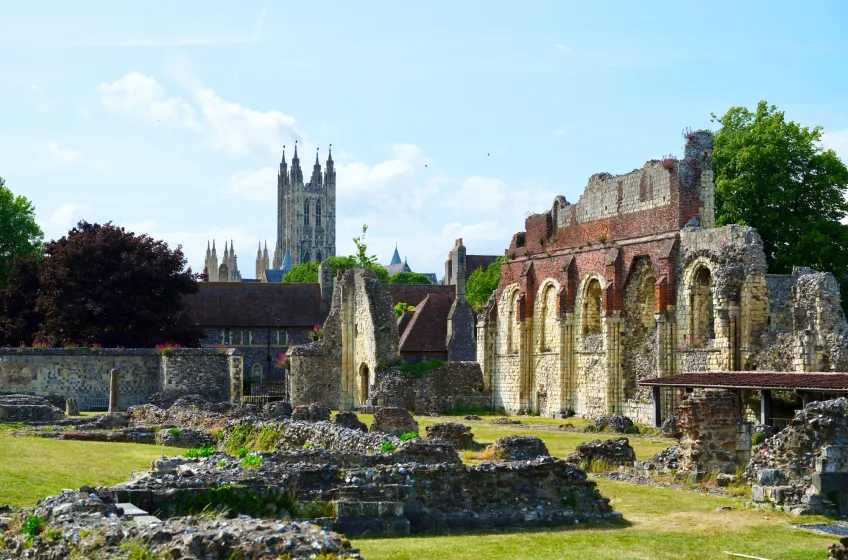
The abbey is also architecturally and archaeologically significant. Though much of the superstructure was dismantled during the 16th century, substantial remains are still visible, including parts of the nave, cloister, crypt, and outer precincts. These allow visitors to understand the layout and scale of the original complex. The on-site museum and visitor centre provide interpretative displays that explain the site’s evolution from a Roman-period location, to its founding in the early medieval period, through to its destruction and rediscovery.
Its open-air setting and peaceful atmosphere make the abbey a welcome retreat from the busier parts of Canterbury. Whether interested in early Christian history, medieval monastic life, or simply looking to explore a tranquil and historically rich site, St Augustine’s Abbey offers a rewarding and thoughtful visit.
Highlights of St. Augustine's Abbey
The Ruins of the Monastic Church
The main draw of the site is the extensive remains of the abbey church, which provide a clear sense of its scale and layout. Visitors can trace the outline of the original 6th-century church built by Augustine, which was later expanded in the Romanesque and Gothic styles as the abbey grew in importance. Surviving features include the foundations of the nave, transepts, chancel, and side chapels, as well as fragments of arcading and decorative stonework.
The Royal and Ecclesiastical Tombs
St Augustine’s Abbey was the burial site of several early Anglo-Saxon kings of Kent, including King Æthelberht, the first English king to convert to Christianity. It also housed the remains of early Archbishops of Canterbury, such as Augustine himself and his successors, Laurentius and Mellitus. Although the tombs were desecrated during the Reformation, their positions are marked and interpreted, offering insight into the abbey’s role as a place of royal and religious commemoration.
The Monastic Precinct
The abbey complex included extensive monastic buildings such as the cloisters, dormitories, chapter house, kitchens, and refectory. Visitors can explore the footings and reconstructed outlines of these structures, helping to visualise the daily routines of the Benedictine monks who lived and worked here. Interpretation panels across the site provide context and reconstructions.
The Anglo-Saxon Church of St Pancras
Within the abbey grounds lie the remains of the Church of St Pancras, believed to be the earliest Christian church built in England by Augustine’s mission. It was constructed over a Roman site, and its foundation walls and apsidal east end are still visible today. The blending of Roman materials with early Christian construction reflects the transitional nature of the site’s early use.
The Museum and Visitor Centre
The modern visitor centre houses exhibitions, models, and a short introductory film that explains the abbey’s foundation, development, and decline. Artefacts discovered during excavations—including Roman tiles, medieval stonework, and burial items—are displayed here, and visitors can gain a better understanding of how the abbey functioned and what it looked like before its destruction.
Virtual Reconstructions and Interactive Displays
One of the highlights for many visitors is the digital reconstruction of the abbey complex. Through 3D models and interactive screens, guests can explore how the abbey may have appeared during its medieval height. These digital tools help bring the ruined site to life and offer an educational supplement to the physical remains.
The Site’s Roman Origins
Archaeological evidence shows that the site was used in Roman times before Augustine’s arrival. The presence of reused Roman materials in early abbey construction demonstrates the continuity and transformation of sacred space. Visitors can learn about this earlier phase and its influence on the design of the initial Christian buildings.
Educational Programmes and Guided Tours
English Heritage offers educational resources for schools and group visits, including curriculum-linked materials and guided tours led by trained staff. For the general public, occasional talks and tours provide a deeper insight into the site’s history, archaeology, and broader significance in English Christianity.
Quiet Garden Spaces
Despite its status as a ruin, the site retains a peaceful, contemplative atmosphere. The open lawns, bordered by fragments of monastic walls, invite visitors to take time to reflect and appreciate the abbey’s spiritual heritage. The combination of history and landscape makes it suitable for slow-paced, self-guided exploration.
Nearby Attractions
St Augustine’s Abbey is situated just a ten-minute walk from the centre of Canterbury, making it easy to combine with other major sites. Chief among these is Canterbury Cathedral, one of the most famous religious buildings in the world and the seat of the Archbishop of Canterbury. The cathedral, with its stunning Gothic architecture and historical connections to figures such as Thomas Becket, forms the centrepiece of Canterbury’s spiritual identity.
A short walk from the abbey is St Martin’s Church, the oldest church in continuous use in the English-speaking world. According to tradition, it was the private chapel of Queen Bertha, the Christian wife of King Æthelberht, and was used by Augustine upon his arrival in England. Together, the cathedral, abbey, and church form the Canterbury World Heritage Site.
Other nearby attractions include The Beaney House of Art and Knowledge, which features museum collections and art galleries in a historic building on the High Street, and the Canterbury Roman Museum, which explores the city's Roman past through preserved remains and archaeological finds. Westgate Towers, the Canterbury Castle ruins, and the picturesque Westgate Gardens also offer additional heritage sites within walking distance.
Practical Advice for Visitors
St Augustine’s Abbey is managed by English Heritage and is open to the public for much of the year, although opening times can vary by season. It is advisable to check the English Heritage website for current times, admission prices, and details of any special events. Entry is free for English Heritage members, and family and concession tickets are available.
The site is easily accessible on foot from central Canterbury and is approximately a 15-minute walk from Canterbury East railway station. Car parking is available nearby at public car parks, though availability may be limited during busy periods. The surrounding area is pedestrian-friendly, and there are plenty of cafés, shops, and public facilities in the vicinity.
Due to the nature of the site, some paths are uneven and grassy, which may be challenging for wheelchair users or visitors with limited mobility. However, the visitor centre and its facilities are accessible, and staff are available to assist where needed.
Visitors should allow around 1 to 1.5 hours to explore the site thoroughly, though those with a particular interest in early Christianity or medieval monasticism may wish to stay longer. Guidebooks are available for purchase at the site, and downloadable resources can also be accessed online.
Bringing water, appropriate footwear, and weather-appropriate clothing is recommended, as the majority of the site is outdoors and exposed to the elements. Dogs on leads are allowed in the grounds, making it suitable for those visiting with pets.
Conclusion
St Augustine’s Abbey is one of the most important ecclesiastical and historical sites in England, marking the birthplace of organised Christianity in the country and the beginning of Canterbury’s long-standing religious prominence. Although now a ruin, its atmosphere, interpretive displays, and surviving structures allow visitors to gain a vivid sense of its past importance and architectural scale. As part of the UNESCO World Heritage Site, the abbey complements visits to Canterbury Cathedral and St Martin’s Church, forming a triad of locations that together tell the story of Christianity’s arrival and establishment in Anglo-Saxon England. For anyone interested in religious history, archaeology, or early medieval England, St Augustine’s Abbey remains a site of enduring significance and quiet reflection.
Shortlist
- Your Shortlist is empty