
Discover Weimar | A Visitor's Introduction to Weimar
Recommended places to visit, places to stay and things to do in and around Weimar
Weimar is a small but culturally mighty town in the German state of Thuringia. Known as the birthplace of German classicism and the cradle of the Bauhaus movement, Weimar is steeped in artistic, literary, and political history. Home to greats such as Goethe, Schiller, Bach and Liszt, it also played a pivotal role in 20th-century Germany as the namesake of the ill-fated Weimar Republic. Despite its compact size, Weimar packs in grand architecture, leafy parks, fascinating museums, and a deeply reflective atmosphere. It’s the perfect destination for culture lovers, history buffs, and those looking to explore the heart of German identity in a beautiful and walkable setting.
Search All Weimar accommodation
Pre-book Weimar Attractions, Tours & Experiences
Why is Weimar Worth a Visit?
Weimar is worth visiting for its unique combination of intellectual heritage, beautifully preserved old-world charm, and significant place in both European culture and political history. Nowhere else in Germany will you find such a concentration of world-shaping movements in one small town: the German Enlightenment, the Romantic era, early modernist architecture, and democratic reform all found a home in Weimar.
Walking through Weimar feels like stepping into a living museum. The cobbled streets and leafy parks echo with the legacies of Johann Wolfgang von Goethe and Friedrich Schiller, whose homes you can still visit. The Bauhaus movement, which changed the course of modern design, was founded here in 1919. And Weimar's political history – as the seat of Germany's first democratic constitution – gives it a complex, sobering edge, especially when combined with the proximity of the Buchenwald concentration camp memorial.
But it’s not all serious. Weimar is a charming, friendly town, full of cosy cafés, galleries, and green spaces. It’s ideal for slow, thoughtful travel and makes an excellent base for exploring Thuringia.
Weimar Highlights: Things to See and Do in Weimar
Goethe’s House and the Goethe National Museum
Goethe lived in Weimar for over 50 years, and his house on Frauenplan is one of the town’s most important attractions. The elegant Baroque building has been carefully preserved, with original furniture, extensive collections of art and minerals, and plenty of insight into his daily life. The adjoining Goethe National Museum delves deeper into his work, philosophy, and contributions to science and literature.
Schiller’s House
Just a short stroll from Goethe’s house, you’ll find the former home of Friedrich Schiller, another giant of German literature. The museum recreates the domestic setting where he wrote some of his greatest works, and showcases his life, friendships, and literary legacy. Together with Goethe’s house, it forms part of the “Classical Weimar” UNESCO World Heritage listing.
Bauhaus Museum
Weimar was the birthplace of the Bauhaus movement, founded here by architect Walter Gropius in 1919. The sleek, modern Bauhaus Museum opened in 2019 and showcases the ideas, designs, and artefacts that revolutionised art, architecture and design across the world. It’s a fascinating contrast to the classical heritage of the town, and a must-see for design fans.
Belvedere Palace and Park
Just a few kilometres south of the town centre lies Schloss Belvedere, an elegant baroque summer residence surrounded by landscaped gardens and forested parkland. The palace houses part of the Weimar Classic Foundation’s art collection, including porcelain, 18th-century paintings and decorative arts. It’s a lovely spot for a half-day trip, especially in spring or autumn.
Park an der Ilm
This vast English-style landscape park stretches along the banks of the Ilm River and is the green heart of Weimar. Goethe played a key role in designing parts of it, and his Garden House still stands near the entrance. Wander among meadows, winding paths, and neoclassical monuments such as the Roman House and the Tempelherrenhaus. It’s ideal for relaxed walking, picnics, and a glimpse into 18th-century landscaping ideals.
Duchess Anna Amalia Library
This breathtaking Rococo library is one of the most beautiful in the world. Named after the enlightened Duchess who promoted the arts in Weimar, it houses rare manuscripts, historic maps, and volumes once used by Goethe and Schiller. The Rococo Hall, with its curved balconies and celestial ceiling fresco, is a highlight – note that entry is limited and booking ahead is essential.
Weimar City Castle (Stadtschloss)
The Stadtschloss, or city palace, is a striking structure that reflects various architectural styles, from Gothic to Baroque and Neoclassical, due to repeated reconstructions. Today, it houses the Castle Museum, featuring German art from the Middle Ages to the 20th century, including works by Lucas Cranach the Elder and members of the Weimar School of Painting.
Buchenwald Memorial
Located about 8km from Weimar, the Buchenwald concentration camp memorial is a sobering but deeply important site. One of the largest camps on German soil, it imprisoned and killed tens of thousands of people during the Nazi regime. Today, the site serves as a memorial and education centre, with exhibitions, preserved buildings, and commemorative monuments. A visit here adds a necessary perspective to the cultural glories of Weimar.
Nietzsche Archive and Museum
The philosopher Friedrich Nietzsche spent the final years of his life in Weimar, and the house where he died has been turned into a museum and archive. The museum offers insight into his complex philosophical ideas, personal life, and posthumous legacy. The building itself is of interest too – a fascinating mix of historicism and early 20th-century interior design.
Market Square and Town Centre
Weimar’s Altstadt (Old Town) is compact, walkable, and full of character. The Market Square is the heart of the town, surrounded by pastel-coloured buildings, cafés, and shops. Highlights include the Town Hall, with its distinctive neo-Gothic façade, and the Lucas Cranach House, home to the famous Renaissance painter. It’s the perfect place to sit with a coffee and soak up the atmosphere.
Liszt House
Composer Franz Liszt lived and worked in Weimar during two important periods of his life, and his former residence now hosts a small but engaging museum. You can see his original piano, manuscripts, and letters, and get a sense of his creative process and life in Weimar’s cultural circle.
German National Theatre
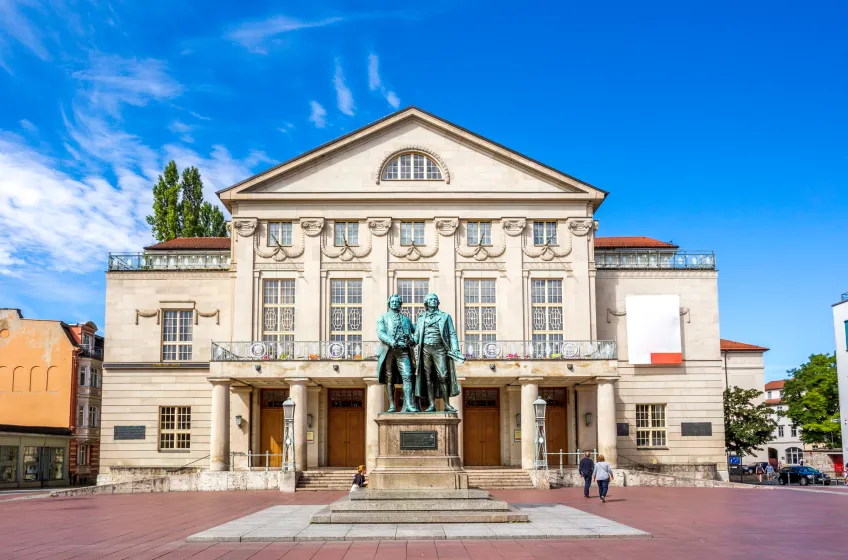
This theatre is not only the centre of dramatic arts in Weimar but also of political history – it was here that the Weimar National Assembly met in 1919 to draft Germany’s first democratic constitution. Today, the theatre continues to offer a rich programme of classical and modern performances.
Practical Advice for Visitors
Getting There
Weimar is well connected by train, with direct regional services from Erfurt (20 minutes), Leipzig (1 hour), and Frankfurt (about 2.5 hours). From Berlin, it takes around 2.5 to 3 hours by train, with a change at Erfurt. The nearest major airport is Leipzig/Halle (LEJ), with regular rail connections. If you're driving, the A4 motorway provides easy access, and the town is well signposted.
Parking
Weimar’s city centre is largely pedestrianised, but there are several car parks and Park+Ride facilities on the outskirts. The Parkhaus Atrium or Parkhaus am Goetheplatz are good options for central parking. Street parking is possible in designated areas, but be sure to check signage for time limits and fees.
Dining
Weimar has a range of dining options, from traditional Thuringian cuisine to modern cafés and wine bars. Try local favourites like Thüringer Rostbratwurst (grilled sausage), Sauerbraten (marinated roast beef), or Kloß mit Soß (dumplings with gravy).
Recommended spots include:
-
Anastasia – A stylish modern restaurant with seasonal, locally sourced dishes.
-
Zum Schwarzen Bären – One of the town’s oldest inns, offering hearty regional fare.
-
Gourmetrestaurant Anna Amalia – Fine dining in the Hotel Elephant, perfect for a splurge.
-
Café Frauentor – Great for coffee, cakes and light lunches in a cosy setting.
Weimar also has excellent bakeries and wine shops, especially around the Market Square and the Frauenplan.
Shopping
While Weimar isn’t a shopping destination in the traditional sense, it offers a good selection of independent boutiques, bookshops, and design stores. Look out for Bauhaus-inspired souvenirs, Thuringian handicrafts, and fine stationery. The Goethe Shop and Bauhaus Museum shop both offer tasteful, curated gift ideas.
For fresh produce and regional treats, visit the weekly market on the Market Square (usually Wednesdays and Saturdays).
When to Visit
The best times to visit Weimar are spring (April to June) and autumn (September to October), when the parks are at their most colourful and the weather is pleasant. Summer is also beautiful, with open-air concerts and festivals, but can be a bit busier, especially during school holidays.
Winter brings festive markets and a cosy atmosphere, though some attractions may have reduced hours. The Christmas market, set around the market square and the Goetheplatz, is charming and more relaxed than in larger cities.
Local Events
Weimar has a packed cultural calendar, reflecting its artistic heritage. Key events include:
-
Weimar Arts Festival (Kunstfest Weimar) – Held in late August to early September, this festival features music, theatre, dance, and visual arts across the city.
-
Genius Loci Festival – A unique digital art festival that projects visual storytelling onto the façades of historic buildings.
-
Bauhaus Week (Bauhaus-Woche) – Celebrating the Bauhaus movement each April with workshops, exhibitions and lectures.
-
Easter and Christmas Markets – Cosy and atmospheric, with handmade gifts and local food.
-
Onion Market (Zwiebelmarkt) – Every October, this quirky three-day folk festival celebrates the humble onion with food stalls, live music, and crafts. It’s one of the town’s most beloved events.
Exploring Beyond Weimar
Weimar is perfectly placed for exploring central Germany. Erfurt, the capital of Thuringia, is just 20 minutes away and offers a stunning medieval centre and cathedral. Jena, with its science heritage and student energy, is also nearby.
Further afield, you can explore the Thuringian Forest for hiking and nature, or head to Eisenach to visit Wartburg Castle, a UNESCO site where Martin Luther translated the New Testament. The region is also known for its spa towns, such as Bad Sulza and Bad Berka, perfect for a relaxing detour.
Weimar is a place where history, culture and reflection come together in an intimate and walkable setting. Whether you're tracing the footsteps of Goethe, marvelling at Bauhaus design, or simply enjoying coffee in a leafy square, the town offers an experience that’s quietly profound and deeply memorable. Rich in legacy yet welcoming in spirit, Weimar invites you to slow down and savour the depth of German culture.
Shortlist
- Your Shortlist is empty