
Temple Church | A Visitor's Introduction to Temple Church
Temple Church is a historic and architecturally significant site located in the heart of London, nestled between Fleet Street and the River Thames. Originally built by the Knights Templar in the late 12th century, the church is one of the few surviving Norman round churches in England and has played an important role in the legal, religious, and cultural history of the country. Today, it continues to serve as a functioning church and a place of quiet reflection, while also drawing visitors interested in medieval history, ecclesiastical architecture, and the legacy of the Templars.
Recommended City of London accommodation: Hotels Bed & Breakfasts Pub Accommodation
Pre-book London Attractions, Tours & Experiences
Why Is Temple Church Worth a Visit?
Temple Church is worth visiting for its unique combination of historical depth, architectural rarity, and cultural relevance. As one of the oldest churches in London, it offers a direct link to the medieval world, particularly the period of the Crusades and the powerful military-religious order of the Knights Templar. The church’s distinctive design, notably its circular nave, reflects the influence of the Church of the Holy Sepulchre in Jerusalem and sets it apart from most other ecclesiastical buildings in the UK.
In addition to its medieval features, Temple Church also has strong associations with the legal profession, as it lies at the heart of London’s Inns of Court. This makes it a compelling stop for those interested in British legal history. Furthermore, the church has been featured in popular culture, including literature and film, which has helped renew public interest in its story and the mystique of the Templars.
Temple Church Highlights
The Round Church
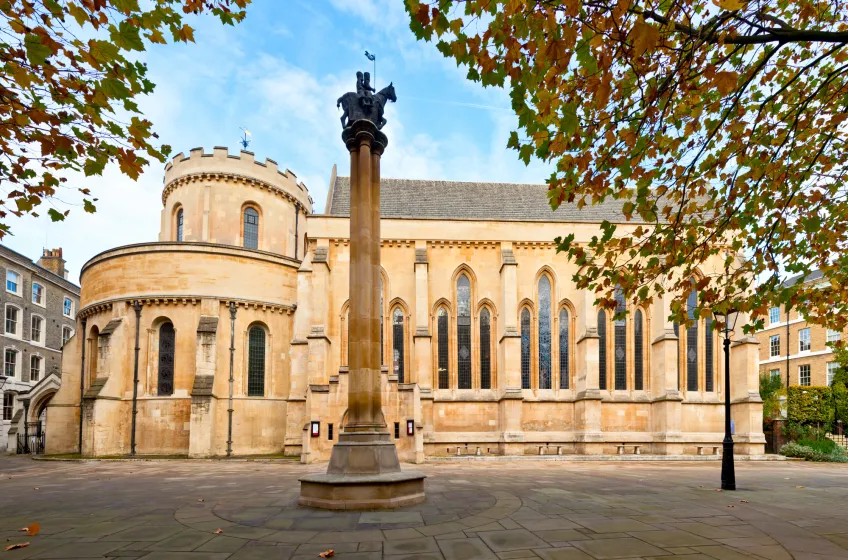
The most distinctive feature of Temple Church is its original round nave, completed in 1185. This rotunda was modelled after the Church of the Holy Sepulchre in Jerusalem and was intended to symbolise the sacred sites of the Holy Land. The circular design is extremely rare in English church architecture, adding significant interest for visitors. The simplicity and solidity of the stone construction evoke the martial spirituality of the Templars.
The Effigies of the Knights
Within the round church lie several stone effigies of 13th-century knights, traditionally believed to represent prominent members of the Templar order. Although some of the identities remain uncertain, the recumbent figures, carved in stone with crossed legs and chainmail, are evocative of the romanticised image of the crusading knight. They are among the most photographed features of the church and serve as a tangible link to the medieval past.
The Chancel
Added in the 13th century, the rectangular chancel complements the earlier circular nave and reflects the development of Gothic architecture. It features elegant ribbed vaulting and clerestory windows that allow natural light to illuminate the interior. The chancel continues to serve liturgical functions and contains elements from later periods, including Victorian restorations and additions.
The Organ and Music
Temple Church has a long-standing choral tradition and houses a significant pipe organ. The church is home to the Temple Church Choir, which has achieved a high level of recognition both nationally and internationally. Visitors who attend a service or a recital can appreciate the acoustics and musical heritage of the building. The organ, restored in recent decades, plays a central role in these performances.
The Legal Connections
Temple Church occupies a central position between the Inner Temple and Middle Temple, two of the four Inns of Court that have trained and housed generations of English barristers. Historically, the church functioned as the spiritual centre for these legal communities, and it continues to host legal ceremonies and events. The connection between the church and the legal world is underscored by plaques, memorials, and coats of arms found throughout the building.
The Templar History
The Knights Templar were granted the land to build the church by King Henry II, and the building served as their English headquarters until the order was suppressed in the early 14th century. This connection adds a layer of historical intrigue, as the Templars were central to many myths and controversies in medieval Europe. Temple Church is one of the few places in the UK where visitors can explore this legacy in a genuine Templar site.
WWII Damage and Restoration
Temple Church was heavily damaged during the Blitz in World War II. Incendiary bombs gutted the roof and destroyed much of the interior. The church was painstakingly restored in the post-war period, with a commitment to preserving its medieval character while incorporating necessary repairs. The story of its destruction and revival is part of the broader narrative of London’s wartime experience and resilience.
The Churchyard and Courtyard
The area surrounding Temple Church includes a quiet courtyard and gardens that provide a peaceful contrast to the bustle of the City. This space, enclosed by legal chambers and historic buildings, allows visitors to appreciate the church’s setting within the Inns of Court. The churchyard is also the site of various commemorative plaques and historic markers.
The Magna Carta Connection
Temple Church played a part in the history of the Magna Carta, as it was the place where King John negotiated with the barons before agreeing to the charter in 1215. William Marshal, 1st Earl of Pembroke and one of the Magna Carta’s guarantors, is believed to be among the knights commemorated by the church’s effigies. This connection adds to the church’s national historical significance.
Filming and Pop Culture
In recent years, Temple Church has appeared in books and films, most notably in Dan Brown’s novel The Da Vinci Code and its film adaptation. Although the fictional portrayal includes embellishments, it has sparked renewed interest in the site and its Templar heritage. The church occasionally hosts exhibitions and talks that explore these modern cultural connections.
Facilities
Temple Church maintains basic visitor facilities suited to its function as a working place of worship and a heritage site. There is a small gift shop on-site offering books, postcards, and themed souvenirs. Public toilets are not located within the church itself but can be found nearby within the Inns of Court complex.
The church is fully accessible for those with limited mobility, although some areas, particularly the surrounding cobbled courtyards, may pose challenges. Visitors are advised to check opening times in advance, as the church is not open every day and is sometimes closed for private events or legal services. Guided tours are available on selected days and are recommended for those who want a more detailed understanding of the site’s history.
The church also hosts regular services, concerts, and educational events. These are listed on its official website and provide opportunities for visitors to engage with the building in different ways.
Nearby Attractions
Temple Church is centrally located and within walking distance of several other notable London attractions. Directly adjacent are the Inner and Middle Temple Inns, which can themselves be explored, including Middle Temple Hall, a stunning example of Elizabethan architecture.
To the west lies the Royal Courts of Justice, an imposing Gothic Revival building that serves as the seat of the High Court and Court of Appeal. Guided tours are sometimes available, offering insight into the UK’s legal system.
Fleet Street, historically associated with British journalism, runs nearby and contains various historic pubs, churches, and buildings. St Bride’s Church, often called the "journalists’ church", is particularly noteworthy and is a short walk away.
To the east, visitors can reach the historic Temple Bar gateway and the boundary of the City of London. Further beyond are St Paul’s Cathedral and the Museum of London, both easily accessible on foot or by public transport.
The Victoria Embankment and the River Thames are just to the south, providing pleasant walking routes and access to riverboat services. Somerset House, a major arts and cultural centre, is also nearby and often hosts exhibitions and events.
Practical Advice
Visitors planning a trip to Temple Church should note that its opening hours can be irregular. It is typically open to the public on weekdays, with reduced access on weekends and during special services. Checking the church’s official website ahead of time is advisable, especially if you wish to attend a guided tour or a concert.
Access to the church is via narrow passageways from Fleet Street or the Embankment, so comfortable footwear is recommended. The nearest Underground stations are Temple (Circle and District lines) and Blackfriars, both of which are a short walk away. Buses also run frequently along Fleet Street and the Strand.
Photography is generally permitted inside the church for personal use, but visitors should be respectful of services and events. Tripods and professional photography may require prior permission.
Although there is no café on-site, a variety of cafés, restaurants, and pubs are available along Fleet Street and in the nearby Strand area. The peaceful nature of the church and its grounds make it a good spot for a short reflective visit, especially for those interested in medieval history, architecture, or London’s legal institutions.
Temple Church remains one of London’s quieter historic gems, offering a rich experience for those who take the time to explore its unique heritage and setting.
Shortlist
- Your Shortlist is empty