
Discover Santiago | A Visitor's Introduction to Santiago de Compostela
Recommended places to stay, places to visit and things to do in and near Santiago de Compostela
Santiago de Compostela is the historic capital of Galicia in north-western Spain and the celebrated destination of the Camino de Santiago pilgrimage routes. Known for its magnificent cathedral, granite old town, lively university culture and deeply atmospheric squares, this compact city is a perfect destination for history lovers, walkers, foodies and travellers interested in religious and cultural heritage. With arcaded streets, traditional taverns, green parks and pilgrims arriving from across the world, Santiago offers one of Spain’s most distinctive city breaks.
Browse Santiago de Compostela Hotels and Other Accommodation
Pre-book Santiago de Compostela Activities, Tours and Experiences
Why is Santiago de Compostela Worth a Visit?
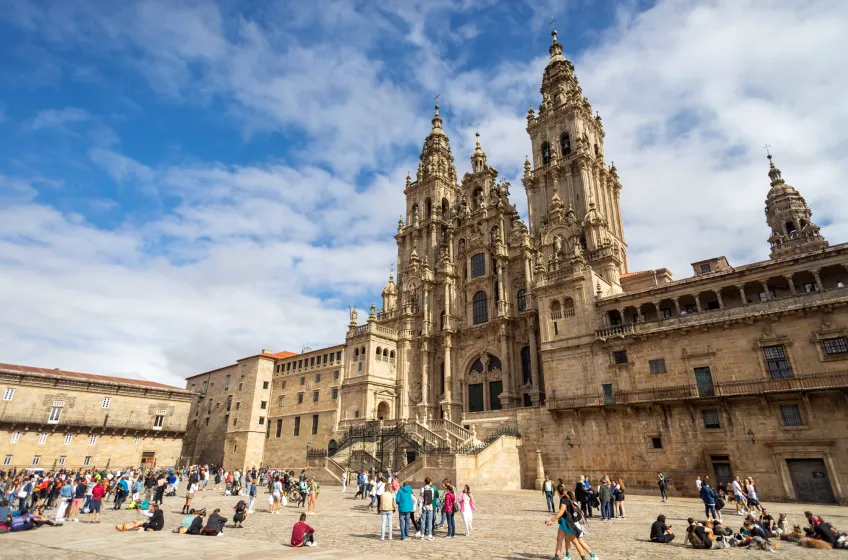
Santiago de Compostela is worth visiting because it combines monumental architecture with an unusually emotional sense of arrival. Even visitors who have not walked the Camino can feel the significance of Praza do Obradoiro, where pilgrims gather beneath the cathedral’s Baroque façade after completing journeys lasting days, weeks or months.
The old town is exceptionally well preserved. Granite churches, monasteries, colleges and houses line narrow streets that open suddenly into grand public squares. Rain and mist often deepen the atmosphere, giving the stone surfaces a silvery appearance.
Santiago is also a lively university city rather than simply a religious destination. Students, residents, pilgrims and visitors share the same cafés, markets and streets, preventing the centre from feeling like an open-air museum.
Food is another major reason to visit. Galician seafood, octopus, empanadas, cheeses and local wines are widely available, while the city’s traditional market remains one of the best places to understand the region’s produce.
Two full days are enough for the cathedral, old town and principal museums. Three nights allow a more relaxed visit, while a longer stay provides time for excursions to the coast, Rías Baixas or the final Camino stages towards Fisterra.
Santiago Highlights: Things to See and Do in Santiago de Compostela
Visit Santiago Cathedral
Santiago Cathedral is the city’s defining landmark and the traditional destination of the Camino de Santiago.
The building developed over many centuries and combines Romanesque, Gothic, Baroque and later elements. Its western façade dominates Praza do Obradoiro, while other entrances reveal different architectural periods.
Inside, visitors can see the main altar, chapels and the shrine traditionally associated with Saint James. The atmosphere changes throughout the day as tourists, worshippers and pilgrims move through the building.
Religious services can affect visitor access, so allow flexibility and dress respectfully.
Experience Praza do Obradoiro
Praza do Obradoiro is the ceremonial heart of Santiago.
The cathedral occupies one side, while the Hostal dos Reis Católicos, Pazo de Raxoi and university buildings complete the square. Its scale and architectural unity make it one of Spain’s most impressive public spaces.
The square is at its most moving when pilgrims arrive, drop their backpacks and look towards the cathedral. Early morning provides the quietest atmosphere, while evening brings softer light and a more reflective mood.
See the Pórtico da Gloria
The Pórtico da Gloria is a masterpiece of Romanesque sculpture created for the cathedral.
Its carved figures represent biblical scenes, saints, musicians and symbolic imagery arranged around the central figure of Christ. Centuries of restoration and conservation have revealed details that are easy to miss from a distance.
Access is often controlled separately from general cathedral entry, so check current arrangements and book ahead when necessary.
Visit the Cathedral Museum
The Cathedral Museum explains the history, construction and artistic importance of the complex.
Its collections include tapestries, sculpture, religious objects, manuscripts and architectural material. Some visitor routes may also provide access to cloisters, balconies or elevated areas.
The museum is especially useful for understanding how the cathedral changed over time and why Santiago became such an important pilgrimage destination.
Watch the Botafumeiro
The Botafumeiro is the cathedral’s enormous ceremonial incense burner.
When used, it swings high across the transept, controlled by a team using ropes and pulleys. The spectacle is dramatic, but it does not operate at every service or every day.
Do not plan a visit on the assumption that it will definitely be used. Check current liturgical information and treat the event as a religious ceremony rather than a performance.
Walk Through the Old Town
Santiago’s old town is a dense network of arcaded streets, stone lanes, small squares and historic buildings.
Rúa do Franco and Rúa da Raíña are known for restaurants and bars, while Rúa do Vilar and Rúa Nova contain shops, cafés and university buildings. The arcades are especially welcome during Galicia’s frequent rain.
The best way to explore is to wander without following only the main pilgrimage streets. Quieter corners often reveal carved doorways, hidden courtyards and small churches.
Explore Praza das Praterías
Praza das Praterías lies beside the cathedral’s southern entrance.
Its fountain, stone façades and Romanesque portal create one of the old town’s most attractive enclosed spaces. The name refers to silversmiths who traditionally worked in the area.
The square is busier than some nearby spaces but offers excellent architectural detail and easy access to the cathedral museum.
Visit Praza da Quintana
Praza da Quintana stands on the eastern side of the cathedral.
The broad stone steps divide the square into upper and lower levels, while monastic and religious buildings surround it. The Holy Door is located on this side of the cathedral and is opened during designated Holy Years.
The square is especially atmospheric after dark, when the stone walls are illuminated.
See the Monastery of San Martiño Pinario
San Martiño Pinario is a vast former Benedictine monastery close to the cathedral.
Its monumental façade, grand church and enormous scale reflect the wealth and influence of the institution. Parts of the complex now serve educational, religious and hospitality functions.
Visitor access may include the church, museum areas or selected cloisters, depending on current arrangements.
Visit the Museum of the Galician People
The Museum of the Galician People occupies the former Convent of Santo Domingo de Bonaval.
Its exhibitions explore Galician fishing, agriculture, crafts, music, clothing and traditional life. The museum is particularly useful for understanding the cultural diversity of Galicia beyond Santiago.
The building’s extraordinary triple spiral staircase is one of its architectural highlights.
Explore the Galician Centre for Contemporary Art
The Galician Centre for Contemporary Art stands beside the Museum of the Galician People.
Designed by Portuguese architect Álvaro Siza, the building uses pale stone, sharp lines and carefully framed views. Temporary exhibitions focus on contemporary art from Galicia, Spain and beyond.
The modern architecture creates a striking contrast with the neighbouring convent.
Walk Through Bonaval Park
Bonaval Park occupies a former convent garden and cemetery behind the museums.
Sloping lawns, old walls and tree-lined paths provide views over the city’s rooftops and towers. It is one of the best places for a quiet break close to the historic centre.
The paths can become slippery in wet weather.
Visit the Mercado de Abastos
Santiago’s Mercado de Abastos is one of the city’s best places to experience Galician food culture.
Stalls sell fish, shellfish, meat, cheese, vegetables, bread and regional produce. Morning is the best time to see the market at its busiest and freshest.
Some nearby businesses prepare simple meals using market ingredients. Seafood prices vary significantly, so ask before ordering expensive items.
Walk Through Alameda Park
Alameda Park lies just south-west of the old town.
Its paths, gardens and mature trees provide excellent views towards the cathedral skyline. The Paseo da Ferradura is particularly popular for photographs.
The park is easy to combine with the old centre and offers welcome space after visiting busy monuments.
See the Two Marías
The Two Marías is a well-known sculpture in Alameda Park.
It represents sisters Maruxa and Coralia Fandiño, colourful local figures who became familiar sights on Santiago’s streets. Their story has both humorous and poignant aspects connected with social exclusion and political repression.
The sculpture has become one of the city’s most photographed modern landmarks.
Visit the University Buildings
The University of Santiago de Compostela has shaped the city for centuries.
Historic faculties, colleges and libraries are spread around the old town, particularly near Rúa do Franco and Praza de Mazarelos. Some interiors are accessible through exhibitions, events or guided visits.
The student population gives Santiago a lively atmosphere outside peak pilgrimage periods.
Walk the Final Camino Approach
Several Camino routes converge on Santiago, and walking a short final section provides a sense of the pilgrimage experience.
The approach from Monte do Gozo is one of the best known. From there, pilgrims traditionally gain their first distant view of the cathedral towers before descending into the city.
The route through suburban areas is not always scenic, but the final arrival in the old town is memorable.
Visit Monte do Gozo
Monte do Gozo, meaning Mount of Joy, lies east of central Santiago.
It is associated with the moment when medieval pilgrims first saw the cathedral in the distance. A monument and pilgrim facilities occupy the broad hilltop area.
Views depend on weather and urban development, but the site remains symbolically important.
Discover the Pilgrimage Museum
The Museum of Pilgrimage and Santiago explores the development of pilgrimage, the cult of Saint James and the international growth of the Camino.
Displays cover religious belief, travel, art and the changing experience of pilgrims over centuries. It is particularly rewarding for visitors who want more context than the cathedral alone provides.
Explore the Colegiata de Santa María do Sar
Santa María do Sar stands outside the central old town.
This Romanesque church is known for its visibly leaning interior columns and external buttresses, added to support the structure. The quiet setting and unusual architecture make it one of Santiago’s more distinctive lesser-known sights.
It can be reached on foot or by local transport.
Enjoy Santiago After Dark
Santiago’s old town becomes especially atmospheric in the evening.
Illuminated façades, wet paving and the sound of bells create a strong sense of place. Praza da Quintana, Obradoiro and the lanes around the cathedral are particularly attractive.
The centre remains lively because of students, pilgrims and restaurants, but quieter streets are never far away.
Practical Advice for Visitors
Getting There
Santiago de Compostela Airport lies east of the city and is connected with the centre by bus, taxi and road.
The city has direct or straightforward rail connections with A Coruña, Vigo, Pontevedra, Ourense, Madrid and other Spanish destinations. Long-distance services can be busy during holidays and major pilgrimage periods.
Coaches provide additional links to Galician towns and rural destinations.
Getting Around
The historic centre is compact and best explored on foot.
Most streets are pedestrianised or have restricted vehicle access. Granite paving can be uneven and slippery, particularly when wet.
Local buses serve the airport, railway station, outer districts and Monte do Gozo.
Taxis are useful for travellers with heavy luggage, especially because some accommodation lies on narrow streets inaccessible to ordinary traffic.
Parking
Driving into the old town is not recommended.
Access restrictions, one-way streets and limited parking make central driving difficult. Use public garages around the edge of the historic district and continue on foot.
Hotels may provide special directions for luggage drop-off, but these should be confirmed before arrival.
Choosing Where to Stay
Accommodation within the old town provides the strongest atmosphere and easiest access to the cathedral, though rooms may be small and streets noisy.
The area near Alameda Park is quieter while remaining close to the centre. Properties around the railway station can offer better value and easier transport access.
Pilgrim hostels are designed mainly for walkers and often provide basic shared facilities rather than conventional hotel comfort.
Weather
Santiago has a mild but wet Atlantic climate.
Rain can occur at any time of year, including summer. Pack a waterproof jacket, compact umbrella and shoes with good grip.
Temperatures are generally moderate, but damp conditions can feel colder than expected. Layered clothing is useful.
Mist and drizzle often add atmosphere rather than ruining a visit, provided you are properly equipped.
Dining
Galician cooking is one of Santiago’s greatest pleasures.
Typical dishes include octopus, empanadas, shellfish, grilled fish, pork with turnip greens and substantial soups. Restaurants range from traditional taverns to modern Galician cooking.
Lunch usually begins after 1.30pm, while dinner commonly starts after 8.30pm.
Tourist menus around the cathedral vary in quality, so explore side streets and compare where local residents are eating.
Try Pulpo á Feira
Pulpo á feira is one of Galicia’s defining dishes.
Boiled octopus is cut into pieces and served with olive oil, paprika and coarse salt, traditionally on a wooden plate. It is simple but highly dependent on texture and careful preparation.
It is widely available in Santiago, though specialist octopus restaurants often provide the best experience.
Taste Empanada Gallega
Galician empanada is a large savoury pie filled with ingredients such as tuna, cod, meat, shellfish or vegetables.
It is sold by the slice in bakeries, markets and bars. The pastry and filling vary considerably between establishments.
Empanada is convenient for lunch, a picnic or a train journey.
Seafood
Santiago is inland but receives excellent seafood from the Galician coast.
Scallops, mussels, clams, razor clams, spider crab and goose barnacles may appear on menus. Availability and price depend on season and harvesting conditions.
Some shellfish is priced by weight. Always ask before ordering if the cost is unclear.
Cheese
Galician cheeses are widely available in Santiago’s markets and restaurants.
Tetilla is soft and mild, Arzúa-Ulloa is creamy, San Simón da Costa is often lightly smoked and O Cebreiro has a distinctive shape and fresh texture.
A mixed cheese board is the easiest way to compare several types.
Wine
Galicia has several important wine regions.
Albariño from Rías Baixas is fresh and well suited to seafood. Ribeiro produces a variety of whites, while Ribeira Sacra is known for Mencía reds and Godello whites.
Wine bars around the old town often serve regional wines by the glass, providing a practical introduction.
Tarta de Santiago
Tarta de Santiago is the city’s best-known sweet.
This moist almond cake is usually dusted with icing sugar in the shape of the Cross of Saint James. Traditional versions contain no flour or very little, though recipes vary.
It is sold throughout the city and travels reasonably well when boxed.
Shopping
Typical purchases include Tarta de Santiago, wine, cheese, canned seafood, ceramics and Camino-related items.
The old town contains many pilgrimage souvenir shops, but better-quality crafts and food products are usually found in specialist businesses and the market.
Scallop-shell symbols are widely sold, though genuine pilgrim credentials and certificates follow formal rules rather than simply being souvenirs.
When to Visit
April to June is excellent for walking, spring greenery and manageable visitor numbers.
July and August bring the largest numbers of pilgrims and tourists. Accommodation prices rise, and cathedral areas become crowded.
September is one of the best months, with fewer visitors and generally pleasant conditions.
October can be atmospheric but wetter. Winter is quiet, cool and frequently rainy, yet the old town remains beautiful and restaurants are less crowded.
Local Events
The Feast of Saint James is Santiago’s principal celebration, bringing religious ceremonies, concerts and public events to the city.
During a designated Holy Year, pilgrimage activity and visitor numbers increase significantly.
University events, music festivals and cultural programmes take place throughout the year.
Festival dates and access arrangements vary, so check the current programme before planning around a specific event.
Safety and Common Visitor Problems
Santiago is generally safe and easy to explore.
The main everyday risk is slipping on wet granite paving. Wear shoes with good grip and take care on steps.
Pickpocketing can occur around the cathedral, market and transport hubs during crowded periods.
Pilgrims should protect passports, phones and credentials in shared accommodation and avoid leaving valuables unattended.
Exploring Beyond Santiago de Compostela
A Coruña offers the Tower of Hercules, Atlantic promenades and a lively waterfront.
Pontevedra has a beautifully pedestrianised old centre and provides access to the Rías Baixas.
Cambados is one of the principal towns of the Albariño wine region.
The Ría de Arousa is known for seafood, fishing communities and island scenery.
Fisterra and Muxía are traditional extensions of the Camino, set on the dramatic Costa da Morte.
Noia and Muros provide historic centres and a quieter estuary atmosphere.
The Cíes Islands can be reached seasonally through coastal ports, while Lugo offers complete Roman walls and a strong inland food culture.
Shortlist
- Your Shortlist is empty