
Discover Pontevedra | A Visitor's Introduction to Pontevedra
Recommended places to stay, places to visit and things to do in and near Pontevedra
Pontevedra is an elegant small city in Galicia, north-western Spain, set near the head of the Ría de Pontevedra. Known for its largely pedestrianised historic centre, granite squares, arcaded streets and relaxed food culture, this compact city is a perfect destination for slow travellers, architecture lovers, pilgrims and visitors exploring the Rías Baixas. With attractive churches, lively markets and easy access to coastal villages, beaches and Albariño wine country, Pontevedra offers one of Galicia’s most enjoyable urban breaks.
Browse Pontevedra Hotels and Other Accommodation
Pre-book Pontevedra Activities, Tours and Experiences
Why is Pontevedra Worth a Visit?
Pontevedra is worth visiting because it combines the beauty of a historic Galician city with an unusually calm and walkable centre. Much of the old town is pedestrianised, so its squares, arcades and narrow lanes feel less dominated by traffic than those of many comparable cities.
The historic centre is compact but full of character. Granite buildings, traditional balconies, fountains and small churches create a strong sense of place, while lively cafés and tapas bars stop the city from feeling overly formal.
Pontevedra is also an important stop on the Portuguese Way to Santiago de Compostela. Pilgrims pass through the centre throughout much of the year, adding an international atmosphere to what remains a strongly local city.
Its location is another major advantage. From Pontevedra, visitors can reach Combarro, Cambados, the beaches of the Rías Baixas and several islands and vineyard areas without changing base.
Two nights are enough for the main city sights and an evening meal, while three or four allow time for nearby coastal excursions.
Pontevedra Highlights: Things to See and Do in Pontevedra
Explore the Historic Centre
Pontevedra’s old town is one of the most attractive and best-preserved in Galicia.
Its lanes open into a succession of small squares, many surrounded by arcades and traditional stone buildings. Because the centre is largely pedestrianised, it is particularly pleasant for unhurried wandering.
Praza da Leña, Praza da Verdura and Praza da Ferraría are among the most atmospheric spaces. Each has its own character, from café terraces to historic façades and fountains.
The old town is especially lively in the early evening, when residents gather for drinks and food.
Visit Praza da Leña
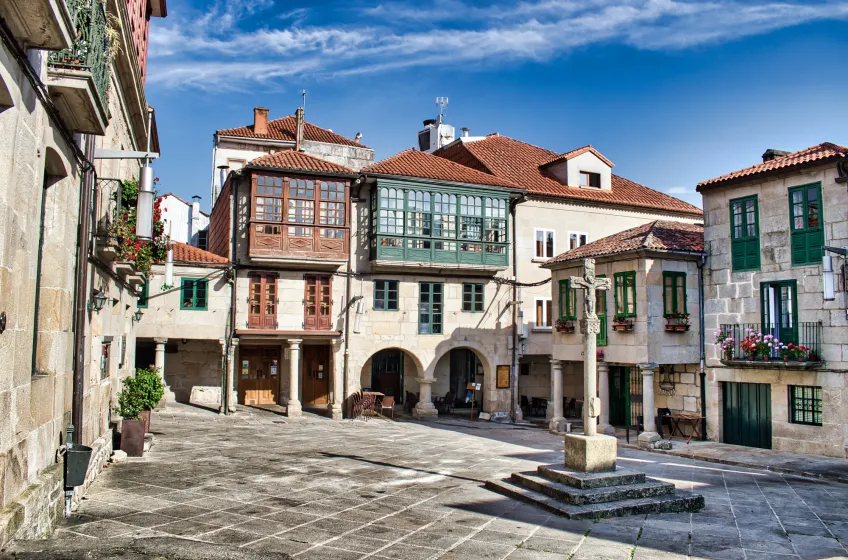
Praza da Leña is one of Pontevedra’s prettiest squares.
Small granite houses, wooden galleries and stone arcades create an intimate setting, while cafés and restaurants occupy the surrounding buildings. The square’s name refers to the firewood once sold here.
It is particularly photogenic in the morning before tables fill the open space.
Relax in Praza da Ferraría
Praza da Ferraría is one of the largest and most important public spaces in central Pontevedra.
It is framed by arcades, gardens and historic religious buildings, including the Church of San Francisco. The square has long been associated with markets, crafts and civic life.
Today it is an excellent place for coffee, people-watching and a pause between old-town sights.
Visit the Church of the Pilgrim Virgin
The Church of the Pilgrim Virgin is Pontevedra’s most distinctive religious building.
Its curved floor plan is traditionally compared with a scallop shell, the symbol of the Camino de Santiago. The church stands on the Portuguese Way and is dedicated to a pilgrim image of the Virgin.
Its Baroque façade and position at the entrance to the old town make it one of the city’s principal landmarks.
The interior is relatively small, so visits may be brief when services are not taking place.
See the Basilica of Santa María a Maior
The Basilica of Santa María a Maior is one of Pontevedra’s most impressive historic buildings.
Built with support from the city’s seafaring community, it has an exceptionally elaborate western façade filled with religious figures and decorative carving. Gothic and Renaissance elements appear throughout the structure.
The church stands close to the former Jewish quarter and surviving sections of the old city walls.
A climb to an upper terrace may be possible depending on access arrangements, offering views over the rooftops.
Walk Through Praza da Pedreira
Praza da Pedreira is a quieter square within the old town.
It is surrounded by noble buildings and has a more formal architectural character than Pontevedra’s café-filled market squares. The square takes its name from the stonecutters who once worked nearby.
It is a useful place to escape the busiest pedestrian routes and appreciate the city’s granite architecture.
Visit the Pontevedra Museum
The Pontevedra Museum is one of Galicia’s most important regional museums.
Its collections cover archaeology, religious art, painting, decorative objects and the history of Pontevedra and Galicia. Displays are spread across several buildings in and around the historic centre.
The museum is especially useful for understanding the city’s maritime past and the broader cultural development of the region.
Opening arrangements may differ between buildings, so check locally before planning a detailed visit.
Explore the Ruins of Santo Domingo
The ruins of Santo Domingo stand close to Alameda Park.
Gothic arches, chapels and carved tombs survive from the former Dominican church. The open-air setting gives the site a romantic appearance and provides a quick introduction to medieval religious architecture.
The ruins form part of the Pontevedra Museum’s collections and may have seasonal opening arrangements.
Walk Along the River Lérez
The River Lérez flows past the northern side of the city before reaching the estuary.
Riverside paths, bridges and green spaces provide easy walking away from the old town. The route becomes quieter as it moves upstream.
This is a good option for an early-morning walk, a run or a relaxed break after sightseeing.
Cross the Burgo Bridge
The Burgo Bridge is an important landmark on the Portuguese Camino route.
Although the present structure has been altered over time, the crossing has long connected Pontevedra with routes heading north towards Santiago. Pilgrim symbols mark the bridge and surrounding paths.
From the riverbank, there are pleasant views towards the city and estuary.
Visit the Mercado de Abastos
Pontevedra’s food market is one of the best places to experience local produce.
Stalls sell fish, shellfish, meat, cheese, vegetables, bread and other Galician specialities. Morning is the liveliest time, when fresh seafood and local produce are most widely available.
Some nearby businesses serve prepared food and simple meals. Ask about prices before ordering shellfish sold by weight.
Explore the Alameda and Palm Garden
The Alameda is a broad green space beside the historic centre.
Tree-lined paths, monuments and nearby civic buildings provide a more formal contrast with the old town’s narrow streets. The adjacent palm garden adds a surprisingly Mediterranean note to the city.
The area is useful for resting, particularly during warm afternoons.
See the Convent of San Francisco
The Church and Convent of San Francisco stand above Praza da Ferraría.
The Gothic church has a relatively restrained interior and a prominent position overlooking the square. Its stone façade and rose window form part of one of Pontevedra’s most recognisable urban scenes.
The church remains active, so access may be affected by services.
Follow the Portuguese Way
The Portuguese Way to Santiago passes directly through Pontevedra.
Shell markers guide pilgrims across the Burgo Bridge and through the historic centre before the route continues north. Walking a short section gives visitors a sense of the city’s role in the wider Camino network.
Early morning is the best time to see groups of pilgrims setting off.
Visit A Moureira
A Moureira is the historic maritime district associated with Pontevedra’s former port and fishing economy.
Much of the original waterfront has changed, but street names, churches and surviving buildings still reflect the city’s relationship with the sea.
Exploring this area reveals a less polished and more residential side of Pontevedra.
Visit the Island of Sculptures
The Island of Sculptures lies in the River Lérez near the city.
Paths pass outdoor artworks set among trees, grass and river scenery. The project combines contemporary sculpture with a public park environment.
It is particularly pleasant for walking, cycling and picnics during dry weather.
Practical Advice for Visitors
Getting There
Pontevedra has good rail and bus connections with Santiago de Compostela, Vigo, A Coruña and other Galician cities.
The railway and bus stations stand close together south-east of the historic centre. Walking into the old town usually takes around 15 to 20 minutes.
Vigo Airport is the nearest major air gateway, while Santiago Airport often offers a wider choice of routes. Both are accessible through public transport connections, though a transfer may be required.
Getting Around
Central Pontevedra is compact and best explored on foot.
The pedestrianised old town is easy to navigate, and most major attractions lie within a short distance of one another. The terrain is generally gentle compared with hillier Galician cities such as Vigo.
Local buses are useful for outer districts, while regional trains and coaches serve nearby towns.
Parking
Driving into the historic centre is unnecessary and often restricted.
Public car parks are available around the edge of the pedestrian zone and near the railway station. Park once and explore on foot.
Spaces become busier during summer weekends, festivals and market periods.
Choosing Where to Stay
The old town is the best choice for atmosphere, restaurants and evening walks.
Accommodation near Alameda Park is slightly quieter while remaining close to the centre. Properties near the railway station may offer better value but feel less historic.
Pontevedra is compact enough that most central accommodation remains within easy walking distance of the main sights.
Dining
Pontevedra has an excellent informal food scene.
Galician seafood, octopus, empanadas, grilled fish and seasonal vegetables feature widely. Tapas bars and small restaurants cluster around the old-town squares.
Lunch normally begins after 1.30pm, while dinner commonly starts after 8.30pm.
Restaurants with outdoor tables become busy on warm evenings, so reservations are useful at weekends.
Try Pulpo á Feira
Pulpo á feira is one of Galicia’s defining dishes.
Boiled octopus is cut into pieces and served with olive oil, paprika and coarse salt. It is traditionally presented on a wooden plate.
Texture is crucial, so specialist restaurants or busy local taverns are usually the best places to try it.
Eat Seafood
Pontevedra’s proximity to the Rías Baixas gives it access to excellent shellfish and fish.
Mussels, clams, scallops, razor clams and octopus appear frequently on menus. Availability and price vary with season, weather and local harvesting restrictions.
Some seafood is priced by weight, so ask before ordering if the cost is unclear.
Taste Empanada Gallega
Galician empanada is a large savoury pie filled with tuna, cod, meat, shellfish or vegetables.
It is sold by the slice in bakeries, markets and bars. Recipes differ considerably, so trying more than one version is worthwhile.
It makes a convenient light lunch or picnic food.
Wine
Pontevedra lies close to several important Rías Baixas wine-producing areas.
Albariño is the best-known local grape, producing fresh white wines that pair well with seafood. Nearby districts around Cambados and the Salnés Valley contain numerous wineries.
Wine bars in the city offer regional bottles by the glass. Winery visits usually require advance booking.
Shopping
Typical local purchases include wine, canned seafood, cheese, ceramics, bakery products and Camino-related items.
The old town contains independent shops and small food businesses, while the market is best for fresh produce.
Most ordinary shops close on Sundays, though tourist businesses and some food outlets may remain open.
Weather
Pontevedra has a mild Atlantic climate.
Rain is possible throughout the year, including summer. Bring a waterproof jacket and shoes suitable for wet stone paving.
Summers are usually warm rather than extremely hot, while winters are damp and relatively mild.
The estuary and nearby coast may experience different conditions from the city, so check the forecast before excursions.
When to Visit
May to June is excellent for mild temperatures, green landscapes and fewer peak-season visitors.
July and August offer the warmest weather but bring larger crowds to the Rías Baixas and nearby beaches.
September is one of the best months, with pleasant conditions and a calmer atmosphere.
Winter is quiet and well suited to food, museums and old-town walks, although rain is more frequent.
Local Events
Pontevedra hosts religious, cultural and maritime celebrations throughout the year.
The city’s principal summer festivities bring concerts, fairs, processions and public activities to the centre.
Pilgrimage-related events and Camino traffic are strongest during the warmer months.
Food festivals take place across the surrounding Rías Baixas, celebrating seafood, wine and regional produce.
Dates vary annually, so check the current programme before organising a visit around a particular event.
Safety and Common Visitor Problems
Pontevedra is generally safe and easy to explore.
The main practical issue is slippery granite paving after rain. Wear shoes with good grip.
Pickpocketing is uncommon but remains possible around markets, festivals and busy transport areas.
Drivers should respect pedestrian zones and avoid following navigation software into restricted streets.
Exploring Beyond Pontevedra
Combarro is a picturesque coastal village known for waterfront granaries and narrow stone lanes.
Cambados is one of the main centres of Albariño wine and has an attractive historic centre.
Sanxenxo offers beaches, resort facilities and easy access to the Ría de Pontevedra.
The Illa de Arousa has beaches, coastal paths and a quieter island atmosphere.
Vigo provides a larger urban experience and boat connections towards the Cíes Islands.
Santiago de Compostela is an easy rail excursion and the final destination of the Camino.
The Barosa River Natural Park offers waterfalls, old mills and short woodland walks inland from the city.
Shortlist
- Your Shortlist is empty