
Discover Bilbao | A Visitor's Introduction to Bilbao
Recommended places to stay, places to visit and things to do in and near Bilbao
Bilbao is a dynamic riverside city in Spain’s Basque Country, set among green hills a short distance from the Bay of Biscay. Known for the Guggenheim Museum, striking contemporary architecture, excellent pintxos and a revitalised industrial waterfront, this compact city is a perfect destination for art lovers, foodies and travellers interested in urban design. With an atmospheric old quarter, distinctive Basque identity and easy access to the coast, Bilbao offers one of northern Spain’s most rewarding city breaks.
Browse Bilbao Hotels and Other Accommodation
Pre-book Bilbao Activities, Tours and Experiences
Why is Bilbao Worth a Visit?
Bilbao is worth visiting because it has transformed itself from a heavily industrial port into a confident cultural destination without losing its working-city character. Former docklands and industrial areas now contain museums, riverside paths, public art and bold modern buildings, while older neighbourhoods preserve traditional markets, churches and taverns.
The Guggenheim Museum is the city’s international landmark, but Bilbao offers much more than a single famous building. The medieval Casco Viejo, Art Nouveau food market, hilltop viewpoints and elegant 19th-century Ensanche district all contribute to a varied urban experience.
Food is another major attraction. Bilbao has an exceptional concentration of pintxos bars, traditional restaurants and specialist food shops. Eating here is usually social and informal, with visitors moving between several establishments rather than remaining in one bar all evening.
Bilbao also makes an excellent base for exploring the Basque coast. Getxo, Portugalete, San Juan de Gaztelugatxe, Bermeo and Gernika are all accessible on day trips.
Two full days are enough for the Guggenheim, old town and main neighbourhoods. Three or four nights allow a more relaxed visit and at least one coastal excursion.
Bilbao Highlights: Things to See and Do in Bilbao
Visit the Guggenheim Museum Bilbao
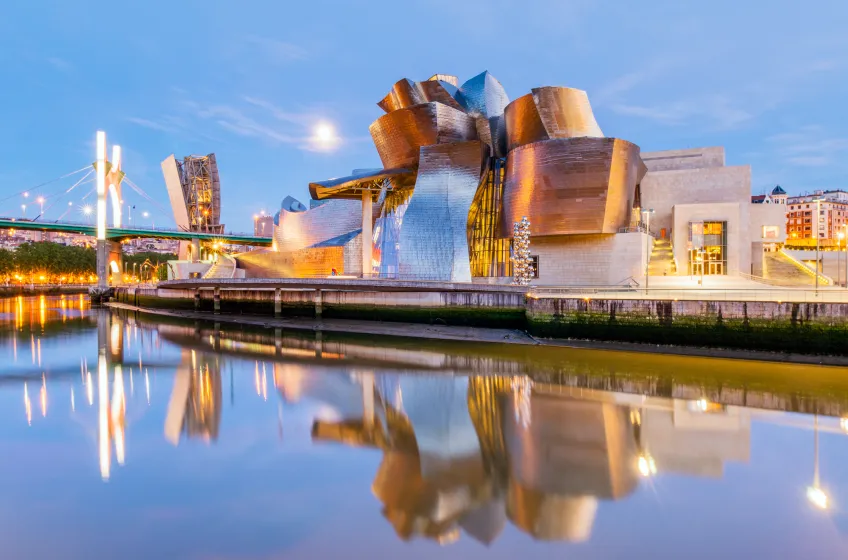
The Guggenheim Museum is Bilbao’s defining modern landmark.
Designed by Frank Gehry, the building is formed from sweeping titanium, glass and stone surfaces beside the Nervión estuary. Its appearance changes with the light, weather and viewing angle, making the exterior almost as important as the exhibitions inside.
The museum presents modern and contemporary art through permanent installations and changing exhibitions. Large-scale works are particularly well suited to its vast gallery spaces.
Allow at least two hours for the interior and additional time to walk around the building outside. Advance booking is sensible during weekends and holidays.
See Puppy
Jeff Koons’ enormous flower-covered sculpture Puppy stands outside the Guggenheim’s main entrance.
The living surface changes with the seasons, giving the work a different appearance throughout the year. It has become one of Bilbao’s most recognisable public artworks.
Early morning is best for an unobstructed view.
Walk Around the Guggenheim Exterior
Several major artworks stand outside the museum.
Louise Bourgeois’ monumental spider sculpture, Maman, occupies the riverside terrace, while other installations appear around pools, bridges and public spaces.
Walk across the nearby bridges and along both riverbanks to see how the museum fits into the wider city.
Explore the Casco Viejo
Bilbao’s Casco Viejo is the historic heart of the city.
The original centre developed around the Siete Calles, or Seven Streets, which remain filled with shops, cafés, pintxos bars and traditional buildings. The area is largely pedestrianised and easy to explore on foot.
Its atmosphere is liveliest around lunchtime and in the evening, but early morning is better for appreciating the architecture.
Visit Plaza Nueva
Plaza Nueva is an elegant neoclassical square in the Casco Viejo.
Arcaded buildings contain some of Bilbao’s best-known pintxos bars, making the square a popular place to begin an evening food crawl. Markets and public events may also take place here.
The most enjoyable approach is to order one drink and one pintxo in a bar before moving to another.
See Santiago Cathedral
Santiago Cathedral stands in the centre of the old town.
Its Gothic architecture reflects Bilbao’s medieval development and its position on a branch of the Camino de Santiago. The building has been altered over time, but its cloister, portals and tall interior remain impressive.
Access may be affected by religious services, so allow some flexibility.
Visit the Ribera Market
The Ribera Market occupies a prominent riverside building beside the Casco Viejo.
Fresh fish, meat, cheese, vegetables and other Basque products are sold inside. Food counters and casual dining spaces provide an easy way to sample local flavours without committing to a formal meal.
Morning is best for seeing the traditional market activity, while later hours suit eating and drinking.
Walk Along the Nervión River
Bilbao’s riverside paths reveal the scale of the city’s transformation.
The route between the Casco Viejo and Guggenheim passes bridges, public art, university buildings and former industrial land. It is mostly flat and suitable for an easy urban walk.
Continue towards the Maritime Museum and Euskalduna district for a longer route.
Cross the Zubizuri Bridge
The Zubizuri is a distinctive white footbridge designed by Santiago Calatrava.
Its curved form and cable structure create a striking crossing between the city centre and the northern riverbank. It is particularly attractive when illuminated after dark.
The bridge surface can become slippery in wet weather, so walk carefully.
Ride the Artxanda Funicular
The Artxanda Funicular climbs from near the city centre to the hills above Bilbao.
At the top, viewpoints provide broad panoramas over the river, Guggenheim, old town and surrounding mountains. Parks and restaurants make the area suitable for a longer visit.
Clear late-afternoon conditions provide the best light, though Bilbao’s weather can change quickly.
Explore the Ensanche
Bilbao’s Ensanche developed as the city expanded beyond the old town.
Broad avenues, grand civic buildings and elegant residential blocks contrast with the narrow lanes of the Casco Viejo. Gran Vía is the district’s main commercial street.
The area around Plaza Moyúa contains some of Bilbao’s most impressive late 19th- and early 20th-century architecture.
Visit the Bilbao Fine Arts Museum
The Bilbao Fine Arts Museum has an important collection ranging from medieval religious art to modern painting.
Basque and Spanish artists are strongly represented alongside wider European works. The museum provides a more historically varied experience than the Guggenheim.
Opening arrangements and gallery access may change during building projects or exhibition installations, so check current information before visiting.
Explore Azkuna Zentroa
Azkuna Zentroa is a former wine warehouse transformed into a major cultural and leisure complex.
Its interior was redesigned with a dramatic covered courtyard supported by individually decorated columns. The building contains exhibition spaces, a library, cinemas, restaurants and sports facilities.
Visitors can enter the central areas without committing to a full exhibition visit.
Visit the Itsasmuseum
The Itsasmuseum explores Bilbao’s maritime and industrial history.
Exhibitions cover shipbuilding, port activity, navigation and the relationship between the city and its estuary. Outdoor displays may include boats, machinery and preserved dock features.
It provides valuable context for understanding Bilbao before its cultural redevelopment.
See the Euskalduna Palace
The Euskalduna Palace stands on former shipyard land beside the river.
Its rust-coloured exterior references Bilbao’s industrial heritage, while the interior hosts concerts, opera, conferences and performances.
The surrounding district includes riverside gardens and modern architecture.
Explore Doña Casilda Park
Doña Casilda Park is one of central Bilbao’s main green spaces.
Tree-lined paths, ponds, fountains and lawns provide a quiet break between the Ensanche and the river. The park is popular with families, walkers and office workers.
It combines easily with the Fine Arts Museum and Guggenheim.
Visit the Basilica of Begoña
The Basilica of Begoña stands on a hillside above the old town.
It is dedicated to the Virgin of Begoña, an important patron figure for Bilbao and Biscay. The church is reached by road, lift or a demanding series of steps.
The elevated position and strong local devotion make it worth visiting even for travellers with limited interest in church architecture.
Walk Through Bilbao La Vieja
Bilbao La Vieja lies across the river from the Casco Viejo.
Once associated with mining and working-class life, the neighbourhood now combines older residential streets with street art, independent businesses and multicultural restaurants.
The character varies from street to street, making it best explored during the day or early evening.
Visit the San Francisco District
San Francisco is one of Bilbao’s most diverse neighbourhoods.
It contains international restaurants, creative spaces and independent bars, as well as areas still undergoing regeneration. The district offers a less polished perspective on the city than the Guggenheim waterfront.
Remain aware of your surroundings late at night, as in any busy urban neighbourhood.
Ride the Metro
Bilbao’s metro is both practical and architecturally distinctive.
Its curved glass station entrances, commonly known as fosteritos, were designed as part of a unified modern transport system. The network connects the centre with outer neighbourhoods, Portugalete, Getxo and coastal areas.
A metro journey is one of the easiest ways to explore the wider estuary.
Practical Advice for Visitors
Getting There
Bilbao Airport lies north of the city and is connected with the centre by regular airport buses and taxis.
The city has long-distance coach and rail connections with San Sebastián, Santander, Madrid, Burgos and other Spanish destinations. Journey times and frequencies vary considerably between rail and coach services, so compare both.
Bilbao’s main coach station has metro and tram connections, while principal railway stations are close to the city centre.
Getting Around
Central Bilbao is compact and straightforward to explore on foot.
The Guggenheim, Ensanche, Casco Viejo and riverfront are all within comfortable walking distance. The terrain is mostly manageable beside the river but becomes steep in hillside neighbourhoods.
Metro, tram, buses, suburban trains and funiculars provide excellent coverage. Public transport is particularly useful for Getxo, Portugalete and coastal excursions.
Parking
Driving in central Bilbao is unnecessary.
Traffic systems, controlled parking and limited street spaces can make driving stressful. Public garages are available around the Ensanche, Casco Viejo and Guggenheim districts.
Park once and use public transport or walk.
Choosing Where to Stay
The Ensanche is the best all-round area for first-time visitors, with convenient access to museums, shops and restaurants.
The Casco Viejo offers historic atmosphere and excellent nightlife but can be noisy, particularly at weekends.
Accommodation near the Guggenheim is ideal for contemporary architecture and riverside walks.
Indautxu offers good food, transport and a more residential feel while remaining central.
Dining
Bilbao is one of Spain’s strongest food destinations.
Traditional Basque cooking emphasises excellent ingredients, particularly seafood, grilled fish, beef, peppers and seasonal vegetables. Restaurants range from simple taverns to highly ambitious tasting-menu establishments.
Lunch often begins after 1.30pm, while dinner commonly starts after 8.30pm.
Reservations are advisable for popular restaurants, particularly on Friday and Saturday.
Eat Pintxos
Pintxos are small dishes served in bars and are central to Bilbao’s social life.
Some are arranged on bread and displayed on the counter, while others are hot dishes ordered from a menu. Quality and complexity vary from simple snacks to elaborate miniature cooking.
Take a plate only when the system is clear, and keep track of cocktail sticks or dishes if the bar uses them for billing.
The best experience comes from visiting several bars and ordering one or two items in each.
Try Bacalao al Pil-Pil
Bacalao al pil-pil is one of the best-known Basque dishes.
Salt cod is cooked gently with olive oil, garlic and chilli until the natural gelatine forms a thick sauce. The preparation appears simple but requires considerable skill.
Traditional restaurants and specialist fish establishments are the best places to try it.
Taste Marmitako
Marmitako is a tuna and potato stew associated with Basque fishing communities.
It is usually flavoured with peppers, onion and tomato and is particularly popular when fresh bonito tuna is in season.
The dish is hearty without being as heavy as many inland Spanish stews.
Try Txangurro
Txangurro refers to spider crab, often prepared with onion, tomato and brandy before being baked in its shell.
It is rich and may be expensive, especially when made with fresh local crab. Confirm the price before ordering.
Drink Txakoli
Txakoli is a fresh, high-acid Basque white wine that pairs especially well with seafood and pintxos.
Several wine-producing areas lie within the Basque Country, including parts of Biscay close to Bilbao. Styles vary, but many bottles are light, crisp and slightly saline.
Wine bars usually serve it by the glass.
Shopping
Typical local purchases include cheese, anchovies, preserved seafood, chocolate, wine and Basque culinary products.
The Casco Viejo contains independent boutiques and traditional businesses, while Gran Vía has larger shops.
Food markets and specialist shops are better than general souvenir stores for regional products.
Most ordinary shops close on Sundays.
Weather
Bilbao has a mild, wet Atlantic climate.
Rain is possible throughout the year, including summer. Bring a waterproof jacket and shoes suitable for wet paving.
Temperatures are generally moderate, though occasional summer heat can occur. Evenings can feel cool beside the river.
Cloud and rain often pass quickly, so flexible planning is more useful than cancelling an entire day.
When to Visit
May to June is excellent for mild weather, green surroundings and manageable visitor numbers.
July and August are lively and generally warm, though accommodation prices can rise during major events.
September is one of the best months for food, cultural visits and comfortable walking.
Autumn and winter are wetter, but museums, pintxos bars and indoor attractions make Bilbao a strong year-round destination.
Local Events
Bilbao’s principal summer festival brings concerts, street performances, fireworks and celebrations across the city.
Holy Week includes religious events, though it is generally less elaborate than in many southern Spanish cities.
Music, film, art and food festivals take place throughout the year.
Football matches involving Athletic Club create a particularly strong city atmosphere.
Event dates and programmes vary annually, so check current arrangements before planning around a specific occasion.
Safety and Common Visitor Problems
Bilbao is generally safe and easy to navigate.
Pickpocketing can occur in busy transport areas, nightlife districts and crowded festivals. Keep phones and wallets secure.
Rain can make pavements, bridges and old-town stones slippery.
Bars become crowded late at night, so take normal precautions and use official taxis or public transport.
Exploring Beyond Bilbao
Getxo has waterfront promenades, beaches, grand houses and views across the estuary.
Portugalete is best known for the Vizcaya Bridge, a remarkable transporter bridge linking the two banks.
San Juan de Gaztelugatxe is a dramatic islet connected to the mainland by a stone bridge and steep staircase. Access controls may apply.
Bermeo is an attractive fishing town with a busy harbour and strong maritime identity.
Mundaka is known for surfing and views across the Urdaibai estuary.
Gernika has important Basque political history, a peace museum and the symbolic Assembly House.
San Sebastián offers outstanding food, beaches and elegant architecture, while Vitoria-Gasteiz provides a quieter historic centre and excellent green spaces.
Shortlist
- Your Shortlist is empty