
Discover Zaragoza | A Visitor's Introduction to Zaragoza
Recommended places to stay, places to visit and things to do in and near Zaragoza
Zaragoza is the lively capital of Aragón in north-eastern Spain, set beside the River Ebro roughly midway between Madrid and Barcelona. Known for the vast Basilica del Pilar, impressive Mudéjar architecture, Roman remains and a strong tapas culture, this historic city is a perfect destination for architecture lovers, foodies and travellers crossing inland Spain. With monumental squares, riverside walks and far fewer visitors than Spain’s biggest cities, Zaragoza offers a rewarding and good-value city break.
Browse Zaragoza Hotels and Other Accommodation
Pre-book Zaragoza Activities, Tours and Experiences
Why is Zaragoza Worth a Visit?
Zaragoza is worth visiting because it brings together Roman, Islamic, medieval and Baroque history in a compact and easily explored centre. The city was founded as Caesaraugusta under the Romans, later became an important Muslim city and eventually developed into a major Christian and political centre.
Its skyline is dominated by the Basilica del Pilar, one of Spain’s largest and most recognisable religious buildings. Nearby, La Seo Cathedral combines several architectural periods, while the Aljafería Palace preserves one of the finest surviving examples of Islamic palace architecture outside Andalucía.
Zaragoza also feels refreshingly lived-in. The central streets are busy with local residents, university students and office workers rather than being entirely shaped by tourism. Tapas bars, markets and neighbourhood squares retain a strong everyday atmosphere.
The city is well suited to a two-night stay, although three days allow time for museums, palaces, riverside walks and a slower exploration of its Mudéjar heritage.
Zaragoza Highlights: Things to See and Do in Zaragoza
Visit the Basilica del Pilar
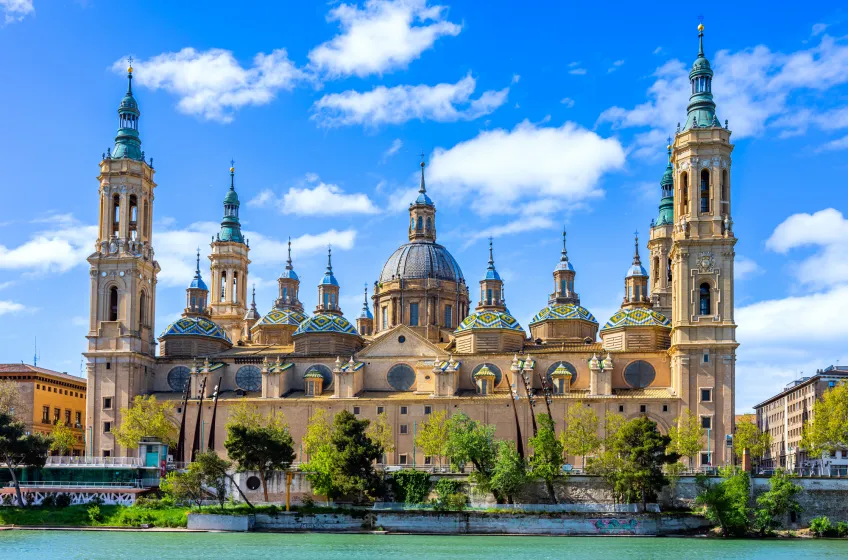
The Basilica of Our Lady of the Pillar is Zaragoza’s defining landmark.
Its enormous Baroque structure stretches along the River Ebro, with domes and towers creating one of Spain’s most impressive urban skylines. The church is an important pilgrimage destination associated with a long tradition of Marian devotion.
Inside, visitors can see richly decorated chapels, frescoes and the small sacred pillar from which the basilica takes its name. Works by Francisco de Goya are among the artistic highlights.
The interior is vast, so allow at least an hour. Religious services may affect access to some areas.
Climb a Basilica Tower
A lift and staircase may provide access to one of the basilica’s towers.
From the upper level, views extend across the domes, the River Ebro, historic centre and wider city. The perspective over the tiled roofs is particularly striking.
Access arrangements can change, so check locally before planning your visit.
Explore Plaza del Pilar
Plaza del Pilar is one of the largest pedestrian squares in Spain.
The basilica, La Seo Cathedral, town hall and several museums surround the long open space. Fountains, sculptures and public seating make it the principal gathering place in central Zaragoza.
The square is especially attractive in the evening, when the monuments are illuminated and the daytime heat has eased.
Visit La Seo Cathedral
La Seo del Salvador stands at the eastern end of Plaza del Pilar.
The cathedral displays an extraordinary mixture of Romanesque, Gothic, Mudéjar, Renaissance and Baroque styles. Its exterior Mudéjar wall is one of Zaragoza’s most distinctive architectural features.
Inside, chapels, choir stalls, tombs and religious artworks reflect centuries of rebuilding and patronage.
The atmosphere is generally quieter and more intimate than in the Basilica del Pilar.
See the Tapestry Museum
La Seo’s tapestry collection is one of the finest of its kind in Spain.
Large Flemish and European tapestries depict biblical, mythological and historical scenes in remarkable detail. Their scale, colours and craftsmanship make the museum one of Zaragoza’s most underrated attractions.
Entry arrangements may be combined with the cathedral.
Explore the Aljafería Palace
The Aljafería is Zaragoza’s most important secular monument.
Originally built as an Islamic palace, it was later adapted by Christian rulers and used for military and governmental purposes. Its horseshoe arches, ornamental plasterwork and intimate courtyards preserve the sophistication of medieval Islamic architecture in Aragón.
The Palace of the Catholic Monarchs adds Gothic and Mudéjar elements, creating a layered architectural experience.
The building remains partly in official use, so access may be restricted on certain days. Booking ahead is advisable.
Visit the Roman Forum Museum
Beneath Plaza de la Seo lie remains of the Roman forum of Caesaraugusta.
The museum explains the civic, commercial and political centre of the Roman city through archaeological remains, models and audiovisual displays.
It is best combined with Zaragoza’s other Roman museums for a broader understanding of the ancient city.
Explore the Roman Theatre
Zaragoza’s Roman theatre once held thousands of spectators.
Its surviving foundations and seating areas reveal the scale of public entertainment in Caesaraugusta. A modern museum presents finds and explains how the theatre was used and later abandoned.
The site is easy to include during a walk through the central streets.
Visit the Roman Baths Museum
The remains of Roman public baths provide insight into everyday urban life.
Although smaller than the forum or theatre, the site helps explain the social importance of bathing in Roman culture. Displays cover heating systems, changing rooms and communal activity.
It is most rewarding as part of a combined Roman itinerary.
See the Roman River Port
The River Port Museum preserves archaeological remains associated with Roman trade on the Ebro.
The river was an important transport route linking Zaragoza with wider commercial networks. Exhibits explain the movement of goods, warehouses and river activity.
The museum is compact and can be visited in under an hour.
Walk Across the Stone Bridge
The Puente de Piedra crosses the River Ebro directly opposite the Basilica del Pilar.
Walking across provides one of the classic views of Zaragoza’s skyline, particularly at sunrise or sunset. Lion sculptures mark the bridge’s approaches.
Continue onto the northern bank for a wider panorama back towards the basilica and old town.
Walk Along the River Ebro
Paths on both sides of the Ebro provide a calmer alternative to the central streets.
The riverfront includes bridges, parks, viewpoints and modern architecture. The route is mostly flat and suitable for walking or cycling.
Strong winds are common in Zaragoza, especially near exposed river sections.
Visit the Goya Museum
Francisco de Goya was born in the province of Zaragoza and remains closely associated with Aragón.
The Goya Museum presents engravings, paintings and works by artists connected with his period. It provides a useful introduction to his artistic development and influence.
Visitors particularly interested in Goya should also look for his frescoes in the Basilica del Pilar and other sites around the city.
Explore the Pablo Gargallo Museum
The Pablo Gargallo Museum occupies a Renaissance palace in the historic centre.
Gargallo was known for innovative metal sculpture and for using empty space as part of his compositions. The collection includes sculptures, drawings and studies.
The building’s courtyard and historic architecture add to the appeal.
Walk Through El Tubo
El Tubo is Zaragoza’s best-known tapas district.
Its narrow lanes are packed with bars and restaurants specialising in small dishes. Some focus on mushrooms, croquettes, seafood or grilled ingredients, while others offer more contemporary combinations.
The best approach is to move between several bars and order one or two dishes in each.
Evenings and weekends are busiest.
Explore the Central Market
The Mercado Central stands close to the old Roman walls.
Its elegant market building contains stalls selling meat, fish, vegetables, cheese and regional food products. It is one of the best places to understand everyday food culture in Zaragoza.
Visit in the morning for the greatest activity.
See the Roman Walls
Sections of Zaragoza’s Roman walls survive near the Central Market and Plaza del Pilar.
The remains are relatively modest but provide a visible link with Caesaraugusta. A nearby monument to Emperor Augustus reinforces the city’s Roman identity.
This stop takes only a few minutes and fits easily into an old-town walk.
Visit the Church of San Pablo
San Pablo is one of Zaragoza’s finest Mudéjar churches.
Its brick tower is richly decorated with geometric patterns and reflects the distinctive architectural tradition of Aragón. The interior contains chapels, altarpieces and religious art.
The surrounding neighbourhood feels less tourist-oriented than Plaza del Pilar.
See the Church of Santa María Magdalena
Santa María Magdalena has one of Zaragoza’s most impressive Mudéjar towers.
Brickwork, glazed ceramics and geometric detail decorate the exterior. The church stands in a lively central district with bars and local shops.
Even when the interior is closed, the tower is worth seeing.
Visit the Church of San Gil Abad
San Gil is another important Mudéjar church in the centre.
Its compact brick tower and medieval structure are partly hidden among later buildings. The church demonstrates how Mudéjar architecture forms part of Zaragoza’s ordinary streetscape rather than appearing only in grand monuments.
Explore the Patio de la Infanta
The Patio de la Infanta is an elaborate Renaissance courtyard preserved within a modern building.
Its sculpted columns, mythological figures and decorative stonework create an unusually rich interior space. The courtyard originally belonged to a noble palace that was later dismantled and reconstructed.
Access may depend on exhibitions or cultural programming.
Visit the IAACC Pablo Serrano
The Aragonese Institute of Contemporary Art and Culture is housed in a bold modern building.
Its exhibitions focus on contemporary art, including work by Aragonese sculptor Pablo Serrano. Rooftop or elevated spaces may provide city views.
The programme changes regularly.
Walk Through Parque Grande José Antonio Labordeta
This large park south of the centre provides gardens, fountains, monuments and broad avenues.
It is popular with walkers, runners and families. Elevated sections and stairways offer views back towards the city.
The park is especially pleasant in spring and early autumn.
Practical Advice for Visitors
Getting There
Zaragoza is one of Spain’s best-connected inland cities.
High-speed trains link it with Madrid and Barcelona, with many journeys taking around an hour and a half or less. Direct services also connect with other major cities.
The main station, Zaragoza-Delicias, lies west of the centre. Buses, taxis and local transport connect it with Plaza del Pilar and central hotels.
Zaragoza Airport has a limited passenger route network, so Madrid or Barcelona may be more practical international gateways.
Getting Around
Central Zaragoza is compact and easy to explore on foot.
The Basilica del Pilar, La Seo, Roman sites, El Tubo and several museums are close together. The Aljafería Palace is farther west but still reachable by a longer walk, tram or bus.
The city has buses, a tram line and cycle routes.
Parking
Driving in the historic centre is unnecessary.
Pedestrian streets, one-way systems and restricted access make central driving inconvenient. Public garages are available near Plaza del Pilar, the market and shopping districts.
Parking at your hotel or near the edge of the centre is the easiest option.
Choosing Where to Stay
The area around Plaza del Pilar is ideal for first-time visitors and evening walks.
The historic centre near El Tubo suits travellers prioritising tapas and nightlife, though it can be noisy.
Accommodation around Paseo de la Independencia offers modern hotels, shopping and excellent transport.
Properties near Delicias station are convenient for early trains but less atmospheric.
Dining
Aragonese food is hearty and influenced by both the mountains and the Ebro Valley.
Roast lamb, pork, vegetables, pulses and cured meat appear frequently. Zaragoza also has a strong tapas scene, particularly in El Tubo and nearby central streets.
Lunch generally begins after 1.30pm, while dinner commonly starts after 8.30pm.
Reservations are useful for popular restaurants on Friday and Saturday.
Try Ternasco de Aragón
Ternasco de Aragón is one of the region’s best-known dishes.
This young lamb is commonly roasted with potatoes or cooked on the grill. Good versions are tender, rich and simply seasoned.
It is often served as a substantial main course and is particularly popular for Sunday lunch.
Taste Migas Aragonesas
Migas are made from breadcrumbs cooked with olive oil, garlic and various additions.
Aragonese versions may include sausage, bacon, grapes or a fried egg. Traditionally a rural dish, it is now served in many regional restaurants.
It is filling and best enjoyed in cooler weather.
Try Borrajas
Borage is a popular vegetable in Aragón.
The tender stalks are often cooked with potatoes, olive oil, garlic or ham. The flavour is mild, and the dish provides a lighter alternative to roast meat.
It may appear only when in season.
Eat Tapas in El Tubo
El Tubo is the easiest place to sample a variety of local and modern tapas.
Some bars are famous for a single speciality, so look at what other customers are ordering. Mushrooms, fried seafood, croquettes and small meat dishes are common.
Order modestly at each stop and continue to another bar.
Drink Regional Wine
Aragón has several notable wine regions.
Cariñena and Campo de Borja are known for robust reds, often based on Garnacha. Calatayud also produces powerful high-altitude wines, while Somontano offers a broader range of styles.
Many Zaragoza bars serve regional wines by the glass.
Shopping
Typical purchases include wine, olive oil, preserved vegetables, cured meat and regional sweets.
The Central Market is best for food products, while Calle Alfonso and Paseo de la Independencia contain major shops.
Specialist stores may sell ceramics and decorative items inspired by Mudéjar design.
Most ordinary shops close on Sundays.
Weather
Zaragoza has a dry continental climate.
Summers are hot, bright and often intensely sunny. Winter can be cold, while spring and autumn are generally more comfortable.
The cierzo, a strong north-westerly wind, is one of the city’s most distinctive weather features. It can make cool days feel much colder and can be surprisingly powerful near the river.
When to Visit
April to June is excellent for sightseeing, outdoor dining and mild temperatures.
September and October are also attractive, although major festival periods bring larger crowds.
July and August can be extremely hot. Plan outdoor sightseeing for morning and evening, and use museums during the afternoon.
Winter is quieter and often good value, but wind and low temperatures require warm clothing.
Local Events
The Fiestas del Pilar are Zaragoza’s principal annual celebrations.
The festival includes religious events, concerts, flower offerings, street performances and public gatherings. Accommodation fills quickly, and the city centre becomes extremely busy.
Holy Week brings processions and traditional drumming.
Cultural, food and music events take place throughout the year.
Dates and programmes vary annually, so check current arrangements before planning around a particular event.
Safety and Common Visitor Problems
Zaragoza is generally safe and straightforward to explore.
Pickpocketing is possible around crowded festivals, transport stations and major attractions, so keep valuables secure.
Summer heat and dehydration are common practical concerns. Carry water and seek shade during the afternoon.
The cierzo can make cycling, riverside walking and exposed viewpoints uncomfortable.
Exploring Beyond Zaragoza
Belchite preserves the haunting ruins of a town destroyed during the Spanish Civil War. Access arrangements may require an organised visit.
The Monasterio de Piedra combines a historic monastery with waterfalls, gardens and walking routes.
Tarazona has a richly decorated cathedral, Mudéjar architecture and a distinctive historic centre.
Calatayud offers Mudéjar monuments and access to nearby wine country.
Fuendetodos is the birthplace of Francisco de Goya and has museums connected with the artist.
Huesca provides access to the Pyrenees and has a compact historic centre.
The Bardenas Reales in neighbouring Navarre offers a dramatic semi-desert landscape of eroded cliffs and ravines.
Shortlist
- Your Shortlist is empty