
Discover Valencia | A Visitor's Introduction to Valencia
Recommended places to stay, places to visit and things to do in and near Valencia
Valencia is a vibrant Mediterranean city on Spain’s eastern coast, where a compact historic centre meets futuristic architecture, long sandy beaches and one of the country’s strongest food cultures. Known for paella, the City of Arts and Sciences, the vast Turia Gardens and colourful neighbourhood festivals, this lively city is a perfect destination for families, foodies, architecture lovers and travellers seeking culture alongside the sea. With Gothic landmarks, modern museums, relaxed plazas and easy access to the Albufera wetlands, Valencia offers an appealing alternative to Barcelona or Madrid.
Browse Valencia Hotels and Other Accommodation
Pre-book Valencia Activities, Tours and Experiences
Why is Valencia Worth a Visit?
Valencia is worth visiting because it combines several very different experiences within one manageable city. Visitors can explore medieval streets in the morning, cycle through a former riverbed after lunch and finish the day beside the Mediterranean.
The historic centre contains Roman, Islamic, Gothic and Baroque layers. Valencia Cathedral, the Silk Exchange and the Central Market are the principal monuments, while districts such as El Carmen reveal fragments of the old walls, street art and traditional houses.
Valencia’s modern identity is equally distinctive. The City of Arts and Sciences forms a spectacular group of white, sculptural buildings beside the Turia Gardens. Its museums, aquarium and performance spaces are among the city’s biggest attractions.
Food is another major reason to visit. Valencia is the birthplace of paella, and rice remains central to local cooking. The surrounding huerta farmland supplies vegetables, while the nearby Albufera lagoon supports traditional rice cultivation.
Three full days are enough for the main attractions, but four or five allow time for beaches, neighbourhoods and an excursion to the Albufera.
Valencia Highlights: Things to See and Do in Valencia
Explore the City of Arts and Sciences
The City of Arts and Sciences is Valencia’s defining modern landmark.
Designed principally by Santiago Calatrava and Félix Candela, the complex features sweeping white structures, shallow pools and futuristic forms. Even visitors who do not enter the attractions should allow time to walk around the site.
The buildings include a science museum, planetarium, opera house, events venue and aquarium. The complex is particularly photogenic in the early morning and around sunset.
Distances between buildings are greater than they first appear, so wear comfortable shoes.
Visit Oceanogràfic
Oceanogràfic is one of Europe’s largest aquarium complexes.
Its themed environments represent Mediterranean, tropical, polar and deep-sea ecosystems. Sharks, rays, penguins, sea lions and many other marine species are displayed across indoor and outdoor areas.
It is a major family attraction and can take at least half a day. Arrive early during weekends and school holidays.
Animal displays may not appeal to every visitor, so consider your own views before booking.
Explore the Science Museum
The Museu de les Ciències occupies one of the City of Arts and Sciences’ most recognisable buildings.
Interactive displays cover technology, physics, space, biology and the human body. The museum is particularly suitable for families and school-age children.
The exhibitions vary in quality and may change over time, but the architecture alone is impressive.
Walk Through the Turia Gardens
The Turia Gardens form a long green corridor through Valencia.
Created in the former bed of the River Turia after the river was diverted, the park stretches for several kilometres through the city. Paths, sports areas, playgrounds, gardens and bridges connect many major neighbourhoods.
Cycling is one of the best ways to explore the full route. Walkers should remain aware of fast-moving bicycles on shared sections.
The gardens link the historic centre with the City of Arts and Sciences and continue towards the coast.
Visit Valencia Cathedral
Valencia Cathedral stands at the heart of the historic centre.
The building combines Gothic, Romanesque, Renaissance and Baroque elements. Inside are chapels, religious artworks and a cup traditionally claimed to be the Holy Grail.
Whether or not visitors accept the cup’s historical identification, the chapel and surrounding traditions are an important part of Valencia’s religious heritage.
The cathedral remains active, so services may affect access.
Climb El Miguelete
El Miguelete, or Micalet, is the cathedral’s octagonal bell tower.
A spiral staircase leads to an open terrace with panoramic views over the old town, tiled domes and wider city. The climb is steep and involves many steps.
There is no convenient alternative for visitors unable to manage the staircase, but the view is one of the best in central Valencia.
Visit the Silk Exchange
La Lonja de la Seda is one of Valencia’s finest Gothic buildings.
Constructed during the city’s commercial golden age, it reflects Valencia’s importance in Mediterranean trade. The main hall is supported by elegant twisted columns that resemble stone palm trees.
The courtyard, tower and Consulate of the Sea complete the complex.
It stands directly opposite the Central Market and is easy to combine with a morning food visit.
Explore Valencia Central Market
Valencia’s Central Market occupies a beautiful modernist building filled with stained glass, decorative tiles and an enormous iron dome.
Inside, stalls sell fruit, vegetables, meat, cheese, fish, spices and regional products. The market reflects Valencia’s connection with the surrounding agricultural plain and Mediterranean coast.
Visit in the morning, as many stalls close by early afternoon. Saturdays are particularly lively.
Walk Through El Carmen
El Carmen is one of Valencia’s most atmospheric historic neighbourhoods.
Its lanes contain medieval buildings, street art, bars, small galleries and fragments of the old city walls. The district is lively at night but also rewarding during the day.
Plaça del Tossal and streets around the Serranos and Quart towers are useful starting points.
Some streets become noisy late at night, particularly at weekends.
Climb the Serranos Towers
The Torres de Serranos formed one of the principal gateways through Valencia’s medieval walls.
Their broad stone towers overlook the Turia Gardens and northern side of the historic centre. Visitors can climb to the upper terraces for views over the city.
The stairs and open edges require care, particularly with young children.
Visit the Quart Towers
The Torres de Quart are another surviving medieval gateway.
Their thick walls still bear marks associated with past military attacks. The towers feel heavier and more defensive than the elegant Serranos gateway.
Climbing them provides a good perspective over the western side of the old city.
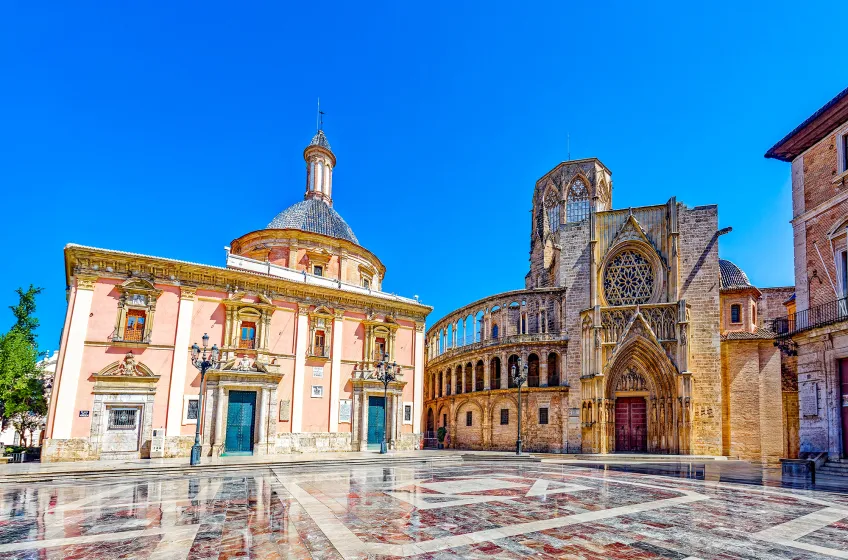
Explore Plaza de la Virgen
Plaza de la Virgen is one of Valencia’s most attractive central squares.
The cathedral, Basilica of the Virgin and regional government buildings surround the open space. A large fountain refers to the River Turia and its irrigation channels.
The square is lively throughout the day and especially pleasant in the evening when the façades are illuminated.
Visit the Basilica of the Virgin
The Basilica of the Virgin of the Forsaken stands beside Valencia Cathedral.
It is an important place of local devotion and plays a central role in religious festivals. The Baroque interior contains frescoes, chapels and the revered image of the Virgin.
Visitors should remain respectful during services and private prayer.
Explore the Almoina Archaeological Centre
The Almoina centre preserves archaeological remains beneath the historic city.
Walkways pass above Roman streets, baths, buildings and later structures. The museum explains how Valencia developed through Roman, Visigothic and Islamic periods.
It is one of the best places to understand the city beneath the visible Gothic centre.
Visit the National Ceramics Museum
The National Ceramics Museum occupies the ornate Palace of the Marqués de Dos Aguas.
Its Baroque entrance is one of Valencia’s most elaborate façades. Inside, rooms contain decorative arts, ceramics, furniture and historic interiors.
The building is as important as the collection and provides an excellent contrast with the city’s Gothic monuments.
Explore the Fine Arts Museum
The Museum of Fine Arts of Valencia contains an important collection of Spanish and Valencian painting.
Works by artists including Sorolla and other regional figures appear alongside religious art and sculpture. The galleries are generally calmer than the city’s main tourist attractions.
It stands near the Turia Gardens and can be combined with the Serranos Towers.
Visit the Sorolla Centre and Related Collections
Valencian painter Joaquín Sorolla is closely associated with the city and Mediterranean light.
Works by Sorolla appear in several local collections and temporary exhibitions. His beach scenes and portraits provide a useful artistic perspective on Valencia’s landscape and culture.
Exhibition locations may vary, so check current museum programmes before planning a specialist visit.
Explore Ruzafa
Ruzafa is one of Valencia’s liveliest modern neighbourhoods.
Independent cafés, restaurants, bars and shops fill streets around its traditional market. The area combines older residential architecture with a strong creative and international food scene.
It is particularly popular for brunch, dinner and evening drinks.
Visit Cabanyal
El Cabanyal is a historic maritime district near the beach.
Colourful tiled façades, narrow houses and traditional street patterns reflect its fishing-community origins. The neighbourhood has undergone rapid change, but much of its distinctive architecture survives.
Explore during the day and combine the visit with the nearby beach or marina.
Relax on Malvarrosa Beach
Malvarrosa is Valencia’s best-known urban beach.
The broad sandy shore is backed by a long promenade with restaurants, cafés and sports facilities. It is easy to reach by tram or bus from the centre.
The beach becomes crowded in summer, especially at weekends. Early morning and evening are quieter.
Observe lifeguard flags and do not leave valuables unattended.
Visit Patacona Beach
Patacona lies immediately north of Malvarrosa.
It has a similar broad beach but often feels slightly calmer and more residential. The promenade contains cafés and restaurants popular for breakfast and evening drinks.
The distinction between the two beaches is subtle, and they can easily be visited on the same walk.
Explore Valencia Marina
The marina area contains restaurants, event spaces and modern buildings beside the harbour.
It developed significantly around major sailing events and now serves as a leisure district. The waterfront is particularly pleasant around sunset.
Parts of the port remain industrial or functional, so not every section is scenic.
Discover the Albufera
The Albufera is a freshwater lagoon and wetland south of Valencia.
Rice fields, reed beds, traditional boats and birdlife create a landscape very different from the city. Boat trips provide views across the lagoon, especially around sunset.
The surrounding villages are closely associated with paella and other rice dishes.
Public buses reach parts of the area, but a car, taxi or organised excursion provides greater flexibility.
Visit El Palmar
El Palmar is a small settlement within the Albufera area.
It is known for restaurants specialising in paella, all i pebre and other rice or eel dishes. The village makes a good base for a lagoon boat trip and traditional lunch.
Reserve ahead at popular restaurants during weekends.
Explore Bioparc Valencia
Bioparc is a modern zoo at the western end of the Turia Gardens.
Its design attempts to create open landscapes with fewer visible barriers between visitors and animals. African habitats form the main focus.
It is a major family attraction, though visitors may wish to consider their personal views about zoos before attending.
Practical Advice for Visitors
Getting There
Valencia Airport lies west of the city.
Metro services, buses and taxis connect the airport with the centre. The journey is generally straightforward, though late-night public transport is more limited.
High-speed trains connect Valencia with Madrid, while other rail services link the city with Barcelona, Alicante, Castellón and destinations throughout Spain.
Long-distance trains usually arrive at Joaquín Sorolla station, while local and regional services use Estació del Nord. A shuttle or short transfer may connect the two depending on current arrangements.
Getting Around
Valencia is relatively flat and easy to explore.
Metro, tram and bus services cover most districts, including the airport and beaches. Walking works well in the historic centre, while cycling is ideal for the Turia Gardens and waterfront.
Cycle lanes are widespread, so pedestrians should look carefully before crossing them.
Transport fares and ticket types may change, so check current options after arrival.
Parking
Driving in central Valencia is unnecessary.
The historic centre contains restricted streets, pedestrian areas and limited parking. Public garages are available, but daily costs can be high.
A car is more useful for rural excursions than for city sightseeing.
Choosing Where to Stay
Ciutat Vella is best for first-time visitors who want historic atmosphere and easy access to the main sights.
Ruzafa offers restaurants, nightlife and a more contemporary neighbourhood feel. The area around Colón and the Eixample is central, polished and convenient for shopping.
Cabanyal and Malvarrosa suit travellers prioritising the beach, although they are farther from the principal monuments.
Rooms in nightlife districts can be noisy, so check reviews carefully.
Dining
Valencian cooking is built around rice, vegetables, seafood and produce from the surrounding huerta.
Traditional restaurants often specialise in one or two rice dishes. Many require advance ordering because paella is cooked from scratch.
Lunch usually begins after 1.30pm and is the traditional time for eating paella. Dinner commonly starts after 8.30pm.
Avoid restaurants displaying dozens of brightly photographed paellas unless quality is clearly established.
Try Paella Valenciana
Authentic paella Valenciana is traditionally made with rice, chicken, rabbit, green beans and large local white beans. Snails may also appear.
Seafood paella is popular but is a different dish rather than the original local version.
Paella is usually cooked in a broad pan and intended for sharing. The crisp layer of rice at the bottom, known as socarrat, is particularly prized.
The best versions are often found outside the most tourist-heavy streets and around the Albufera.
Try Arroz a Banda
Arroz a banda is a seafood-based rice dish cooked in a concentrated fish stock.
The fish was traditionally served separately, though modern restaurant versions vary. The rice usually has a deep savoury flavour and may be accompanied by allioli.
It is an excellent alternative for visitors who prefer seafood to meat.
Taste Fideuà
Fideuà resembles a seafood paella but uses short noodles instead of rice.
It originated farther south along the Valencian coast and is commonly served with fish, shellfish and allioli.
Like paella, it is often prepared for at least two people.
Drink Horchata
Valencian horchata is made from tiger nuts, water and sugar.
It is pale, sweet and refreshing, particularly during hot weather. Traditional horchaterías serve it with fartons, long soft pastries designed for dipping.
Alboraya, immediately north of Valencia, is especially associated with tiger-nut cultivation and horchata production.
Try Agua de Valencia
Agua de Valencia is a cocktail made with orange juice, sparkling wine and spirits.
It is usually served in a jug and shared. The sweet citrus flavour can disguise its strength.
Drink slowly and avoid ordering it before cycling or driving.
Shopping
The streets around Colón, Don Juan de Austria and the central market form the main shopping areas.
Typical local purchases include ceramics, rice, orange products, wine, olive oil and tinned seafood.
Ruzafa and El Carmen contain independent shops, while larger brands are concentrated in the Eixample and central commercial streets.
Most ordinary shops close on Sundays.
When to Visit
March is famous for Las Fallas but brings crowds, noise and much higher accommodation prices.
April to June is excellent for warm weather, outdoor dining and beach visits before peak summer heat.
September and October are also appealing, with warm sea temperatures and a more relaxed atmosphere.
July and August are hot, humid and busy. Plan sightseeing for the morning and evening.
Winter is mild, quieter and often excellent for architecture, museums and food.
Local Events
Las Fallas is Valencia’s most famous festival.
Huge temporary sculptures are placed throughout the city before being burned during the final nights. Fireworks, marching bands, street events and loud daily firecracker displays form part of the celebration.
The festival is visually spectacular but extremely noisy and crowded. Ear protection is useful, especially for children.
Other major events include religious celebrations, maritime festivals and neighbourhood fiestas.
Dates and programmes vary annually, so check current arrangements before planning around a specific event.
Safety and Common Visitor Problems
Valencia is generally safe, but pickpocketing can occur around markets, festivals, stations and crowded beaches.
Keep bags closed and valuables secure. Do not leave phones or wallets on café tables near busy pedestrian routes.
Summer heat is a significant practical concern. Carry water, seek shade and avoid strenuous outdoor activity during the hottest part of the day.
Take care when crossing cycle lanes, particularly in the Turia Gardens and central districts.
Exploring Beyond Valencia
The Albufera is the easiest excursion for wetlands, rice fields, boat trips and traditional paella.
Xàtiva has a spectacular hilltop castle and an attractive historic centre.
Sagunto preserves a Roman theatre, castle and old Jewish quarter.
Requena is known for wine cellars, historic streets and nearby vineyards.
Cullera combines beaches, a hilltop castle and coastal views.
Peñíscola has a dramatic seaside fortress and whitewashed old town farther north.
Alicante is an easy onward destination for beaches, a hilltop castle and a lively waterfront.
Shortlist
- Your Shortlist is empty