
Discover Innsbruck | A Visitor's Introduction to Innsbruck
Recommended places to visit, places to stay and things to do in and around Innsbruck
Innsbruck is the capital of Tyrol, positioned in the broad Inn Valley between the Nordkette and the mountains of the Central Alps. Known for its colourful medieval centre, Habsburg heritage and exceptional access to high-altitude scenery, this compact city is a perfect destination for architecture enthusiasts, active travellers and winter-sports lovers. With cable cars beginning close to the old town, Innsbruck offers one of Europe’s most distinctive combinations of urban culture and Alpine adventure.
Recommended Innsbruck hotels and other accommodation
Pre-book Innsbruck Attractions, Tours & Experiences
Why is Innsbruck Worth a Visit?
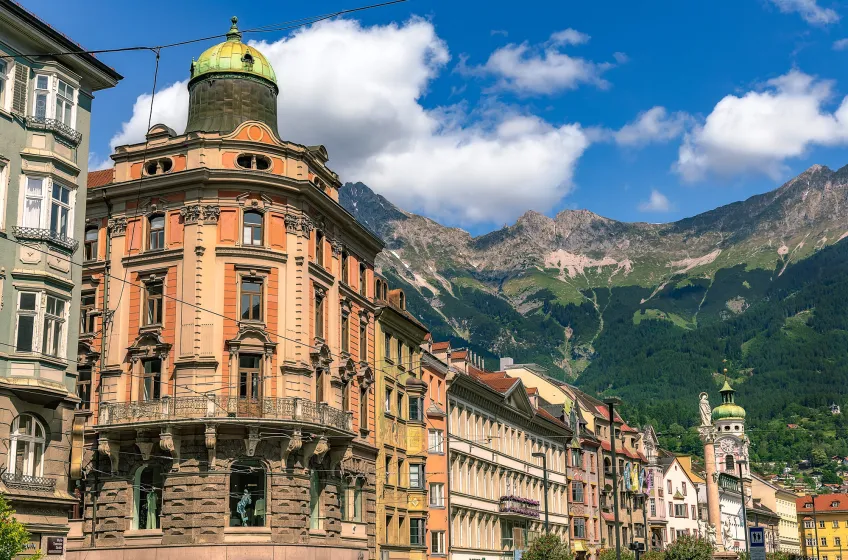
Innsbruck is worth visiting because the mountains are an integral part of the city rather than a distant backdrop. From the historic centre, you can travel by funicular and cable car to the Nordkette, reaching high Alpine terrain in remarkably little time.
The city also has considerable historical depth. Innsbruck became an important Habsburg residence, leaving landmarks such as the Imperial Palace, Court Church and Golden Roof. Ambras Castle adds Renaissance collections, ceremonial armour and one of Austria’s most impressive historic halls.
Despite its international reputation for skiing, Innsbruck works throughout the year. Summer brings hiking, cycling and mountain excursions, while museums, cafés and imperial attractions provide plenty to do during poor weather.
Two full days are enough for the principal city sights and one mountain journey. Three or four nights allow time for Ambras Castle, nearby villages and excursions into the Stubai Valley, Seefeld or Achensee.
Innsbruck Highlights: Things to See and Do in Innsbruck
Golden Roof
The Golden Roof, or Goldenes Dachl, is Innsbruck’s best-known landmark. It projects from the façade of a late-medieval building in the heart of the old town.
Its roof is covered with thousands of gilded copper tiles and was created for Emperor Maximilian I. The decorated balcony allowed the imperial court to observe celebrations and public events in the square below.
A small museum inside explores Maximilian’s reign, political ambitions and influence on Innsbruck. The exterior is most attractive during the morning, when the narrow square is quieter.
Innsbruck Old Town
Innsbruck’s historic centre is compact, colourful and easy to explore on foot. Tall houses with painted façades and decorative bay windows line streets beneath the Nordkette mountains.
Maria-Theresien-Strasse forms the grand approach to the old town, passing Baroque buildings, cafés and the ornate St Anne’s Column. Farther north, Herzog-Friedrich-Strasse leads towards the Golden Roof.
Look beyond the principal streets into courtyards and narrow passages. The old town is especially atmospheric during early morning and after dark, when day visitors have left.
Nordkette
The Nordkette is Innsbruck’s defining mountain attraction. A journey beginning near the old town uses the Hungerburg funicular and connecting cable cars to climb above the city towards Seegrube and Hafelekar.
The upper stations provide dramatic views across Innsbruck and towards the Central Alps. Short paths near the stations offer accessible viewpoints, while longer routes enter steep and exposed mountain terrain.
Check live summit conditions before buying a ticket. Cloud can hide the panorama even when the city centre is sunny, and temperatures at the top may be considerably lower.
Wear proper shoes and carry an additional layer. Cable-car access makes the mountain easy to reach but does not make the surrounding trails risk-free.
Imperial Palace
The Imperial Palace, or Hofburg, reflects Innsbruck’s importance as a Habsburg residence.
Its grand state rooms include the Giant Hall, decorated with portraits of Maria Theresa and her family. Further rooms explore court life, imperial ceremonies and the palace’s changing architectural styles.
The building is less extensive than Vienna’s Hofburg but easier to appreciate during a single visit. Allow around 90 minutes.
Court Church
The Court Church contains the elaborate memorial of Emperor Maximilian I.
Although Maximilian is not buried here, his large empty tomb is surrounded by 28 bronze figures representing ancestors, relatives, saints and heroic rulers. These dark, larger-than-life statues create one of Austria’s most memorable church interiors.
The adjacent Tyrolean Folk Art Museum can often be visited on the same ticket. Together, the two attractions provide valuable insight into imperial and regional history.
City Tower
The City Tower rises beside the Golden Roof and once served as a watchtower.
A staircase leads to a viewing platform above the old town. From here, visitors can see the tiled roofs, River Inn and surrounding mountain walls.
The tower is much lower than the Nordkette viewpoints but provides a better perspective on the city’s architecture. The climb involves numerous steps and narrow sections.
Ambras Castle
Ambras Castle stands on a wooded hillside south-east of the centre and is one of Innsbruck’s strongest cultural attractions.
Archduke Ferdinand II developed it as a Renaissance residence and a setting for his collections. Highlights include historic armouries, the Chamber of Art and Curiosities and the long Spanish Hall, decorated with portraits of Tyrolean rulers.
The extensive grounds contain formal gardens, woodland and roaming peacocks. Allow at least half a day when combining the interiors and park.
Public transport reaches the surrounding area, although the final approach may involve an uphill walk.
Bergisel Ski Jump
The Bergisel Ski Jump stands on a hill south of central Innsbruck and is associated with international ski-jumping competitions.
Its modern tower was designed by architect Zaha Hadid. A lift and short staircase lead to an elevated viewing area overlooking the landing slope, city and mountains.
The site also has historical importance as the setting of battles connected with Tyrolean resistance leader Andreas Hofer. The nearby Tirol Panorama museum explores this history through an enormous panoramic painting.
Competition preparations and sporting events can affect access, so check before travelling.
Tirol Panorama
The Tirol Panorama museum is built around a vast circular painting depicting the Battle of Bergisel in 1809.
The immersive artwork surrounds the visitor and presents the conflict from a strongly Tyrolean perspective. Exhibitions explain the uprising, regional identity and the role of Andreas Hofer.
An underground connection leads to the Kaiserjäger Museum, which covers Tyrolean military history.
The museum combines well with the Bergisel Ski Jump and surrounding walking paths.
Tyrolean Folk Art Museum
The Tyrolean Folk Art Museum contains one of Austria’s most important collections devoted to regional culture.
Displays include traditional clothing, painted furniture, religious objects, masks, tools and reconstructed wood-panelled rooms from different valleys.
The museum is especially useful for visitors travelling beyond Innsbruck, as it explains customs and design traditions still visible in Tyrolean villages.
It stands beside the Court Church and can easily be included in the same visit.
Innsbruck Cathedral
Innsbruck Cathedral, dedicated to St James, is a richly decorated Baroque church close to the old town.
Its interior contains ceiling frescoes, decorative plasterwork and a revered image of the Virgin Mary by Lucas Cranach the Elder. The tomb of Archduke Maximilian III is another important feature.
The cathedral remains an active place of worship. Sightseeing may be restricted during services, concerts and religious ceremonies.
River Inn and Colourful Houses
One of Innsbruck’s most recognisable views looks across the River Inn towards a row of colourful houses, with the Nordkette rising behind them.
The best-known perspective is from the bridges and paths near Marktplatz. Morning often provides clearer mountain light, while late afternoon illuminates the painted façades.
Riverside paths are useful for walking or cycling beyond the centre. Remain aware of fast-moving bicycles on shared routes.
Alpine Zoo
Alpenzoo occupies a hillside above Innsbruck and specialises in animals native to the Alpine region.
Its collection includes ibex, bears, lynx, eagles, otters and other species adapted to mountain environments. The steep site reflects the animals’ natural habitats but involves considerable uphill walking.
The zoo can be reached from Hungerburg or as a stop on the Nordkette funicular route. It is particularly suitable for families and visitors wanting a half-day attraction outside the old town.
Patscherkofel
Patscherkofel rises south of Innsbruck and offers a gentler contrast to the rocky Nordkette.
A cable car climbs from Igls to high walking routes, mountain restaurants and viewpoints. The Zirbenweg, or Stone Pine Trail, is a popular elevated path through ancient pine woodland.
Although the trail is not technically difficult, it remains a mountain route with uneven surfaces and changing weather. Check the operating times of connecting lifts and buses before setting out.
Practical Advice for Visitors
Getting There
Innsbruck has direct rail connections with Vienna, Salzburg, Munich, Zurich and several destinations in northern Italy. Its central position on the main east–west Alpine railway makes it particularly convenient for a car-free holiday.
Innsbruck Hauptbahnhof is around 10 to 15 minutes on foot from the old town. Trams and buses leave from outside the station.
Innsbruck Airport lies close to the western edge of the city. A local bus normally reaches the centre in around 20 minutes, depending on traffic.
Munich Airport offers a much broader flight network but requires a longer onward train or road journey.
Getting Around
The historic centre is compact and best explored on foot.
Trams and buses serve Ambras Castle, Bergisel, Igls, the airport and surrounding residential districts. The Hungerburg funicular begins close to the old town and connects with the Nordkette cable cars.
Visitors staying at participating accommodation may receive a regional guest card that includes or discounts public transport and selected attractions. Conditions depend on the property, length of stay and current scheme.
Check the final bus or cable-car departure when visiting mountain areas. Evening services are less frequent than daytime connections.
Parking
A car is unnecessary for the central sights and most popular mountain excursions.
Central garages are available near the old town, railway station and Congress area, but daily charges can be high. Street parking is controlled by payment zones, time restrictions and resident spaces.
Park-and-ride facilities provide a less stressful option for day visitors. Leave the vehicle outside the centre and continue by tram or bus.
Hotel parking is not always included in the room price, so confirm the charge and vehicle-height restrictions before arrival.
Dining
Tyrolean cooking is hearty and well suited to a mountain climate.
Try Tiroler Gröstl, a pan-fried combination of potatoes, onion and meat usually topped with an egg. Other favourites include cheese dumplings, bacon dumplings, Kasspatzln and schnitzel.
Tyrolean speck is a cured ham commonly served with mountain cheese, pickles and dark bread. Mountain huts offer filling dishes such as dumpling soup and Kaiserschmarrn.
Traditional restaurants are concentrated around the old town, while the university district and streets outside the centre offer more affordable international choices.
Reserve dinner on Friday and Saturday evenings, particularly during ski season and major events.
Shopping
Maria-Theresien-Strasse and the old-town lanes contain the principal shopping area.
Typical purchases include Tyrolean speck, mountain cheese, schnapps, honey, herbal products and outdoor clothing.
The historic centre also has shops selling traditional garments such as Dirndl dresses and Lederhosen. Quality and local production vary considerably, so check labels before buying expensive items.
Most ordinary shops close on Sundays, apart from selected railway-station, bakery and tourist businesses.
When to Visit
May, June and September are excellent for combining city sightseeing with lower-level walking. Conditions are usually milder than in high summer, though mountain snow may remain.
July and August offer the fullest cable-car and hiking programme. They also bring heat, thunderstorms and larger visitor numbers.
Late September and October can provide clear mountain views and autumn colour. Some cable cars and mountain restaurants begin reducing their schedules.
December to March is the main winter-sports period. Innsbruck itself may have little snow even when surrounding ski areas have good conditions.
April, May, October and November can be transition periods, with selected lifts and mountain businesses closed for maintenance.
Local Events
The Innsbruck Christmas markets take place at several locations, including the old town, Maria-Theresien-Strasse and Hungerburg. Each has a different atmosphere, from traditional stalls to elevated city views.
The Four Hills Tournament brings international ski jumping to Bergisel around the beginning of January.
Summer festivals and outdoor concerts bring music and performance to public spaces during the warmer months.
The Innsbruck Festival of Early Music presents opera and concerts in historic venues.
Sporting events, trail-running competitions and cycling races may affect mountain access and accommodation demand. Confirm dates before making non-refundable arrangements.
Exploring Beyond Innsbruck
Hall in Tirol lies east of Innsbruck and has a beautifully preserved medieval centre, old mint and quieter streets than the regional capital.
Swarovski Crystal Worlds at Wattens combines gardens, installations and elaborate displays centred on crystal design.
Seefeld occupies a high plateau north-west of Innsbruck and is known for walking, cross-country skiing and an attractive pedestrian centre.
The Stubai Valley offers waterfalls, mountain villages, cable cars and access to the Stubai Glacier. Regular buses make it practical without a car.
Achensee is Tyrol’s largest lake and offers boats, swimming, mountain lifts and lakeside walking.
Mittenwald in Germany has painted façades, violin-making traditions and direct rail connections through the mountain landscape.
Bolzano in northern Italy can be reached by direct train through the Brenner Pass, making it possible to combine Tyrolean and South Tyrolean culture in one journey.
Shortlist
- Your Shortlist is empty