
Discover Metz | A Visitor's Introduction to Metz
Recommended places to visit, places to stay and things to do in and around Metz
Metz, the capital of the Moselle department in the Grand Est region of north-eastern France, is one of the country’s most elegant and underrated cities. Sitting proudly at the confluence of the Moselle and Seille rivers, Metz (pronounced “mess”) is a city that effortlessly blends Gothic grandeur, Germanic influences, green spaces, and cutting-edge contemporary art. Known for its golden Jaumont stone, world-class museums, and easy-going atmosphere, Metz is a destination that offers rich history and modern vibrancy in equal measure.
Recommended Metz accommodation: Hotels
Why is Metz Worth a Visit?
Metz is worth visiting for its astonishing cathedral, charming old town, and innovative art scene. It boasts a rich 3,000-year history, having been a Roman city, a Merovingian capital, a Free Imperial City of the Holy Roman Empire, and part of both France and Germany at different times. That unique heritage has left a visible mark in Metz’s architecture and identity.
Yet Metz is also a forward-looking city—home to the satellite Centre Pompidou-Metz, one of France’s most exciting spaces for contemporary art. With its lush parks, riverside walks, lively cafés and festivals, Metz offers a balance of culture and relaxation that makes it feel both lived-in and luxurious.
It’s a place that welcomes you slowly: linger in a square with a coffee, browse the morning market, lose yourself in the side streets of the imperial quarter, or take a picnic by the river. Metz is quietly unforgettable.
Metz Highlights: Things to See and Do in Metz
Cathédrale Saint-Étienne de Metz (Saint Stephen’s Cathedral)
Nicknamed the “Lantern of God”, Metz’s cathedral is a Gothic masterpiece famed for its spectacular stained-glass windows—over 6,500 square metres of them, including stunning works by Marc Chagall, Jacques Villon, and Roger Bissière.
The cathedral soars to 42 metres in height inside, with a towering nave, soaring arches, and golden Jaumont stone giving it a honey-coloured glow. Don’t miss the astronomical clock, the 16th-century portals, and the view from nearby cafés, which offer ideal angles for photographing this iconic landmark.
Centre Pompidou-Metz
Just a 10-minute walk from the train station, the Centre Pompidou-Metz is a striking modern art museum with an undulating roof inspired by a Chinese hat. Opened in 2010, it is the first satellite of Paris’s Centre Pompidou and houses rotating exhibitions of international contemporary and 20th-century art.
Its airy galleries, large-scale installations, and outdoor art spaces have made it a cultural landmark in its own right. The square outside often hosts open-air performances and temporary art exhibits.
Imperial Quarter (Quartier Impérial)
Built during the German annexation (1871–1918), the Imperial Quarter is an architectural showcase of Wilhelmine grandeur, featuring styles from Neo-Romanesque to Jugendstil (German Art Nouveau).
Wander around the area near the Gare de Metz-Ville, one of France’s most beautiful railway stations, and admire buildings like the Post Office, Palais du Gouverneur, and Temple Neuf. The mix of German precision and French flair gives the district a unique charm, especially when viewed from the leafy Avenue Foch.
Temple Neuf and Esplanade Gardens
Set on the edge of the Moselle River on Île du Petit-Saulcy, the Temple Neuf is a Romanesque Revival Protestant church that adds a dramatic silhouette to the cityscape—particularly at night when it’s lit up and reflected in the water.
Adjacent to it is the Esplanade, one of Metz’s most beautiful green spaces, with manicured lawns, fountains, sculptures, and panoramic views over the Moselle valley. It’s a lovely place for a picnic or afternoon stroll.
Musée de la Cour d’Or
This museum, housed in a series of historic buildings near the cathedral, is a treasure trove of Roman, medieval, and Renaissance artefacts. Highlights include:
-
Remains of a Roman bath complex
-
Gallo-Roman sculpture and mosaics
-
Medieval and early modern religious art
-
Reconstructions of historic rooms from Metz townhouses
It's an eclectic and quietly fascinating museum that gives you a deep sense of Metz's long and varied history.
Covered Market (Marché Couvert)
Located just behind the cathedral, Metz’s Covered Market is housed in a 19th-century neoclassical building that was originally intended to be a palace for the bishop. Today it’s filled with local producers selling cheese, charcuterie, bread, fruit, pastries, and regional wines.
Pick up Mirabelle plum tarts, Quiche Lorraine, or local cured meats for a picnic, or grab a seat at Les Terroirs de Lorraine, one of the little eateries inside the market.
Place Saint-Louis
This arcaded medieval square is one of the most atmospheric spots in Metz. Originally a centre for money changing and trade in the Middle Ages, it now houses cafés, wine bars, boutiques, and a delightful Christmas market in winter.
Its ochre facades and Italianate arches reflect the city’s importance during the Renaissance. A great place for an aperitif or morning espresso.
Fortifications and Porte des Allemands
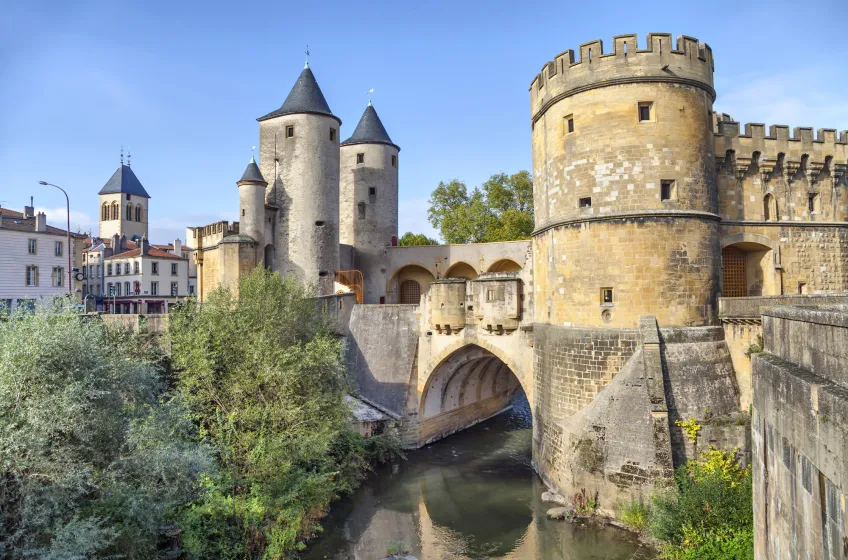
Metz’s long history as a military city is visible in its well-preserved fortifications. The most striking structure is the Porte des Allemands, a bridge-castle with twin towers that once formed part of the medieval ramparts.
You can walk along parts of the old city walls, or simply admire this impressive structure from the nearby riverside paths.
Arsenal Concert Hall
A former military building converted by architect Ricardo Bofill, the Arsenal is now a prestigious concert venue with superb acoustics. It hosts performances of classical, jazz, and contemporary music by top French and international ensembles.
Even if you’re not attending a concert, the building and surrounding Place de la République are worth visiting, especially during the summer light shows or Christmas season.
Practical Advice for Visitors
Getting There
By Train: Metz is well served by high-speed TGV trains. Travel time from Paris Gare de l'Est is around 1 hour 20 minutes, making Metz a popular weekend destination. Trains also connect to Strasbourg, Nancy, Luxembourg, and Germany.
By Car: Metz lies on the A31 and A4 motorways. It’s around 3.5 hours from Paris and 1.5 hours from Luxembourg City or Strasbourg.
By Air: The nearest airport is Metz-Nancy-Lorraine Airport (30 mins), with domestic flights. For international connections, Luxembourg Airport and Saarbrücken (Germany) are also within easy reach.
Parking
Metz has excellent parking infrastructure. Underground car parks near Place Saint-Jacques, Place Coislin, and the train station offer central access. There are also park-and-ride (P+R) options with public transport into the city centre.
Getting Around
Metz is highly walkable and has an efficient bus and rapid transit system known as LE MET’. Most attractions are within easy walking distance, and bike rentals are available if you want to explore further afield.
Dining
Metz’s culinary scene is rooted in Lorraine tradition with German and Alsatian influences. Must-try specialities include:
-
Quiche Lorraine – the classic savoury tart
-
Tarte aux Mirabelles – using the region’s golden plums
-
Pâté lorrain – a pork pastry with white wine
-
Fleischschnacka – meat-filled pasta rolls
-
Lorraine cheeses – including Munster and Tomme de Metz
Top restaurant picks:
-
La Table de Pol – modern French with seasonal ingredients
-
Les Pas Sages – small plates and natural wines
-
L’Imaginarium – inventive cuisine near the cathedral
-
Brasserie Flo Metz – classic French in a Belle Époque setting
Shopping
Metz is great for artisan shopping and local produce. Head to:
-
Rue Serpenoise for boutiques and fashion
-
Place Saint-Jacques for department stores
-
Marché Couvert for gourmet gifts
-
Maison de la Mirabelle for plum-based products
-
L’Artisan Créateur for handmade ceramics, glass, and art
When to Visit
The best time to visit Metz is between May and October, when the weather is pleasant and outdoor events fill the city’s squares and parks. July and August bring the spectacular Constellations de Metz light and art festival.
Spring sees Metz’s many gardens bloom, while autumn is ideal for wine tastings and local food festivals. In December, Metz hosts one of the largest and most atmospheric Christmas markets in eastern France, with light shows, ice rinks, and mulled wine.
Local Events
-
Constellations de Metz (June–September): Outdoor art, light shows, and exhibitions
-
Mirabelle Festival (August): Celebrating the golden plum with parades, fireworks, and food
-
Metz Est Wunderbar (May): Showcasing Franco-German friendship and culture
-
Christmas Market (late November–December): Five market zones throughout the city centre
Exploring Beyond Metz
If you're staying longer or want to explore the region:
-
Amnéville-les-Thermes (20 mins): Thermal spa, zoo, skiing, and family fun
-
Rodemack (40 mins): A “Plus Beau Village” with medieval walls
-
Thionville and Moselle Valley (30–45 mins): Vineyards and riverside walks
-
Nancy (45 mins): Another beautiful city, home to Art Nouveau and Place Stanislas
-
Verdun (1 hour): First World War history and powerful memorials
Metz is a city of beauty, contrast, and discovery—where golden Gothic towers sit alongside sleek modern museums, and where every corner reveals a trace of Roman, medieval, or Germanic influence. It's a city to explore slowly, to savour, and to remember, with a charm that grows deeper the longer you stay. Whether you come for the cathedral, the culture, the food, or simply the view across the river at sunset, Metz will surprise and inspire you.
Shortlist
- Your Shortlist is empty