
Discover Marseille | A Visitor's Introduction to Marseille
Marseille is a bold, vibrant, and endlessly fascinating city on France’s Mediterranean coast. As the country’s oldest city—founded by Greek traders over 2,600 years ago—it has long been a melting pot of cultures, flavours, and stories. Today, Marseille is the beating heart of the Bouches-du-Rhône department and the second largest city in France, offering a dynamic blend of gritty authenticity, historic landmarks, multicultural energy, and sun-drenched southern charm.
From the bustling fish markets of the Vieux-Port to the dramatic white cliffs of the Calanques and the rich flavours of bouillabaisse, Marseille invites visitors to explore a very different side of Provence—less postcard-perfect, more raw and real, and all the more rewarding for it.
Recommended Marseille Accommodation: Hotels
Why is Marseille Worth a Visit?
Marseille is worth visiting for its unique identity—a city shaped by centuries of immigration, trade, and reinvention. It's not a manicured tourist town, but a living, breathing port city with a personality as salty and bold as the sea breeze that sweeps through its streets. It’s a place where North African markets, French cafés, Le Corbusier’s modernism, and ancient Roman ruins coexist in glorious disarray.
The city has undergone a major transformation in recent years, sparked by its role as European Capital of Culture in 2013, and now boasts world-class museums, revitalised neighbourhoods, and a thriving food and arts scene. Its seaside setting is spectacular, with boat trips, beaches, and coastal hikes all within easy reach.
Whether you're looking for culture, coastline, or culinary adventure, Marseille is one of France’s most exciting and distinctive urban destinations.
Marseille Highlights: Things to See and Do in Marseille
Vieux-Port (Old Port)
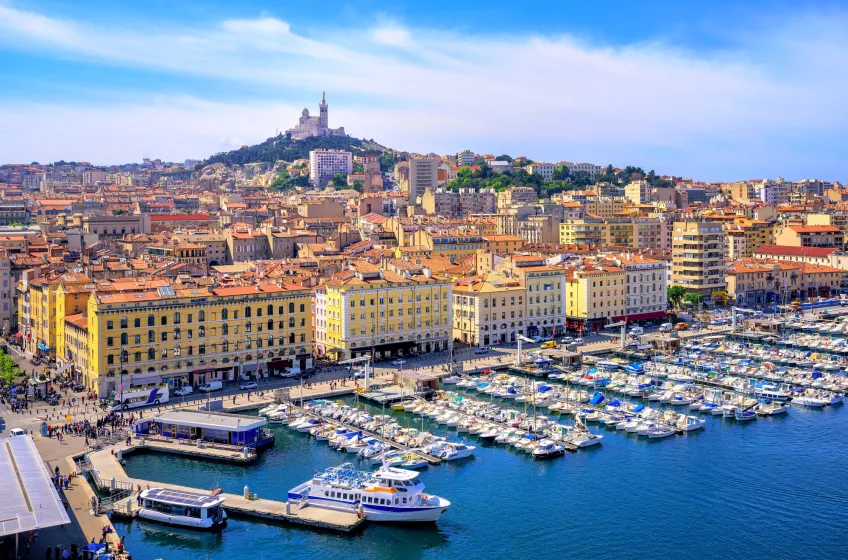
The Vieux-Port is the historic and emotional heart of Marseille. Once a key Mediterranean trading hub, it’s now a lively marina surrounded by bars, seafood restaurants, and bustling quays. Watch the fishmongers at the morning market, hop on a boat to the Calanques or Frioul Islands, or simply sip a pastis at sunset with views of Notre-Dame de la Garde on the hill above.
The modern shaded mirror canopy by architect Norman Foster adds a sleek contemporary contrast to the age-old port.
Notre-Dame de la Garde
Marseille’s most iconic landmark, Notre-Dame de la Garde is a 19th-century basilica perched high above the city. Locals call her "La Bonne Mère" (The Good Mother), and she watches protectively over Marseille from her hilltop perch. Inside, the church is richly decorated with mosaics and model boats suspended from the ceiling.
Climb the hill (or take the Petit Train or bus) for panoramic views over the city, the sea, and the mountains. It’s especially beautiful at sunrise or just before dusk.
Le Panier District
Wander the Le Panier neighbourhood—Marseille’s oldest quarter and now one of its most characterful. With narrow streets, colourful shutters, street art, and hidden squares, it’s a village within the city. Once working-class and now a haven for artisans, it’s packed with boutiques, galleries, cafés, and local charm.
Don’t miss La Vieille Charité, a beautiful 17th-century former almshouse now home to museums and exhibitions.
MuCEM (Museum of Civilisations of Europe and the Mediterranean)
Opened in 2013, MuCEM is a flagship of modern Marseille—a stunning cube of latticework set beside the sea, linked by footbridge to the historic Fort Saint-Jean. The museum explores Mediterranean history, culture, and civilisations through creative, thought-provoking exhibitions.
Even if you don’t go inside, the rooftop and outdoor spaces offer fantastic views, and the museum’s café is a scenic spot for a break.
Château d’If
A short boat ride from the Old Port takes you to Château d’If, a 16th-century island fortress turned prison. Most famously, it was immortalised as the setting of The Count of Monte Cristo by Alexandre Dumas. Walk its ramparts, learn about its history, and enjoy stunning views back towards the mainland.
The boat ride alone, passing the Frioul archipelago, is worth the trip on a sunny day.
The Calanques National Park
Just beyond the city limits, the Calanques are dramatic white limestone inlets with crystal-clear waters—like fjords, but Mediterranean-style. Ideal for hiking, kayaking, or boat excursions, they offer secluded beaches, stunning cliffs, and postcard-worthy vistas.
Calanque de Sugiton, Calanque d’En-Vau, and Calanque de Morgiou are among the most famous. Bring sturdy shoes, water, and sunscreen. Access may be restricted in summer due to fire risks, so check ahead.
La Corniche and the Beaches
Follow La Corniche, the scenic coastal road that runs from the Vieux-Port toward the southern beaches. You’ll pass elegant villas, sea-view cafés, and striking views over the Med. It’s great for a walk or cycle, especially toward Plage des Catalans, Prado beaches, and the less-crowded Anse de Malmousque.
Marseille’s beaches are varied—some sandy, some rocky, but always lively. Don’t expect Riviera glitz, but do expect families, students, sunbathers, and swimmers.
Cité Radieuse (Le Corbusier)
Architecture fans shouldn’t miss Cité Radieuse, the pioneering modernist housing block designed by Le Corbusier. Built in the 1950s, it’s a “vertical village” with apartments, shops, a school, and rooftop terrace. Guided tours are available, and the rooftop is home to MAMO, a contemporary art space with great views and exhibitions.
Markets and Food Culture
Marseille’s markets are a feast for the senses. Visit:
-
Marché des Capucins – vibrant and multicultural
-
Marché du Prado – good for clothes and food
-
Marché Noailles – spices, mint, couscous, and North African flavours
For a classic Marseillais dish, try bouillabaisse, a rich fish stew traditionally served in two parts. Good (authentic) places to try it include Chez Fonfon, Le Rhul, and L’Épuisette (book ahead!).
Practical Advice for Visitors
Getting There
Marseille Provence Airport (MRS) is 30 minutes from the city and served by flights from the UK, Europe, and North Africa. A shuttle bus connects the airport to Gare Saint-Charles, the city’s main train station.
Marseille is well-connected by TGV, with high-speed trains from:
-
Paris – 3 hours
-
Lyon – 1 hour 40
-
Nice – 2 hours 30
Driving is possible, but navigating Marseille’s traffic and narrow streets can be challenging. Use public transport to get around the city centre and coast.
Getting Around
Marseille has a good public transport network of:
-
Metro (2 lines)
-
Tram (3 lines)
-
Buses
Single tickets and day passes are available and valid across all modes. Bike hire, e-scooters, and walking are also great options for getting around central areas.
Parking
Parking is limited in the centre. Use underground car parks (like Vieux-Port, Estienne d'Orves) or park further out and use public transport. Traffic restrictions may apply in certain neighbourhoods, especially during summer.
Dining
Marseille’s food reflects its Mediterranean and multicultural identity. Look for:
-
Bouillabaisse (real versions are pricey but unforgettable)
-
Pieds et paquets (stuffed tripe dish for the adventurous)
-
Panisse (chickpea flour fritters)
-
Navettes (anise biscuits)
The Noailles district and Cours Julien are great for eating out, from street food to bistro fare. For seafood with a view, head to Vallon des Auffes, a picturesque fishing cove.
Shopping
Shop for:
-
Savon de Marseille – traditional olive oil soap
-
Provençal textiles and herbs
-
Local wine and pastis
-
Artisan crafts and pottery
Browse Rue Paradis, Rue Saint-Ferréol, and local markets for gifts and goods.
When to Visit
-
Spring (April–June): Warm weather, fewer crowds—ideal for walking and sightseeing.
-
Summer (July–August): Festivals and beach life—but hot and busy.
-
Autumn (September–October): Warm sea, vibrant city life, fewer tourists.
-
Winter (November–March): Milder than much of France, good for cultural visits and fewer crowds.
Local Events
-
Festival de Marseille (June–July): Dance, theatre, music
-
Fiesta des Suds (October): World music festival
-
La Fête du Panier (June): Celebrates Marseille’s oldest neighbourhood
-
Christmas Market and Provençal Santon fair (December)
Exploring Beyond Marseille
Marseille is a great base for wider exploration:
-
Cassis and the Calanques – 45 minutes by car/train
-
Aix-en-Provence – 35 minutes by train
-
Arles and the Camargue – 1 hour by car
-
Avignon – 1 hour 20 by train
-
Luberon villages – 1–1.5 hours
Marseille is a city like no other in France—bold, buzzing, and full of contrasts. It’s not always polished, but it’s always alive. Whether you’re taking in sweeping sea views from a basilica, losing yourself in street art and spices, or diving into the deep blue calanques, Marseille invites you to live in the moment, embrace the unexpected, and discover the soul of the Mediterranean.
Shortlist
- Your Shortlist is empty